
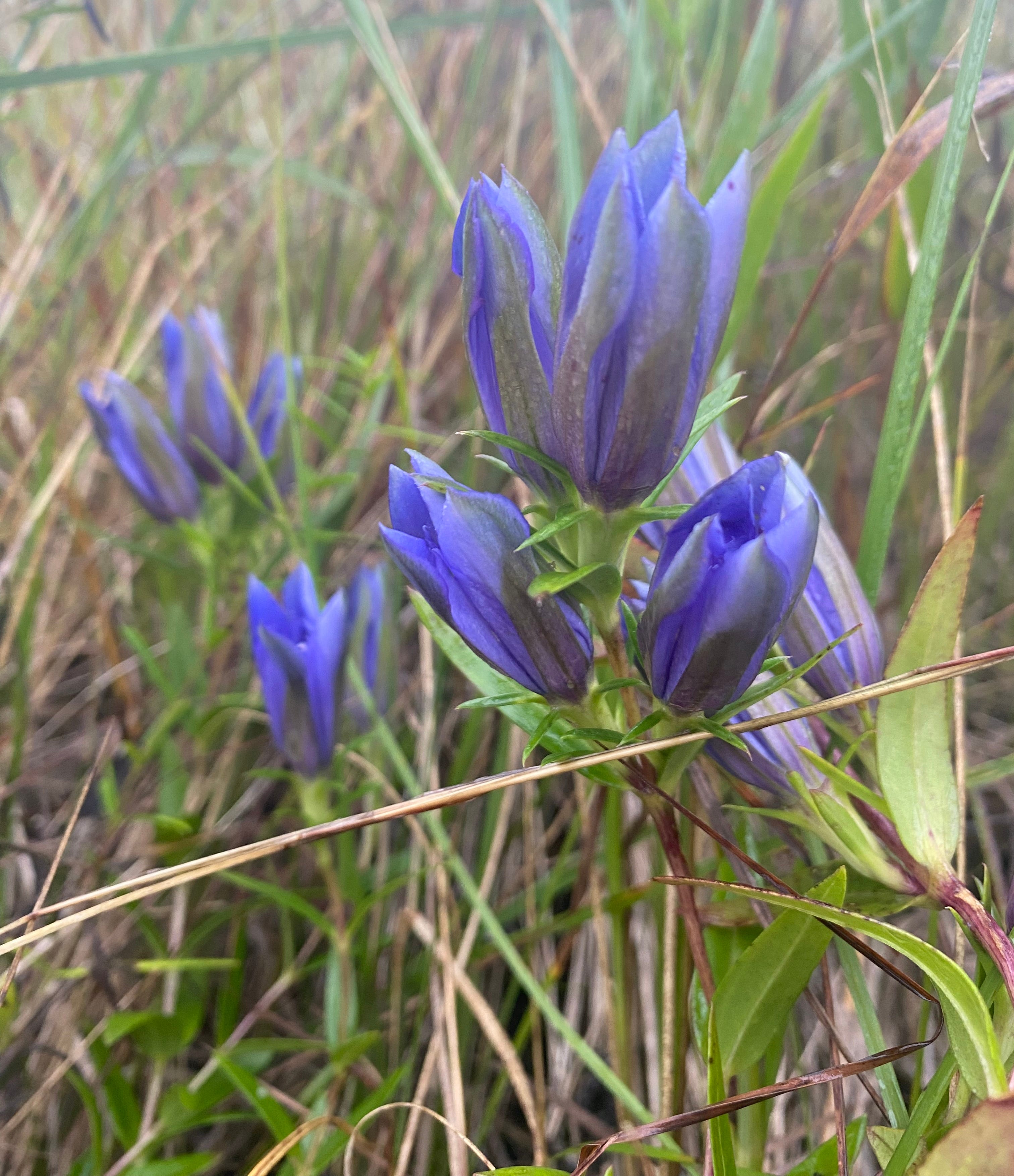
Downy gentian (Gentiana puberulenta)—also known as prairie gentian1—should be of particular interest to conservationists, since it’s endangered or threatened in a number of US states, exceptionally rare (though not designated endangered) in the Canadian province of Manitoba, and generally not abundant anywhere in its native range. Downy gentian is unique among Wisconsin-native species of Gentiana in that it is adapted to dry soils; the other three species of Gentiana found in Wisconsin—bottle gentian (G. andrewsii), cream gentian (G. alba), and red-stemmed gentian (G. rubricaulis)—tend to grow in moist or mesic soils. For this reason, it is the predominant species of Gentiana in the remnants of the Empire Prairie (which are largely dry and dry–mesic), although it’s still relatively rare (and typically hidden among taller plants: see Figure 1).
Live plants of downy gentian are very rare in the nursery trade (the notable exception being Windflower Natives), and it is also very difficult to find seed for this plant on the market. Prairie Moon offers small quantities of the seeds sporadically (over the last 3 years, I think they’ve offered seeds once), and that’s about it. Here in Wisconsin—and perhaps elsewhere in its native range—seed pods often fall prey to moth larvae, and they are therefore often found filled entirely with frass rather than seed.2 For this reason, restorationists struggle to collect enough to establish new populations of this special plant.
Because downy gentian seed is so scarce—and thus precious—downy gentian is a good candidate for container culture, where every viable seed can be nursed to maturity.3 If you can only collect a few hundred seeds in a year, you’d probably rather ensure that each of those seeds yields a plant rather than scattering them outside and hoping the birds and insects and fungi don’t take them. The good news is that, like other members of the Gentiana genus, downy gentian seed pods contain many, many seeds, so a single frass-free seed pod can yield a hundred or more plants (though for the sake of genetic diversity, more pods would be ideal).
The bad news is that, if you’re a home grower, you may struggle to find downy gentian seeds on the market. I think that there is opportunity to establish populations of this plant for seed production, and to responsibly manage larval infestations in a way that does not harm pollinators. But until that happens, you’ll just have to put yourself on the Prairie Moon waitlist and hope.
And without further ado, here’s everything I know about growing downy gentian from seed.
I haven’t yet tested downy gentian seed storage potential, so I do not know how long the seeds remain viable when kept in warm–dry storage, but I know that they retain substantial viability for at least three months of warm–dry storage.4 I’ve written previously that a different species of Gentiana—bottle gentian (Gentiana andrewsii)—may have a relatively short window of viability.5 Since storage potential for downy gentian is unknown, I would suggest beginning cold–moist stratification as soon as possible (or within three months).
As mentioned in the introduction, moths have a proclivity for downy gentian, boring small holes in the seed pods, eating the seeds, and leaving frass in their place. So I have two pieces of advice for folks harvesting and cleaning downy gentian seeds:
Process the seeds the same day you harvest! You may find that heads containing viable seeds also contain larvae. So processing your seeds immediately means you can separate the larvae from the seeds before the larvae eat all of the seeds.
Make sure you’re processing gentian seeds, not frass. Gentian seeds are very small, and if you’ve not worked much with them, you may struggle to distinguish them from frass. It would be a shame to waste time cleaning, stratifying, and sowing frass, so grab a loupe and inspect carefully.
I’ve had such good success germinating downy gentian that I’ve never run an experiment to determine their stratification requirements. In my experience, fourteen weeks of cold–moist stratification yields very high germination. But it’s possible they’ll germinate just as well with a shorter pretreatment time. If I can get my hands on enough seed, perhaps next year I’ll systematically test their germination requirements.
I have not tested whether downy gentian requires light for germination. I have, however, tested bottle gentian, which does require light to germinate. I therefore operate under the assumption that downy gentian also requires light. I use a photoperiod of fourteen hours (i.e., in my propagation chamber, the lights are on for fourteen hours per day).
I surface sow my downy gentian seeds, and just barely sprinkle them with vermiculite (truly the lightest dusting you could imagine). The vermiculite is almost certainly unnecessary, but it makes me feel good—it’s like the vermouth in a dry martini: somehow essential, despite being barely present.
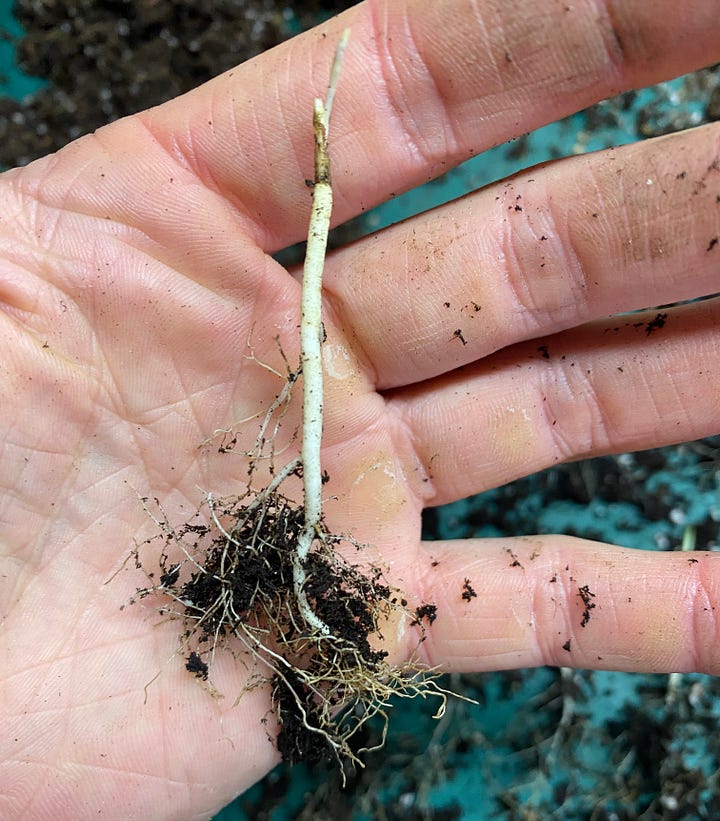
I sow mine in SureRoots DeepPots 50-cell trays in unamended ProMix BX potting medium. I do recommend using a deep container (e.g., five inches deep), since downy gentians form a tap root (see Figure 2). With that being said, they will do just fine in slightly shallower containers; they’ll simply form a shorter tap root.

As with all my seed germination, I use a humidity dome to keep humidity in the range of 95–100% relative humidity until germination. And as I do with most of my native plants, I germinate my downy gentians using an alternating temperature regime consisting of 20°C days and 10°C nights (more info on alternating temperature regimes here). At that temperature regime, germination typically begins in five to eleven days (though germinants are so small that they are hard to see with the naked eye).
After germination, I grow my plants out at the same 20/10°C temperature regime I use for germination, though I allow temperatures to drift as high as 25°C during the day and 15°C at night.
I keep my propagation chamber at 76±4% relative humidity, so downy gentian seems to tolerate humidity up to 80%. Alex from Windflower Natives posted about his plants suffering from an excess of humidity, but I don’t have any personal experience of that. Perhaps the humidity in their greenhouses goes above 80%? If you want to be cautious, keep your humidity below 75%!
I do try to water mine sparingly, allowing the surface of the soil to dry considerably between waterings. Not surprisingly for a plant native to dry upland prairies, downy gentian seems to thrive on neglect. I’ve forgotten to water my seedlings for weeks and saw no seedling death (though I don’t necessarily recommend doing that as a general habit).
As with all my plants, I fertilize weakly every time I water. I use 3 ml of Superthrive Grow per gallon of water. I’m generally an organic grower, but I use non-organic fertilizer for my containerized seedlings.
I’ve seen reports that downy gentian grows extremely slowly. In my experience so far, relative to their mature size, downy gentian grows at a rate comparable to bottle gentian and cream gentian. That is, after a season of growth, downy gentian rosettes are noticeably smaller than cream and bottle gentians after a comparable season of growth, but since mature downy gentians are also noticeably smaller than mature bottle and cream gentians, I’d estimate that all three species make the same amount of progress relative to their mature size.
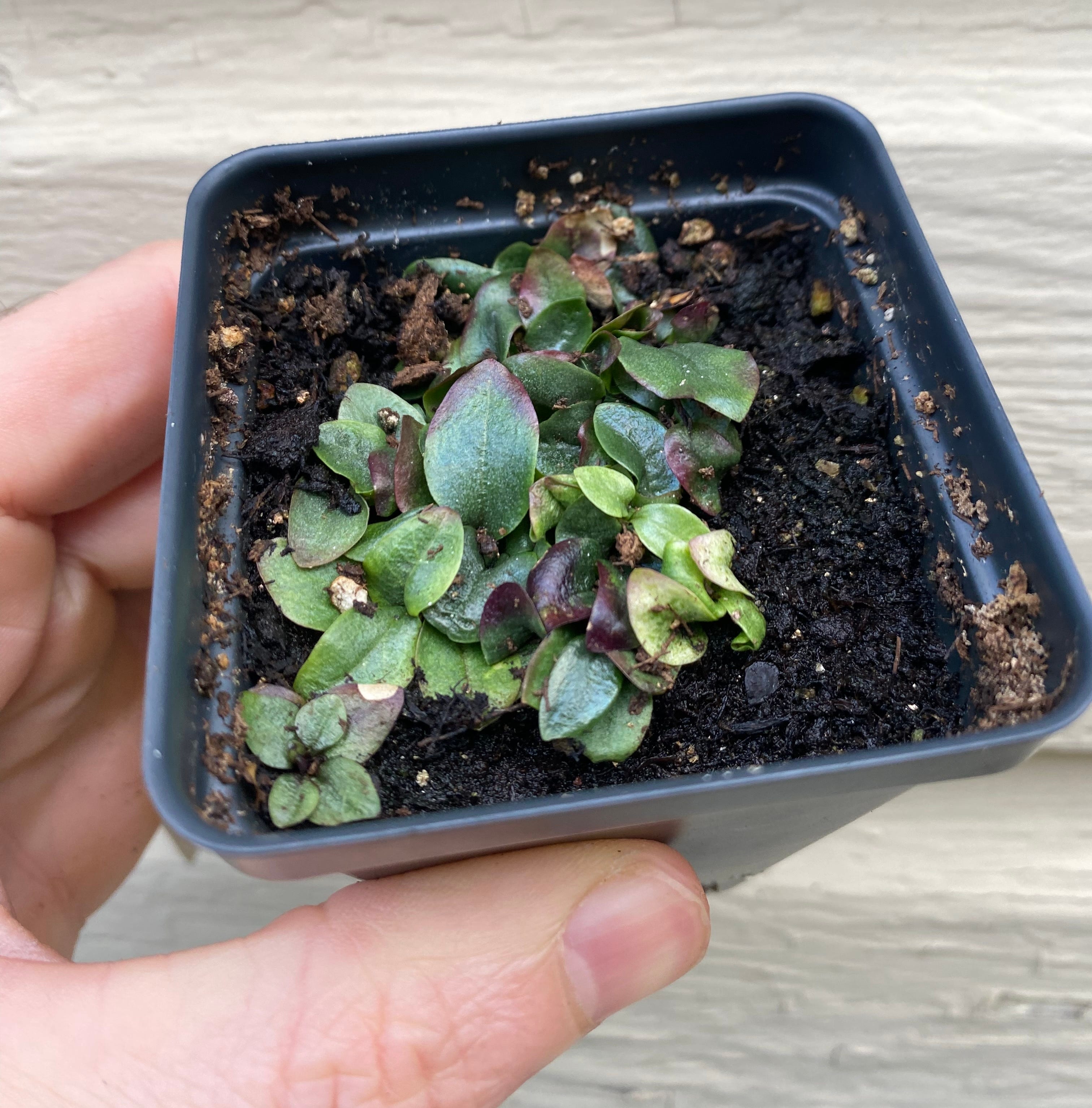
Like other true gentians, downy gentian produces only a basal rosette in its first season of growth, and even when environmental conditions are kept constant, that basal rosette will eventually stop growing. I wrote a post recently about this growth pattern, where seedlings behave as though an internal clock stops their growth after a fixed period of time. For lack of a better term, I call this “Type 2” growth, in contrast with the more common “Type 1” growth pattern where species grow indefinitely under favorable conditions. Read the post for more info!
The practical implication of this Type 2 growth pattern is that, no matter how optimal your conditions are—and no matter how happy the plants are—they won’t produce anything more than a few leaves their first season (see Figure 3).
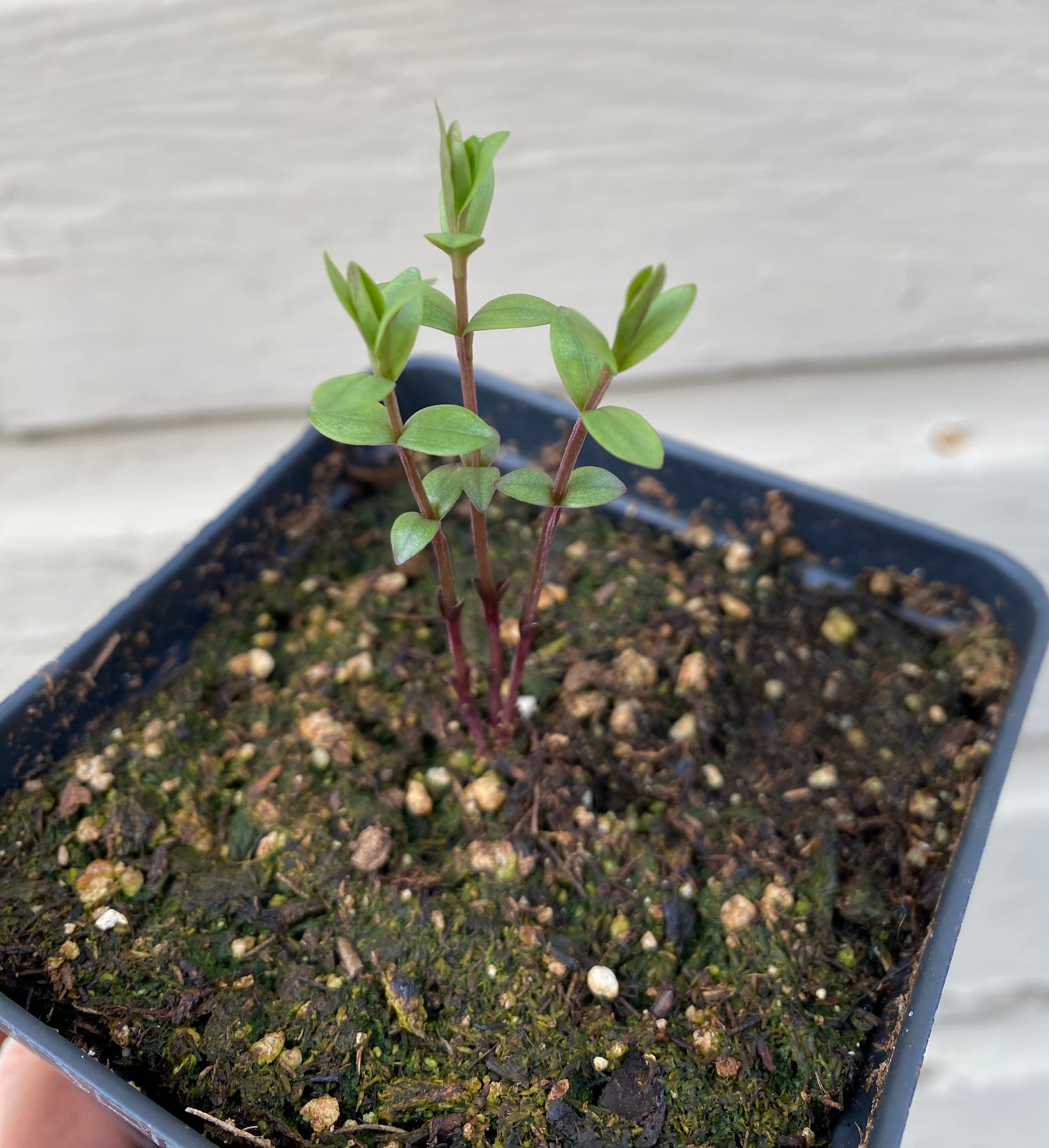
Once the basal rosette has stopped growing, downy gentians need a period of chilling to restart growth. I prefer to do this in my fridge, and I explain my reasoning for this—and the protocol I use—in my post on chilling live plants. After their period of chilling, they resprout with an entirely new morphology; instead of reappearing as basal rosettes, they come out of dormancy as erect stems reaching for the sky, with one to three stems per plant (see Figure 4). I call this transformation “cryomorphosis,” and discuss it in more detail here.
I have no evidence to back up this claim, but I don’t think downy gentians are large enough to plant out after only a single season of growth. The main issue is that, after only one season, they don’t produce enough root mass to hold together the potting medium in a 2.5 × 2.5 × 3.5-inch nursery pot or a 5-inch deep plug. So if you did try to transplant them, the root ball would likely fall apart, and you’d probably damage a lot of fine feeder roots in the process. I prefer to transplant just as the roots are filling out the plug, which doesn’t seem to happen in the first year of growth.
The other issue with planting them out after only one season is that they are not able to compete with other plants. I have observed them to be sensitive to shading, and a basal rosette the size of a quarter can be shaded out by even a tiny weed.
So if you apply my refrigerator chilling method, you can collect seed in October, stratify seeds for three months, sow seeds in January, chill in June, return to spring conditions in September, then chill again in February. Thus by April/May (approximately a year and a half after seed harvest), you have relatively large, third-season seedlings that are ready to plant out (and might even flower that same year).
When I’ve encountered downy gentian in prairie remnants, it’s usually growing mixed in with taller plants. Because it has such floppy stems, having stiffer plants to lean on helps keep it upright, and it’s possible it benefits from a little bit of light herbaceous shade. With that being said, it doesn’t like to be fully shaded. I saw one quickly die in my plot when nearby forbs choked out the light. So I would suggest planting it in the company of mild-mannered graminoids, such as little bluestem (Schizachyrium scoparium) or prairie dropseed (Sporobolus heterolepis). If you know of better companions, let me know in the comments!
Well that’s everything I know about growing downy gentian from seed. I’ll be sure to post pictures when my three-year-old plants emerge this spring! ■
Have a question? If you have questions about Midwestern native plant propagation that you want answered in a future post, I’d love to hear from you! Shoot me an email at plantpropagationproject@gmail.com
Want to support this work? Buy me a cup of coffee (or a bag of potting medium)!
I’ve sometimes seen the three Southern Wisconsin species of Gentiana referred to as “prairie gentians,” so to avoid ambiguity, I use the name “downy gentian.”
I believe the precise culprit is Endothenia hebesana, but I have extremely limited entomological knowledge, and I’m relying nearly entirely on this one helpful slide.
In January 2025, I bought seed from Prairie Moon and began cold–moist stratification on January 26, 2025. I don’t know when Prairie Moon collected that seed, but I’m assuming that it was collected in October 2024. So the seed was likely stored for approximately three months.
I’m currently testing bottle gentian’s ability to store at room temperature. Results will be posted later this year.
No posts
Comments
Nothing yet. Say the first thing.
Sign in to join the conversation.