
If you find yourself getting into growing less-commonly-cultivated native perennials (e.g., spring ephemerals, lilioids, true gentians), you will experience the fact that some of these plants grow a bit differently than more commonly-grown species. For instance, some plants will stop growing after a certain period of time, even when no changes have been made to their growing conditions. And of those plants that suddenly stop growing, some will shrivel up and turn brown. This cessation of growth—and possible shriveling—can be highly alarming to the uninitiated; often, when our plants shrivel, it means we’ve done something horribly wrong. So I’m here to tell you that everything is probably okay. What’s happening is that you’ve encountered a new growth pattern, and you’ll need to get to know it a bit.
For the sake of generalization, let’s say that, after seed germination, first-season growth of perennial herbaceous plants follows two basic patterns when plants are given ideal growing conditions (see Figure 1):
Type 1: continuous growth until mature size is reached
Type 2: limited growth, stopping well short of mature size1
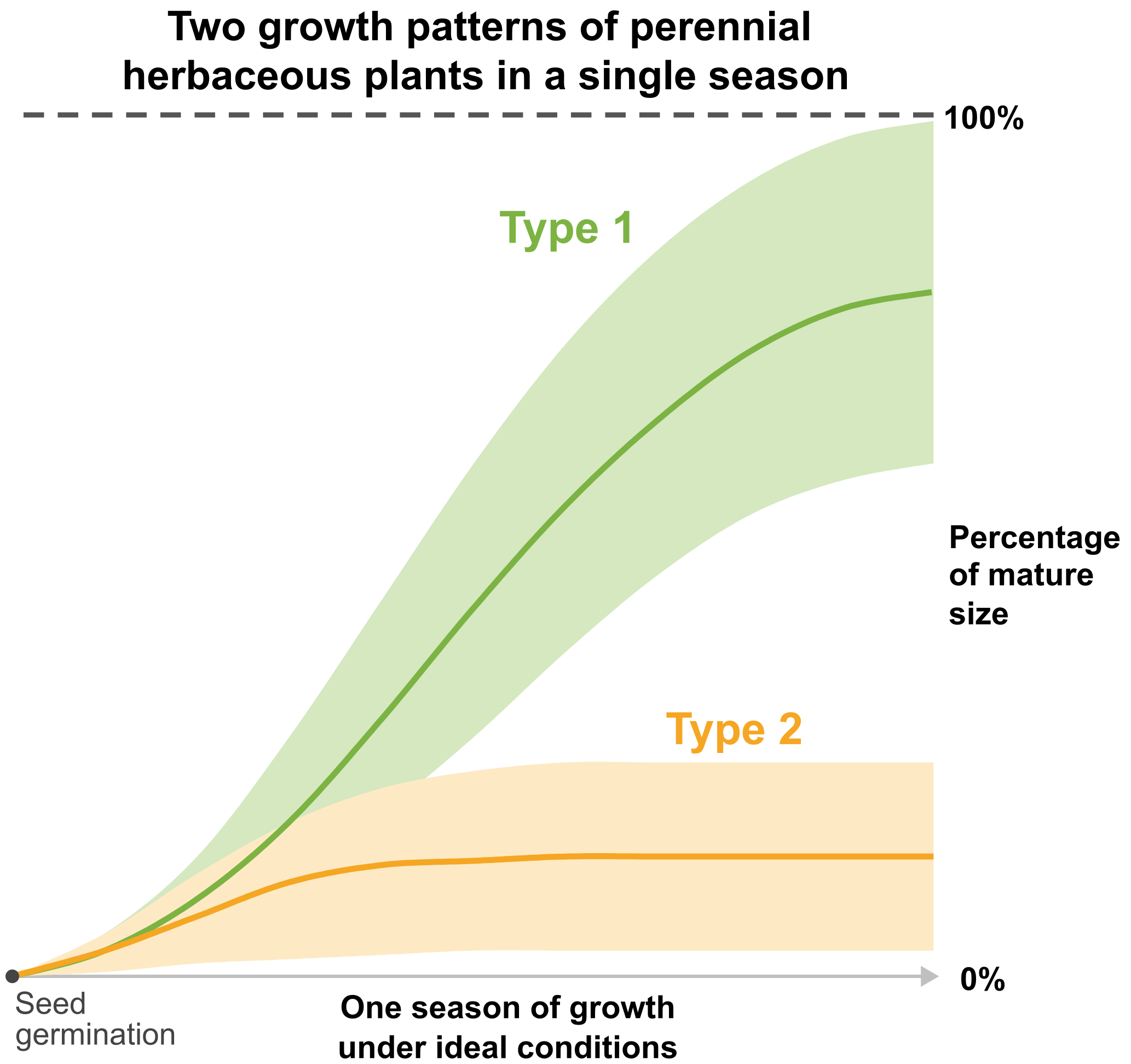
In the sections that follow, I’ll describe these patterns in further detail.
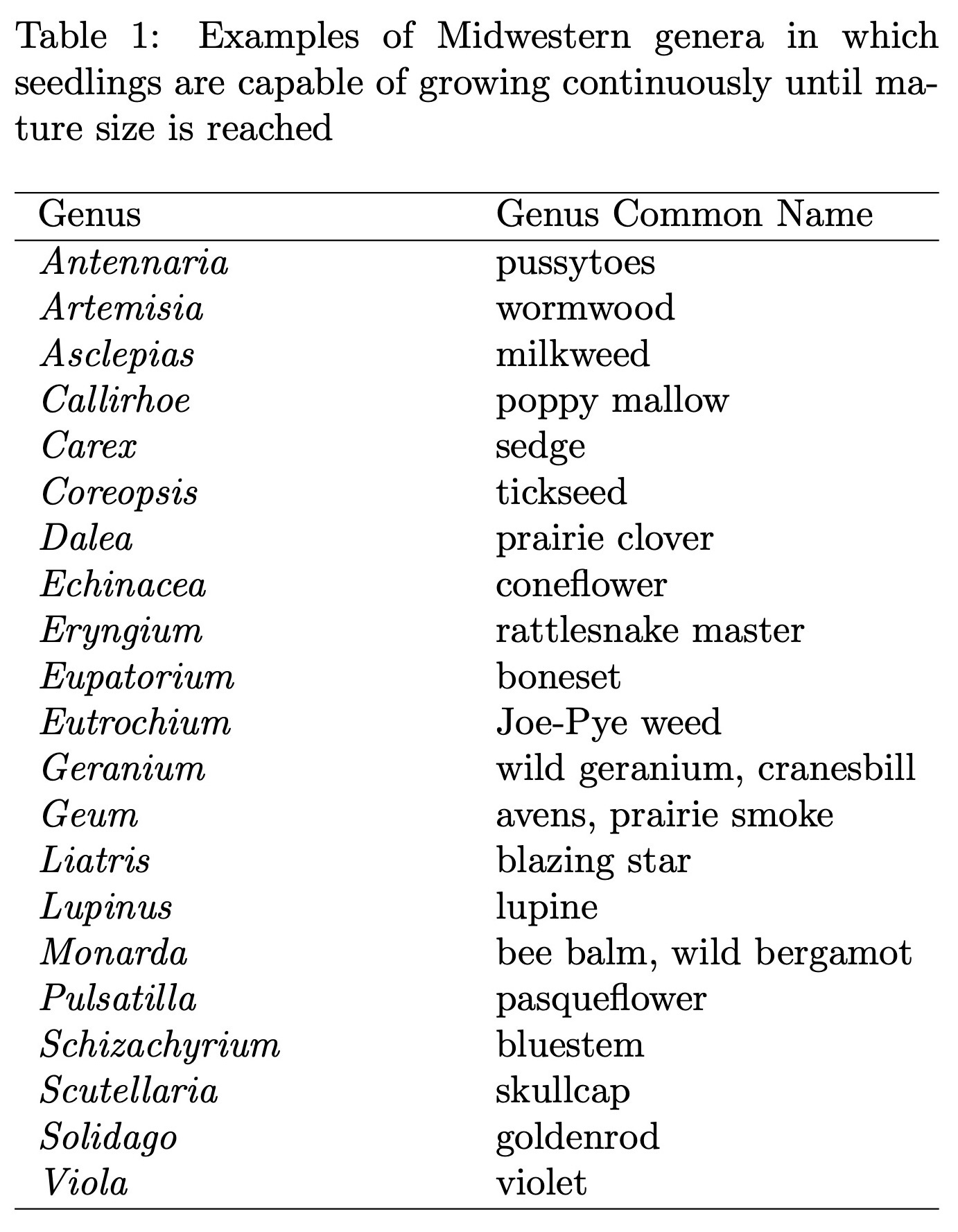
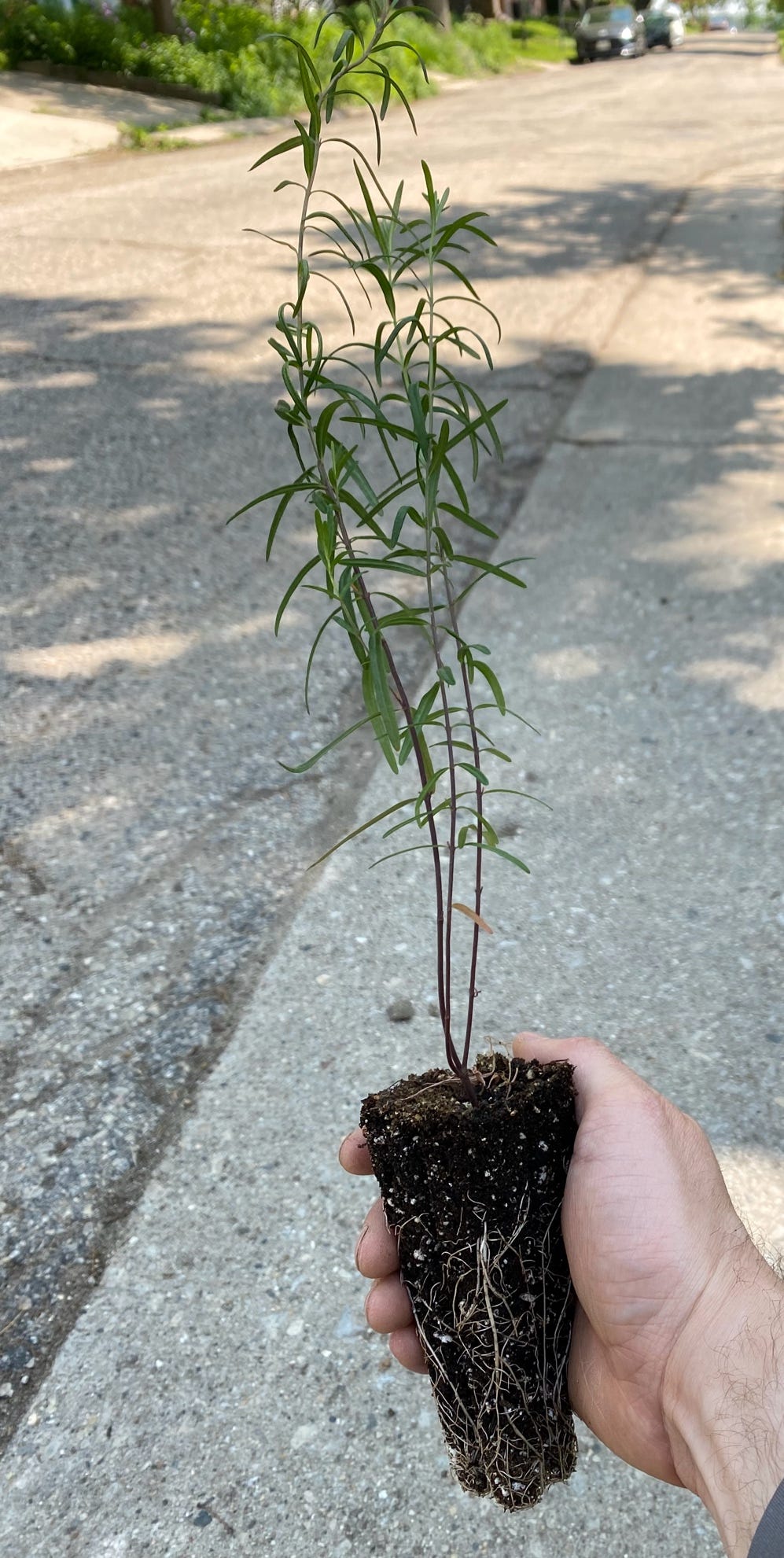
This is the growth pattern most folks are more familiar with, and it’s typical of plants that are considered “easier-to-grow” (see Table 1). Given a long enough growing season—and optimal conditions—plants in this group are capable of reaching their mature size, or near to it, in a single season of growth. Take, for example, whorled milkweed (Asclepias verticillata). If I sowed seeds today, they would grow continuously, and in a few months, I’d have plants roughly the size of mature specimens (see Figure 2).
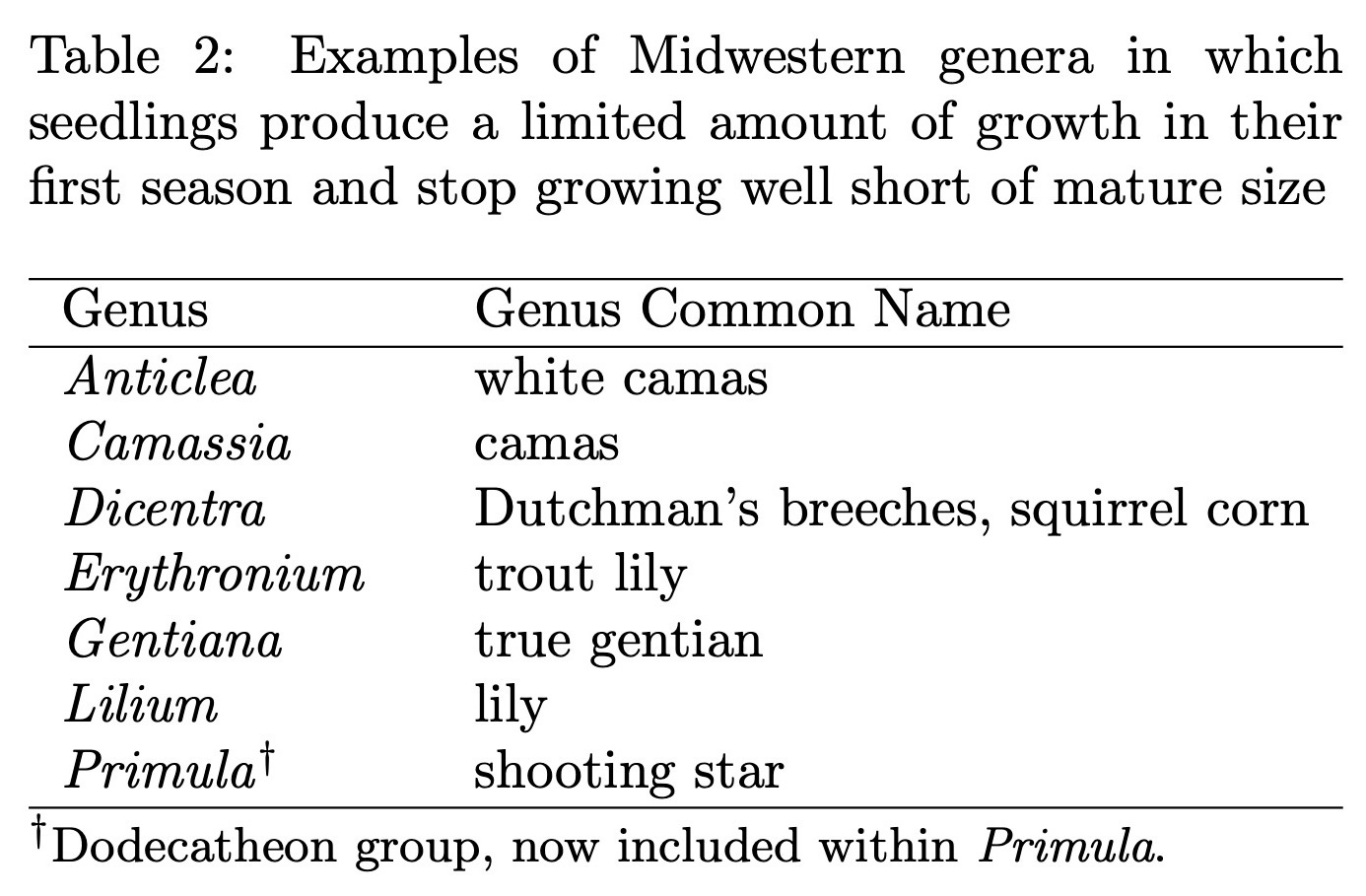
In this growth pattern, plants are frugal with how much energy they’re willing to put into their above-ground growth. These plants are therefore much slower to reach maturity, and they provide a bit more challenge to the grower. For this reason, plants that follow this growth pattern are generally less common in the nursery trade (see Table 2). After germinating, they will devote a certain amount of energy to shoot/leaf growth, and then stop, even when environmental conditions are kept constant (i.e., environmental conditions do not trigger dormancy). So in their first season, they may attain only 5%–25% of their mature size. After they’ve completed their allotted growth for the season, they may visibly senesce (as is the case for spring ephemerals; see Figure 3), or they may simply stop growing above-ground but enter no obvious dormancy (as is the case for true gentians; see Figure 4).
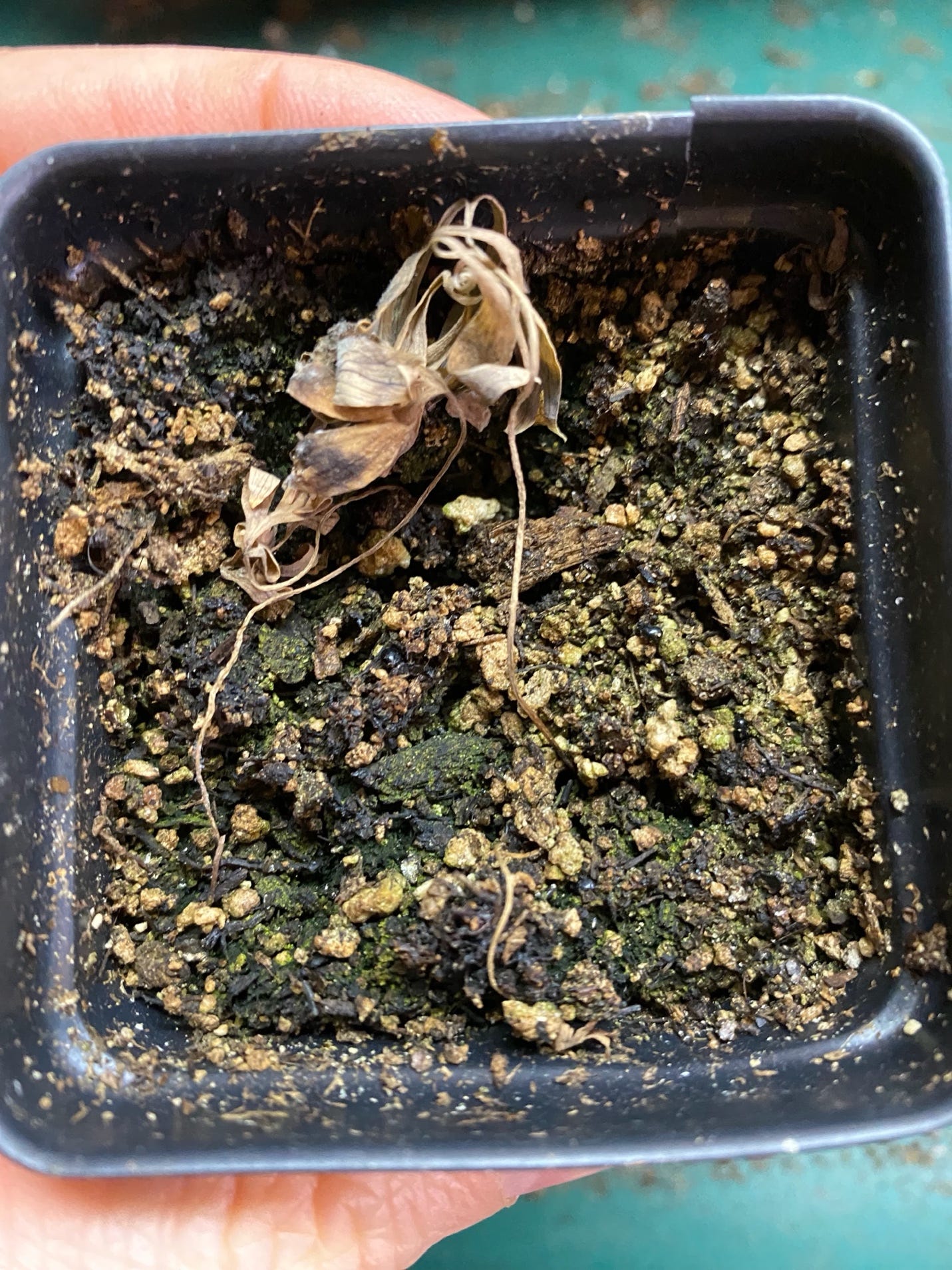
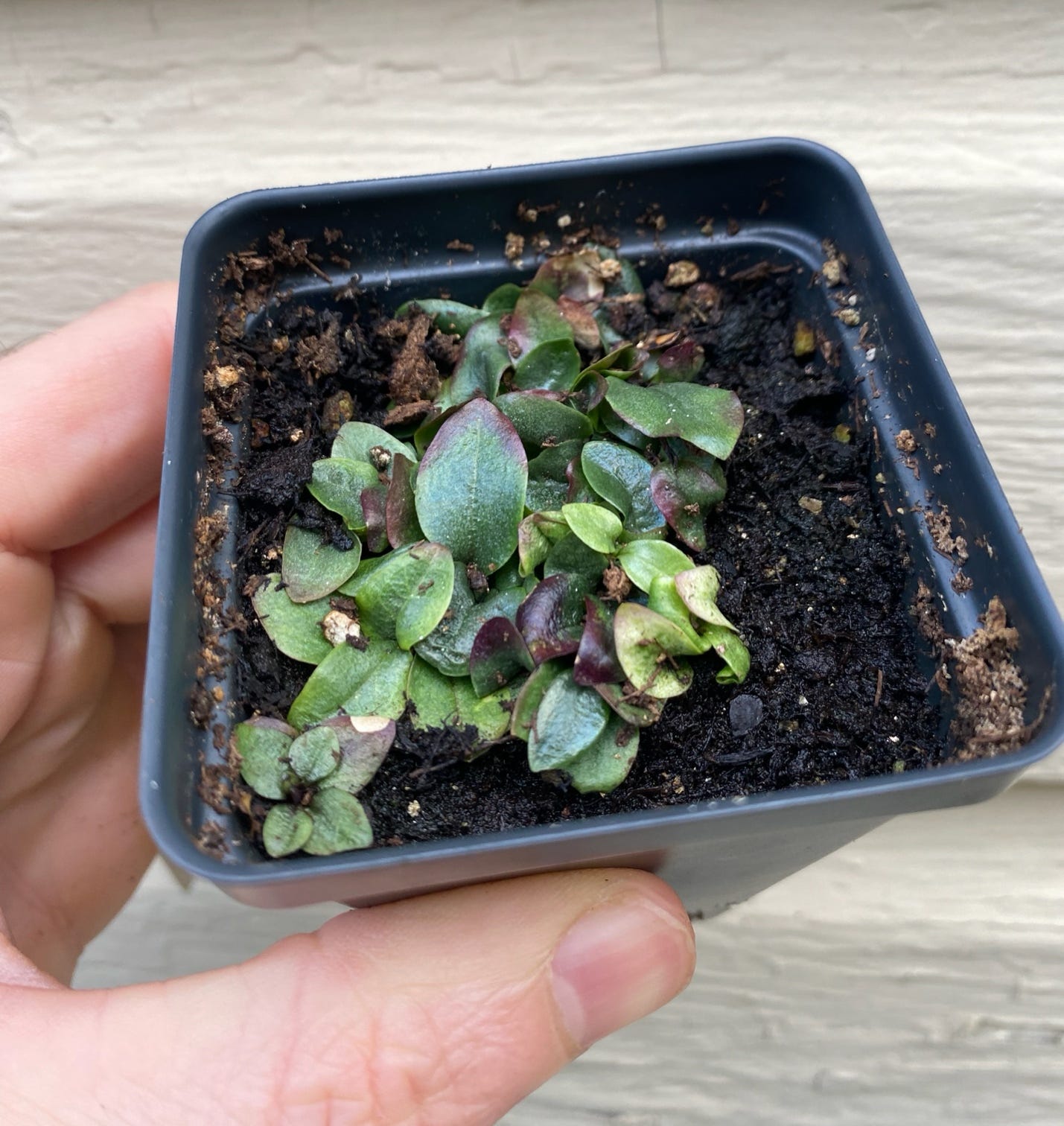
For Midwestern perennials, after growth has ceased for the season, additional growth can typically be triggered by a period of chilling. This can be provided naturally through overwintering, or it can be simulated by the grower in a refrigerator. But that’s a topic for a future post.
For those plants that stop growing after a certain amount of growth, a subset of those plants emerges from their first winter—or simulated winter—looking like entirely different species. The Michigan lily (Lilium michiganense), for instance, spends its first season as one or two modest leaves, but after a period of chilling it presents itself as a tall, whorled-leaf stalk (see Figure 5). Similarly, downy gentian (Gentiana puberulenta) spends its first season as a basal rosette, but after a period of chilling, reemerges as one or more erect stems (see Figure 6).
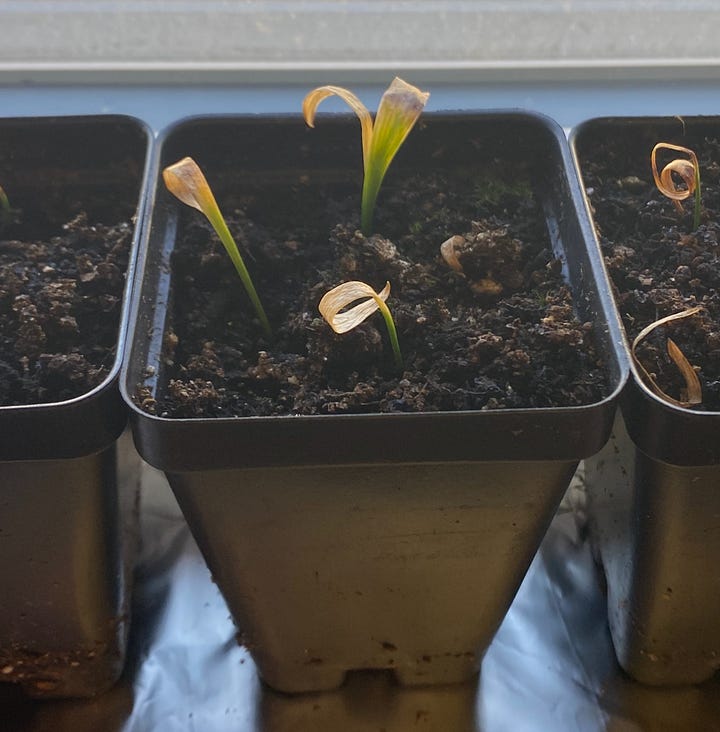
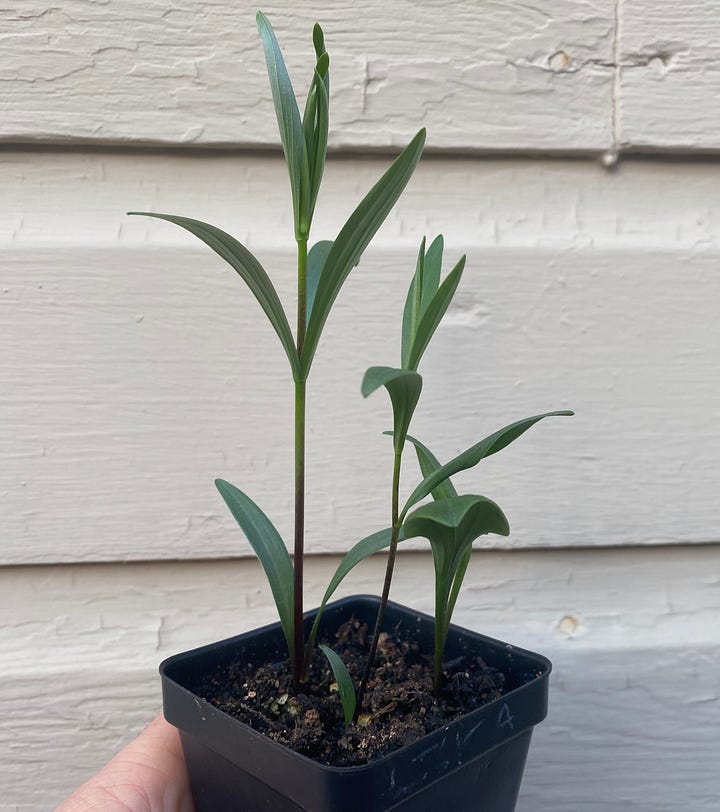


I think this phenomenon deserves a name, so I’m calling it cryomorphosis. I’ve chosen “cryo-” as the prefix here because chilling is the mechanism I have observed, but note that the underlying trigger may prove to be dormancy release rather than cold exposure per se. Also note that I’m naming an observable phenomenon, not some underlying biological reality. And this phenomenon is not a true binary; the degree to which a plant’s morphology is changed by dormancy is variable. I’m not claiming that this concept is particularly useful for botanists, or that it refers to a single mechanism, but as a grower, it’s useful to have a vocabulary to describe the patterns I observe in plant growth.
It’s common for perennials to have juvenile forms that look radically different from their mature forms. In botanical terms, the shift from a juvenile form to mature form is called heteroblasty. Heteroblasty refers to any shift in morphology, including the gradual shifts that occur across a season. But since cryomorphosis is an apparently sudden phenomenon, seemingly tied to dormancy, I think it deserves its own special name.
Understanding this facet of the life cycle of native plants can help us strategize our propagation approach and set expectations. When I started growing lilies and gentians, I thought it was because of my lack of skill that my plants were stuck in their juvenile form, refusing to send up a stalk. Now that I understand their growth strategy more, I’m able to plan my propagation schedule around cycles of growth and dormancy. Moreover, I find that the juvenile form of plants can be very vulnerable in the garden setting, with even the slightest amount of shading/crowding capable of killing a small basal rosette. So I aim to plant my lilies and gentians after they have formed an erect stalk, and I know that doing so requires subjecting them to a chilling cycle.
One last thing: for those readers who are thinking to themselves “isn’t this just vernalization?” my answer is that no, cryomorphosis is distinct from vernalization. Vernalization refers specifically to the cold-induced acquisition of flowering competence.2 That is, the process by which a plant becomes capable of flowering after a period of chilling. This is why winter wheat needs to be sown in the fall and experience cold temperatures in order to flower and produce grain, why artichokes generally won’t flower until after a period of chilling, and why daffodils flower poorly in mild climates unless they are pre-chilled before planting. So while vernalization is about flowering, cryomorphosis is about plant architecture. A gentian that sends up a central stalk after chilling has not necessarily acquired flowering competence; it has simply transitioned from its juvenile basal form to its mature caulescent form. Likewise, a Michigan lily sending up its whorled-leaf stem after its first winter has undergone cryomorphosis, but it may not flower for another season or two. ■
Have a question? If you have questions about Midwestern native plant propagation that you want answered in a future post, I’d love to hear from you! Shoot me an email at plantpropagationproject@gmail.com
Want to support this work? Buy me a cup of coffee (or a bag of potting medium)!
This is conceptually analogous to the endogenous rhythmic growth described by Francis Hallé, Roelof A. A. Oldeman, and Philip B. Tomlinson in Tropical Trees and Forests: An Architectural Analysis (Berlin: Springer-Verlag, 1978), but operating on a seasonal rather than intra-seasonal timescale.
Formally defined by P. Chouard as “the acquisition or acceleration of the ability to flower by a chilling treatment” (“Vernalization and Its Relations to Dormancy,” Annual Review of Plant Physiology 11 (1960): 191–238). In Arabidopsis thaliana, a model species widely used in plant biology, the classical mechanism involves epigenetic silencing of the floral repressor FLC, with Polycomb-associated chromatin changes that create a mitotically stable memory of winter but are reset each generation. Ruth Bastow et al., “Vernalization Requires Epigenetic Silencing of FLC by Histone Methylation,” Nature 427 (2004): 164–67; Sibum Sung and Richard M. Amasino, “Vernalization in Arabidopsis thaliana Is Mediated by the PHD Finger Protein VIN3,” Nature 427 (2004): 159–64.
No posts
Comments
Nothing yet. Say the first thing.
Sign in to join the conversation.