
Author’s note: I imagine everybody in America has Fourth of July traditions. Growing up, ours included patriotic outfits, cookouts, neighborhood parades, fireworks at the high school, reading the Declaration aloud and singing patriotic songs. Once I moved to DC, there were concerts at the Capitol, fife and drummers and reenactors at the Archives and fireworks and flyovers on the National Mall. Some new Americans participate in citizenship ceremonies at Ellis Island, Mount Vernon and Monticello.
Historically, commemorations of America’s Declaration of Independence have also had common characteristics: readings, orations, reenactments, parades, artillery salutes, fierce partisanship and dramatic summer weather. Given the divisions over our 2026 semiquincentennial, I wanted to learn more about our earlier birthdays.
1776 On July 2, 1776, the Second Continental Congress declared our independence from Great Britain and offered a rationale for rebellion, in the Declaration of Independence. “These United Colonies are, and of right ought to be, free and independent states.”
Virginia delegate Thomas Jefferson, attended by his enslaved servant Robert Hemings, wrote the Declaration in seventeen days on a desk he designed, now in the Smithsonian. “We the People . . . hold these truths to be self-evident, that all men are created equal, that they are endowed by their Creator with certain unalienable rights . . . That to secure these rights, Governments are instituted among Men, deriving their just powers from the consent of the governed.”
The Congress deleted a quarter of his draft. It adopted the edited document on July 2 and on formally endorsed it on July 4. Irish immigrant John Dunlop printed 200 copies. One was sent to England; another was read to colonial troops. On August 2, the Declaration was embossed on parchment for delegates to sign, starting with John Hancock, president of the Congress. The story of his writing in large cursive, “so the King could read it without his spectacles,” is a myth.
Forty-one were enslavers, but all fifty-six would have benefitted from the country’s slave economy. These privileged, educated, white men pledged “to each other our Lives, our Fortunes and our sacred Honor” and committed treason against Great Britain. Five were captured by the British, tortured and died. Nine died from battlefield wounds. Three lost sons in the war. Twelve had their homes ransacked and burned. Wives were imprisoned; children perished. Josiah Bartlett, the president on the television series The West Wing (1999-2006), was named for one of New Hampshire’s signers. His wife’s name was Abigail.
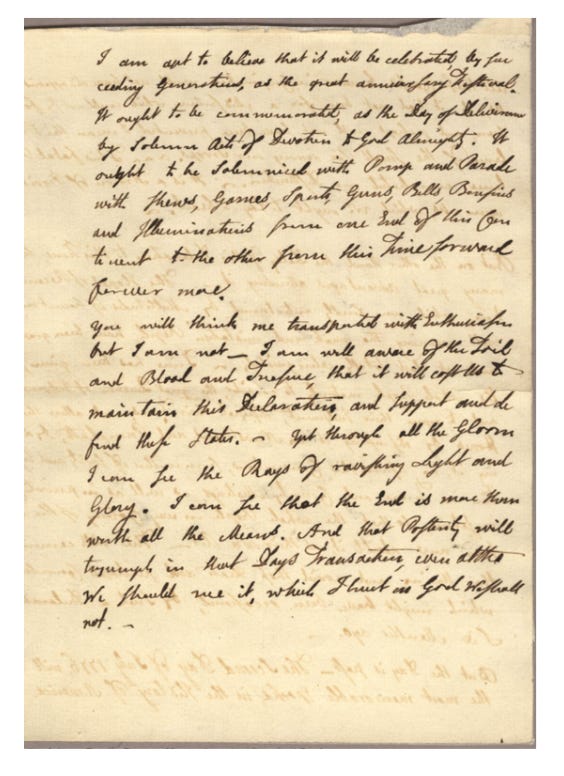
On July 3, John Adams wrote to his Abigail. “The Second Day of July 1776 will be the most memorable . . . in the History of America. I am apt to believe that it will be celebrated, by succeeding Generations, as the great anniversary Festival. It ought to be commemorated s a Day of Deliverance by solemn Acts of Devotion . . . It ought to be solemnized with Pomp and Parade, with Shews, Games, Sports, Guns, Bells, Bonfires and Illuminations from one End of this Continent to the other from this Time forward forever more.” Even as president, Adams never celebrated July 4.
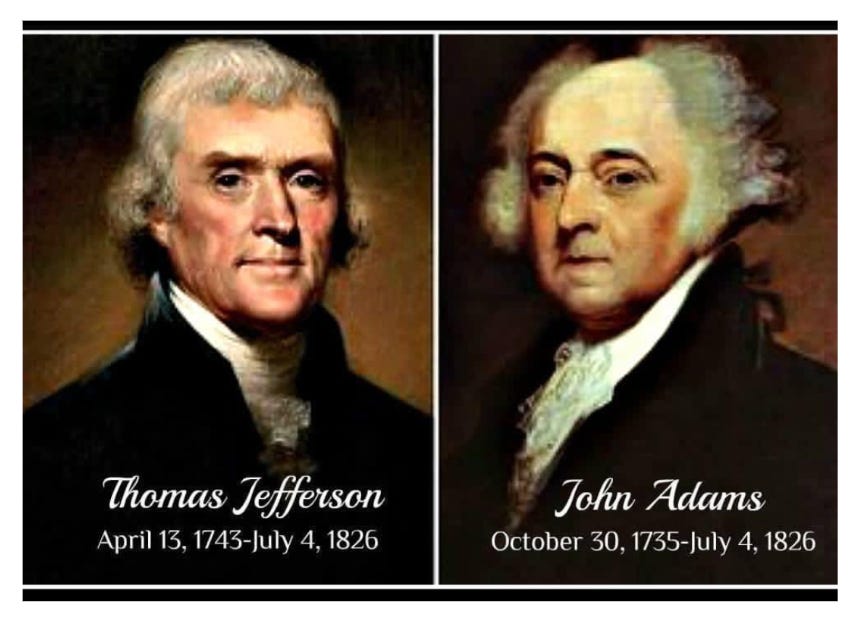
1801 Jefferson, Adams’ vice president and political rival, celebrated the twenty-fifth anniversary of the Declaration with a reception at the White House. Surrounded by five Cherokee chiefs, he greeted diplomats, military officers and members of the public in the “oval saloon” as the Marine band played. There were horse races and cockfights on the grounds. In the years following, commemorations excluded Federalists, becoming increasingly partisan. Many communities found them undignified, dominated by “office seekers and demagogues.”
1826 The semicentennial was celebrated with orations, parades and cannon salutes. The population had quadrupled to 12 million. The country reached across the continent, with twenty-four states, two west of the Mississippi. Ninety percent was agricultural but the completion of the Erie Canal in 1825 signaled growing industry in the North.
The mayor of Washington invited the living signers (Presidents Adams, 90, and Jefferson, 83, and Charles Carroll, of Maryland, 89, the only Catholic signer), and former presidents James Madison and James Monroe, to come to the Capitol. Their letters of regret were published and presented to President John Quincy Adams.
Jefferson’s was another masterpiece.
“Respected Sir: The kind invitation I received . . . to be present . . . at the celebration of the Fiftieth Anniversary of American Independence, as one of the surviving signers of an instrument, pregnant with our own and the fate of the world, is most flattering . . . I should, indeed with particular delight, have met and exchanged congratulations . . . with the small band, the remnant of that host of worthies who joined . . . in the bold and doubtful election we were to make, for our country, between submission and the sword . . . May it be to the world . . . the signal . . to burst the chains . . and to assume the blessings and security of self-government. . . “
On July 4, 1826, soldiers marched from Lafayette Square to the Capitol, accompanied by the Marine band, followed by the second President Adams. Dignitaries convened in the House chamber for a reading of the Declaration. No one knew that both Adams and Jefferson had died that day, “a strange and striking coincidence,” as John Quincy Adams would note.
After years of rivalry, the Southern enslaver and his Northern opponent and colleague had reconciled. Jefferson had been failing but seemed to rally, asking, “Is it the Fourth?” The news reached Washington on July 6. In Quincy, John Adams sent a toast to the local celebration: “Independence Forever!” He died unexpectedly in his study, saying, “Thomas Jefferson still lives.” News of Adams’ death did not reach his son until July 9. As one scholar concluded, their deaths reawakened a consciousness of the republican ideal the two patriots exemplified.
1851 Millard Fillmore was president for the seventy-fifth anniversary. He used the occasion to lay the cornerstone for the new House and Senate wings of the Capitol. The expansion of the country to thirty-one states not only raised concerns about the spread of slavery, temporally resolved by the Compromise of 1850, but also strained the capacity of the Capitol.
One a mild, sunny day, aging Revolutionary War veterans marched to the Capitol, where the Architect buried a time capsule. A Masonic official used the trowel President George Washington had employed in setting the 1793 cornerstone. Secretary of State Daniel Webster, America’s foremost orator, spoke, followed by cannonades and fireworks on the Mall.
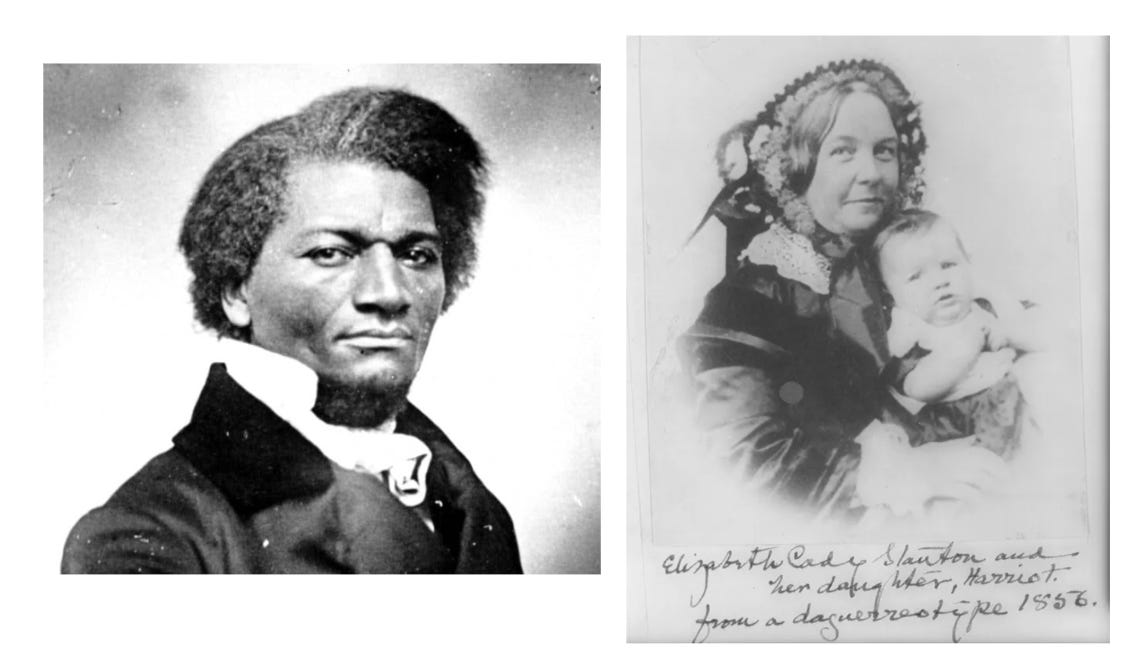
Increasing regional animosity over slavery pointed highlighted those excluded from the Declaration. In 1848, in Seneca Falls, New York, Elizabeth Cady Stanton introduced a Declaration of Sentiments, based on the Declaration. She asserted that “all men and women are created equal” and substituted “all men” for the tyrant King George III.
Harvard professor Annette Gordon Reed and Akhil Reed Lamar and David Blight, at Yale, have identified how change agents like Stanton, Frederick Douglass and Abraham Lincoln embraced the Declaration’s aspirational language to expand our democracy.
On July 5, 1852, Frederick Douglass addressed an audience of 600 at an Independence Day celebration, sponsored by the Rochester, NY, Ladies’ Anti-Slavery Association. Formerly enslaved, the editor of The North Star was the most famous Black man in America. The powerful orator asked his audience, “What to a Slave Is the Fourth of July?” After commending the Declaration’s commitment to “life, liberty and the pursuit of happiness,” Douglass continued:
“Fellow citizens, I am not wanting in respect for the fathers of this republic. The signers . . . were brave men. . . . They were statesmen, patriots and heroes, and for . . . the principles they contended for, I will unite with you to honor their memory.” But “Were the great principles of freedom and of natural justice . . . extended to us? . . . The blessings in which you . . . rejoice, are not enjoyed in common. The rich inheritance of justice, liberty, prosperity and independence, bequeathed by your fathers, is shared by you, not me. . . This Fourth of July is yours, not mine. You may rejoice, I must mourn.”
Douglass introduced the idea of the Declaration as a promissory note, to which Martin Luther King would allude at the Lincoln Memorial in 1963. David Blight calls Douglass’ speech a “rhetorical masterpiece,” . . . “a symphony in three movements”: praise for the founders, condemnation of the horrors of slavery and hope that the nation might yet extend freedom to the enslaved.
Stanton’s privileged life as a white woman was constrained in different ways. She vented her frustrations to Susan B. Anthony in a letter dated July 4, 1858, when she was the mother of six and possibly already pregnant with her seventh child.
“How I long for a few hours of blessed leisure each day. How rebellious it makes me feel when I see Henry going about how and where he pleases. . . . As I contrast his freedom with my bondage, and feel that, because of the false position of women, I have been compelled to hold all my noblest aspirations in abeyance in order to be a wife, a mother, a nurse, a cook, a household drudge, I am fired anew . . . to pour forth . . . the whole long story of women’s wrongs. I have been alone today as the whole family except Hattie and myself have been out to celebrate our national birthday. What has a woman to do with patriotism?
At Gettysburg, President Lincoln refuted the assertion by Alexander Stephens, Vice President of the Confederacy, that the Declaration’s founding ideal of equality was “fundamentally wrong,” because African Americans were inherently inferior. In 1863, Lincoln counted back “four score and seven years ago,” to the founding of a “new nation, conceived in liberty, and dedicated to the proposition that all men are created equal.”
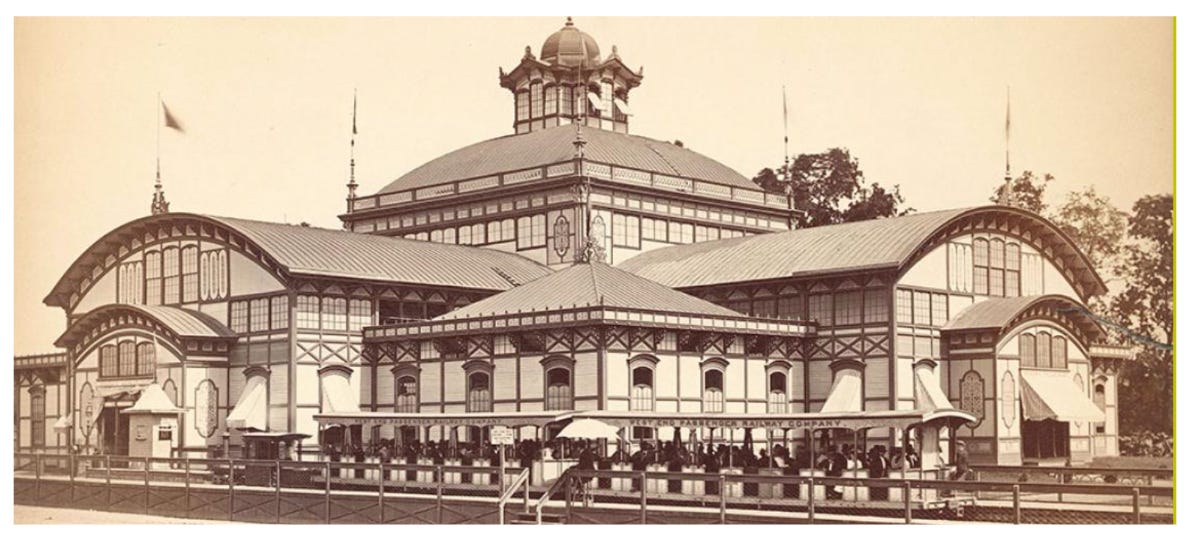
1876 The Centennial of the Declaration was held in Philadelphia. The “International Exhibition of Arts, Manufacturers and Products of the Soil and Mine,” the first world’s fair held in America, was a dazzling, six-month, May to November extravaganza. It erected 200 buildings on 285 acres in Fairmont Park.
Ten million people, 20% of the population, paid fifty cents to see a fading copy of the Declaration, a Corliss Steam Engine, Alexander Graham Bell’s telephone, a Remington typewriter and a Singer sewing machine, or to sample Heinz ketchup and Hires root beer. France sent a model of the Statue of Liberty’s hand, holding the torch, which one could climb for another fifty cents, to fund its completion. The emphasis was on America’s industrial strength. Despite high tariffs, thirty-seven countries participated. The British exhibited high- wheeled bicycles.
It was modeled on the Sanitary Fairs run by Northern women during the Civil War, to raise funds to support Union troops. Organizers in 1876 created a Women’s Centennial Executive Committee to help with organization and fundraising. Financial support depended on attendance fees; individual, city and state contributions; and a loan from the federal government that the Supreme Court insisted be repaid.
Elizabeth Duane Gillespie, Benjamin Franklin’s great granddaughter, chaired the committee. This progressive, “imperial wizard” led an army of female volunteers. They underwrote the Women’s Pavilion, covering an acre. It exhibited seventy-four patents held by women and examples of their domestic, intellectual and artistic accomplishments, among them The Death of Cleopatra by Black sculptor Edmonia Lewis. The women published an eight-page weekly newspaper, the New Century, printed by women on presses in their hall.
The National Woman Suffrage Association hoped to use the Centennial to draw attention to the inequality of women. Anthony asked General Joseph Hawley, head of the Centennial Commission, to present a version of Stanton’s Declaration of Sentiments on July 4, including a demand for woman suffrage. Hawley refused. No woman was invited to speak.
Hawley also refused her request for dozens of free tickets. He later relented and provided five tickets, which proved to be a mistake. On July 4, Anthony led her band to the platform and handed her declaration to pro-suffrage Senator Thomas Ferry (R-Michigan). Expecting to be arrested at any moment, they walked off the stage, distributing more copies as they exited, while General Hawley shouted for order. Outside, Anthony read her Declaration, shaded from the broiling sun by an umbrella.
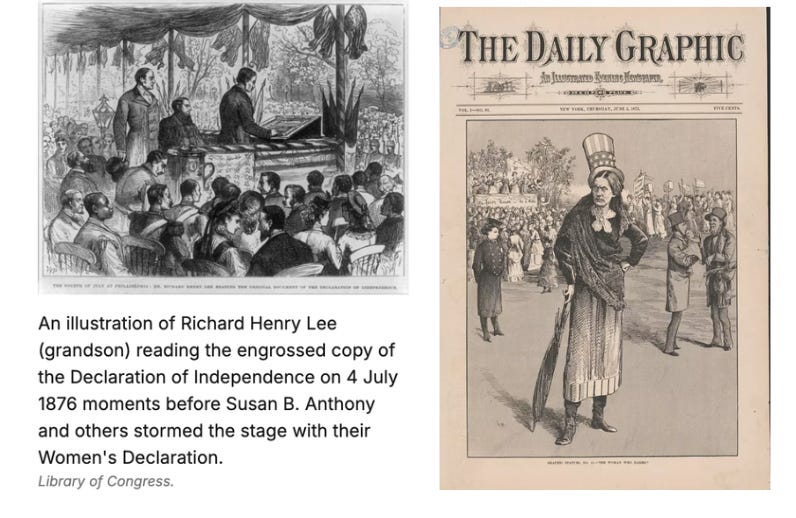
The Centennial suffered from a July heat wave, pushing temperatures to 100 degrees and depressing attendance. Organizers built a small hospital on the grounds, along with a temporary police station.
Immigrant, Indigenous and Black Americans were also marginalized. Frederick Douglass was invited to sit on the platform on opening day but was not invited to speak. Police initially denied him entrance, incredulous that a Black man would be welcome in the company of President Grant and the other dignitaries on the dais. The most popular restaurant advertised “old time darkies” playing banjos.
Judges of the art exhibit were distraught to learn that a major prize winner, Edward M. Bannister, was a Black artist. They tried to rescind the award given to “Under the Oaks,” until other artists threatened a boycott. Bannister retained his gold medal.
The Main building displayed artifacts of Indigenous culture with an emphasis on its inferiority. It was a shock when news broke on July 6 that General George Armstrong Custer and a third of his 7th Cavalry has been killed at Little Big Horn.
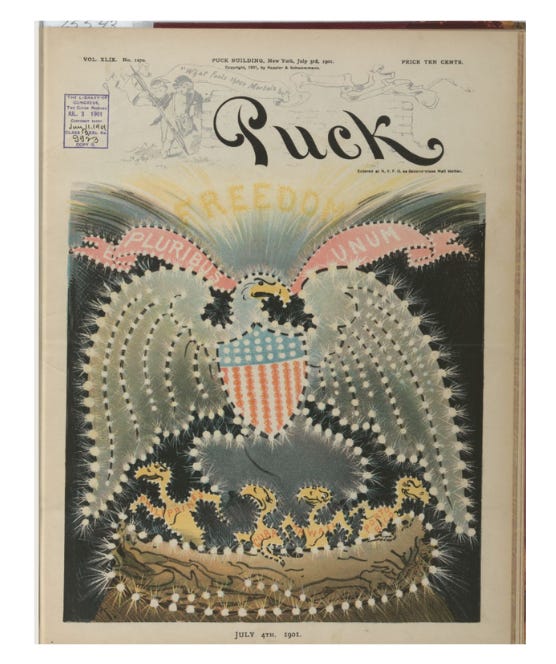
1901 Last week, at the opening of the Theodore Roosevelt Library in Medora, former North Dakota governor and Secretary of Interior Doug Burgum mistakenly identified TR as presiding over the Declaration’s 125th anniversary. It was William McKinley. On that occasion, an Executive Order signed by McKinley ended military occupation of the Philippines and appointed William Taft as its Civil Governor, following the Spanish American War, and America’s first foray into imperialism. Artist Uno Keppler created a lithograph featuring fireworks spelling out “Freedom,” above an eagle, hovering over four chicks labeled “Philippines, Cuba, Hawaii and Porto [sic] Rico.”
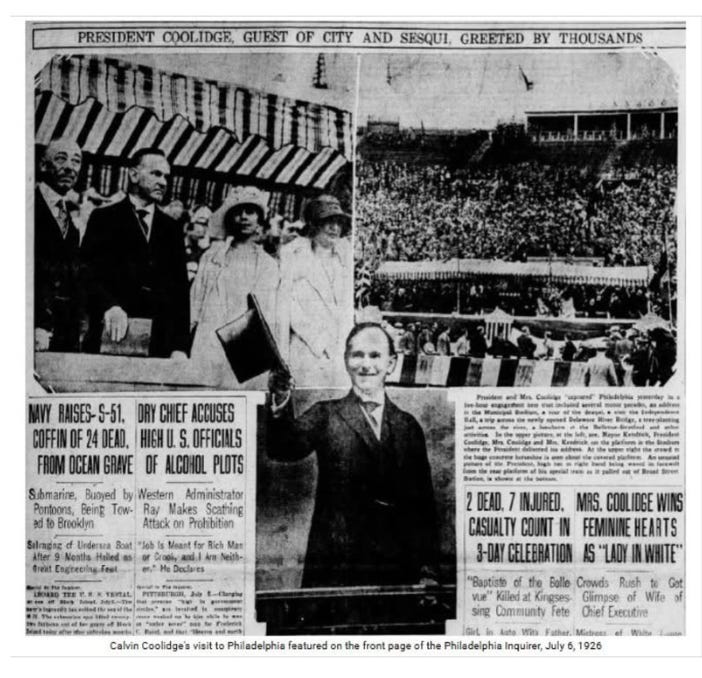
1926 President Calvin Coolidge, who was born on July 4, celebrated his fifty-fourth and the nation’s 150th birthday in Philadelphia, on the “hallowed ground” of Independence Hall, on July 5. He affirmed the endurance of the values of the Declaration. Equality, inalienable rights and the consent of the governed, “those old theories and principles . . . time [has] demonstrated to be sound.” “Silent Cal” emphasized the idea and ideal of democracy.
The centerpiece of the Sesquicentennial was an eighty-foot replica of the Liberty Bell, covered with 26,000 lightbulbs. A new stadium hosted patriot pageants, religious ceremonies and a controversial championship boxing match between Gene Tunney and Jack Dempsey, watched by 125,000 fans standing in the rain.
The country had survived a world war, a global pandemic and a Red Scare to embrace the “normalcy” and prosperity of the Roaring Twenties. For the first time, more people lived in cities than on farms. Women won the right to vote, lynchings and Klan membership increased and bootlegging flourished, until the decade ended with a crash.
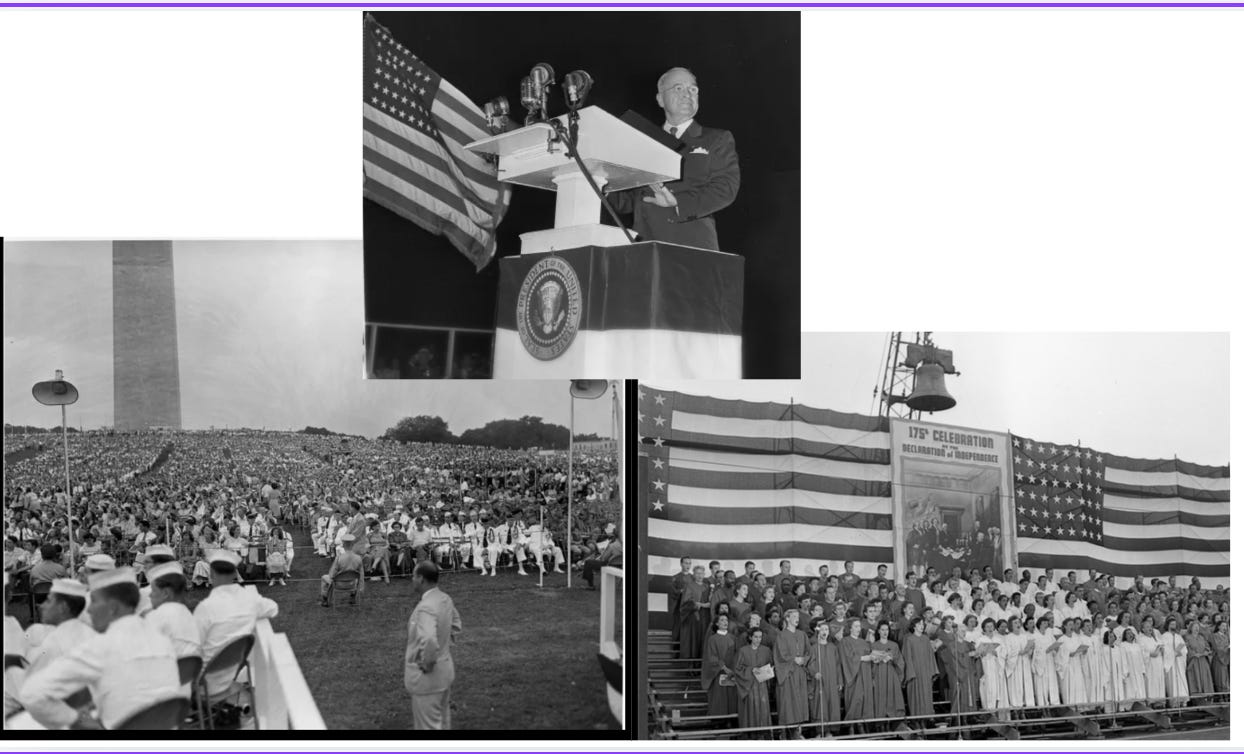
1951 To mark the 175th anniversary of the Declaration, President Harry Truman gave an evening radio address from the grounds of the Washington Monument to the nation and a crowd of 175,000. Musical performances included a Black quartet. Truman compared the vision of the Declaration of Independence to that of the newly created United Nations and NATO, to secure democracy and defeat communism. For the “demisemiseptcentennial,” the original Declaration was publicly displayed.
1976 After the anger and assassinations of the 1960s, the end of the Vietnam War, the Watergate scandal and the first resignation of a President, the Bicentennial brought the country together. It offered an opportunity for Americans to reassert their optimism, with celebrations in Boston, New York, Philadelphia, Washington and across America.
Observances began with the anniversaries of the battles at Lexington and Concord in 1775 and continued for twenty months. Organized by a bipartisan Bicentennial Commission, the celebration featured a cross-country Conestoga wagon train, Freedom Trains, armadas of tall ships, reenactors, huge fireworks displays, grand parades and a visit by Queen Elizabeth II. She presented Philadelphia with a replica of the Liberty Bell, made in the same foundry as the original, inscribed “Let Freedom Ring.”
President Ford traveled to Valley Forge, Philadelphia and New York City, by car, plane and helicopter, before returning to Washington for the fireworks on the National Mall, speaking and signing bills to mark the occasion.
The Smithsonian sponsored a twelve-week Festival of American Folk Life on the National Mall and opened the Air & Space Museum. A wave of patriotism, nostalgia and relief swept the nation. People painted mailboxes, fire hydrants and themselves red, white and blue. There were bicentennial coins and stamps (then thirteen cents). It was a unifying, uplifting moment.
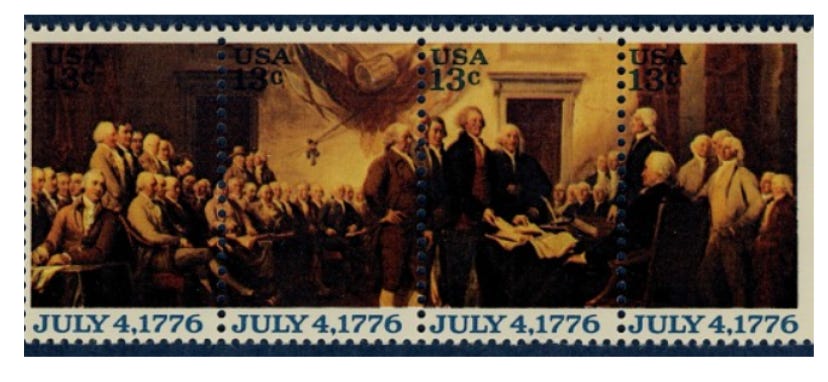
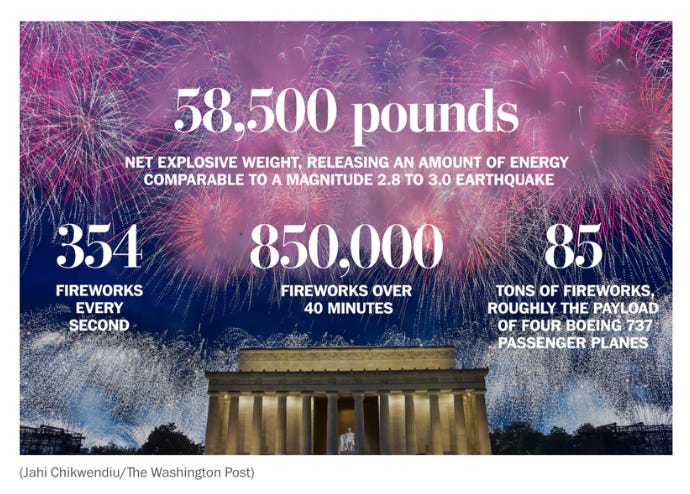
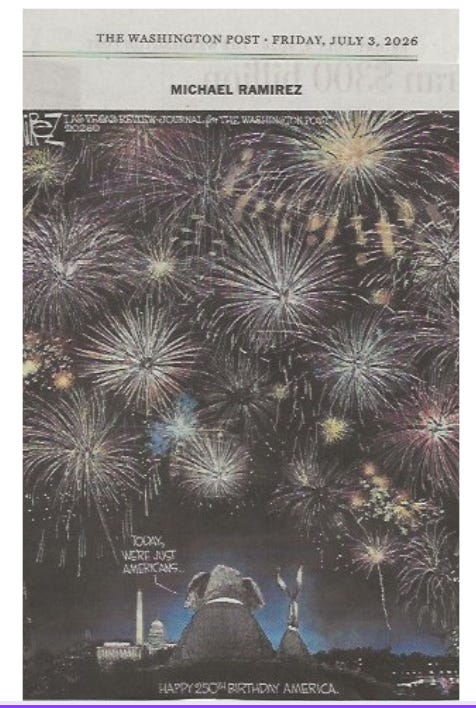
2026 While journalists will describe the events of this summer’s celebrations and scholars will offer historical footnotes, we may need to wait until the smoke clears from the largest ever fireworks display in the nation’s capital to assess how America measures up to the Declaration’s aspirational ideals after 250 years.
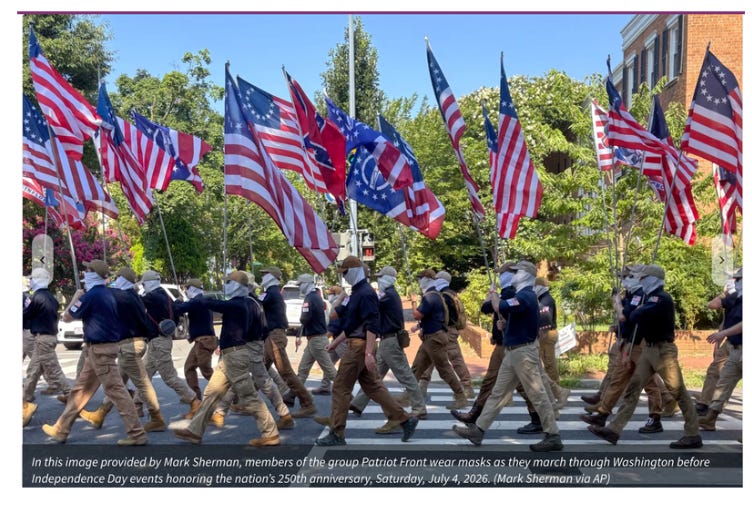
The National Mall, from the Capitol to the Lincoln Memorial, is barricaded by chain link fences, Humvees and the National Guard. Scorching heat cancelled the parade but white nationalists in face masks, called the Patriot Front, marched from Union Station to the Capitol, carrying American and Confederate flags, shouting anti-immigrant abuse. Liberal activists also marched. Both sides demanded their country back.
President Trump replaced the bipartisan America250 Commission, which emphasized block parties and volunteer service, with his handpicked Freedom250 Committee. It replaced the Folk Life Festival with the sparsely attended Great American State Fair, with exhibits sponsored by Boeing and evangelical churches (whereas the Smithsonian’s Renwick Gallery’s “State Fairs” exhibit had quilts, canned goods and a real butter cow).
Musicians cancelled their performances and what the President called his “largest rally ever” was delayed by record heat and a severe weather warning prompted the Secret Service to order an evacuation of thousands, who had waited for hours to enter the grounds. Gates eventually reopened and the President spoke at 11:00 pm. He honored veterans, reiterated claims of voter fraud and inferred that Democrats were communists. It was followed by a midnight, forty-minute finale of 850,000 fireworks.
The hyper-partisanship of planners prompted someone to post, “Republicans don’t own July 4. They own January 6.” As conservative columnist George Will observed, “In 1876, . . . most Americans looked back with pride and ahead with confidence. In 2026, many look back with chagrin and ahead with trepidation.” Yet the contested election of 1876 resulted in the end of Reconstruction and the withdrawal of federal troops from the South, ending the enforcement of civil rights for newly emancipated Black Americans.
There were still neighborhood parades, with firetrucks, kids on bikes, grandmothers doing routines with lawn chairs and recent immigrants dancing. I attended a patriotic sing-along that I wished had been replicated on the Mall. Visitors to World Cup games, surprised by the welcome and warmth of Americans across the country, reminded us of our country’s character and generosity.
Our democratic values are under attack but remain at the core of our country, so let’s sing and celebrate and VOTE. Happy Fourth! USA!
SOURCES
Photo credits: public domain unless noted.
https://www.whitehousehistory.org/the-first-fourth-of-july-celebration-at-the-presidents-house
L.H. Butterfield, “July 4 in 1826,” American Heritage (June 1955, Volume 6, Issue 4), https://www.americanheritage.com/july-4-1826
“Capitol’s Extension Cornerstone Dedicated, July 4, 1851,” https://www.senate.gov/about/historic-buildings-spaces/capitol/capitol-extension-cornerstone.htm
Elisabeth Griffith, In Her Own Right: The Life of Elizabeth Cady Stanton (Oxford University Press, 1984).
John L. Puckett, “Gender and Race at the Centennial Exhibition,” West Philadelphia Collaborative History, https://collaborativehistory.gse.upenn.edu/stories/gender-and-race-centennial-exposition
Mary Frances Cordato, “Toward a New Century: Women and the Philadelphia Centennial Exhibition, 1876,” Pennsylvania Magazine of History and Biography 107, no. 1 (1983).
Fergus M. Bordewich, Centennial: The Great Fair of 1876 and the Invention of America’s Future (Knopf, 2026)
Tammy S. Gordon, The Spirit of 1976: Commerce, Community, and the Politics of Commemoration (University of Massachusetts Press, 2013).
Matthew Goetz, “Gerald R. Ford’s Bicentennial Adventure,” White House Historical Association (May 2026), https://www.whitehousehistory.org/gerald-r-fords-bicentennial-adventure
George Will, “What America’s Proud 1876 Birthday Says About the 250th,” Washington Post (July 5, 2026), https://www.washingtonpost.com/opinions/2026/06/26/america-250th-birthday-could-learn-nation-centennial/
Layli Nazarova et. al., “A Birthday Beset by Extreme Heat and Political Division,” Washington Post (July 5, 2026), https://www.washingtonpost.com/nation/2026/07/04/celebrations-americas-250th-begin-amid-heat-political-division/
John D. Harden and Beth Broadwater, “354 Fireworks Every Second: The Fourth of Juluy Show By the Numbers,” Washington Post (July 2, 2026), https://www.washingtonpost.com/dc-md-va/2026/07/02/354-fireworks-every-second-fourth-july-show-by-numbers/
No posts
Comments
Nothing yet. Say the first thing.
Sign in to join the conversation.