
Wonder Woman, a comic book heroine, has been a feminist icon since she first appeared in 1941. The advocate of peace, justice and women’s rights was created by a Harvard-educated psychologist. William Marsden lived with his wife Elizabeth and student Olive Byrne, Margaret Sanger’s niece, fathering children with both women. Another woman he may have sexually exploited was Joye Hummel, who wrote the first three years of Wonder Woman scripts.
The imaginary heroine was an Amazonian princess and warrior. She was never a “damsel in distress.” Disguised as Diana Prince, she partnered with US intelligence officer Steve Trevor, changing into a bustier to save the world. Since its heroine was “not sufficiently dressed,” Catholic bishops banned her comics.
In a dream sequence in a 1944 strip, Wonder Woman was tempted to trade in her golden bracelets for a wedding ring. Diana agreed to marry Steve, declaring, “I’m ready to be your docile little wife.” It turned out to be a nightmare. Diana divorced Steve and Wonder Woman went back to fighting Nazis.
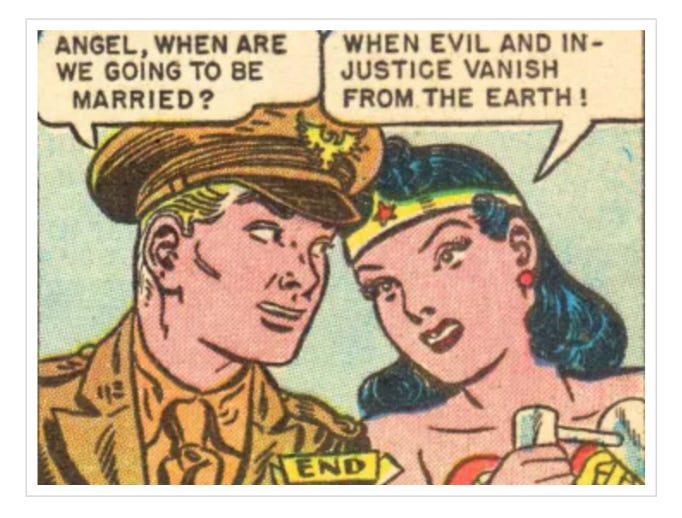
Like the “It Girl,” Betty Crocker, Nancy Drew and Rosie the Riveter, Wonder Woman joined the pantheon of white, fictional female idols. Insouciant, capable and smart, they combined the shifting characteristics of the ideal American woman. Other than Betty Crocker, they rarely cooked. In 1945, the baking company’s aproned advertising image, was the second best-known woman in America, after Eleanor Roosevelt.
Although Wonder Woman ran for president in 1943, in the 1950s Diana worked as a babysitter, a romance editor, a model and a movie star. She ran for president again, on the cover of Volume 1, #1 of Ms. magazine, published on July 1, 1972. She would appear again on the covers of several anniversary issues.
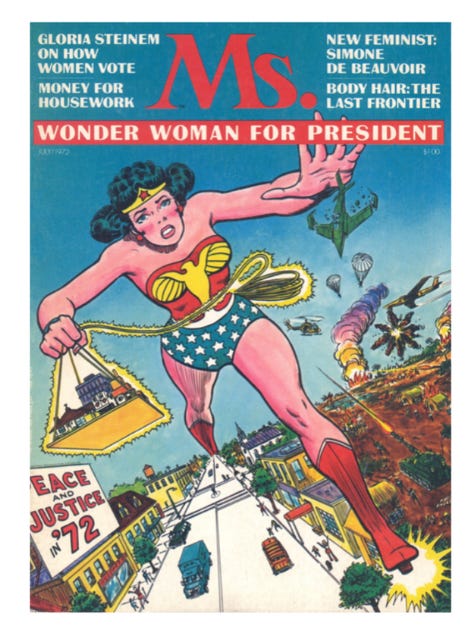
The feminist magazine with its provocative name was founded by Gloria Steinem, Patricia Carbine and Letty Cotton Pogrebin. The editors considered naming it for Sojourner Truth, but decided Sojourner sounded like a travel magazine. They also dismissed Lilith, Bimbo and Sisters, which sounded religious. The honorific Ms. did not reveal a woman’s marital status. Supposedly neutral, it annoyed men and divided women. Major news organizations did not embrace its use until the New York Times adopted it in 1986.
The owner of DC Comics was an investor, as was Washington Post publisher Katharine Graham. Despite such backers, Ms. struggled financially. It refused advertising from tobacco companies and included a column on ads which demeaned women.
Ms. first appeared as an insert in New York magazine in spring 1972. Newsstands sold 300,000 copies of its 40-page test run in three days. That issue’s cover art, by Miriam Wosk, depicted the eight-armed Hindu goddess Kali as a pregnant woman juggling women’s roles, represented by a clock, feather duster, iron, mirror, skillet, steering wheel, telephone and typewriter. Its contents included a pro-abortion petition signed by fifty-three prominent women who had had abortions, including Nora Ephron, Lillian Hellman, Billie Jean King, Anais Nin, Susan Sontag and Steinem.
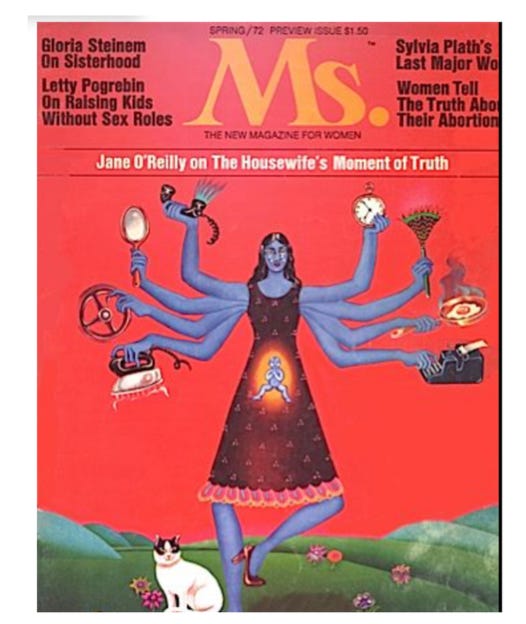
Gloria Steinem led Ms. for fifteen years and remains on its masthead and advisory board. Purchased by Australians in 1987 and bought back by a group of American feminists two years later, it became part of the Ms. Foundation for Education and Communication. In 2001, Ms. was sold to NOW’s Feminist Majority Foundation and became an ad-free quarterly. In 1993 the Ms. Foundation created “Take Our Daughters to Work Day.” A decade later it included sons.
I’ve written about Steinem before, in Formidable and another PINK THREAD. She is also a Wonder Woman.
Born in 1934, Steinem survived a childhood in Toledo, Ohio, defined by an absent father, a mentally ill mother, and poverty. She competed in teen beauty contests, studied dance and aspired to be a Radio City Rockette. Graduating from Smith College, with a fellowship to study in India, she had an abortion in London at age twenty-two. Steinem dedicated her memoir, My Life on the Road (2015), to the physician who helped her.
In the 1960s, she worked as a freelance writer in New York, covering civil rights, anti-war politics, labor unions, lesbians and abortion. She wrote about Bobby Kennedy, Gene McCarthy, George McGovern and Pat Nixon, who told Steinem, “I never had it easy. I’m not like you . . . all those people who had it so easy.” Researching an article on Playboy Bunnies in 1963, she was famously photographed working undercover, making her “the liberals’ pin-up girl.”
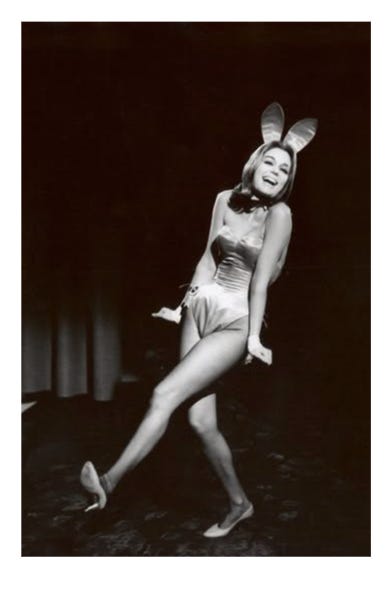
Her long hair, long legs, short skirts, aviator glasses and heterosexuality attracted media attention. According to Nora Ephron, Steinem became “the only remotely chic thing connected to the [women’s] movement.”
To mark the fiftieth anniversary of the Nineteenth Amendment, she joined the August 1970 Women’s Strike. She testified on the behalf of the Equal Rights Amendment and cofounded the Women’s Action Alliance, the National Women’s Political Caucus, the Coalition of Labor Union Women and Ms.
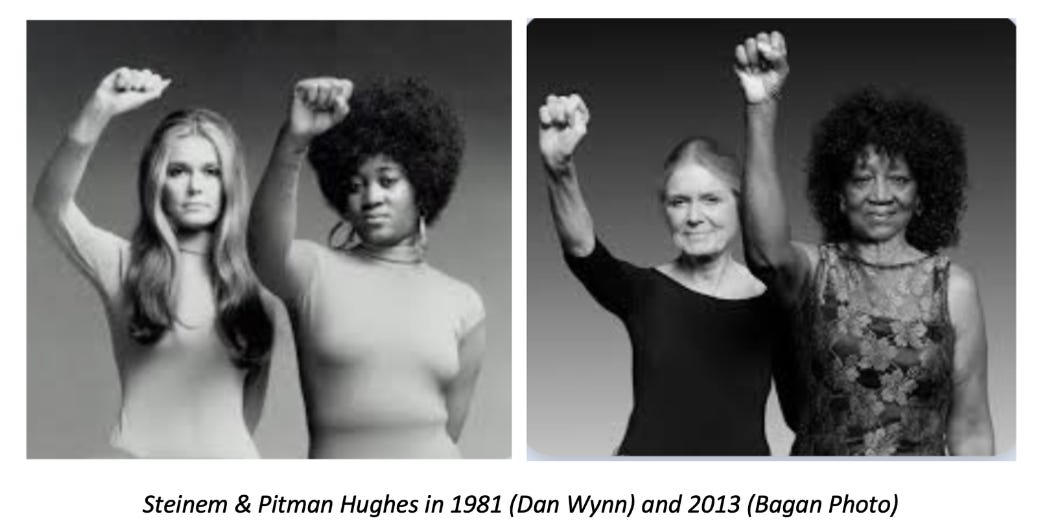
Initially hesitant to speak in public, Steinem teamed up with other feminists. Among them were child welfare pioneer Dorothy Pittman Hughes and Flo Kennedy, a flamboyant attorney. It was a way to center Black as well as white women’s stories, declaring that “racism and sexism are intertwined and can only be uprooted together.”
Betty Friedan, author of The Feminist Mystique and “founding mother,” was not comfortable among younger, diverse activists who did not revere her. She referred to lesbians in the National Organization for Women (NOW), which she inspired in 1966, as a “lavender menace.”
Steinem, now 92, has been on the front lines of the fight for equal rights for six decades. She supported farm workers, civil rights, women’s rights and reproductive rights. She opposed apartheid, genital mutilation, sexual harassment and sex trafficking. “I am an entrepreneur of social change,” she says. “I raise money. I talk. I write. I tell stories.”
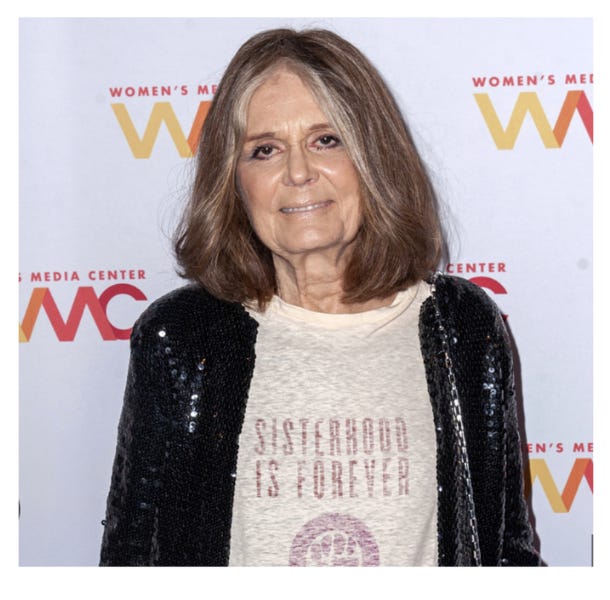
Since 1992, she has worked with Equality Now, an international network of lawyers who sue governments to end legal inequality and sexual violence. With Jane Fonda and Robin Morgan, Steinem founded the Women’s Media Center in 2004, to focus on the representation of women on screens and opinion pages. She has skewered programs like Desperate Housewives as “minstrel shows.”
Not unlike the suffrage movement, the solidarity of the modern sisterhood was rent by rivalries, resentments and racism. It has both expanded and fractured over gun violence, environmental toxins, maternal mortality, food deserts and trans rights. Groups formed around shared identities – lesbians, Latinas, librarians, women in physics. Interests and identities overlapped and competed.
Not unlike Susan B. Anthony, Steinem has outlived her contemporaries. Bella Abzug lost a bid for the Senate and died in 1998, at 78. Betty died in 2005, on her eighty-fifth birthday. Their nemesis Phyllis Schlafly died in 2016, age 92.
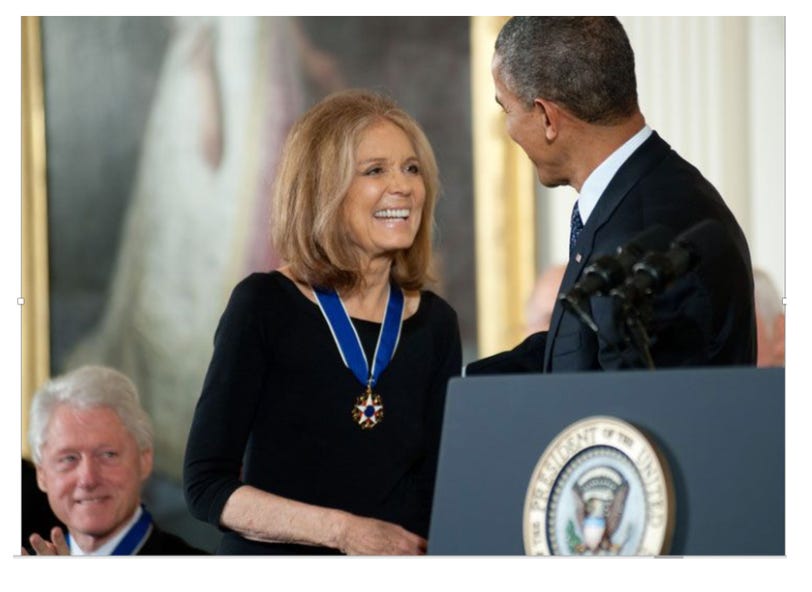
In 2013, President Obama awarded Steinem the Medal of Freedom. A social justice advocate, she keeps speaking up and marching on. She is less well known among younger people. As early as 1983, graduates of Smith, her alma mater, found her an anachronism. A 2005 CBS poll about feminism found that 69% of American women believed it had improved their lives, only 24% called themselves feminists and almost 80% did not know who Gloria Steinem was.
Neither a political strategist nor a feminist theorist, Steinem remains a presence. She brings people together, listening and then amplifying their stories, trying to break down silos of separation. She is a wonder.
SOURCES
Photo credits: public domain unless noted.
Jill Lepore, The Secret History of Wonder Woman Alfred A. Knopf, 2014).
Linda Napikoski, “Articles in the First Issue of Ms. Magazine,” https://www.thoughtco.com/ms-magazine-first-issue-3529076
Gloria Steinem, “A Great Woman Who Was Everywoman [Katharine Graham],” New York Times (July 21, 2001), www.nytimes.com/2001/07/21/opinions/a-grest-woman-who-was-every-woman.html
Carolyn G. Heilbrun, The Education of a Woman: The Life of Gloria Steinem (Random House, 2016).
Gloria Steinem, My Life on the Road (Random House, 2016).
Nora Ephron, “Miami,” Crazy Salad: Some Things About Women (Alfred A. Knopf, 1975).
Jane Kramer, “Road Warrior: After Fifty Years, Gloria Steinem Is Still at the Forefront of the Feminist Cause,” The New Yorker (October 19, 2015), https://www.newyorker.com/magazine/2015/10/19/gloria-steinem-profile-jane-kramer
Elisabeth Griffith, FORMIDABLE: American Women and the Fight for Equality, 1920-2020 (Pegasus, 2022).
No posts
Comments
Nothing yet. Say the first thing.
Sign in to join the conversation.