
Hou and colleagues studied 226 undergraduate students in a digital literacy course. Students worked in groups on a policy proposal about real cases of AI misuse on campus, and all of them used Generative AI.
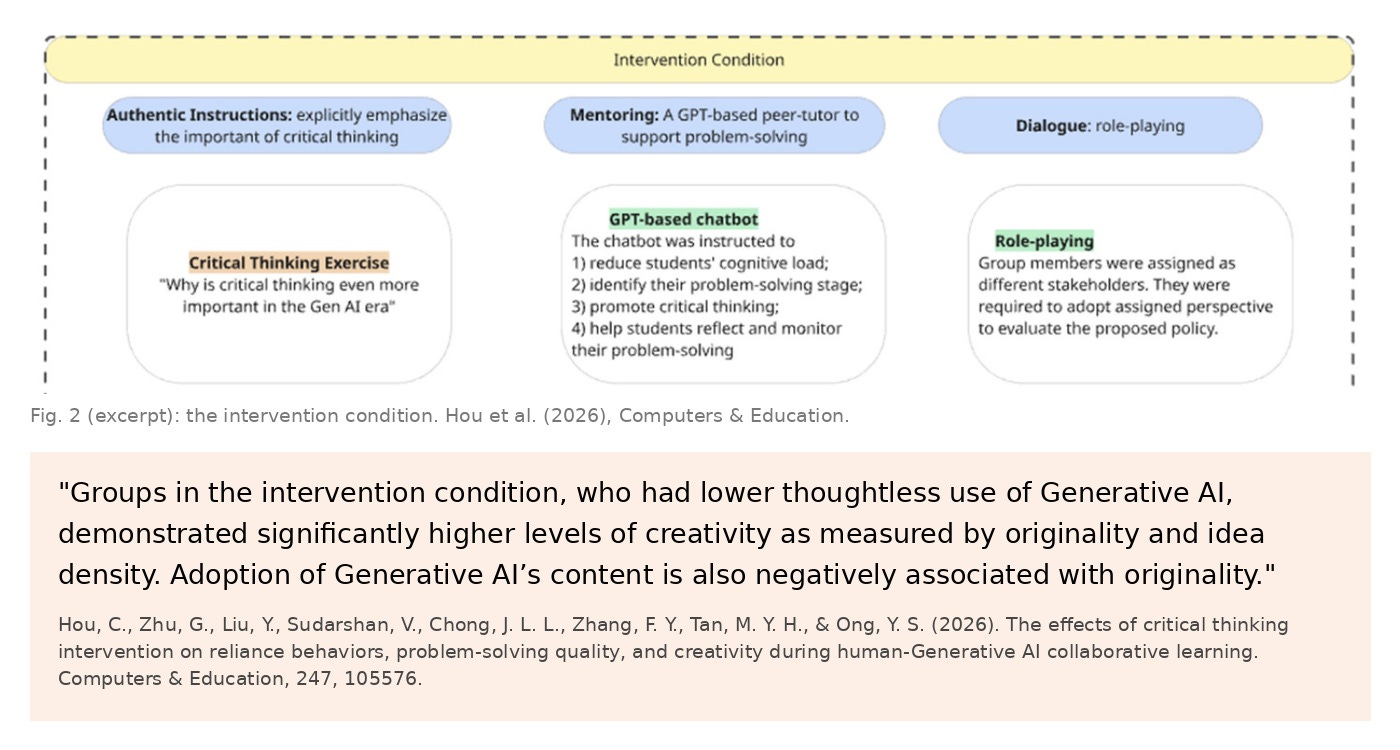
But there were two groups. Students in the intervention condition received three types of supports while using AI. They were first asked to write prompts that might expose AI bias and then analyze the output to find it. They worked with a GPT-based peer tutor that asked reflective questions, pointed out logical gaps, and offered counterarguments. And they took on assigned stakeholder roles, as administrators, instructors, or students, to evaluate the proposal from each perspective. Students in the comparison condition could use Generative AI freely, with no guidance on how.
The key findings:
1. The intervention did not raise self-reported critical thinking. Students in the two conditions rated their own critical thinking about the same.
2. But their work was rated to be more creative. The intervention groups produced reports with significantly higher originality, higher idea density, and higher human-rated novelty.
What is the best way to design collaborations with AI so that it leads to greater critical thinking? In this study, the intervention guided students to use AI intentionally while problem solving. That meant detecting bias in AI output, tutoring from AI, and AI-guided role-playing of different stakeholders.
It is interesting that the intervention did not significantly increase self-reported critical thinking compared to the control condition. But when more objective measures of creativity were applied to their reports, the intervention helped students produce more original ideas and a greater density of ideas than the group that used AI heavily without intentional guidance.
Here again we see the connections between intentional use of AI, less reliance on AI in our thinking, and originality.
AI can provide a lot of ideas and lower our cognitive load. That means we may feel our report is high in quality even when our use is uncritical and more dependent. That is reflected in the high self-reported critical thinking among the group who used AI freely. In the longer run, though, this may compromise our ability to come up with original ideas, which is ultimately the most important ability for reducing overreliance on AI and thinking more independently.
For younger students, this can also model how they can use AI more intentionally, to protect and develop their creativity while still using AI for the benefit of access to a greater amount of information.
The study: Hou, C., Zhu, G., Liu, Y., Sudarshan, V., Chong, J. L. L., Zhang, F. Y., Tan, M. Y. H., & Ong, Y. S. (2026). The effects of critical thinking intervention on reliance behaviors, problem-solving quality, and creativity during human-Generative AI collaborative learning. Computers & Education, 247, 105576. https://doi.org/10.1016/j.compedu.2026.105576
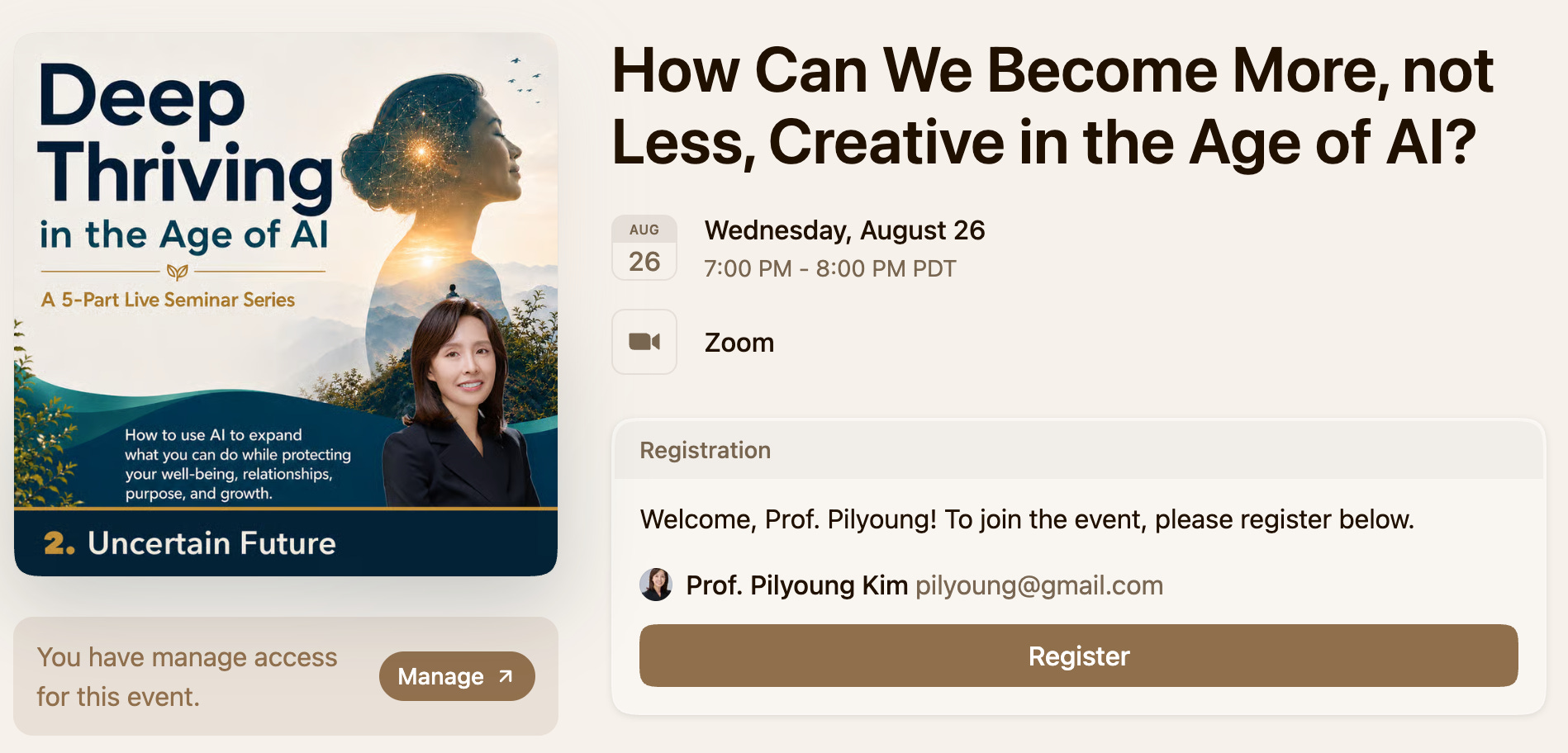
In the next Deep Thriving in the Age of AI seminar, we will discuss how we can strengthen our creativity in the age of AI.
I will review current research and share practical strategies for supporting creativity when we are using AI for our work and study.
Learn more and register for the next seminar
Event details
Date: This Wednesday, August 26, 2026
Time: 7:00 p.m. Pacific Time
Register: https://luma.com/pp763s4p
Cost: Free
I would be delighted to have you join us!
No posts
Comments
Nothing yet. Say the first thing.
Sign in to join the conversation.