
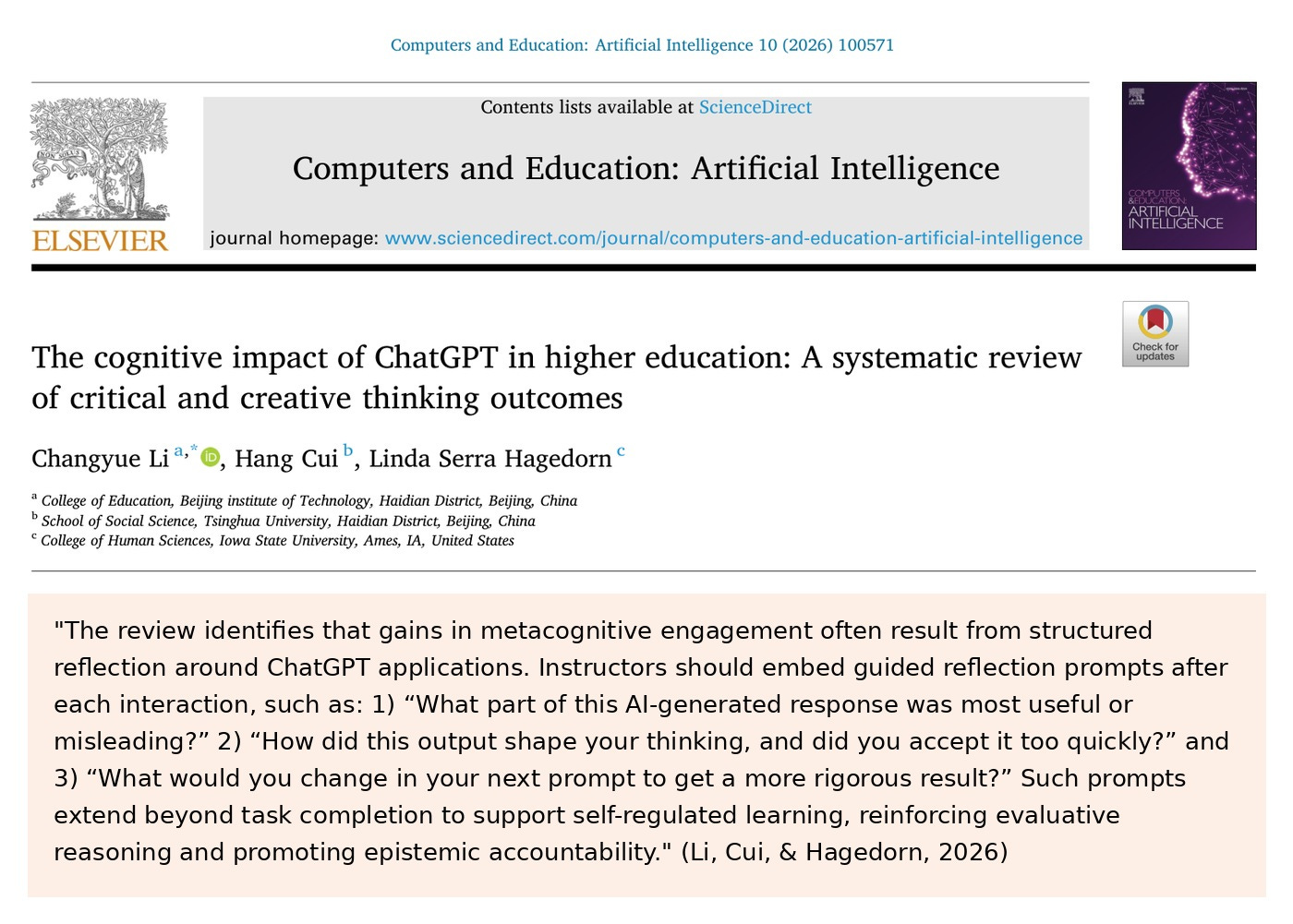
Li, Cui, and Hagedorn reviewed 67 empirical studies published between 2022 and 2025 on how ChatGPT affects university students’ thinking. They examined two kinds of thinking. Critical thinking is convergent. It involves interpreting and evaluating information, making reasoned judgments, and building evidence-based arguments. Creative thinking is divergent. It involves producing original and flexible ideas through synthesis and idea generation.
The review then asked what happens to each one under different instructional conditions.
The key findings:
1. The effect critically depends on the instructional design. When ChatGPT was embedded in inquiry-based or project-based tasks with reflective scaffolding, students gained in both critical and creative thinking at the same time. Eighteen studies showed this pattern.
2. Unguided use produced an uneven result. ChatGPT helped idea generation while critical thinking declined. Cognitive offloading was reported in 21 studies, and it was most pronounced among novice users and students with less AI literacy.
3. Even the creative gains came with a cost. Students described an erosion of personal voice and emotional authenticity. They said the AI output did not sound like them, and that folding in its suggestions diluted the originality of their own work.
4. The two kinds of thinking support each other. The review found that they are interdependent. Idea generation, critical reflection, and revision are part of one loop, so a task that engages one tends to engage the other.
The review provides clear evidence for structured use as the key to making AI support these kinds of thinking rather than hurt them.
The review’s own recommendation is intentional scaffolds for metacognition. Instructors are advised to embed guided reflection prompts after each interaction, asking students what part of the response was useful or misleading, how the output shaped their thinking, and what they would change in the next prompt.
For students, then, the important thing is AI literacy in a specific sense. How to use it intentionally and in a structured way. What specific part of this task will I get AI’s help with? Which parts of its suggestions are most useful? How can it help me improve my original idea rather than replace it?
After reading this review, what concerns me is who is currently getting the structure. This review was conducted with university students. In my research, most middle school students report using AI often, but they are mostly left alone with these tools, and their use is unguided. Based on what this review found in unguided conditions, it seems highly likely that this kind of use is undermining their critical thinking and creativity rather than building them.
1. ChatGPT can influence both critical thinking and creative thinking, and the direction depends on how the use is structured. With scaffolding, both improved together.
2. Unguided use carries a risk of cognitive offloading. Students defer to the output instead of evaluating it, and they report that the ideas do not feel like their own.
3. Unguided use also carries a risk to creativity. Students report that AI can support creativity such as idea generation, but they also report losing their sense of ownership of the ideas.
4. The optimal intervention may be guided and structured use that supports both critical and creative thinking.
Reference: Li, C., Cui, H., & Hagedorn, L. S. (2026). The cognitive impact of ChatGPT in higher education: A systematic review of critical and creative thinking outcomes. Computers and Education: Artificial Intelligence, 10, 100571. https://doi.org/10.1016/j.caeai.2026.100571
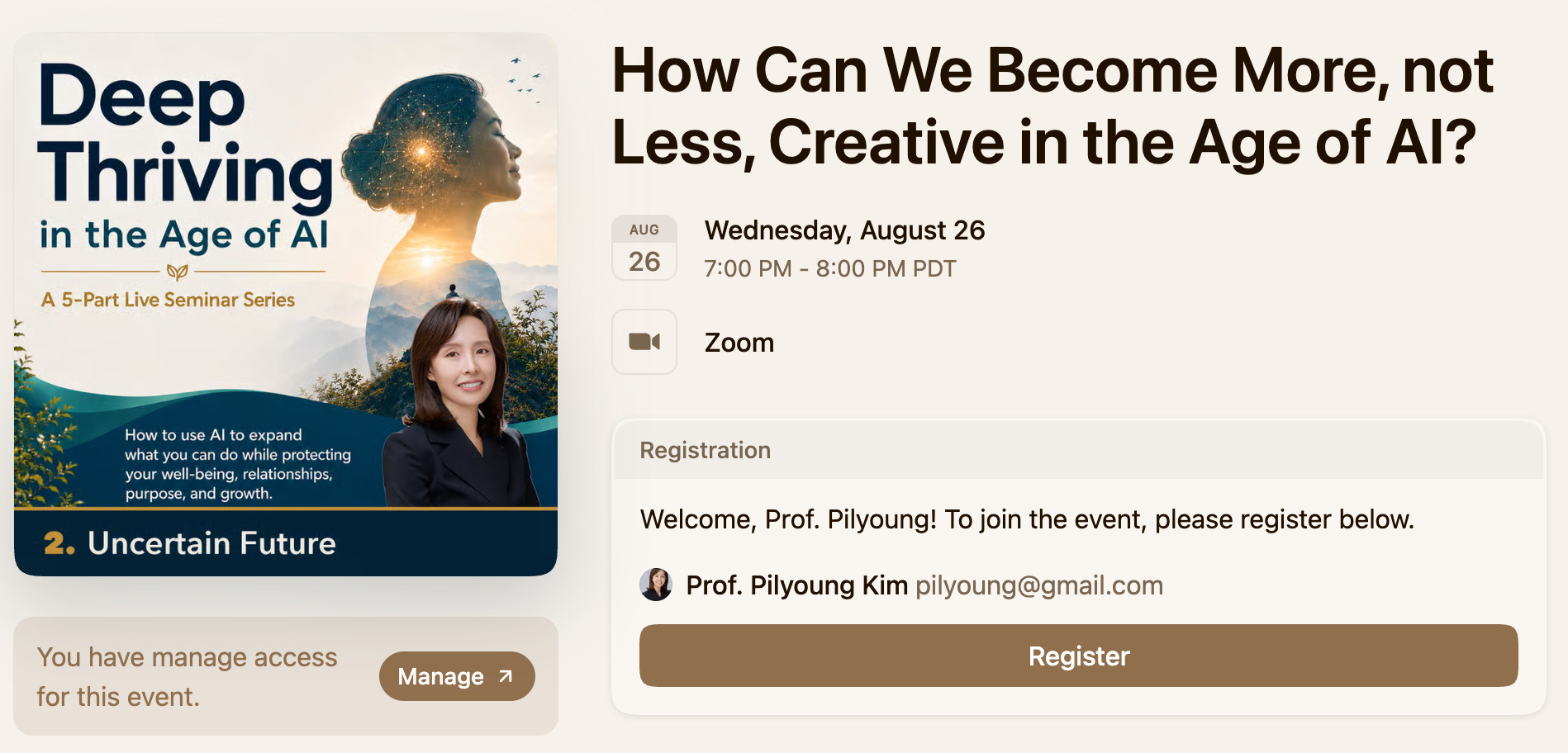
In the next Deep Thriving in the Age of AI seminar, we will discuss how we can strengthen our creativity in the age of AI.
I will review current research and share practical strategies for supporting creativity when we are using AI for our work and study.
Learn more and register for the next seminar
Event details
Date: This Wednesday, August 26, 2026
Time: 7:00 p.m. Pacific Time
Register: https://luma.com/pp763s4p
Cost: Free
I would be delighted to have you join us!
No posts
Comments
Nothing yet. Say the first thing.
Sign in to join the conversation.