
In the last two posts, I wrote about how AI may affect well-being through uncertainty, psychological safety, and the feeling that one’s expertise is being devalued.
This third post focuses on a different but closely related question:
What is it like to work with AI as a coworker?
Most discussions about AI at work focus on productivity. Can AI help people work faster? Can it improve decisions? Can it reduce costs? Can it take over repetitive tasks?
These are important questions. But there is another question that may become increasingly important:
If people spend more of their working time interacting with AI instead of human coworkers, what happens to their social well-being?
A fascinating paper by Tang and colleagues (2023), No person is an island: Unpacking the work and after-work consequences of interacting with artificial intelligence, speaks directly to this question. The authors examined what happens when employees interact more frequently with AI systems at work. Across four studies, they tested whether working with AI increases people’s need for social connection and loneliness, and whether these experiences affect behavior at work and well-being after work.
One strength of this paper is that it does not rely on one sample or one method.
The authors conducted four studies with employees from different countries, jobs, industries, and AI systems. Their samples included employees in Taiwan, Indonesia, the United States, and Malaysia. They also used different methods, including field surveys, field experiments, and an online simulation study. In some studies, they collected data not only from employees, but also from coworkers and family members.
This is one reason I found the paper compelling. The findings were highly consistent across multiple studies, samples, and designs.
The question is also timely. The study was conducted in 2021–2022. Since then, our interactions with AI have become much more extensive. For many people, AI is no longer only a tool used occasionally. It is becoming a daily collaborator, tutor, assistant, evaluator, and sometimes even a conversational partner.
So I read this paper with an additional question in mind: if these effects were already visible in 2021–2022, what might they look like now?
The authors start from the idea that AI is increasingly being treated as a kind of coworker. AI systems can give advice, make recommendations, help with decisions, and support work tasks that people previously completed through interaction with human colleagues.
This creates a new kind of work environment.
In the past, if someone needed help, they might ask a colleague. They might talk through a decision, ask for feedback, or get reassurance. Even when the conversation was mainly about the task, there was still a human interaction embedded in it.
Now, AI can often provide that information more quickly.
That can be efficient. But it may also remove many small moments of human connection that used to be part of the workday.
A person may get the answer they need, but not the social signal that comes from another person saying, “Yes, I see what you mean,” or “I struggled with that too,” or “Let’s think about this together.”
This is the important psychological issue. AI may help us complete the task, but it may not satisfy the human need for social connection.
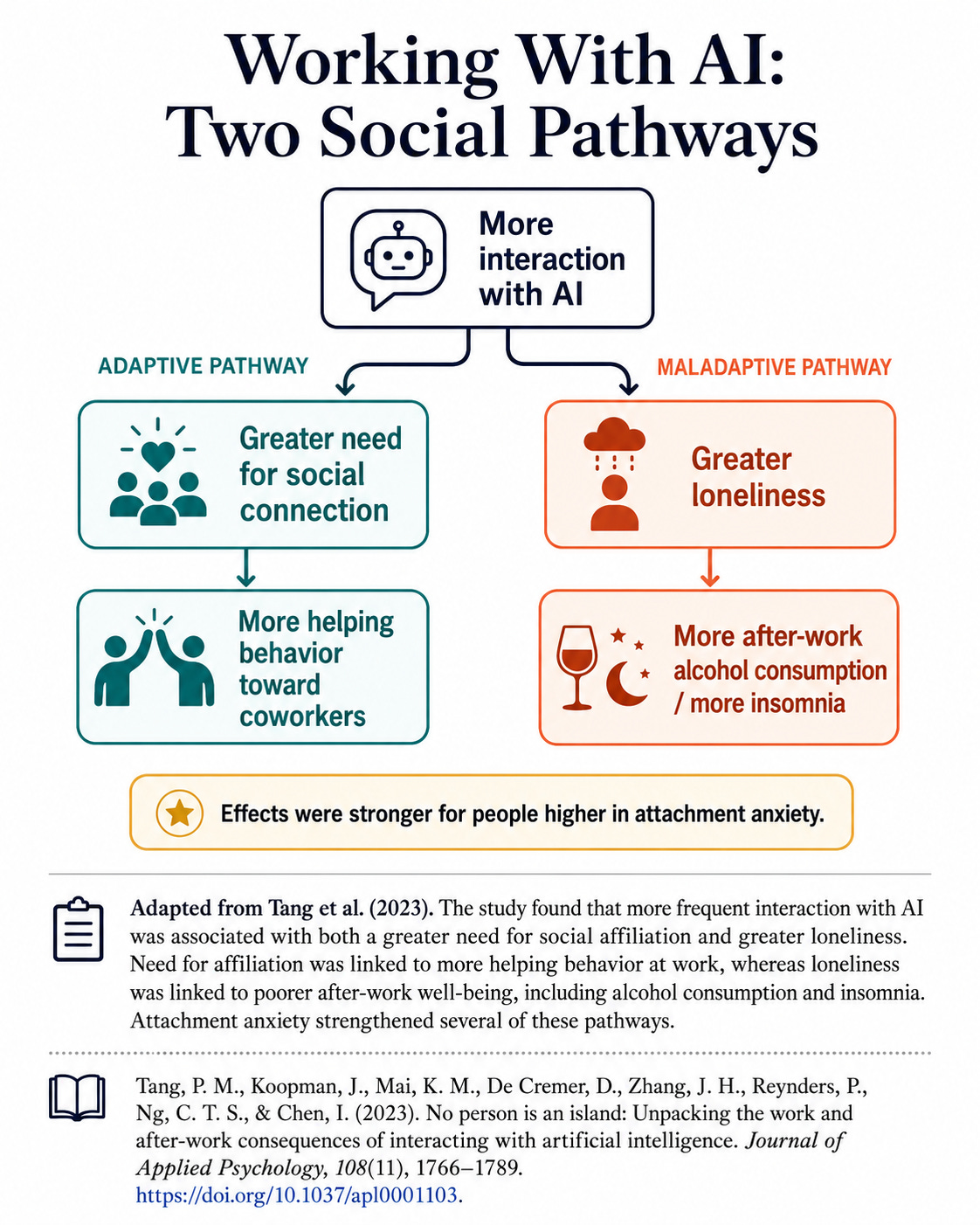
The findings were not all negative.
The authors found that more frequent interaction with AI was associated with a greater need for affiliation. After working more with AI, people seemed to have a stronger desire to connect with other people. This greater need for affiliation was associated with more helping behavior toward coworkers.
This is interesting because it suggests one adaptive response. When people feel socially deprived, they may try to reconnect. They may help colleagues more, perhaps because helping becomes one way to restore human connection.
But the study also found a more concerning pathway.
More frequent interaction with AI was associated with greater loneliness. Loneliness, in turn, was associated with more after-work drinking and more insomnia.
So the findings show both sides.
Working with AI may increase people’s desire to connect with others, and that may lead to more helping behavior. But it may also increase loneliness, and that loneliness may spill over into life after work.
Human beings are social. Even at work, where we often talk about productivity and performance, people still need signals of belonging, recognition, and connection.
So when people interact with AI repeatedly throughout the day, they may be getting task support without enough social nourishment.
That may create a strange psychological situation: people are interacting all day, but still feel socially deprived.
This may be especially true as AI becomes more human-like. The interaction may feel social on the surface, but not fully satisfying at a deeper level.
One of my own concerns is that we may be approaching a new stage.
When this study was conducted, many employees were interacting with AI systems, but the level of AI integration was still much more limited than it is becoming now. Since then, generative AI has changed the nature of daily work.
For some people, AI may become the most frequent “interaction partner” during the workday.
The original study found that people who interacted more with AI had a greater need for social connection and, sometimes, responded by helping coworkers. But what happens if there are fewer opportunities to interact with coworkers in the first place? What happens if more work becomes individualized through AI? What happens if each person is working with their own AI assistant instead of collaborating with other humans?
People may feel a stronger need for connection, but have fewer natural opportunities to meet that need. In that case, loneliness may become more intense.
Another important part of the study is that the effects were stronger for people with higher attachment anxiety.
Attachment anxiety refers to a tendency to strongly desire close connection and to worry about rejection, abandonment, or social disconnection. The authors found that people with higher attachment anxiety were more affected by interaction with AI.
This is important because AI may not affect everyone in the same way.
People who already have strong social support may be able to compensate more easily. They may work with AI during the day but still have enough human connection through coworkers, friends, family, or community.
But people who already feel socially insecure, isolated, or disconnected may be more vulnerable. If AI replaces some of their everyday human interactions, the effect may be stronger.
This matters for workplaces. It also matters for students, remote workers, freelancers, and young people who may already have fewer stable social structures around them.
The pressure right now is to use AI as much as possible.
But this paper reminds us that the human side of AI adoption cannot be reduced to productivity.
If people’s well-being is negatively affected over time, the productivity gains may not be sustainable. Loneliness, insomnia, and after-work coping behaviors are not small issues. They can affect mental health, physical health, motivation, relationships, and long-term performance.
Organizations may gain efficiency in the short term while slowly weakening the social fabric that supports people’s well-being and collaboration.
The findings suggest that if more work will involve AI, then workplaces need to be more intentional about preserving human-human interaction.
This may include creating more opportunities for collaboration, peer learning, mentoring, shared problem-solving, and informal connection. This may be especially important in remote and hybrid work, where spontaneous human connection is already reduced.
I also think about how these findings may be connected with what our students are experiencing at school.
AI tutors may become highly effective. But the social connections are critical for social and emotional development.
If AI tutors increase individualized learning time but reduce peer-to-peer or student-teacher interaction, we need to think carefully about the long-term consequences.
Reference:
Tang, P. M., Koopman, J., Mai, K. M., De Cremer, D., Zhang, J. H., Reynders, P., Ng, C. T. S., & Chen, I. (2023). No person is an island: Unpacking the work and after-work consequences of interacting with artificial intelligence. Journal of Applied Psychology, 108(11), 1766–1789. https://doi.org/10.1037/apl0001103.
No posts
Comments
Nothing yet. Say the first thing.
Sign in to join the conversation.