
The shadowy world of the dance floor has held a particular cultural fascination over the last decade in the English-speaking world, from pop music’s attempts to bring clubbing to the charts (Charli XCX, FKA Twigs) to books like Emily Witt’s memoir about the 2010s Brooklyn rave scene, Health and Safety, and the poet Aria Aber’s novel featuring the clubs of Berlin, Good Girl. Though I’ve never been much of a raver—I’m a boring morning person who likes going to bed early—it’s a world I’ve enjoyed reading about, and I’ve previously written about this trend, and writing about parties.
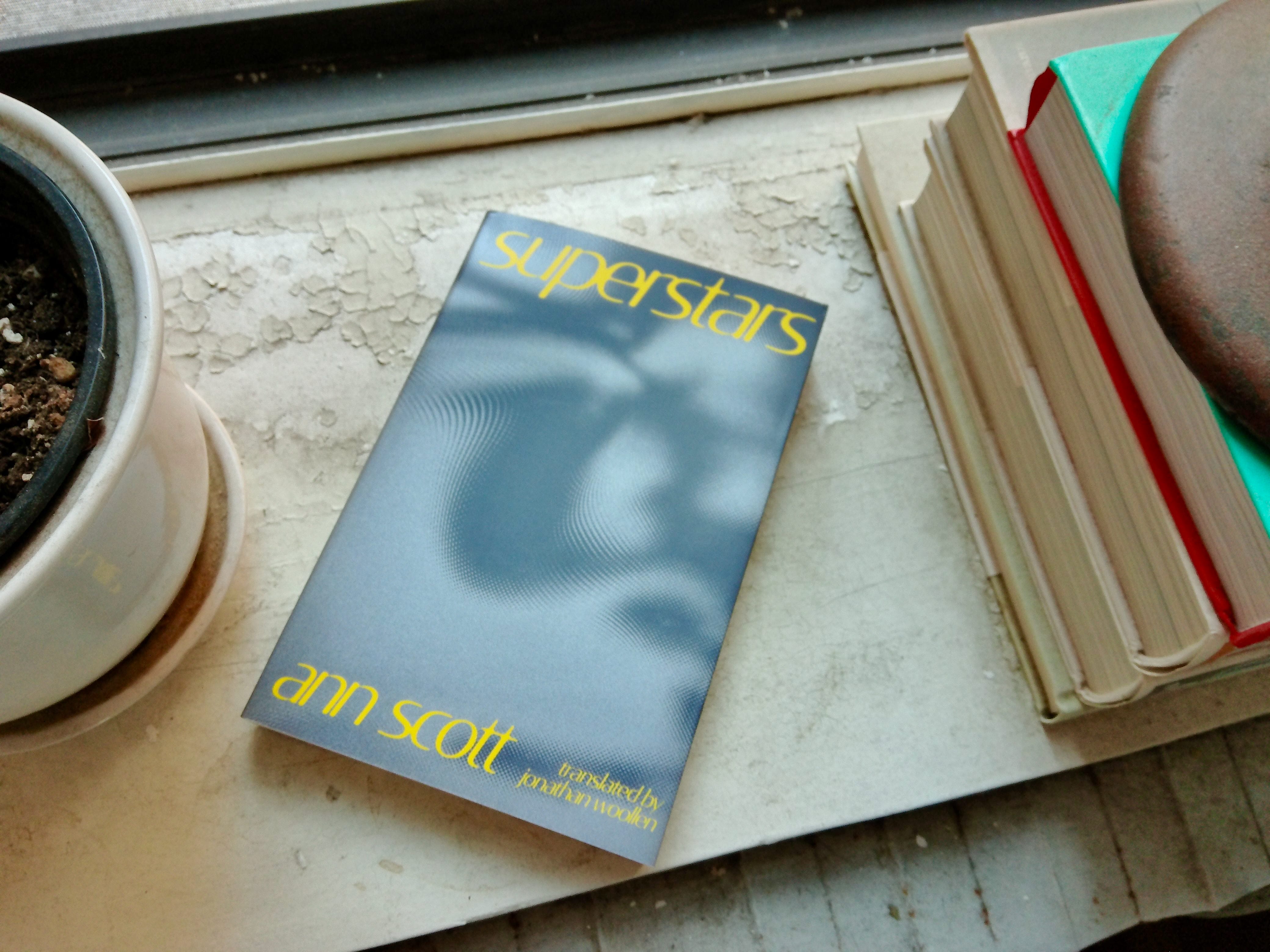
Last week, I was reminded of how interesting writing about the dance floor can be when I attended the release party for the French writer Ann Scott’s Superstars, first published in 2000 and now newly translated into English by Jonathan Woollen and published by Astra. Following its lead character, Louise, a musician and DJ on the verge of a big break in ’90s Paris as she navigates the highs and lows of the queer techno scene, it’s an intense portrayal of a specific world at a specific time, and a moment that, in our politically-chaotic present tense, looks almost prelapsarian. Jonathan first read an excerpt from his translation in September 2024 at one of the Wish You Were Here readings at Bar Jade in Bushwick that Kate Peters and I co-curate, and I thought it would be fun to ask him a few questions via email about the translation process.
1. How did you first encounter Superstars? Were you already a fan of Ann Scott’s work, or was this the first novel of hers that you read?
I hadn’t heard of Ann Scott until her most recent novel, Les insolents, won the Prix Renaudot, which outside of the Goncourt is arguably the most prestigious French literary prize. All the French coverage of her win emphasized two things: a) this was a huge surprise, and b) the author was mostly known for her “cult classic” Superstars. Hearing that designation is like catnip for me, so I looked up the book and it sounded right up my alley, temperamentally, more so than her more recent book—I immediately ordered myself a copy. As a music obsessive who came into my twenties during a time when the noise scene was starting to blend rather seamlessly into underground techno, it felt really enticing to find a novel about similar dynamics playing out in ’90s France, with its central character having migrated from the punk world to raving.
I’ve since read Les insolents, too, and I absolutely love it and am currently drafting a translation. It’s actually a really interesting counterpart with Superstars, as in what would happen if you removed the earlier book’s characters from the heart of nightclub Paris and stranded one of them, alone, in deepest Brittany. It’s a more outwardly pensive book than Superstars, but all of that book’s fire remains, lurking just under the surface.
2. Superstars is a very of-its-moment, slang-filled novel. How did this influence your approach to translating it?
I think a lot about voice—like spoken voice—whenever I’m translating, regardless of the book’s tone. It’s my acting background coming out, I think; I have to believe that as an actor I could truly buy myself reciting these lines. The ’90s, as depicted in this book, still feels very present to me as someone who was a kid at that time (and as a millennial with something of a Gen X sensibility borne from my uncle exposing me early on to lots of canonical alternative and “college rock”). As a result, I rarely questioned my instincts about the English slang that first came to mind; if it sounded right coming out of my mouth, I usually just went with it. There might have been a couple times I wanted to make sure I wasn’t using total anachronisms, but rarely enough that I can’t remember what those instances might have been. I did however want to make sure I didn’t overuse specific drug slang, so I had lots of internal discussion about when to call heroin “smack” vs. “dope” vs. “skag” and on and on.
3. Can you tell us a little bit about the impact Superstars had on the French literary scene when it was first published?
This book, her second, was a commercial success, in ways that none of her subsequent novels would match up until Les insolents won the Renaudot. But it wasn’t necessarily respected as writing. It was treated, by its fans and detractors alike, more as a juicy, unfiltered scene portrait than as a work of high literary value. I’m thinking of this televised interview Ann gave at the time for the popular TV panel show Tout le monde en parle, in which everyone seems most interested in the titillating details. The host gives one reading from the book and chooses to go with one of its most graphic sex scenes. Later, he asks Ann, point blank, if she’s a nymphomaniac, among other psychological disorders. She answers it all with equal parts disarming sincerity and hard-edged irony.
And though it’s become a perennial touchstone for queer literature in France, Superstars also generated significant controversy upon release as to whether its portrait of lesbian Paris was too caustic, too pathological. It got Ann in a lot of hot water, and she lost a number of friends over the book. That said, one of the main characters, the protagonist’s ex named Alex, was quite clearly based on that friend group’s Delphine Palatsi, better known as DJ Sextoy, and Superstars greatly enhanced her profile, helping cement her as a legend of French queer culture and dance culture alike. (When Sextoy died two years after the book’s release, Paris’s then-mayor insisted on burying her in the iconic Père Lachaise cemetery. Her plot is right around the way from the grave of Pierre Bourdieu.) There’s actually a great mini-documentary about Sextoy available to watch online that prominently features Ann throughout, with a spotlight on the book at the 37-minute mark.
4. What was the most difficult part of the novel to translate, and what was the simplest or most straightforward?
Simplest was managing the tone, because Ann’s voice is so potent in the original French. I felt very confident from the jump about leaning into dry, colloquial language and rhythms. To me, hardest was a far more interesting conundrum, which had more to do with paranoia about the book’s eventual reception than it did about my translation per se. The middle of Superstars centers an obsessive short-term fling that I knew in an American context would immediately turn certain readers against the narrator. There was a period while translating that section, when I was most immersed in its emotions and explicit descriptions, during which I had severe anxiety about just how negative its reception might be. At least so far, now that the book has been making the rounds, I’ve been pleasantly surprised by how little of an issue it’s become, how easily people are able to ride with its dynamics, taking them primarily in terms of character portrait, depictions of “another place and time”, and sheer uncomfortable honesty.
5. Much of the novel takes place during underground parties in the ’90s techno scene in Paris, and the main character, Louise, is a musician on the verge of a big break. If you were putting together a soundtrack for the novel, what songs might you include?
Funny you should ask! Right around the time I turned in my draft, I made a playlist to this effect—try here or here. It’s got the Tricky song that gave the book its title (“Tricky Kid”); it’s got tracks that are explicitly referenced in the book (“Answering Machine” by Green Velvet, “I Wanna” by DJ Rush, “Mr. Self Destruct” by Nine Inch Nails, “The Beautiful People” by Marilyn Manson); it’s got tracks by almost all the folks who “play” the early rave scene in the book (Kevin Saunderson, DJ Hell, The Hacker, Atari Teenage Riot, Freaks, Herbert, and more); it’s got nods to other references from the book (Johnny Thunders, Aphex Twin, the Liquid Sky soundtrack); it’s got tracks from the real-life scene the book depicts, from those who I know shared stages and/or labels with Sextoy, those who collaborated with her, or those who were featured in her DJ sets (Marie Chantale, Ellen Allien, Steve Bug, Miss Kittin, Chicks on Speed, a song from the soundtrack to Virginie Despentes’s Baise-moi, I could go on); and it’s got tracks from artists who simply, to me, feel of a piece philosophically (Surgeon, Regis, Thomas P. Heckmann, Robert Hood).
To find out more about Superstars, you can visit the Astra Publishing House website. If you are curious to hear more from Ann Scott herself and are based in New York, she and Jonathan will be giving a reading at Albertine Books on May 7 at 6 p.m., as well as multiple other locations on the East Coast.

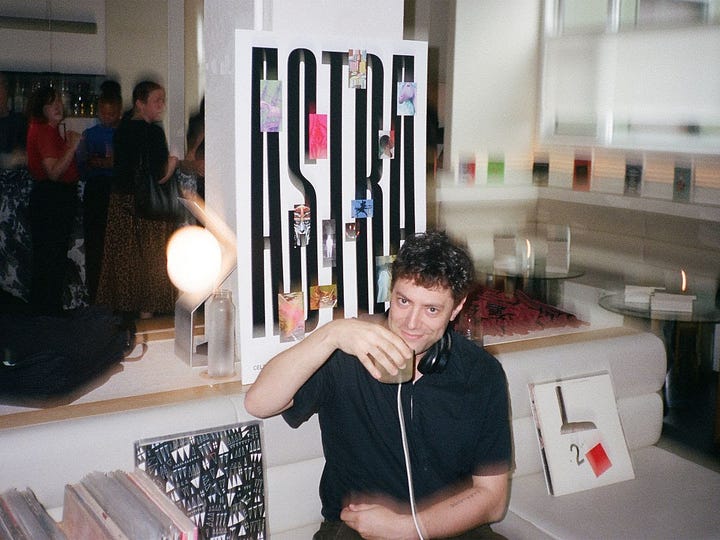
Ann Scott is the author of ten novels. Her most recent novel, Les Insolents, won the 2023 Prix Renaudot in France.
Jonathan Woollen is a French-to-English translator originally from North Carolina, currently based in Queens, New York, and working in publishing. Superstars is his first published book-length translation.
No posts
Comments
Nothing yet. Say the first thing.
Sign in to join the conversation.