
Art versus reality: before we delve into the usual subject matter of this monthly dispatch (the former), we’re going to need to take a brief detour into the latter. For the past two years, I’ve been freelancing full-time, and I recently learned that one of my main anchor gigs will unfortunately be ending at the close of April, when the website in question will be shutting down (a classic media story). It was kind of a dream of a writer’s day job—some SEO, copy editing, and web production for a pet-themed website—and I’ll be sorry to see it go.
I’ve got some other pots in the fire and projects in the works, but I am going to be looking for more work to replace this. If you’re reading this newsletter and have any leads, do let me know! I’ve previously worked on staff at The Baffler, The Paris Review, and Vanity Fair; I’ve written for publications including The Atlantic, The Nation, and many more; I’ve ghostwritten and edited things for some different tech companies and startups; and I’ve worked (briefly) in politics. Oh, and I’ve written three novels and one short story collection that are as-of-yet unpublished. Basically: I’ve got a lot of experience in anything word-related, be it newsletters, social media, copy writing and editing, SEO, etc. Hit me up at rhiansasseen@gmail.com!
Anyway, enough housekeeping. I also had a couple pieces come out in March—for The Atlantic, I wrote a fun list of six books that simply must be talked about, be it in a book club, on a date, or just with friends, and included titles by Emily Nemens, Stephen Greenblatt, Naguib Mahfouz, Kristi Coulter, and more. And for the spring issue of Kinfolk, I interviewed Makenna Goodman about her new novel, Helen of Nowhere, which came out via Fitzcarraldo in the U.K. and Coffee House Press in the U.S. Makenna and I were on a panel together a couple of years ago about the work of the Japanese writer Izumi Suzuki, and it was fun to reunite and talk about her own theater-inflected new novel.
Unrelated to any of the above: I made this new carrot-orange marmalade muffin recipe from the Times three times in March (I’m eating one now in April as I type this) and I’m recommending it to everyone I know. They are so good, though I personally recommend cutting the sugar in half—the marmalade makes them sweet enough.
Books
1. Exit Interview: The Life and Death of My Ambitious Career, Kristi Coulter
I read this for the aforementioned Atlantic piece, and it was pretty rage-inducing. For over a decade starting in 2006, Coulter worked in pretty high-up managerial roles at Amazon, and she does not hold back about how the company treated her in this very candid memoir. You can read my full recommendation at The Atlantic’s website. There are a lot of jaw-dropping moments in it that I didn’t get a chance to mention, including a horrible meeting in which some computer engineer guy higher-up interrupts Coulter while she’s making the (very logical) case that a global shopping website should probably have more than one professional copy editor reading for mistakes and dismisses her by calling her “stupid” to her face.
2. The spring 2026 issue of The Yale Review
This was a great issue, and one particular highlight was Jhumpa Lahiri’s essay on rereading Thomas Hardy’s Jude the Obscure. You can read the entire thing on The Yale Review’s website.
3. How We Disappear: A Personal History of Information, Thomas S. Mullaney
I might be trying to place a review of this somewhere so I won’t say much, but I thought this work of non-fiction concerning the idea of disappearing and the relevance of the archive in the internet age, written by a professor of history of Stanford, to be really fascinating. Over a decade ago I wrote a piece for Al Jazeera America about the idea of “bit rot” and the digital archive, and I talked to some librarians at the Library of Congress who told me that at the time (2014), they were actually more worried about technological obsolescence when trying to transfer archival material between formats. Anyway, this book is coming out in June.
4. On Morrison, Namwali Serpell
Loved this! It’s always so much fun to read a really in-depth work of literary analysis, and Serpell, a professor of English at Harvard as well as a novelist in her own right, is brilliant at both contextualizing Toni Morrison’s life and career and breaking down and analyzing her novels on a structural level. I love reading about a writer’s process, and this book has a lot of that. I also thought the final chapter, in which Serpell critiques Morrison’s (far less well-known) poetry, was really interesting—some artists excel in certain genres over others, and it was illuminating to see how many of Morrison’s strengths as a writer lend themselves better to prose.
5. Diorama, Carol Bensimon (translated by Zoë Perry and Julia Sanches)
This new Brazilian novel had an intriguing premise involving taxidermy, family secrets, and a political murder, but to be honest, it didn’t particularly grab me. I did finish it, though (I only include books that I finish on this list).
6. Erik Satie Three Piece Suite, Ian Penman
I was in the mood for some non-fiction after reading Diorama, and this inventive biography of the oddball French composer Erik Satie was extremely satisfying. I love Satie’s pioneering idea of “furniture music” and the interest he had in the relationship between writing, images, and music. His instructions on his scores could be famously off-kilter—rather than the usual fortissimo, adagio, etc., he’d write things like, “Be an hour late,” “Look like a fraud,” or “With your head between your hands.” After reading this, I am also curious to know more about the one major love affair he had in his life, an intense six months spent with the painter Suzanne Valdon, who later left him and to whom many unsent letters were found addressed in his small living quarters on the outskirts of Paris following his death.
7. The Method: How the Twentieth Century Learned to Act, Isaac Butler
Again, I was in a non-fiction mood, and I find it inspiring to read about other forms of art. Actors are so odd to me, but I found this deep dive into the history of method acting—which won the 2022 National Book Critics Circle award and traces the technique from its early development by Stanislavski in pre-revolutionary Moscow to its popularization in mid-century New York to its current established status in the present day—to be a smart and satisfying read.
8. They, Helle Helle (translated by Martin Aitken)
This Danish novel about a sixteen-year-old girl in rural Denmark in the 1980s and her relationship to her dying mother was promoted as being quite minimalist, so I knew what I was getting into, but to be honest, it was maybe a little bit too minimalist for me. There is a deep melancholy to it that at times was quite beautiful, though.
-
Reading-wise, I attended the March edition of the First Mondays reading series that Sarah Schulman runs, which my friend Ama told me about and that features writers’ works-in-progress. It was really fun, and the one I attended featured Lana Dee Povitz, reading from a biography of Shulamith Firestone; Mathew Rodriguez, reading from a memoir about sugar; and Melissa Febos, reading from a novel about a lesbian professor-and-student romance set in the 1980s. On the last day of March, I also attended another edition of …Wish You Were Here!, the reading series I co-curate with Kate Peters, which was wonderful and featured the poet Sasha Burshteyn, the fiction writer Izzy Beach, the playwright Steven Glavey, and the poet Addy Malinowski. The next one will be in late May, and I think it will an alumni-themed reading featuring some previous readers! Stay tuned for more details.
Film
I’m Not Everything I Want to Be, directed by Klara Tasovska
This is a new documentary about the Czech photographer Libuše Jarcovjáková, who in the marketing material is compared to Nan Goldin for her photographs of the underground queer scene in Prague before the fall of the Berlin Wall. But I found the pacing of the documentary to be frustrating; these particular photographs don’t even make an appearance until forty minutes into the film (it seems as though they were only a small part of Jarcovjáková’s oeuvre?). I found her photos of factory workers in Prague to be quite compelling, though. To continue with the Goldin comparisons, it’s presented in the style of Goldin’s slideshows, which I guess is a canny way to market the movie. Ultimately, I found this less interesting than I thought I would.
Documenteur, directed by Agnes Varda
Uncle Yanco
Black Panthers
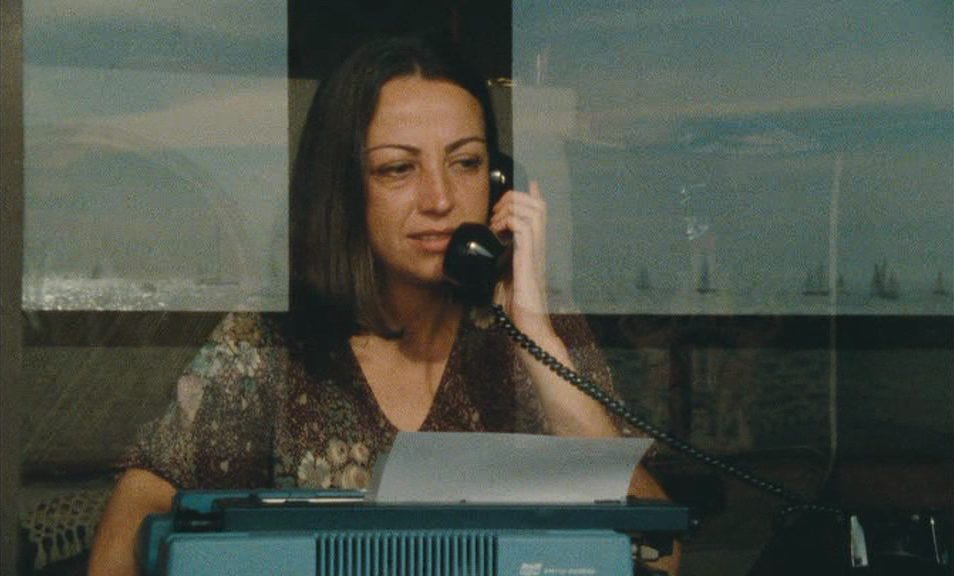
Film Forum had a great Agnes Varda retrospective, and I was happy to see her 1981 movie Documenteur, a blend of fact and fiction inspired by the aftermath of Varda’s separation from her husband Jacques Demy. (They eventually reconciled.) It’s set in Los Angeles, and the curator who gave a talk beforehand told us that Varda said she made sure to film only on days in which L.A. was overcast; the protagonist’s young son is also played by Varda and Demy’s real-life son. There was a line that stuck with me: standing somewhere in public, surrounded by men, the protagonist says she feels as though, post-divorce, she is an exile in a world of men.
The film was preceded by two well-known short documentaries of Varda’s, the charming Uncle Yanco and the thoughtful Black Panthers, both filmed in the Bay Area in the 1960s.
One Sings, the Other Doesn’t, directed by Agnes Varda
Women Reply
I was supposed to see this 1977 abortion-themed musical with a friend, but she unfortunately got sick and couldn’t make it. In the Film Forum lobby I instead bumped into Kate and a friend of hers who I had met at a previous reading of ours. Clearly, the Varda retrospective was the place to be! I had high hopes for this one but it turned out to not be my favorite of Varda’s work; I really disliked the hippie folk songs and I thought the character of Pauline / Pomme (“apple”) was a little annoying, as was the entire confusing way she went about divorcing her Iranian economist husband and abandoning their firstborn. I admired the character of Suzanne, though, both for her strength in the face of her first husband’s suicide and her drive to found a women’s clinic and distribute birth control to the women of southern France.
On the Beach at Night Alone, Hong Sang-soo
The last time I watched this movie, based on the real-life highly-publicized dissolution of an affair between lead actress Kim Min-hee and director Hong Sang-soo, was probably when it came out in 2017 or 2018. After seeing Documenteur, I wanted to see this one again—the films share a similar subject matter and approach to their characters’ internal struggles and monologues following the ends of their respective relationships. I generally shy away from talking that much about my personal life in this newsletter (it’s not that interesting), but towards the end of last year, I had a very serious relationship abruptly, unexpectedly end. Both of these movies are very good at portraying the dazed and distant headspace of a relationship’s aftermath, as their female protagonists move through their days in the blanks left behind by the men they loved. I highly recommend both.
Music
Edward Elgar, Violin Concerto; György Kurtág, Brefs messages; Robert Schumann, Symphony No. 1, Spring, performed by Vilde Frang and the New York Philharmonic a
The Kurtág was the best part of the night but way too brief. I’m not really a fan of Elgar (sorry) and the soloist, Vilde Frang, seemed pretty stressed, but I do have a weakness for a lot of the Romantic composers and thus I enjoyed the Schumann. Also, it was great to see a woman conductor (Mirga Gražinytė-Tyla)!
the wealth of nations, David Lang, performed by the New York Philharmonic
This was a very special evening. Way back in November on Black Friday, I bought some tickets for a couple different Philharmonic performances using a discount that was available to me, and I’m so glad I did because every seat at this performance looked to be sold out when I attended and I wouldn’t have had a chance for a last-minute rush ticket (which is usually how I attend the Philharmonic). This was the premiere of the American composer David Lang (co-founder of Bang on a Can and winner of the 2008 Pulitzer in Music)’s new choral work drawing on Adam Smith’s The Wealth of Nations (along with a variety of other texts dwelling on money, capitalism, and our relationship to labor, including Edith Wharton’s The House of Mirth, a speech from Eugene Debs, and Frederick Douglass’s The Accumulation of Wealth). Some editor at Bloomberg called it an opera in this headline but it’s not an opera. Rather, it’s an oratorio inspired by Handel’s Messiah, rather brilliantly replacing the idea of God as the subject with what is our god now in the twenty-first century: money.
The performance I saw wasn’t perfect—the mezzo-soprano’s tone could get a little shrieky in her upper register, and some parts, particularly the one drawing on the Wharton novel, dragged—but overall I found this to be a really powerful piece of music, and one I’ll be thinking of for a long time. There was something particularly moving to seeing it in New York, global capital of finance that it is, and in a physical space (Lincoln Center) so reliant on the donations and whims of the wealthy. Art has long been tied to the wealth of benefactors, and it increasingly feels as though the brief historical moment in which the middle and working classes had the access and purchasing power to engage with art, join in on the conversation, and create our own may be slipping away. I hope I’m wrong.
OTONOMA, Midori Hirano
I’m a fan of the Kyoto-born, Berlin-based composer and pianist Midori Hirano, and her newest album came out last month. One thing I really like about her work, which is present both on this album and in 2019’s Mirrors in Mirrors, is the way she includes the recorded sound of rain.
Sexistential, Robyn
She’s back! This is the pop album we need in 2026—self-reflective, a little bruised, but ultimately still hopeful about the possibilities of love, motherhood, and the dancefloor. But Robyn has always had a canny way of aligning with a particular mood and memory of the time. I’ll never forget the first time I heard Honey, shortly after the album’s release, at a friend’s Halloween party that she and her roommates had quickly dubbed Honey-ween in honor of the occasion. I was dressed up as a member of W.I.T.C.H., the Witches International Terrorist Conspiracy from Hell, that short-lived radical feminist group co-founded by Robin Morgan that famously cast a hex on Wall Street in 1968. We were all very young and optimistic, we drank too much, and we danced to the entirety of Honey on repeat. It was 2018.
Performing arts
The Waves, choreographed by Noé Soulier
One of my New Year’s resolutions was to see more live dance and theater performances (especially dance, which I find myself growing increasingly fascinated by the older I get, and which I have zero background in). I went a little crazy getting nosebleed tickets for some pieces I wanted to see in March, but it was worth it. For two nights only, the Joyce hosted this new work by the French choreographer Noé Soulier inspired by Virginia Woolf’s The Waves, and as a devoted Woolf fan, I had to see it. I found it to be a successful translation of the spirit of the novel.
Romeo and Juliet Suite, choreographed by Benjamin Millepied
If you, like me, are into figure skating, you’ve heard Prokofiev’s Romeo and Juliet a million times over the years and are sick of it (this wiki has a good compendium of all the times it’s been used for figure skating programs in the last decade alone). And yet, at the Park Avenue Armory in March, French choreographer Benjamin Millepied did the impossible: he made the music of this ballet sound fresh again. It was the presence of the video screen and the live-filmed elements that did it for me; I loved the way the dancers would run out of the main auditorium and take advantage of all of the Armory’s dark and winding corridors. But not everyone who saw it agreed: friend of the newsletter Rebecca Deczynski (who, unlike me, actually understands ballet technique) had a thoughtful review up at Fjord about what she considered to be the failings of the piece.
The Firebird, choreographed by Alexei Ratmansky, and Raymonda: Grand Pas Hongrois, choreographed by Marius Petipa
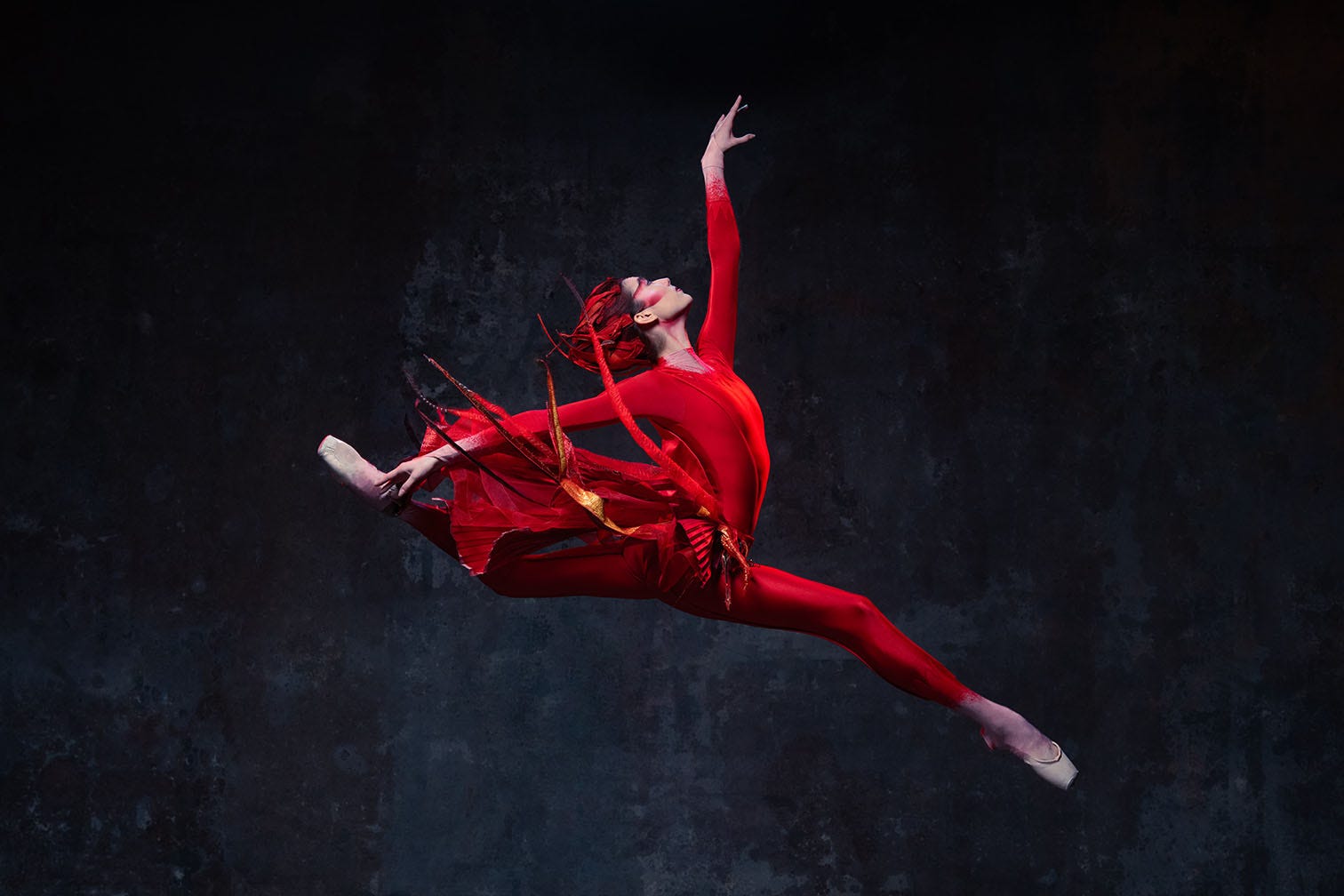
The first ballet I ever saw—around age eight, with a schoolfriend and her mother—was The Firebird, and I still remember just how alive that performance and Stravinsky’s music made me feel. I know essentially nothing about ballet, and this was my first time seeing an ABT performance. This version of The Firebird is a newer choreography created a little over a decade ago, and there was a helter-skelter wackiness to it—particularly in all those flexed feet from the green-hued captured princesses—that I thought worked particularly well to underscore the fairy tale strangeness of the plot. On the night I saw it, principal dancer Chloe Misseldine played the titular role—her limbs are so long! Apparently 2026 is Firebird season in New York; later this month, NYC Ballet will be performing Balanchine’s choreography, and the Dance Theatre of Harlem will be performing John Taras’ choreography, which re-imagines the Russian folk tale in the Caribbean.
Preceding The Firebird this evening was a ballet that first appeared in the nineteenth century, Raymonda: Grand Pas Hongrois, which I hated. It was way too frilly and classical for me, though I did like how the lead female dancer, Hee Seo, had this diva hauteur going on in certain parts of it, as well as this sort of watery quality to the way her feet moved across the stage. That was something else that I hadn’t expected about seeing ballet live: just how loud the toe shoes can sound when a dancer lands from a jump. I loved that—it was an aural reminder of just how physical this artform really is.
MOON, the Mark Morris Dance Group
Reader, I must confess: I didn’t care for this. I had always been curious to see a work by Mark Morris, but this felt like an instant in which some of an artist’s trademarks have become so successful that they emerge almost as quotations of themselves, and so familiar as to lose their freshness. The winking humor, androgyny, and use of twentieth-century American popular music (in this case all themed around the moon) felt so eighties to me in a way that struck me as a little stale (and yet, I also could recognize that if I had been alive in that era, I probably would have responded to this more positively). It raises an interesting question, and one that I was thinking about on the subway home: at what point should or should not an artist rebel against their established style?
No posts
Comments
Nothing yet. Say the first thing.
Sign in to join the conversation.