
With the end of April came an additional ending: I finished, on the last day of the month, another draft—final?—of the new novel I’ve been working on the last two years, called I Stayed in New York All Summer, and sent it to my agent. I’ll share the first three paragraphs, part of a section I’ve read before at a reading here in New York:
“I stayed in New York all summer. I don’t know why I never left. There were no extenuating circumstances. Friends visited me and I visited friends. Instead of a vacation, I took some phone calls. Instead of a train ticket, I bought a dress. I lost track of how many times each political party debated. When visiting the apartment of an old lover, I told myself I would not undress. College friends prepared to be bridesmaids. A childhood acquaintance announced her impending divorce. Four times I told myself I’d buy a vacuum, and four times each I forgot. The taste of sweat, its exact character. Governments changed. People died. Obituaries were written. Each calendar day moved forward fitfully, acquiring, inside that dense and sulphureous heat, a heightened quality, a petroleum gleam, as though smeared with the treacly veneer of fiction. All sense of reality began to melt. In Prospect Park, Sophie turned her head towards me, her pale legs bare against the grass. ‘Ich denke an dich,’ I thought she said, I swore she said, the memory spools forward like a film reel: I’m thinking of you. ‘Ich denke, dass ich 32 bin, und dass ich gerne jemand anderen lieben würde.’
But no, that wasn’t Sophie, it wasn’t Sophie who said that to me at all—the memory breaks, divides, splinters off into disintegrating slivers—was it me who said it? No. I heard those words in a movie, I watched those words be spoken by a woman in a film. Sitting in the leftmost seat in the middle row at Lincoln Center a few weeks after the summer’s beginning, tears forming hot and unexpected in the corners of my eyes. I was crying. Why was I crying? That was the year that I was always crying, especially whenever a piece of art struck me as particularly moving. In a museum. At an author’s reading. Sitting in the cinema. Those months.
The previous winter. Another love affair ended; they were always ending for me. It was winter in the film, too. Voice tremulous, the woman onscreen read a line from a letter that she had left behind upon leaving Berlin, a letter that in the movie she’s postmarked to a woman and her lover, a man who it turns out is the first woman’s lover, too—it’s messy, it’s complicated, it’s a love triangle—I watched the woman onscreen speak, she was dark-haired and a chain smoker. These two qualities appeared often in this particular director’s films; I had watched all of them. Opening her mouth to speak—and the image once again split, shifted, the mood of it didn’t match the words onscreen, the real life paired outside of it— I’m thinking of you, read the subtitles. I’m thinking that I’m 32, and that I would like to love someone else.”
The book is about a woman who confuses real life for fiction, a novel or a movie, while she stays at home in New York during the summer, and that’s all I’ll say for now, because I’m feeling a little superstitious (this is not my first time at the sending-novel-out-to-editors rodeo)! On to some reviews in miniature of everything else I spent my time with in April.
Books
1. Seven, Joanna Kavenna
Coming out from Faber in the U.S. in July (it’s already been published in the U.K.), this is a delightful, witty novel based around a philosophy graduate student’s wild goose chase across Europe concerning a board game called Seven (invented by Kavenna). If you’re into chess or word games, you’ll like this novel. Certain moments made me laugh out loud, and I also really want to play a game of Seven, now, damn it! (And lose thoroughly, I’m awful at board games and terrible at chess; I have no patience. It’s more the spirit that I appreciate.)
2. Strangers: A Memoir of Marriage, Belle Burden
The viral divorce memoir du jour. I couldn’t put it down and read it in one afternoon; if nothing else, it’s a sobering reminder of how closely a woman’s sense of agency is tied to her economic freedom. If this level of emotional and financial abuse—because that’s what Burden’s ex-husband is doing in this book, this is an abusive relationship that is being described—can happen to a woman like Burden (a literal descendent of the Vanderbilts), then what about women who don’t have the resources (and trust fund!) that she did? As I read this, I thought darkly of all the trad wife / stay-at-home girlfriend content the algorithms are rewarding these days.
3. Where Did You Sleep Last Night?, Danzy Senna
After seeing Senna read at Sarah Schulman’s First Monday reading and realizing I had only read her first book, the novel Caucasia, I read three more of her works. This is a memoir about her parents’ marriage—her mother, the poet Fanny Howe, was white, and a descendent of Boston blue bloods; her father, the writer and editor Carl Senna, was black, and raised in poverty and partly in an orphanage in the South—and painful divorce. Halfway through, it borrows from that classic American genre, the road trip novel, as Senna and her father travel to Louisiana and attempt to find out who exactly his father, Senna’s grandfather, was. It’s really, really good.
4. Renoir’s Dancer: The Secret Life of Suzanne Valadon, Catherine Hewitt
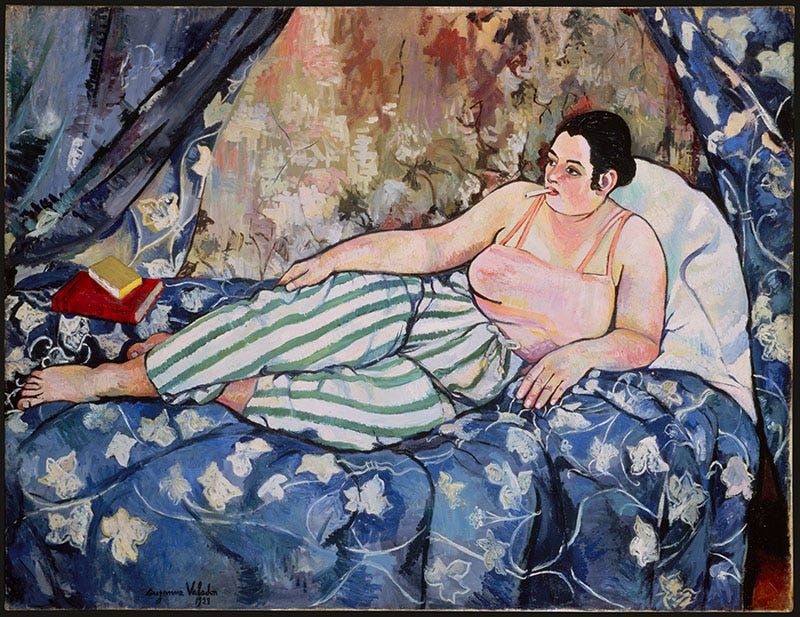
I hate the title of this book, but from a marketing perspective, I understand why it was chosen. Though Suzanne Valadon was the first woman painter to be admitted to France’s Société Nationale des Beaux-Arts, the general public is still probably going to be more familiar with some of the artists she posed for as an artist’s model—Renoir, Toulouse-Lautrec—before she made a name for herself and her own paintings in the world of post-Impressionist Parisian artist circles. But people should know her work, because it’s wonderful (and if you’ve seen any of her paintings, it’s probably The Blue Room, from 1923). I picked this biography up after a few oblique references to Valadon came up in an excellent biography of Erik Satie I read in March (they had a brief, intense love affair, and many unsent letters to Valadon were found in Satie’s room after his death—devastating). Outside of the title, I enjoyed this biography; it was straightforward, and did what it set out to accomplish. I also enjoyed the glimpses into fin de siècle Paris that Hewitt gives, a historical period I’ve always found fascinating, as well as her reconstruction of Valadon’s working-class background and childhood.
5. Colored Television, Danzy Senna
6. Symptomatic, Danzy Senna
After reading Where Did You Sleep Last Night?, I thought I’d read some more of Senna’s fiction. Colored Television is her latest novel, and it’s extremely funny and quite dark—it’s a sharp, parodic look at literature versus television in the U.S., race, and more. It’s definitely a stronger book than Symptomatic, Senna’s second novel, which begins strong but descends into some women best friend stalker cliches by the end. I was glad, though, to read these two back-to-back, because sometimes when you read a few of an author’s books in quick succession you notice certain themes or repetitions you otherwise might not have. For instance: the artist husband in Colored Television completes a series of paintings that have little sketches of a demonic little cartoon figure peering from their top corners—and similarly, an artist boyfriend character in Symptomatic has the same figure in the same place in his paintings. I found this delightful.
7. The Dry Year: A Memoir of Pleasure in a Year Without Sex, Melissa Febos
I’m not sure why I read so many memoirs in April! This was a recommendation from a friend whose taste I generally trust, but I unfortunately didn’t much care for this book, which chronicles the year Febos spent celibate following a breakup. The subject matter intrigued me— I once wrote an essay about female hermits and the gender politics of solitude—but I thought some of the conclusions the book reached about individuality, human relationships, and self-contentment were a bit trite. I do think, though, that it must be difficult to write a memoir that exposes yourself, warts and all, and I admired the sense of fearlessness with which Febos portrays some of her own behaviors in her relationships with women and men, because she sometimes comes across as kind of a nightmare in this.
8. A Woman, Sibilla Aleramo (translated by Simon Carnell and Erica Segre)
My friend Margarita gave this to me when I visited her in D.C. last fall. It’s an autobiographical novel by the Italian feminist writer Sibilla Aleramo, detailing the narrator’s childhood in early twentieth century Italy, and her suffocating marriage following a rape she experiences at fifteen. Eventually, following a suicide attempt, she leaves behind her husband and son, and realizes that her childhood worship of her father and disrespect towards her mother was foolish, and left her unprepared to imagine her own future as a wife and mother. Later, she becomes a writer. I thought the book was excellent, and it was also fascinating to read a work that is truly all telling, almost zero showing; I don’t think quotation marks and conversations even appear until three-quarters of the way through. In real life, Aleramo also left her son when he was six, and was unable to reunite with him due to Italian marriage and custody laws until many years had passed.
Reading-wise, I went to the aforementioned First Monday reading series. I also attended the—very fun!—release party for Jonathan Woollen’s translation of Ann Scott’s novel Superstars (you can read an interview I did with Jonathan about the translation process in this newsletter), as well as the launch for Gwendoline Riley’s latest novel, The Palm House (a book I touched on briefly in the January edition of this newsletter).
Film
Agnès de ci de là Varda, episodes 1—5, Agnes Varda
Varda by Agnès
One Hundred and One Nights
Les dites cariatides
Murs Murs
After seeing a few earlier movies at the Film Forum Varda retrospective in March, I watched a couple of her later films available on Criterion over the course of April. Most of them were documentaries, and I especially enjoyed the Agnès de ci de là Varda series she filmed later in her life, in which she travels around and interacts with the early 2000s art world. Murs Murs, her 1981 documentary about the murals of Los Angeles, was also extremely interesting. At a certain point, I just wanted to hear Varda’s wry narration and voice, I found it very soothing.
The Christophers, directed by Steven Soderbergh
Soderbergh’s films can occasionally veer chilly, but I found this latest from him—featuring Ian McKellen as a vaguely Lucian Freud-esque painter named Julian Sklar and Michaela Coel as the artist that Sklar’s good-for-nothing adult children have hired to forge and finish his untitled series from the early 1990s called The Christophers—to be really quite warm and, dare I say, heartwarming! It also includes many funny lines about the art world, and I enjoyed that Coel seems to be completely decked out in clothing from TOAST, a brand which I admire from afar. Coel’s performance, also, is fantastic; she easily holds her own against McKellen.
Music
La voix humaine, performed and conducted by Barbara Hannigan with the New York Philharmonic
What an absolute treat this was—I think it’s probably the best live musical performance I’ve seen in 2026. Based on a Jean Cocteau play I’d been curious about for years, this opera by Poulenc—one of Les six, a group of composers I’m aware of mostly through their associations with and admiration for Erik Satie—portrays a woman on one side of a telephone call; at the other end of the line, we gather, is her lover, who is in the process of breaking up with her via the phone. The way this play and opera are both constructed around this piece of technology fascinates me.
I wasn’t sure what it would be like to see Hannigan simultaneously conduct and perform, but I thought it was pretty phenomenal and frankly the subject matter leant itself well to this. The character is a woman who is very much fraying at the edges—she’s being left by the man she loves, it’s been a multi-year affair, she’s taking too many sleeping pills—and she is clearly, wildly, trying to grasp at any sense of control that she can. Live video recordings of Hannigan by the video artist Clemens Malinowski accompanied the performance, which also, in this age of video calls, felt like an inspired choice.
“I Feel So Free,” Madonna
Yes, yes, yes!!!!! Madonna is 67 years old and is coming out with a sequel to one of her most beloved albums, 2005’s Confessions on a Dance Floor, which is the album that really made a fourteen-year-old me sit up and start paying attention. If anyone can pull off a sequel to an album that includes one of the smartest pop songs of all time, “Hung Up” (I’ll never get over the combination of that memento mori ticking of the clock that makes the beat, the ABBA sample, the telephone noises, this fusion of past and present and eternity), it’s Madonna. (And yes, Stuart Price is producing!) So far, this first song feels like a spiritual successor to “Future Lovers”—both sample Donna Summer, and there are a few places in “I Feel So Free” that I actually wondered if the live version of “Future Lovers” from the Confessions tour was being sampled, too. (If you’ve never seen a Madonna performance, you must watch this one. Seeing this as a teenager changed something in me, I swear; I love the horses and the x-rays from when she broke her bones horseback riding in England and the haughty lady of the manor vibe, along with the giant disco ball, the S&M outfits, all of the purple, the “I Feel Love” interpolation, and how good her hair looks here.)
My roommate has taken to joking that, whenever I spout off a particularly intense stream of Madonna facts and analysis, I should start an anonymous stan Twitter account with the name @Godonna69. This is a @Godonna69 moment ahead: What I think is going to be the key to Confessions II is that, like the first, it is inspired by and places Madonna in a particular dance music context. It’s not a direct sequel. Confessions on a Dance Floor is inspired by the seventies, disco, and Studio 54; Confessions II seems to be hearkening back to late eighties and early nineties house music, a moment that Madonna was very much inspired by and going out clubbing in herself (listen, for instance, to her song “Rescue Me” from 1990). “I Feel So Free” in fact samples the 1989 Chicago house track “French Kiss” by Lil Louis. I can’t wait for July 3rd, when the album drops. I will be dancing. (I also like the second song that’s been released from the album, the anti-social media anthem “Bring Your Love” featuring the Gen Z pop star of the moment Sabrina Carpenter, but it’s definitely very pop, while “I Feel So Free” is clearly for the club and for the fans.)
Performing arts
Johnny Loves Johann, featuring Johnny Gandelsman on violin, and choreographers John Heginbotham, Caili Quan, Jamar Roberts, and Melissa Toogood at the Joyce Theater
A friend invited me to see this with her when she had comp tickets, and I must say it was not my favorite dance performance I’ve seen this year. It ran a little too self-indulgently long, and while I thought the idea of transposing Bach’s cello suites to violin was interesting, I didn’t love the execution. There were also too many props—did we really need that jokey bit with the artist’s easel and the portrait of Bach? My favorite of the four sections was the one choreographed by Jamar Roberts, and I found both him and Melissa Toogood to be fascinating dancers to watch.
Hamlet, performed by the National Theatre at BAM
It’s been a few years since I saw a performance of Hamlet, and I had high hopes for this version from the U.K.’s National Theatre, directed by Robert Hastie and featuring Hiran Abeysekera as Hamlet. Unfortunately, it was terrible. Hastie seems determined to prove that Hamlet can be relevant for a contemporary audience, rather than just letting the play breathe and indeed, be relevant, because Hamlet always will be. I didn’t like the clownish, childish way Abeysekera portrayed Hamlet, and I didn’t like how he and Ophelia, played by Francesca Mills, were constantly shouting their lines. Others seem to agree; it’s gotten a string of bad reviews.
Visual arts
Marcel Duchamp at the Museum of Modern Art
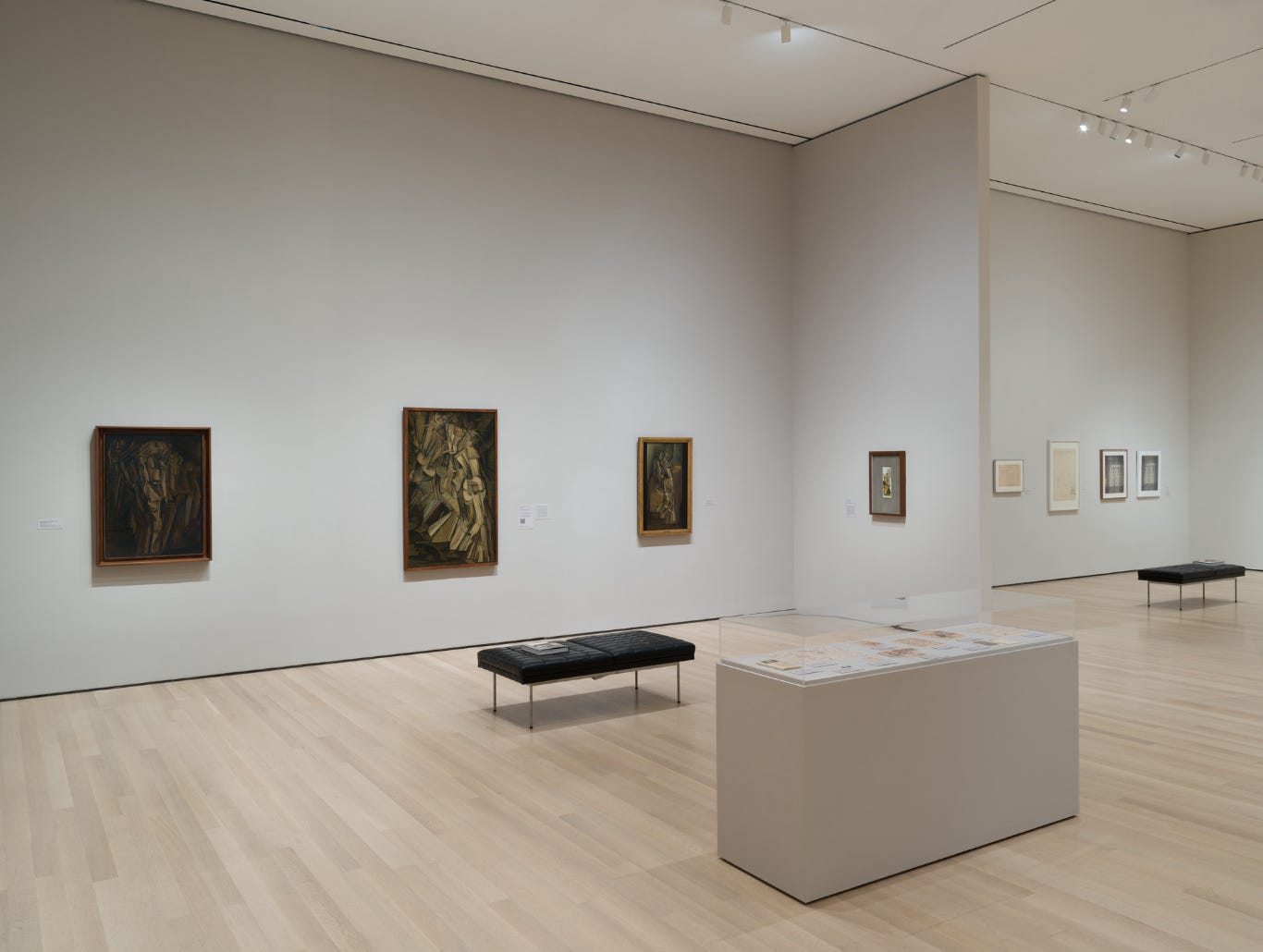
A wide-ranging retrospective of the peculiar, thought-provoking oeuvre and legacy of Marcel Duchamp. All the big hits are here, including his radical, perspective-shifting Nude Descending a Staircase, No. 2, his chess sets, and, yes, the recreations of the infamous Fountain. I love Duchamp’s work, so I loved this; if you have a lower tolerance for his kind of tricks and games, you might find this less interesting. It’s open through August 22.
No posts
Comments
Nothing yet. Say the first thing.
Sign in to join the conversation.