
A nice thing happened towards the end of May: I successfully held a crow pose in my yoga class, and I’m feeling pretty proud of that. I’ve dabbled in yoga over the years, but I started going to a new studio near my apartment in January and have been getting pretty serious about it. Yes, it’s a bit of a cliché that physical movement can help quiet the mind, but there’s a real truth to it.
Another nice thing will be occurring in June, and that’s another edition of the Wish You Were Here reading series that Kate Peters and I co-curate at Bar Jade in Bushwick. This will be an all-stars edition featuring some previous readers—Jonathan Woollen, Ash Pattison-Scott, Robert Rubsam, Margaret Wright, Alex Wolfe, and Noor Qasim—and will occur at 7 p.m. on Tuesday, June 16th. More details + RSVP on Partiful here. We hope to see you there!
Books
1. Will and Attention, Meaghan O’Gieblyn
I’m a huge fan of Meghan O’Gieblyn’s 2021 book God, Human, Animal, Machine: Technology, Metaphor, and the Search for Meaning, the bibliography of which really helped me in my background research when writing my novel The Table-rappers, told from the point of view of a computer scientist in 2014 Boston. Her new memoir, Will and Attention, is forthcoming in October, and is a philosophical interrogation of her relapse into alcoholism during the pandemic, her quickly-abandoned flirtations with Catholicism, and the idea of the will as seen in the work of the French philosopher Simone Weil. Really fantastic, one of my favorite reads of 2026 so far.
2. Zoo, or Letters Not About Love, Viktor Shklovsky (translated by Richard Shelden)
I’d been meaning to read this for years, and finally did so. It’s wonderful. Originally published in 1923, it’s an epistolary novel written during and based around the literary critic and writer Shklovsky’s years of exile in Berlin, composed of a series of letters he sent the writer and translator Elsa Triolet (and a few of her letters, too). The theme of the letters is anything that’s not about love, due to Triolet banning the subject; of course, because Shklovsky was indeed in love with her, every sentence and every paragraph is seeped with unrequited emotion.
3. The Encyclopedia of the Dead, Danilo Kiš (translated by Mark Thompson)
A rather famous short story collection by the Yugoslav writer Danilo Kiš beloved and championed in the U.S. by Susan Sontag. I enjoyed it, particularly the title story, which depicts a scholar in the national library of Sweden who reads through an encyclopedia featuring every individual who has lived since the eighteenth century and becomes fixated with her father’s entry. It’s an interesting experience to read postmodern fiction from the last century, because while it’s still exciting in many ways, there are also an equal number of aspects of this style—the strong interest in the materiality of books, say—that have become tropes in their own sense at this point.
4. First Love, Ivan Turgenev (translated by Isaiah Berlin)
On a whim, I bought this at Greenlight Books when I had time to kill before seeing the movie Silent Friend at BAM (more on that below). This is the first book by Turgenev that I’ve read, and it’s perfect. There is a comfort to be found in literature that dips in and out of a relatively long span of time, like the memory of the narrator’s past and his first love that makes up most of this short novel, if only to remind myself as a reader and as a person in this hurried era that life is long and has many seasons and arcs. And also, too, to be reminded that there is no such thing as a “happy ending,” and that novels, paradoxically, offer a much more realistic approach towards the ambiguities of love and life than the tidy opinions found on the internet. The end of this novella, when the affair between Zinaida and Vladimir’s father is discovered by Vladimir, is devastating. (Sorry for the spoiler, but the book was published in 1860.)
5. A Very Cold Winter, Fausta Cialente (translated by Julia Nelsen)
I love everything Transit Books publishes. One of my Christmas gifts to my sister last year was the press’s monthly book club, which includes invitations to Transit Books-related events in the Bay Area, as well as titles from the press such as this feminist Italian postwar novel depicting a family in Milan immediately after World War II. Fans of Natalia Ginzburg, pick this up!
6. The Telephone: A New History, James Gleick
This history of the telephone and audio technology is coming out from FSG in November, and I really enjoyed it. I’m fascinated by how technology shapes our lives, and I in particular found the section about telephone operators in this to be intriguing when it comes to questions of gender (telephone operators were, for the most part, women). Gleick quotes Proust at one point, comparing telephone operators to the Three Fates, weaving, which I loved. A few years ago, I wrote an essay for The Baffler thinking about the telegraphist at the center of Henry James’s novella In the Cage and comparing it to my own experiences working as a social media manager, the contemporary equivalent. I’m still fond of the first paragraph of that piece:
“My business was boredom. For years, I was the person whose job it was to keep you clicking, to keep you scrolling. To keep you grimly entertained. Forgive me—the concepts of ‘amusement’ and ‘information’ have never been so porous, the line dividing ‘news’ from ‘diversion’ has never before worn so thin. What I needed from you was time, your time, now understood to be a commodity. Somehow, through the alchemy of AdSense, this was supposed to turn into money. In the so-called attention economy, even the most cloistered institutions were aghast to find themselves now begging for spare change.”
7. The World of Yesterday, Stefan Zweig (translated by Anthea Bell)
Stefan Zweig’s famous memoir of pre-war Europe. This is actually the first book by Zweig I’ve read, I think, and I found it difficult to put down. One aspect of it that I appreciated was just how ferociously he tears into the social and sexual mores of pre-World War One, when he makes it extremely clear that the curtailing of female sexual expression, paired with limited economic opportunities for women, created a poisonous degree of neuroses between the sexes.
“Today,” writes Zweig in the nineteen-forties, “when I see young people coming out of their schools and colleges with heads held high, with bright, cheerful faces, when I see boys and girls together in free and easy companionship, competing with each other in studies, sport or games without false shame or bashfulness…I always feel as if not forty but a thousand years lay between them and those of us who had to look for any experiences of giving and taking love in a hole-and-corner way in the shadows. I see genuinely happy expressions on their faces. What a great revolution in morality has taken place to the benefit of the young; how much freedom in life and love they have regained, and how much better they thrive both physically and mentally on this healthy new freedom!” It’s a refreshing observation to read in comparison to so many of the gender war anxieties one encounters in media and in online conversations these days, where there seems to be a persistent belief that a return to the tight societal control of female sexuality under the guise of morality is somehow the correct approach to solving all our lovelorn woes.
Film
Bernstein’s Wall, directed by Douglas Tirola
This documentary of the conductor and composer Leonard Bernstein, as seen in the context of his political viewpoints and the greater politics of the twentieth century, was fine. I saw it at Film Forum.
Silent Friend, directed by Ildikó Enyedi
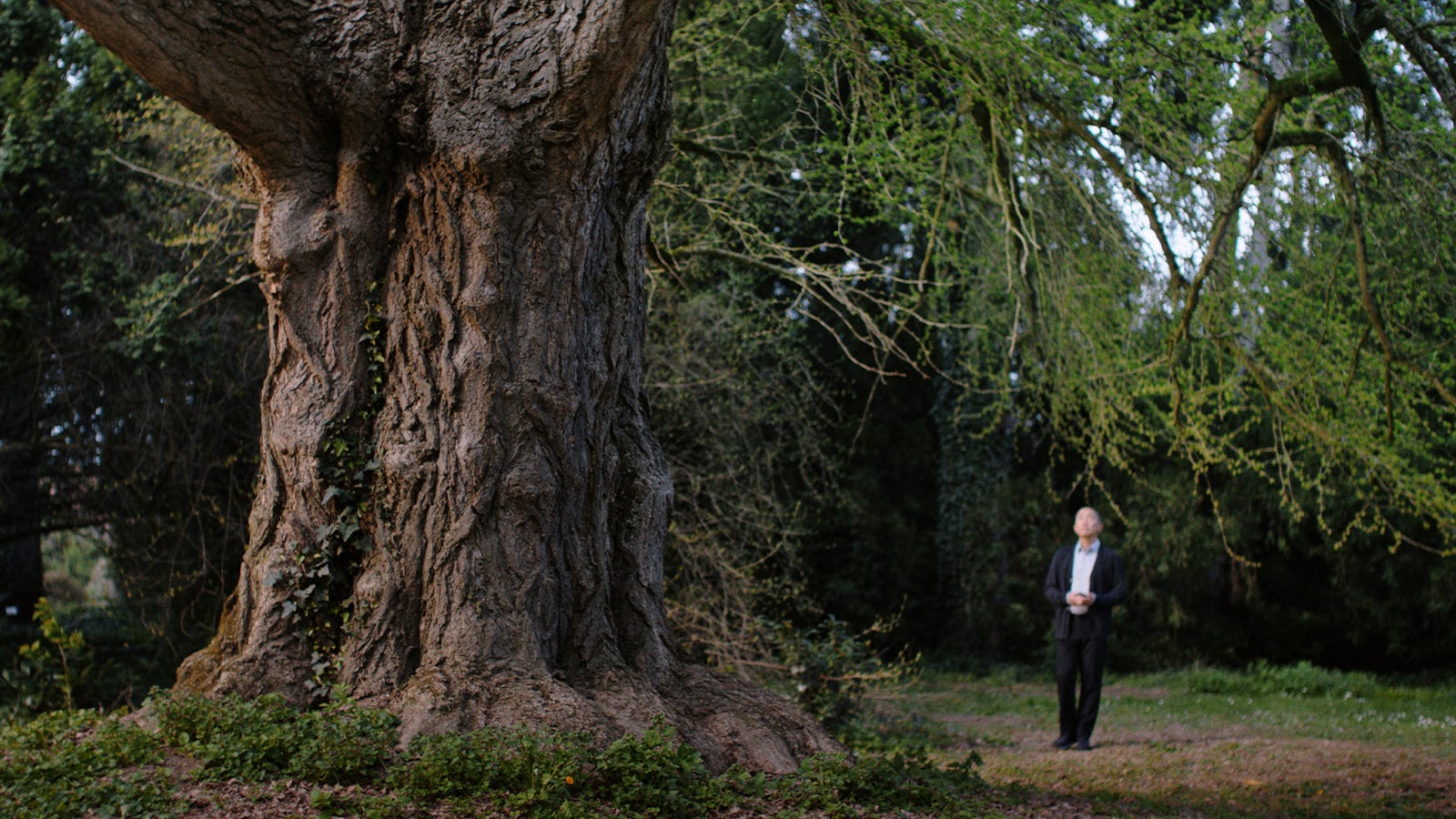
A puzzling film about the intersections of time and the possibility of plant consciousness. Elements I enjoyed: the way each section was filmed on a different type of camera or in a different style depending on the storyline and its era (digital for the contemporary; the intensely saturated colors of Super 8 film for the 1970s; black and white for 1908); Tony Leung’s performance as a neurologist stuck at a German university during the height of the pandemic. I was a little confused by the end, though, and the interweaving of these storylines all tangentially connected to this particular gingko tree on the university campus. I’m not quite as enthralled by this film as a lot of the reviews I’ve read about it seem to be.
Music
Does Spring Hide Its Joy?, Kali Malone with Lucy Railton and Stephen O’Malley at Pioneer Works with Walt McClements
I don’t meditate, but I experienced something akin to what I assume are the pleasures and aims of meditation during this concert of the first of May, held as part of Bang on a Can’s annual Long Play festival (sadly, I missed some of the other fantastic-sounding offerings this year, including a celebration of Steve Reich’s work performed by So Percussion—who I saw last spring at BAM—as well as a new arrangement of Philip Glass’s Glassworks). Standing in the middle of the room with my eyes closed, listening to the electronic sounds and cello combine, I slipped outside of myself, and time, too, seemed to slip away entirely. When I opened my eyes, an hour, somehow, had passed, and then the concert was over. Standing outside of Pioneer Works, I then happily and unexpectedly bumped into Brittany.
Reflections Vol. 3: Water Poems, Félicia Atkinson and Christina Vantzou
Extremely satisfying to listen to on the subway, especially after teaching, when I feel overwhelmed by other people. I like the work of the French musician and artist Félicia Atkinson quite a bit, and the recorded whispers on this record from her and the American composer Christina Vantzou flicker in and out of the microphones like lights turned rapidly on and off. I hadn’t realized until reading the notes on their record label’s website just now that the first track on the record, “Film Still / The Sea,” incorporates field recordings from Delphi, near where the oracle of Pythia would have once intoned her prophecies. I was reading a lot about the oracle, and other seers of the ancient world, last October; another unexpected little synchrocity, after a May filled with them. Anyway, I’m a little sad I missed the performance of this during the Long Play festival, but ah well.
Performing arts
The Maids, written by Jean Genet and directed and adapted by Kip Williams
At first, I was quite taken with the chaotic use of screens and digital interfacing in this adaptation of Jean Genet’s 1947 play The Maids, in which two sisters, Solange and Claire, working as housemaids for the spoiled, wealthy Madame conspire to murder their employer. By the end, though, I was exhausted by the use of phones in this updated version, directed and adapted by Kip Williams (whose The Picture of Dorian Gray was making such a splash last year), and agreed with this excellent review from Helen Shaw at the New York Times.
Graham 2 spring program at the Martha Graham Studio Theater
I attended this with a friend who explained to me that Graham 2 is like the junior company of the Martha Graham Dance Company, drawing on the best students from the Graham School. It was great to see their interpretations of some of Graham’s most famous pieces, such as her 1944 ballet with Aaron Copeland, Appalachian Spring. A fun fact about Martha Graham which relates to another of my obsessions: Did you know that Madonna was a student of Martha Graham’s upon first moving to New York, years before her pop stardom? Graham gave Madonna the nickname “Madame X,” apparently, which many years later became the title of a late career Madonna album.
Figure skating is a sport, yes, but when it’s Stars on Ice, it tips pretty heavily into entertainment. I went with a friend and her two-year-old daughter, and it was a lot of fun. I especially appreciated getting to see Jason Brown, who’s always embodied the artistic side of skating that I prefer to the endless, boring flips and quad jumps of skaters like Ilia Malinin. (I highly recommend watching Jason Brown’s famous Riverdance free skate from the 2014 Olympics in Sochi. That step sequence is divine!)
No posts
Comments
Nothing yet. Say the first thing.
Sign in to join the conversation.