
I have been noticing how many of us are being asked to change form before we have finished making sense of who we have become.
Professions are shifting. Institutions are rearranging themselves. Technologies keep moving the edges of what we thought belonged to a particular role. The architect becomes strategist. The strategist becomes facilitator. The leader becomes listener. The expert discovers that expertise alone is no longer enough.
There is freedom in this.
There is also unease.
When a familiar form begins to loosen, it can feel less like adaptation and more like disappearance.
For a time, I walked to work across Charles Street Weir in Parramatta. The river below carried whatever the previous weather had given it. Leaves. Foam. Fallen branches. Brown water moving through the city without much concern for the names humans had given the things around it.
Some mornings I would find myself thinking about the names I had accumulated.
Architect. Urban designer. Futurist. Poet.
Useful words. Temporary forms.
The river did not ask me which one I was.
Later that morning, I might be standing inside Parramatta Civic Gallery with a room of senior professionals looking towards me. Sharp minds. Experienced people. The sort of room where expertise can easily meet expertise and spend the next few hours defending itself.
I knew what I wanted to ask them to do.
Close their eyes.
Imagine the future of the Parramatta River.
My heart pounded before I said it. I could feel the risk physically. If I pushed too hard, the exercise would become theatre. If I retreated into professional explanation, nothing much would change.
So I breathed.
Then I stopped trying to be impressive.
Between each sentence, I left space.
Gradually, my role altered. I was no longer there primarily as architect, futurist, facilitator or expert. I was holding enough structure for other people to enter their own imagination.
When they opened their eyes, the room felt different. Pens moved across paper. Faces softened. Ideas arrived without being dragged into existence.
The experience stayed with me because I had not abandoned anything I knew.
I had simply stopped insisting that what I knew had to arrive in one particular shape.
A role can protect us.
It tells us how to enter the room, what language to use and what kind of contribution is expected. Sometimes we need that structure. I certainly have.
But a role can slowly harden into armour.
Then adaptation becomes threatening because every change in context seems to question who we are.
I see this tension in leadership now. People are being asked to operate across disciplines, cultures, technologies and forms of knowledge that do not fit neatly inside the identities that made them successful.
The temptation is either to become more rigid or to become endlessly accommodating.
Neither feels particularly alive.
Rigidity protects the form at the expense of relationship. Endless accommodation can dissolve the centre altogether.
There is another possibility.
Indian classical music offers an image I love.
A rāga provides a recognisable melodic character while leaving considerable space for improvisation. The musician does not mechanically reproduce a fixed composition. Nor do they wander anywhere they please.
There is freedom inside fidelity.
The form changes while something recognisable remains.
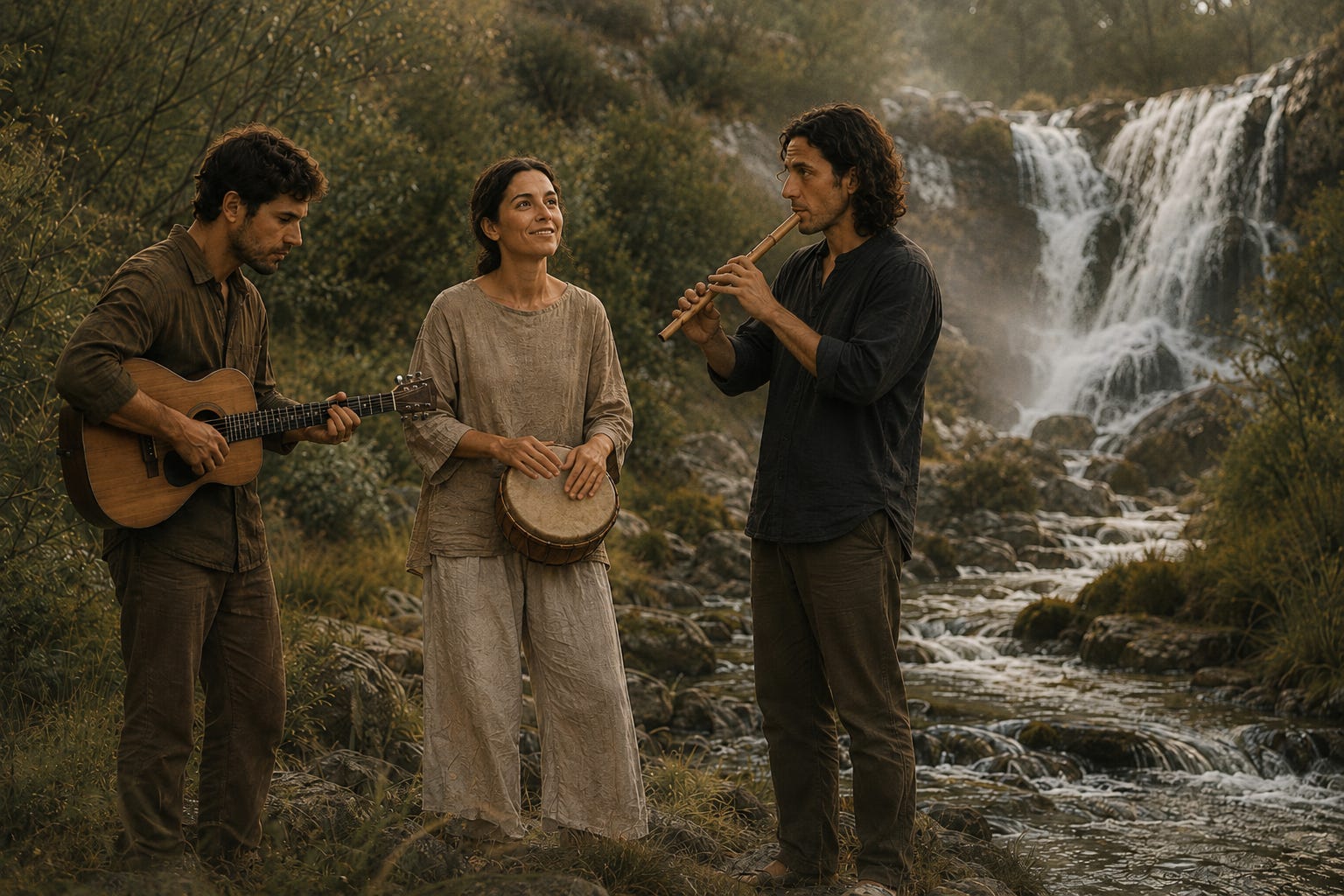
Physics gives us another image through resonance. Strike a tuning fork beside another tuned to the same frequency and the second may begin to vibrate without being touched. It does not become the first fork. It answers according to its own structure.
That matters to me.
Resonance does not require sameness.
Perhaps adaptive capacity is less about becoming endlessly flexible and more about becoming available. Available to the person in front of us. Available to what the place is asking. Available to another vocabulary, another pace, another way of contributing.
Chimamanda Ngozi Adichie has moved through fiction, speech, essay, public commentary and popular culture without becoming identified to any of those forms. The medium changes. Her concerns remain recognisable.
Dignity. Gender. Memory. Power. The right to name one’s own life.
The melody travels.
Over the years, I have found myself reaching for an identity larger than architect, futurist or poet.
Earthling comes closest.
Even that is a form.
Perhaps the deeper work is learning to hold identity strongly enough to act, and lightly enough to let life revise it.
I wrote the following poem in Personal Shifts. Reading it again beside this law, I hear something I probably understood in poetry before I could explain it in prose.
Perhaps it feels something like this.
Poem 48.0 Somebody in Between
From the void, wisdom tells me, I am nothing.
Formless teardrops, pure potential to create.
From the heart, love tells me, I am everything.
Infinite tear drops, in an ocean cognate.
From life, truth tells me, I am dancing something.
Selves in quantum imposition – fluxing fate.
Nothing, everything, something – who am I now?
Nobody. Everybody, Somebody…Dao.
Regenerative power and leadership asks something difficult of us here.
To remain coherent without becoming fixed.
To enter different rooms without performing a different self in each one.
To let expertise become listening when listening is needed. To let conviction become curiosity. To let leadership sometimes become accompaniment.
The centre is not a job title.
It may be closer to the pattern of values, loves and commitments we keep returning to as our forms change around them.
I still do not think this makes identity simple. Perhaps it makes it more interesting.
Somewhere between nobody, everybody and somebody, we keep becoming.
And perhaps the deeper measure of adaptive capacity is whether, through all those changes of key, we can still recognise the melody.
If you prefer to listen, this week’s 3-minute video explores final law 48 — Become Formless and Resonate.
I have completed four rounds of book editing. This law is part of the Adaptive Capacity cluster within Regenerative Power.
Next week I have no idea what I will share. Perhaps some behind the scenes and mindmaps showing how the emergent laws are clustered in seven themes.
Thanks for your attentive spirit and for reading Poetic Designs! If this field note resonates with you, please do me a favour and share it with your comment.
Comments
Nothing yet. Say the first thing.
Sign in to join the conversation.