
Summer light was coming through my study window. Outside, the frangipani was in full bloom.
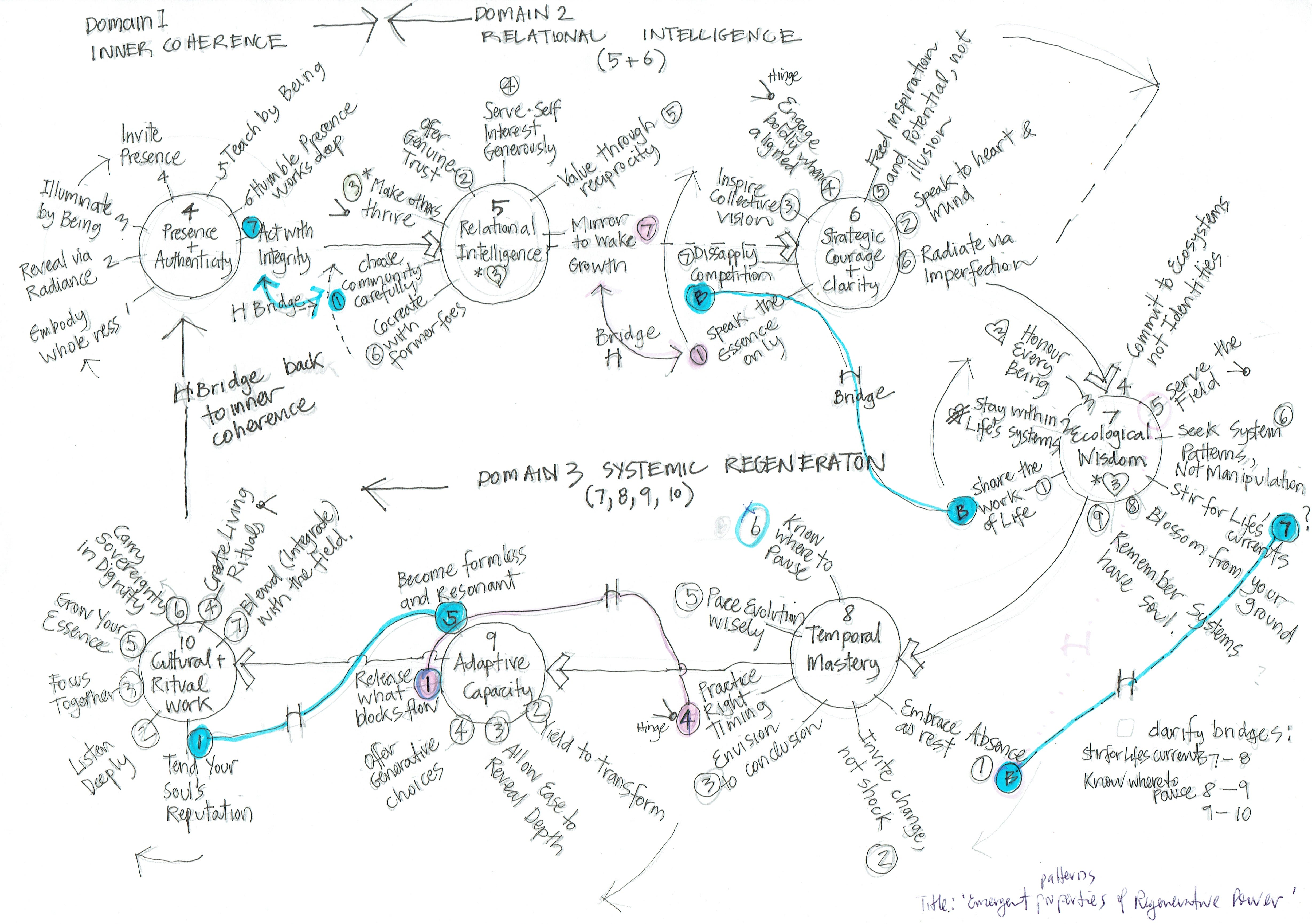
I pulled an A3 sheet from the printer cartridge and began drawing.
Circles first. Arrows. Chapter names. Numbers. Little hearts. Hinges. An H wherever one cluster seemed to reach across and touch the next.
It looked nothing like a book.
At the time I was revising the fourth version of the publishing proposal for Regenerative Power. The earlier structure was straightforward. Part One explored ways of seeing power. Part Two presented forty-eight emergent laws, each partly positioned against Robert Greene’s 48 Laws of Power.
It made sense.
It was also becoming tedious.
Greene’s laws provided a useful Machiavellian shadow, the dark side if you will forgive the Jedi reference. But I was increasingly unconvinced that simply replacing one list of laws with another was enough.
I wanted the reader’s journey to have more elegance. More movement. The structure needed to express something about regenerative power itself.
I had a hunch that deeper patterns were hiding among the forty-eight laws.
So I designed an AI prompt to study them for recurring themes.
Something clicked.
Three larger domains became visible. Inner Coherence. Relational Intelligence. Systemic Regeneration.
Within them, seven movements began to form.
Presence and Authenticity.
Relational Intelligence.
Strategic Courage and Clarity.
Ecological Wisdom.
Temporal Mastery.
Adaptive Capacity.
Cultural and Ritual Work.
I did not experience this as designing a clever framework. It felt more like discovering a structure that had been there for some time, waiting for me to notice it.
Then came the harder work.
The computer could help me examine themes. Drawing by hand helped me internalise them.
Back and forth I went between conversations with Koan, the manuscript and these rough maps. I reordered laws. Tested chapter names. Marked the laws that seemed to form the heart of a movement. Drew hinges where a chapter turned. Added bridges where one movement needed to prepare the next.
Sometimes I muscle-tested a decision rather than relying on logic alone.
That may sound eccentric.
It worked for me.
Architects sometimes use a parti diagram to capture the central generating idea of a building.
A parti is rarely beautiful. A few marks might indicate an axis, a courtyard, a threshold, a relationship between landscape and enclosure. Yet those crude marks can contain the organising idea from which hundreds of later decisions emerge.
These mind maps became the parti of the book.
And, like architectural design, getting the sequence right mattered.
One chapter originally began with Cocreate with Former Foes, followed by Choose Community Carefully, Make Others Thrive and Offer Genuine Trust.
Eventually the movement reversed its logic.
First, choose community carefully.
Then offer genuine trust.
Make others thrive.
Allow reciprocity to deepen.
Only later does the capacity arise to cocreate with former foes and mirror growth back into relationship.
The laws had not changed.
Their relationships had.
That changed the journey.
Looking at the architecture now, the progression seems almost obvious.
Power begins with the work of inner coherence. Presence before performance. Knowing something of who we are before trying to shape the world around us.
From there, coherence enters relationship.
Trust, reciprocity and the capacity to help others thrive create the conditions for harder forms of relationship, including courage, truth-telling and conflict.
Only then does the book widen into ecological wisdom.
I find that placement significant. Many books concerned with sustainability begin with ecology. This one arrives there after relational intelligence has expanded the field of concern. Honour Every Being eventually became the heart of that chapter.
Then another difficulty appeared.
Temporal Mastery and Adaptive Capacity kept bleeding into one another. Both involved timing. It took several manuscript edits to distinguish learning when to act, pause or conclude from learning how to change when conditions themselves change.
Finally, the movement reaches culture and ritual.
That ending felt entirely natural to me.
Individuals die.
Cultures remember.
Stories, ceremony, identity and shared practices can carry patterns beyond a single lifetime. Collective meaning-making becomes part of the regenerative technology.
Perhaps that is where the architecture revealed its largest proposition.
Regenerative power itself has a developmental trajectory.
Building new senses
Years ago, futures studies taught me that transformation in the world is inseparable from transformation within ourselves.
Architecture gives me another way to say it.
I mean senses broadly here. Spirit, body and mind. The capacities through which we perceive relationship, place, possibility and life.
Even the word laws began to trouble me as the structure developed. In one corner of the mind map I scribbled alternatives.
Emergent patterns of Regenerative Power.
Emergent properties of Regenerative Power.
I wanted to avoid suggesting immutable commandments.
The title eventually remained Regenerative Power: 48 Emergent Laws for Rethinking How We Live, Lead and Belong.
But emergent now carries more weight.
These laws are patterns I have encountered through family life, practice, research, nature, history and reflection. They are propositions to live with and test against life.
I still have the drawings.
Looking at them gives me satisfaction more than nostalgia. They remind me of the early sketches for a building, before the mess disappears beneath polished drawings, specifications and finished surfaces.
The finished building hides the ordered chaos that made it possible.
Books do something similar.
Sometimes structure is imposed.
Sometimes, if we listen long enough, the pattern begins to reveal the structure it needs.
If you prefer to listen, this week’s 8-minute video the Parti Beneath the Book.
Thanks for your attentive spirit and for reading Poetic Designs! If this field note resonates with you, please do me a favour and share it with your comment.
Comments
Nothing yet. Say the first thing.
Sign in to join the conversation.