
More movement is not always more life.
I learnt this later than I would have liked.
For much of my professional life, persistence felt virtuous. Keep going. Solve the problem. Make another call. Rewrite the proposal. Find another door.
Sometimes that instinct served me well.
Sometimes it did not.
Winter settles differently over Parramatta.
Cold westerlies move along the river and between the buildings. On the afternoon my contract ended, I stepped outside and pulled my coat tighter. The setting sun had aligned almost perfectly with Macquarie Street and the parallel tram lines.
For a few seconds, steel, glass and sunlight seemed to converge.
I stopped and took a photograph.
Then I sent it to my family with a message.
“The sun is setting over my time at Parramatta.”
I did not know what came next.
So I did what I knew how to do. I worked at finding work.
Each morning began with meditation and a walk along the Parramatta River. Ferries cut through the dark water. White galahs erupted from the riverbank in squawking clouds. Pink magnolias appeared along my street, strangely delicate against the winter air.
Then applications.
Networking.
Interviews.
Breathwork around midday when I could feel stress gathering across my jaw, neck and shoulders.
And writing.
I carried a notebook into Parramatta Library and sat beneath its sloping glass looking down into the square. People crossed below with the determined gait of lunch-hour purpose. Phones to ears. Bags swinging. Somewhere in that daily movement I began asking a more awkward question.
Was I maintaining purpose, or merely maintaining motion?
I finished my Design Shifts poetry collection there by hand. Graphite smudged across the pages. My wrist sometimes ached from writing.
I loved that ache.
It felt different from the strain of another unanswered application. One seemed to be producing something. The other increasingly felt like friction against a door that had already closed.
Still, I persisted.
Two hundred and fifty applications.
Eighteen interviews.
No offers.
Numbers can make persistence look heroic.
They can also tell us something has run its course.
Complex systems often behave differently as they approach a threshold.
Ecologists describe a phenomenon called critical slowing down. A stressed ecosystem can take longer to recover after disturbance. Variations become larger. The system wobbles. Shocks that were once absorbed begin to linger.
The slowing itself contains information.
Human systems do this too.
A team that once recovered easily from disagreement begins carrying conflict from meeting to meeting. An organisation becomes strangely reactive to small problems. A leader sleeps badly, concentrates less easily and keeps adding effort to compensate.
By the time collapse arrives, the threshold may have been visible for some time.
Looking back, my own signals were obvious.
But they did not arrive as a dramatic breakdown.
They arrived as repetition.
That matters.
Exhaustion is not always the first warning. Sometimes the earlier signal is satiety. The sense that something has received enough energy for now. More input will not create more life because there is no remaining capacity to absorb it.
The distinction feels increasingly important in organisations obsessed with momentum.
We have become very good at beginning.
We are reasonably good at accelerating.
Stopping before depletion is another skill altogether.
Ancient cultures understood this in ways modern institutions often forget.
The Hebrew practice of shmita required agricultural land to rest every seventh year. Fields were not sown. Vineyards were left unpruned. Debt release formed part of the same temporal rhythm.
The striking thing is that the pause was scheduled before collapse.
People did not wait for ruined soil and then invent restoration.
Restraint was built into the system.
That principle reaches well beyond agriculture.
During the Vietnam War, Sister Chân Không worked with Thích Nhất Hạnh and young volunteers rebuilding villages, feeding displaced families and caring for communities damaged by violence.
Urgency surrounded them.
There was always more to do.
Yet endless service was consuming the people doing the serving. Activists could burn through their emotional and physical reserves within months.
So stopping became part of the work.
Meditation. Breathing. Communal reflection. Bells calling people back from activity.
Later, at Plum Village, this rhythm became embedded in everyday life.
The work mattered too much to be carried through permanent urgency.
That sentence stays with me.
Winter returned to Parramatta in 2025.
By then I knew something in my body that my professional mind had been slower to accept.
The effort had emptied itself.
Continuing would no longer be perseverance.
It would be repetition.
Around that time, the tenants in our Sunshine Coast house gave notice.
Denise and I stood in the kitchen talking through what this might mean.
The kettle clicked off.
Neither of us rushed to fill the space.
We paused.
And somewhere inside that pause, the answer became uncomplicated.
We would go north.
Mountain Creek met me with different rhythms. Birds announcing dawn before I was ready. Brackish waterways rising and falling with the tides. Earlier light. Walking. Journalling. Writing again by hand.
The labels I had worn for decades started loosening.
Architect.
Futurist.
Even those identities that had served me well needed somewhere to rest.
I did not immediately replace them.
That may have been the important part.
Robert Greene’s forty-seventh law advises us not to go past the mark we aimed for. After victory, he argues, further ambition can turn advantage into vulnerability.
There is intelligence in recognising overreach.
But regenerative pause begins somewhere else.
The question is not how far we can safely extend success.
It is where continued movement begins consuming the conditions that made movement possible.
People.
Relationships.
Attention.
Soil.
Meaning.
Sometimes even identity.
A pause gives experience somewhere to land.
Learning can become visible. Grief can catch up. The body can stop defending a direction simply because it has already invested so much in travelling there.
And then something curious can happen.
Another movement becomes possible.
My own long interruption did not look productive from the outside. For a considerable period I generated very little income and had no clear professional destination.
Yet something was integrating.
Eight years of poetry began finding another shape. Decades of architecture, futures thinking, systems work, leadership and lived contradiction began speaking to one another.
Eventually, a book started emerging.
This book - The Emergent Laws of Regenerative Power.
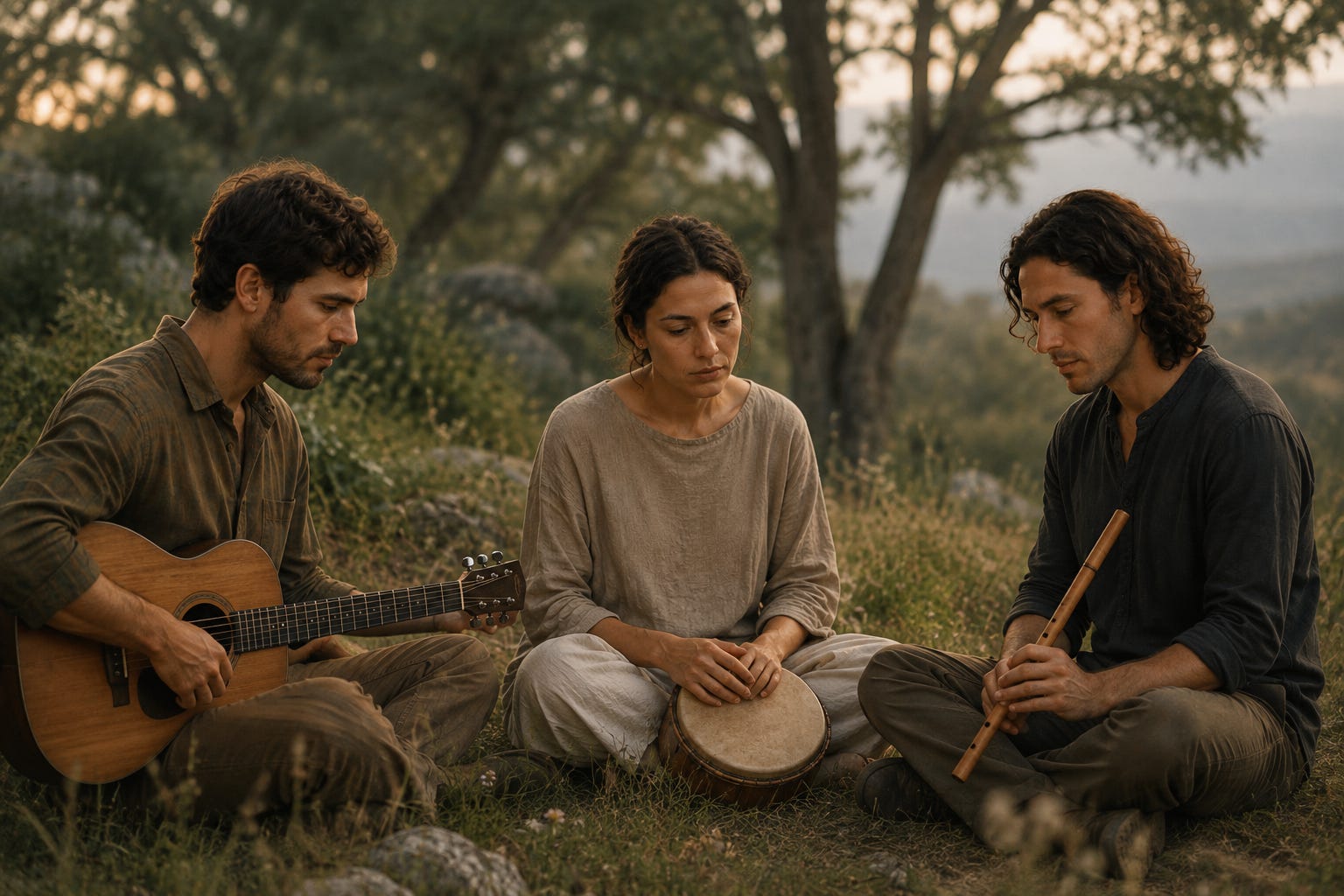
Music comes alive through more than notes.
The pauses are where sound lands.
Perhaps leadership does too.
If you prefer to listen, this week’s 3-minute video explores the emergent Law 47 — Know Where to Pause
Law 47 is part of the Temporal Mastery cluster within the 48 Laws of Regenerative Power.
Behind the scenes, I am editing the manuscript for the forth time: tightening conclusions, deleting sections and cleaning up the endnotes. Next week I’ll share Law 48: Become Formless & Resonant, the final law.
Thanks for your attentive spirit and for reading Poetic Designs! If this field note resonates with you, please do me a favour and share it with your comment.
Comments
Nothing yet. Say the first thing.
Sign in to join the conversation.