
The Lempert Report — Friday Paid Subscriber Edition
ANNOUNCEMENT FOR PAID SUBSCRIBERS ONLY: Our next LIVE one-hour chat will take place on Tuesday August 11, 2026, at 11am Eastern.
Please reserve your spot today by sending me an email to confirm!
While shoppers are filling carts with Summerween inflatables and skeleton pool floats, the real drama for this industry is happening in customs paperwork, not planograms. Today, July 24, the Section 122 global tariff — you know, that flat 10% surcharge that’s applied to imports since February expires by statute. What replaces it is still being finalized, and the timing could not be worse for an industry that sources roughly 90% of its product from overseas and needs goods on the water right now for an October selling season.
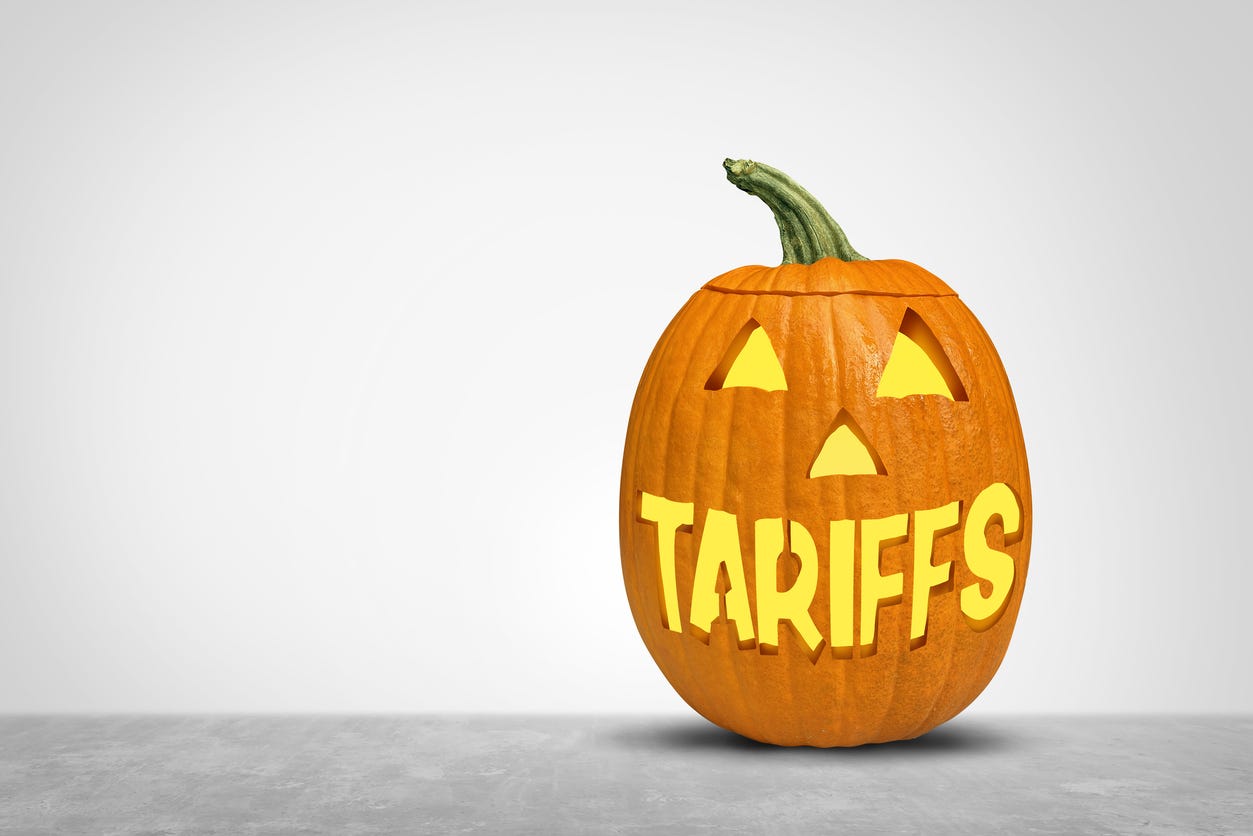
The tariff landscape behind Halloween products has been in near-constant motion for over a year. Additional duties on Chinese apparel and goods swung from 30% in mid-2025 up toward a combined 30–70% range by late 2025, then down to 10% under the Section 122 global surcharge that took effect February 24, 2026, after the Supreme Court struck down the administration’s use of International Emergency Economic Powers Act (IEEPA) to impose the earlier “reciprocal tariff” regime.
Section 122 was never meant to be permanent. It’s capped by statute at 15% and 150 days, and it expires July 24. There is no extension possible without an act of Congress, which hasn’t happened. In its place, The Office of the U.S. Trade Representative (USTR) has proposed a new Section 301 regime built on two investigations launched in March: one covering “structural excess manufacturing capacity” in 16 economies including China, Vietnam and Taiwan, and a second one covering forced-labor enforcement across 60 trading partners. That forced-labor action, announced June 2, proposes a 10% Section 301 tariff on 15 countries that have taken meaningful compliance steps, and 12.5% on the other 45, including China, Vietnam, India and Thailand. A public hearing on the proposal happened July 7; USTR is aiming to have the replacement in place by the time Section 122 sunsets.
Two details matter enormously for our industry specifically. First, China’s existing Section 301 tariffs from Trump’s first term, the 25% to 100% range depending on product category, never went away and remain fully in force; the new 12.5% would stack on top of that already-elevated base. Second, the new Section 301 tariff would not stack on top of Section 232 duties, unlike the current China regime, so categories like steel- or aluminum-heavy Halloween animatronics and metal-framed decorations face a different calculation than fabric costumes or plastic props.
USTR held public hearings on the proposed rates July 7–9 at the U.S. International Trade Commission, drawing a wide cross-section of American industry — everyone from Le Creuset and the American Trailer Manufacturers Coalition to steel producers and the American Petroleum Institute took a turn at the podium, alongside government representatives from South Korea, Sri Lanka and Vietnam pushing back on their own countries’ findings. The apparel and footwear side of the room came prepared. The Fair Labor Association and the American Apparel & Footwear Association (AAFA) filed a joint comment ahead of the hearing arguing the proposal is “both a threat and an aid” to the industry. A threat because new tariffs would raise costs the way last year’s IEEPA duties did, but also useful leverage if it pushes trading partners toward real reform. Their bigger objection is structural: a coalition calling itself the Forced Labor Working Group, which includes AAFA, the Retail Industry Leaders Association, the U.S. Fashion Industry Association, NRF and the Footwear Distributors and Retailers of America, told USTR that applying one blanket 10–12.5% rate across 60 economies fails Section 301’s own statutory requirement for economy-by-economy analysis, calling the approach “disproportionate, inflationary and untethered from the objective of eliminating forced labor.”
The hearing wrapped with testimony from the Footwear Distributors & Retailers of America and the National Council of Textile Organizations, but no signal yet from USTR on whether any of it will move the proposed rates. Post-hearing rebuttal comments were due five days after the hearings concluded (July 14) so, the rebuttal window has closed but nothing has visibly moved. A final rate determination is still pending as of this writing, with the clock running toward Section 122’s July 24 expiration.
One wrinkle worth watching beyond Halloween: the EU-U.S. trade agreement that took effect July 1 commits the U.S. to a 15% “all-inclusive,” no-stacking tariff ceiling on most EU goods. The EU is one of the 14 economies facing the proposed 10% Section 301 forced-labor tariff, and as of early July, EU officials hadn’t said whether they’d treat that as consistent with the 15% ceiling or as a breach of the deal. It’s a sign the entire post-Section 122 tariff architecture is still being tested in real time, not just the pieces that touch our grocery industry directly.
Roughly 90% of Halloween products contain at least one overseas-made component, according to the Halloween and Costume Association, and the overwhelming majority of that is China. Signature Brands, which makes Pumpkin Masters pumpkin-carving kits, has publicly said its China-made products have carried a tariff burden as high as 58–60% of product value at points over the past year. A level customs brokers describe as functionally un-absorbable without either price increases or product discontinuation. Joe Ens, CEO of Signature Brands (which owns Pumpkin Masters and Paas), told CNBC the company has looked at reshoring manufacturing for both product lines but concluded it would be very difficult to compete on labor costs in other markets, particularly given the specialized injection-mold tooling the products require.
That’s the dynamic private-label and national-brand Halloween suppliers are both navigating right now, mid-shipping-season, with the tariff floor scheduled to shift under them on July 24 — right as goods ordered for October retail are on the water. Sourcing guides for 2026 buyers have pushed retailers to lock in China production by July for September sea-freight arrival; anyone who missed that window is now facing the choice between expensive air freight or absorbing whatever the post-July 24 tariff regime turns out to be, with the specific rate still not finalized as of this writing.
Read my column on The Hidden Threat of the Cyclospora Outbreak and why it matters to retailers on The Robin Report
Private label decor and costumes are more exposed than they look. Retailers building exclusive Halloween assortments to protect margin from national-brand price hikes are sourcing through the same Chinese factories facing the same tariff stack, meaning the private-label cost advantage narrows considerably once the new Section 301 rate lands.
Country diversification has limits this cycle. Vietnam, long a go-to alternative to China for costume and textile production, is one of the 45 countries facing the proposed 12.5% rate — so shifting sourcing away from China doesn’t fully insulate a retailer the way it might have during the first Trump-era trade war.
Materials matter more than they used to. Latex and rubber items sourced from Mexico, and goods from countries with USMCA-compliant status, remain largely outside this new tariff stack — expect to see more retailers quietly shifting mask and prop sourcing toward Mexican manufacturers where feasible.
Absorption is being split, not eliminated. Importers like Trick or Trick Studios, who sell Halloween goods to more than 10,000 retailers, reported to CNBC that they are absorbing 60–70% of tariff costs themselves rather than passing the full burden to retail partners. A posture that’s harder to sustain if the new Section 301 rate comes in above the current 10% Section 122 baseline.
Retailers spent the last year treating tariffs as a known, if volatile, cost of doing business. What’s different about this moment is the calendar collision: the tariff regime is scheduled to reset in the exact week Halloween goods need to already be crossing the Pacific for on-time October delivery. Whatever rate USTR finalizes for the Section 301 replacement, expect it to show up first in private-label decorations and costume pricing this fall. It’s not because private label is uniquely exposed as a category, but because it’s the layer of the assortment retailers use to protect margin, and margin protection is exactly what’s under pressure right now.
I’ll be watching for USTR’s final rate determination in the days after July 24 and will update you.
Thanks for reading The Lempert Report!
Comments
Nothing yet. Say the first thing.
Sign in to join the conversation.