
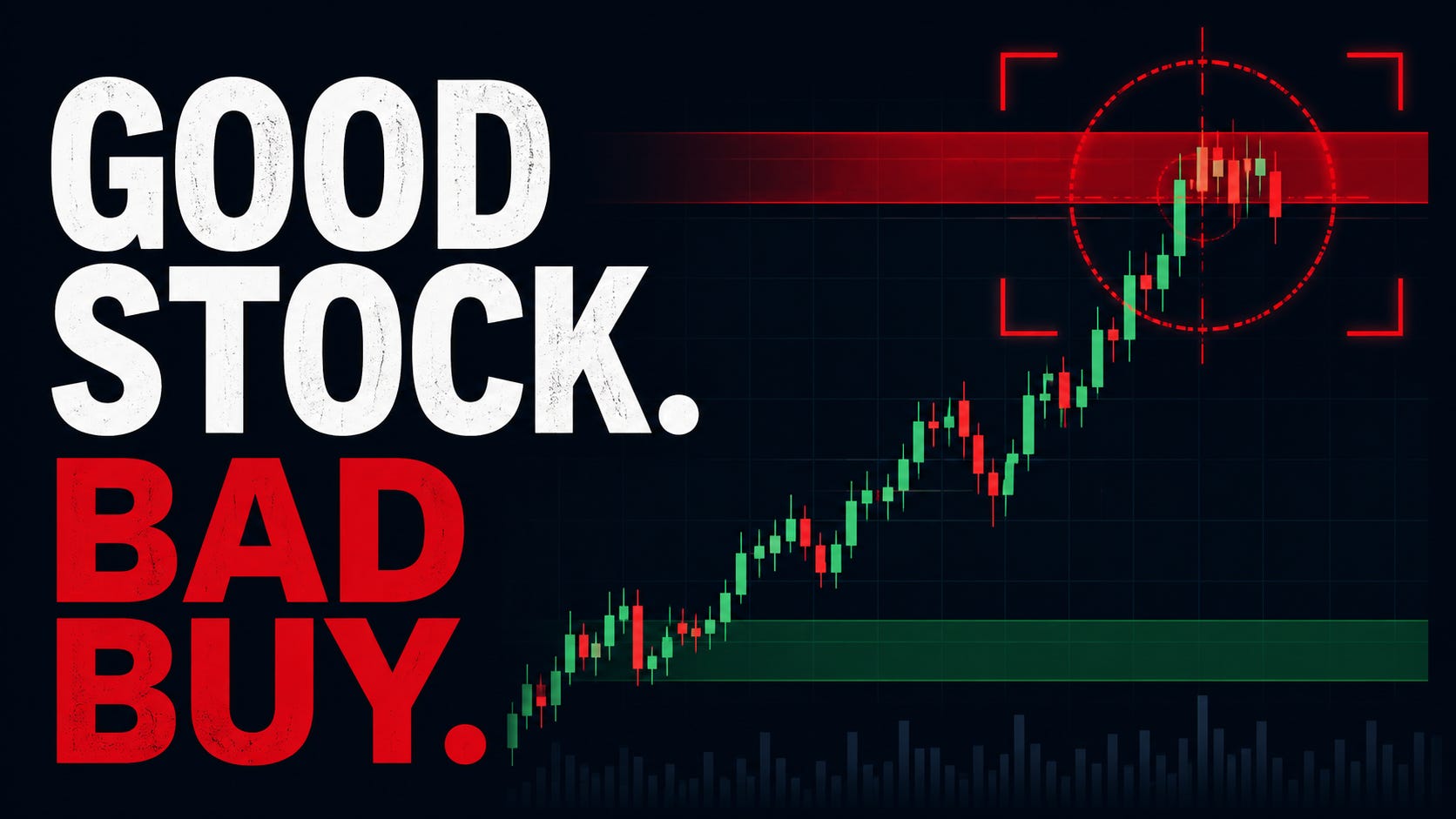
I have spent too much time buying stocks near resistance and not enough time waiting for them to get closer to support.
The problem was rarely that I had chosen a terrible company. The problem was location.
I would do the research, build conviction in the business and decide that I wanted to own it. Once I reached that conclusion, buying started to feel like the natural next step.
Sometimes it was.
Other times, I was buying precisely when everyone else had reached the same conclusion. The business was improving, the story was becoming obvious and the stock was already moving.
I was buying closer to the top of the range than the bottom.
That is a frustrating way to learn that a good company and a good entry are not the same thing.
My fundamental framework was doing the job I built it to do. It helped me decide whether the business deserved my capital.
It never told me where I was buying.
That is why I built the scanner. Not to replace the framework, but to force me to answer the part of the decision I had treated as secondary.
My investing process still begins with the business.
I want to know where the growth is coming from, whether margins are improving, whether cash flow is following earnings and whether management is actually creating value. I want to know what the market already expects and what would have to happen for the thesis to be wrong.
Those questions determine whether a company deserves my capital at all.
They do not tell me whether today is a good day to buy it.
A company can pass every fundamental test I care about and still be sitting directly below resistance. The business can be improving while the stock is already extended. The valuation can make sense over five years while the immediate setup offers poor risk and reward.
Earnings can be days away.
Volume can be fading.
The stock can have so little room before the next meaningful obstacle that the upside no longer justifies the downside if the setup fails.
The company has not suddenly become worse.
The entry has.
That distinction matters because I know my own tendency. Once I decide I want to own something, patience becomes harder.
Research creates conviction.
Conviction creates urgency.
Urgency makes a mediocre entry easier to rationalize.
The scanner is designed to interrupt that process.
The framework tells me whether the business deserves my capital.
The scanner asks whether the stock has earned it today.
I bought Costco near the high without fully appreciating where I was entering.
The business was not the problem.
Costco was still Costco.
I had bought a company I liked at a poor location, and then I had to live with what happened next.
The stock went red.
And the red bothered me far more than it should have.
Eventually I sold.
Not because the business thesis had suddenly collapsed, but because I had allowed a poor entry to become part of an emotional decision.
A better entry would not have guaranteed a better outcome.
But it could have changed the decision I was being forced to make.
My son later asked me a question I could not answer very well.
“You held Apple at 37× and panicked at Costco at 50×?”
He was right to ask.
Valuation mattered, but it was not the entire story. I had bought Costco after much of the move rather than waiting for a better location.
Then, when the stock pulled back, I was reacting to the loss on my screen instead of evaluating the business from a position of patience.
Great businesses do not protect investors from poor entry points.
Conviction in the company does not make resistance disappear.
In the July 21 scan, Arista Networks ranked as the highest-quality name on the watchlist.
The overall setup looked strong. Trend, momentum and relative strength were all strong, and the pullback reset appeared largely complete.
On the surface, that sounds like exactly the kind of name a scanner should promote.
It did not.
ANET remained on the watchlist.
Volume was only 0.71 times average, still below the confirmation level built into the process. Earnings were also approaching.
The scanner was not saying Arista was a bad company.
It was not even saying the setup was poor.
It was saying the setup was not ready.
That is the distinction I wanted the system to enforce.
I have spent enough time buying stocks because I liked the company and then discovering that I had ignored the location. I do not need a scanner that gives me another excuse to do the same thing.
I need one willing to say:
Strong company.
Strong setup.
Not yet.
If ANET runs without giving the confirmation the scanner is waiting for, that will become part of the record too.
The point is not to make every call look right afterward.
The point is to find out whether the rules improve decisions over time.
One of the most important rules behind the scanner is simple.
Location beats score.
A stock can look strong across almost every measure and still be in the wrong place.
Trend can be strong. Momentum can be strong. Relative strength can be strong. Volume can be healthy.
But if the stock is sitting directly below resistance with little room before the next target, the setup can still be poor.
The same problem appears when a stock becomes extended.
Strength attracts attention, but it also changes the entry.
That is why the scanner looks at more than whether a stock is behaving well. It also asks how far the price has moved from support, how much room remains before the next obstacle, whether volume is confirming the move and whether the potential reward still justifies the risk.
That does not make technical analysis more important than fundamental analysis.
It makes entry discipline part of capital allocation.
The price I pay affects the return I can earn.
The location where I enter affects how much downside I may have to tolerate before the thesis has a chance to work.
A high score should not override that.
Neither should conviction.
The psychology of the two locations is almost backward.
A stock approaching resistance feels safer. The chart is strong, the story is working and other investors are becoming interested.
Waiting feels like risking the opportunity.
A stock near support feels worse. The price has pulled back. Momentum may be weaker. Something may feel wrong even when the thesis has not changed.
That uncomfortable location is usually the better one.
The scanner cannot eliminate that tension.
It can make it harder for me to ignore.
Building the scanner was not the end of the project.
It was the beginning of the test.
The next step is keeping score.
I need to know how often a name that moves from Watchlist to Setting Up actually follows through. I need to know what happens to the stocks the scanner blocks near resistance, and whether they later offer better entries or simply run without me. I need to know what happens when it says wait and the setup would have failed anyway.
Those are measurable questions.
They need measurable answers.
The scanner will produce a record. Setups can be tracked. Paper trades can be measured. Missed opportunities can be studied. Failed setups can be examined.
The rules can be challenged.
If the system improves entry quality, the data should eventually show it.
If it does not, the data should show that too.
That matters because I do not want to build a process that merely sounds disciplined.
I want to know whether the discipline changes decisions.
And eventually, whether those decisions change outcomes.
The scanner should be held to the same standard I apply to an investment thesis.
It has to survive contact with evidence.
I knew how to decide what I wanted to own.
I was not always patient enough about where I owned it.
Those are different decisions.
Sometimes both answers will be yes.
Sometimes the company will be right and the location will be wrong.
Sometimes an attractive setup will appear in a business that never makes it through the fundamental framework.
A process should be able to say not yet.
It should be able to distinguish between a company worth following and a stock worth buying today.
The scanner will not eliminate that mistake for me.
But it can make the mistake harder to justify.
The business still has to earn my capital.
Now the entry does too.
This article is for informational and educational purposes only. It is not investment advice or a recommendation to buy or sell any security. I am not a financial adviser. Do your own research and consider your financial situation, objectives, time horizon and risk tolerance before making any investment decision. Any position I hold may change without notice.
Comments
Nothing yet. Say the first thing.
Sign in to join the conversation.