
One of the hardest things about owning individual stocks is that price moves faster than understanding.
A stock falls 10%.
Then 15%.
Then 20%.
The red number is immediate.
The explanation usually is not.
That creates pressure to do something before I have answered the question that actually matters.
What changed?
Sometimes the answer is obvious. The company missed. Guidance was cut. Margins deteriorated. A customer left. Debt became a problem. Management said something that directly challenged the thesis.
Those situations may require action.
But sometimes I go through the numbers, reread the thesis, check the kill switches and reach a much less satisfying conclusion.
Nothing important changed.
The stock just went down.
That sounds simple.
It rarely feels simple when I own it.
I do not believe in ignoring price.
A meaningful decline deserves attention because markets are not always right, but they are not random either. When a stock suddenly falls, my first job is to determine whether the market is reacting to something I have missed.
I go back to the business.
I look for changes in the revenue outlook, margins, cash flow, guidance, competitive position and balance sheet. Then I compare what I find with the reasons I owned the company in the first place.
The goal is not to defend the position.
It is to look for evidence that I am wrong.
That distinction matters because ownership creates bias. Once I hold something, I naturally have a reason to want the thesis to remain intact.
The danger is turning every decline into a story about why the market does not understand the company.
Sometimes the market understands it just fine.
Sometimes I am wrong.
But sometimes the business really is doing exactly what it was doing before the stock fell.
That is when the decision gets harder.
I think about most meaningful declines in three categories.
The first is a broken thesis.
Something fundamental has changed.
The company is no longer producing the results I expected. The assumptions supporting ownership are weakening. A kill switch has been hit, or the evidence is moving close enough to one that the position needs to be reconsidered.
That is not ordinary volatility.
That is new information.
The second is a valuation reset.
The business may still be fine. Revenue can continue growing. Margins can keep expanding. Earnings can still rise.
But the stock was priced for more than the company could reasonably deliver.
In that case, the decline may be saying very little about the business and quite a lot about the price I paid.
A great company can still produce a poor return if the starting valuation requires years of excellent execution just to justify the purchase price.
The third category is the hardest.
Nothing important changed.
The business is still performing.
The thesis remains intact.
The valuation may even be becoming more attractive.
And the stock is falling anyway.
All three situations look exactly the same on the screen.
Red is red.
But they are completely different investment problems.
The easiest time to believe in a thesis is when the stock is going up.
The most important time to understand it is when the stock is not.
That is why I want to know what would make me wrong before the decline happens.
If I own a company because I expect 20% growth and that growth falls to 8%, that matters.
If the thesis depends on expanding margins and margins contract for three consecutive quarters, that matters.
If cash flow is supposed to validate earnings and the gap continues widening, eventually I need a point where I stop explaining it away.
Those are better decision rules than a percentage decline in the share price.
A stock falling 20% can trigger the review.
It should not determine the conclusion.
Without predetermined tests, every drawdown turns into the same internal debate.
Maybe I should sell.
Maybe I should buy more.
Maybe the market knows something.
Maybe everyone is overreacting.
That is not a process.
That is anxiety with a brokerage account.
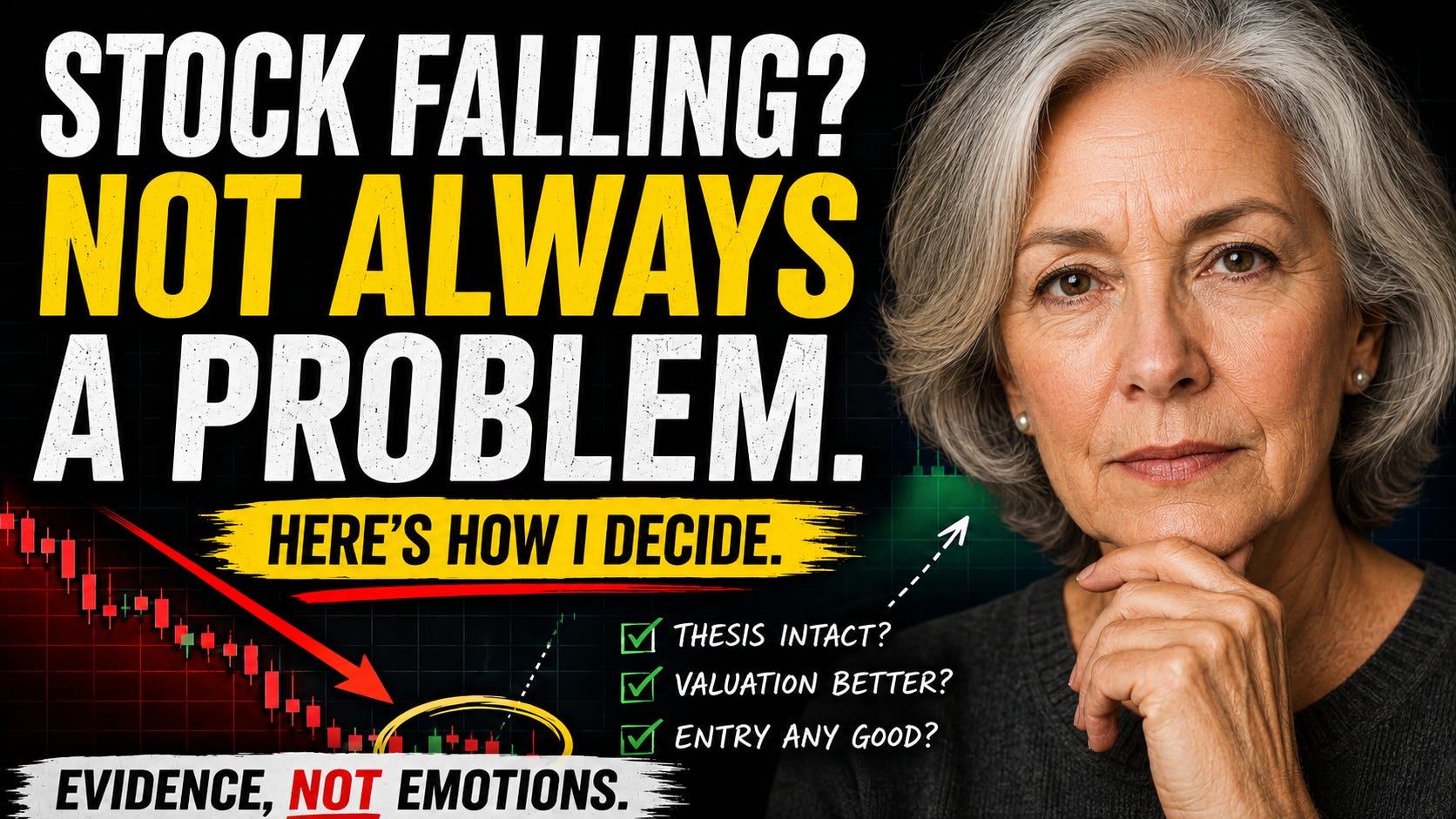
When a stock I own falls meaningfully, I try to slow the decision down.
First, I go back to the original thesis.
Not the stock price.
Not the loss.
The thesis.
I compare what I believed when I bought the company with what I know now. If the facts have changed enough to hit a kill switch, I need to deal with that honestly.
If the thesis remains intact, I move to valuation.
The stock may be 20% cheaper and still not be cheap. A decline from an extreme multiple to a merely expensive one is still a valuation reset, not automatically an opportunity.
Then I look at the setup.
This is where the scanner can help keep the second half of the decision honest. The fundamental framework tells me whether the business still deserves capital; the scanner helps me judge whether the current location deserves action.
Those are different questions.
Only after separating the thesis, valuation and entry do I decide what to do.
Sell.
Hold.
Add.
Or wait.
Very often, the answer is to do nothing yet.
That option deserves more respect than investors give it.
An intact thesis does not make every decline an opportunity.
Sometimes cheaper really is better.
Sometimes it simply means lower.
This is where I have to be particularly careful with averaging down.
Adding to a position can be completely rational when the thesis remains intact, the valuation has improved and the opportunity is genuinely better.
It can also be emotional bookkeeping.
The position is red.
I buy more.
My average cost falls.
The red number becomes smaller.
None of that means the investment became better.
The decision has to be based on what I would do with the stock today if I did not already own it.
That is a much harder standard.
It is also a more honest one.
There is a strange discomfort in researching a decline and finding no obvious reason for it.
It feels incomplete.
Surely something must have happened.
Sometimes something did, and I simply have not found it yet.
But sometimes the market is repricing the same business.
The multiple changes.
The sector rotates.
Interest rates move.
Expectations shift.
Investors decide they are willing to pay less for the same earnings than they were a month earlier.
That can hurt while leaving the long-term thesis completely intact.
The danger is moving too quickly in either direction.
I do not want to sell a good business solely because the stock fell.
I also do not want to use an unchanged thesis as an excuse to ignore a valuation mistake.
Those distinctions are easy to explain after the fact.
They are much harder while the position is red.
After 35 years of investing, I still think that is one of the hardest parts of the job.
Being wrong about the business.
Being wrong about the price.
And simply being uncomfortable because the stock is falling.
They can feel almost identical while they are happening.
Over time, they produce very different outcomes.
A falling stock demands attention.
It does not automatically demand action.
The job is not to defend the position.
The job is to determine what changed.
And sometimes, after doing the work, the honest answer is:
Only the price.
This article is for informational and educational purposes only. It is not investment advice or a recommendation to buy or sell any security. I am not a financial adviser. Do your own research and consider your financial situation, objectives, time horizon and risk tolerance before making any investment decision. Any position I hold may change without notice.
Comments
Nothing yet. Say the first thing.
Sign in to join the conversation.