
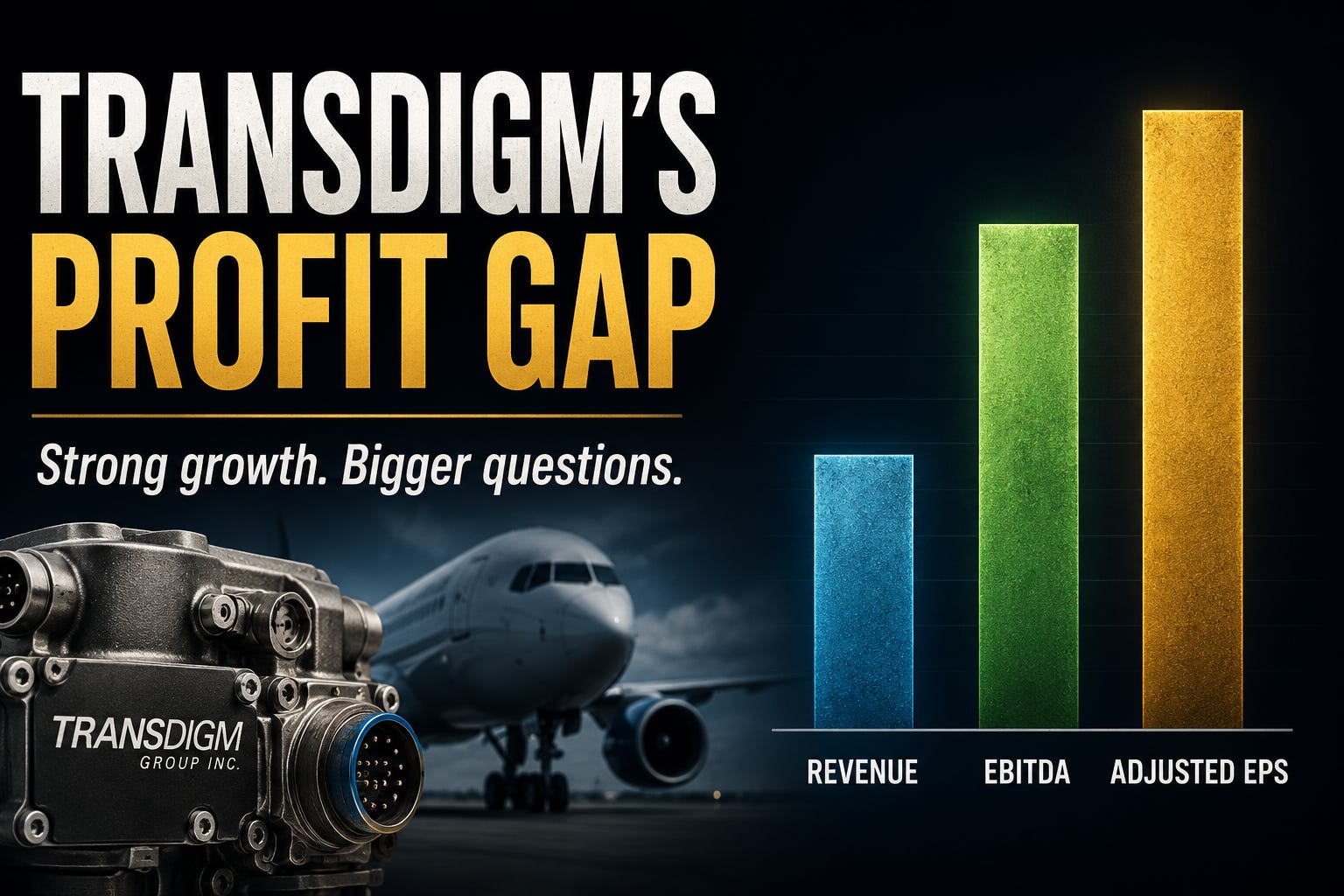
TransDigm reported the kind of third quarter that should have made the investment easier.
Third-quarter revenue increased 23%.
Organic revenue increased 13%.
Commercial aftermarket revenue grew 17%, faster than the company’s other major markets.
Management raised full-year guidance.
Then I reached the bottom of the income statement.
Third-quarter adjusted earnings per share increased 13%.
Revenue grew nearly twice as fast.
One quarter can create noise.
But the results for the first nine months of fiscal 2026 showed the same pattern.
Year-to-date revenue increased 18%.
EBITDA As Defined increased 16%.
Adjusted earnings per share increased only 9%, from $26.53 to $28.94.
GAAP net income increased 4%.
The business is growing.
The shareholder is receiving less of that growth than the headline numbers suggest.
At $1,254.72, TransDigm trades at approximately 31 times the midpoint of fiscal 2026 adjusted EPS guidance.
That does not make the stock cheap.
It makes the gap worth investigating.
The market is not pricing a broken aerospace supplier.
It is still valuing TransDigm as an exceptional business.
What has changed is how much investors appear willing to pay before the operating growth reaches earnings and cash flow.
TransDigm is not an ordinary aerospace manufacturer.
Its companies produce highly engineered components used across commercial and military aircraft.
Many of those products are proprietary, and many generate recurring aftermarket demand long after the original aircraft has been delivered. TransDigm says its products are used on nearly every commercial and military aircraft in service.
That matters because the initial sale is only part of the economics.
Once a component has been designed into an aircraft, replacing it may require engineering work, testing, certification and approval.
The cost of the part may be small compared with the cost of delaying maintenance or leaving an aircraft out of service.
Price matters.
Availability matters.
Reliability matters.
Certification matters.
That combination has allowed TransDigm to produce margins that look unusual for an industrial manufacturer.
The company’s products are spread across actuators, pumps, valves, restraints, cockpit systems, sensors, power controls, lighting systems and other components that aircraft operators cannot simply ignore when they require replacement.
The latest results do not show that advantage weakening.
Commercial aftermarket revenue increased 17% during the third quarter.
Commercial OEM, commercial aftermarket and defense revenue all grew at double-digit rates.
The growth was not dependent on one strong end market or one unusually favorable comparison.
The year-to-date numbers tell the same story.
Organic revenue increased 10% through the thirty-nine week period, with growth across defense, commercial aftermarket and commercial OEM sales.
Acquisitions added another 8 percentage points, bringing total year-to-date revenue growth to 18%.
Demand is not the contradiction.
The contradiction appears after that demand becomes revenue.
Compare second-quarter and first-half revenue growth, EBITDA As Defined growth and adjusted EPS growth. The chart should make the widening gap visible.
Third-quarter EBITDA As Defined margin was 52.8%, down from 54.4% a year earlier.
That initially looked like the answer.
If TransDigm’s pricing power were weakening, revenue could grow while the economics underneath it deteriorated.
But the direction across fiscal 2026 argues against that.
The margin was 52.4% in the first quarter, 52.6% in the second and 52.8% in the third.
The compression is real year over year. It is improving sequentially.
The rest of the income statement is less reassuring than it was last quarter.
Gross margin slipped from 59.5% to 59.4%.
Selling and administrative expenses rose to $332 million from $242 million, an increase from roughly 10.8% to 12.1% of revenue.
That is the opposite of what I saw in the second quarter, when both measures moved in TransDigm’s favor.
The gross margin change is small enough to ignore.
The selling and administrative increase is not.
Some of it belongs to acquisition integration costs, which arrive before the savings do. Some of it reflects a larger company carrying a larger overhead base.
Management attributes much of the margin pressure to recently acquired businesses entering TransDigm below the profitability of the existing portfolio, and quantifies the third-quarter effect from Jet Parts Engineering and Victor Sierra at approximately half a percentage point.
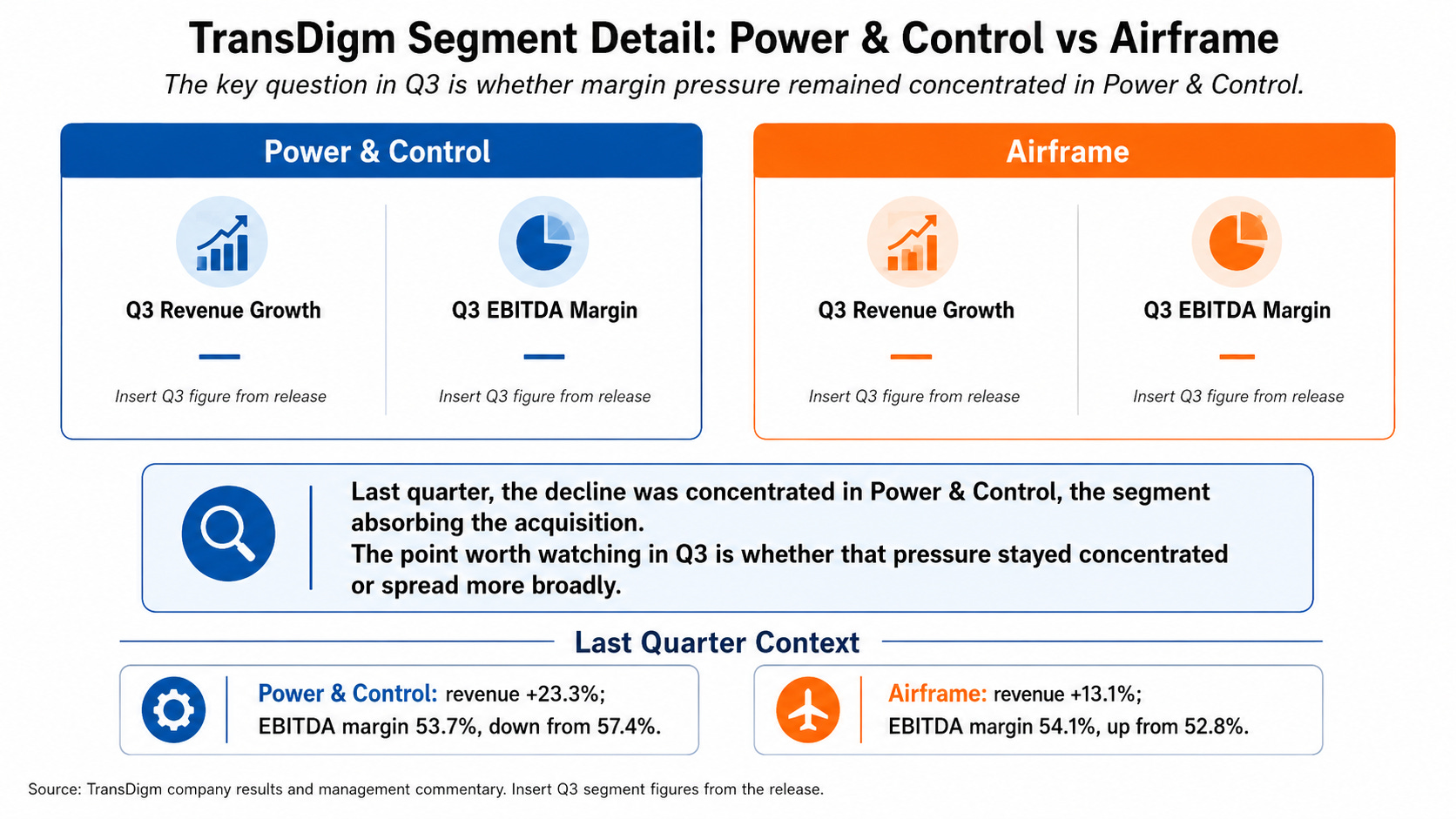
Q3 segment results show whether the acquisition-related margin pressure remained concentrated in Power & Control or began spreading into Airframe.
That distinction matters because TransDigm does not need to buy businesses that already earn TransDigm margins.
It buys aerospace companies with proprietary products and aftermarket exposure, then attempts to improve pricing, costs and cash generation.
A temporary margin decline can therefore be part of the process.
A permanent decline would mean the process is no longer producing the same results.
Three quarters of sequential improvement is early evidence, not proof.
The newest acquisitions have not been owned long enough.
And the amount TransDigm is spending raises the cost of being wrong.
TransDigm completed the acquisition of Jet Parts Engineering and Victor Sierra Aviation Holdings in April 2026 for approximately $2.2 billion in cash.
The acquisition was funded with cash on hand and proceeds from debt issued in February.
Jet Parts Engineering develops proprietary replacement parts and repairs.
Victor Sierra owns businesses that manufacture and distribute proprietary PMA and other aftermarket products, primarily serving general and business aviation.
The strategic fit is clear.
These are aerospace aftermarket businesses.
They sell products that require engineering and regulatory approval.
They operate in the part of the market where TransDigm has historically produced its strongest economics.
The purchase price requires more work.
Jet Parts Engineering and Victor Sierra generated approximately $280 million of combined revenue before the acquisition.
TransDigm paid approximately $2.2 billion.
That is nearly eight times revenue.
A revenue multiple does not tell me whether the acquisition was good or bad.
It tells me how much future improvement has already been purchased.
TransDigm did not pay that price because these businesses currently resemble average aerospace suppliers.
It paid for proprietary products, aftermarket exposure and the profitability it believes it can create.
The purchase price contains an expectation.
Margins must rise.
Cash flow must rise.
The acquired businesses must continue growing.
The financing cost must remain below the value created.
And the buying has not stopped.
After the quarter closed, TransDigm agreed to acquire Prince & Izant for approximately $1.07 billion in cash.
That deal is not in the raised guidance.
TransDigm also withdrew from the Stellant Systems acquisition after Justice Department opposition, which management described as a one-off regulatory event rather than a change in strategy.
Management has a long record of making this work.
The newest transactions still have to prove it.
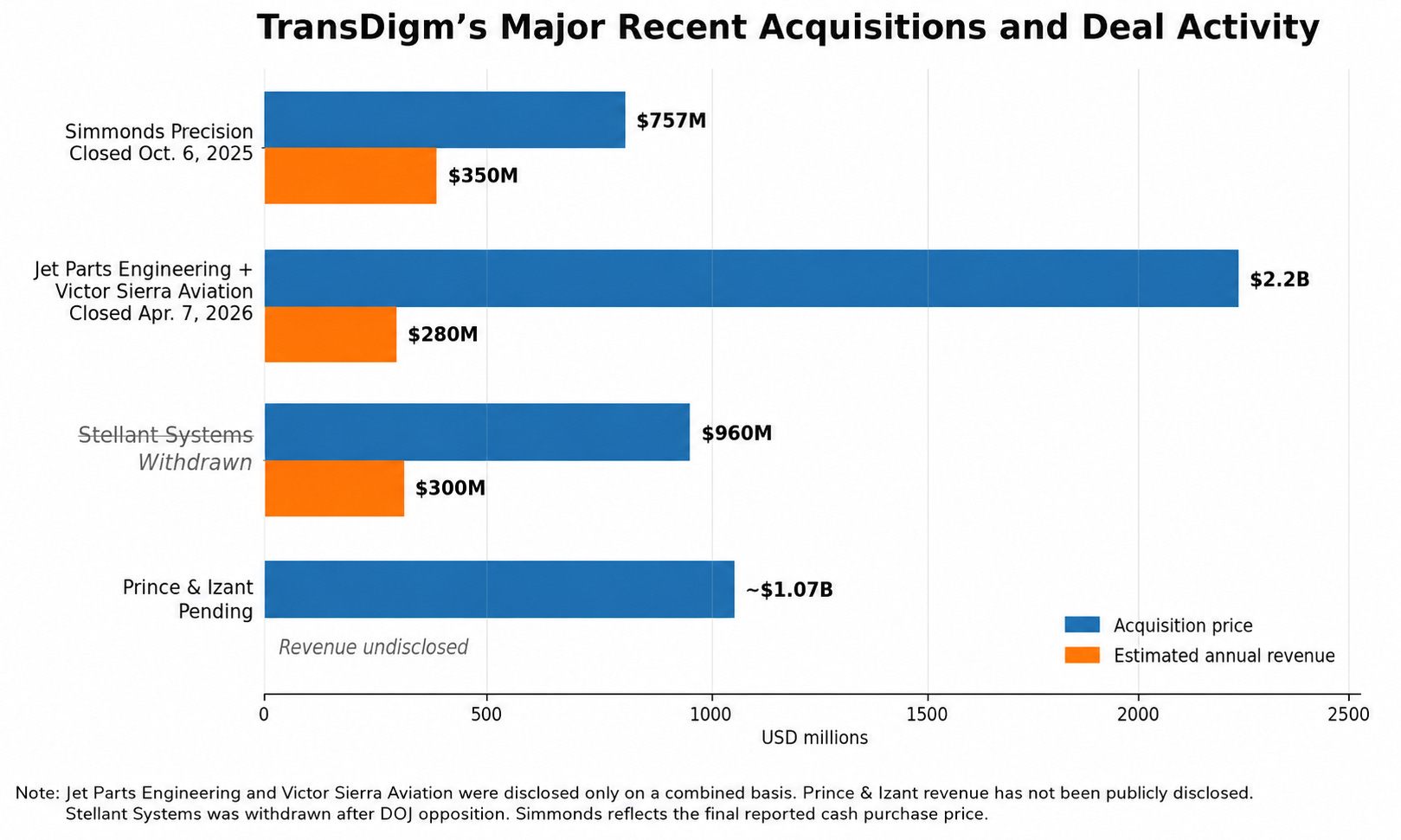
Show TransDigm’s recent deal activity for Simmonds Precision, Jet Parts Engineering + Victor Sierra Aviation, Stellant Systems, and Prince & Izant, including acquisition price, estimated revenue where disclosed, and current deal status.
Jet Parts Engineering and Victor Sierra add another layer to the analysis.
Both businesses have exposure to PMA products.
A Parts Manufacturer Approval allows a company other than the original equipment manufacturer to produce an approved replacement part.
That creates an alternative source for airlines, maintenance providers and aircraft owners.
It would be easy to view TransDigm’s purchase of PMA businesses as evidence that its traditional aftermarket moat is under attack.
The evidence does not prove that.
Jet Parts Engineering and Victor Sierra are not generic low-cost distributors.
They own proprietary, engineered and approved replacement products.
TransDigm may be expanding into a part of the aftermarket that competes with traditional OEM replacement parts rather than simply defending its existing portfolio.
That could make TransDigm both the incumbent and the alternative.
Instead of waiting for PMA suppliers to take business from traditional aerospace manufacturers, TransDigm can own some of the companies providing those alternatives.
The acquisition may broaden the opportunity.
It also changes what I need to watch.
Pricing alone is no longer enough.
TransDigm could continue raising prices while losing unit volume.
Volume could remain strong while customers move toward lower-margin products.
Revenue could grow while the mix becomes less profitable.
I want the evidence to hold together.
Commercial aftermarket revenue should continue growing with flight activity.
Margins should remain strong after acquisition effects are separated.
There should be no sustained evidence that customers are substituting away from TransDigm’s existing products faster than the new PMA businesses are adding revenue.
There is no clear evidence of that today.
The PMA acquisitions widen the test.
They do not break the thesis.
The margin dilution may be temporary.
The interest expense is already here.
Third-quarter net interest expense increased approximately 29%, to roughly $514 million.
Revenue increased 23%.
EBITDA As Defined increased 19%.
Interest expense grew faster than both.
The comparison that matters is what the business created against what the debt consumed.
EBITDA As Defined increased $230 million in the quarter.
Higher interest expense absorbed roughly half of it.
That is why strong operating growth is producing weaker growth at the bottom of the income statement.
The pattern has now held for three consecutive quarters.
It also explains the raised guidance.
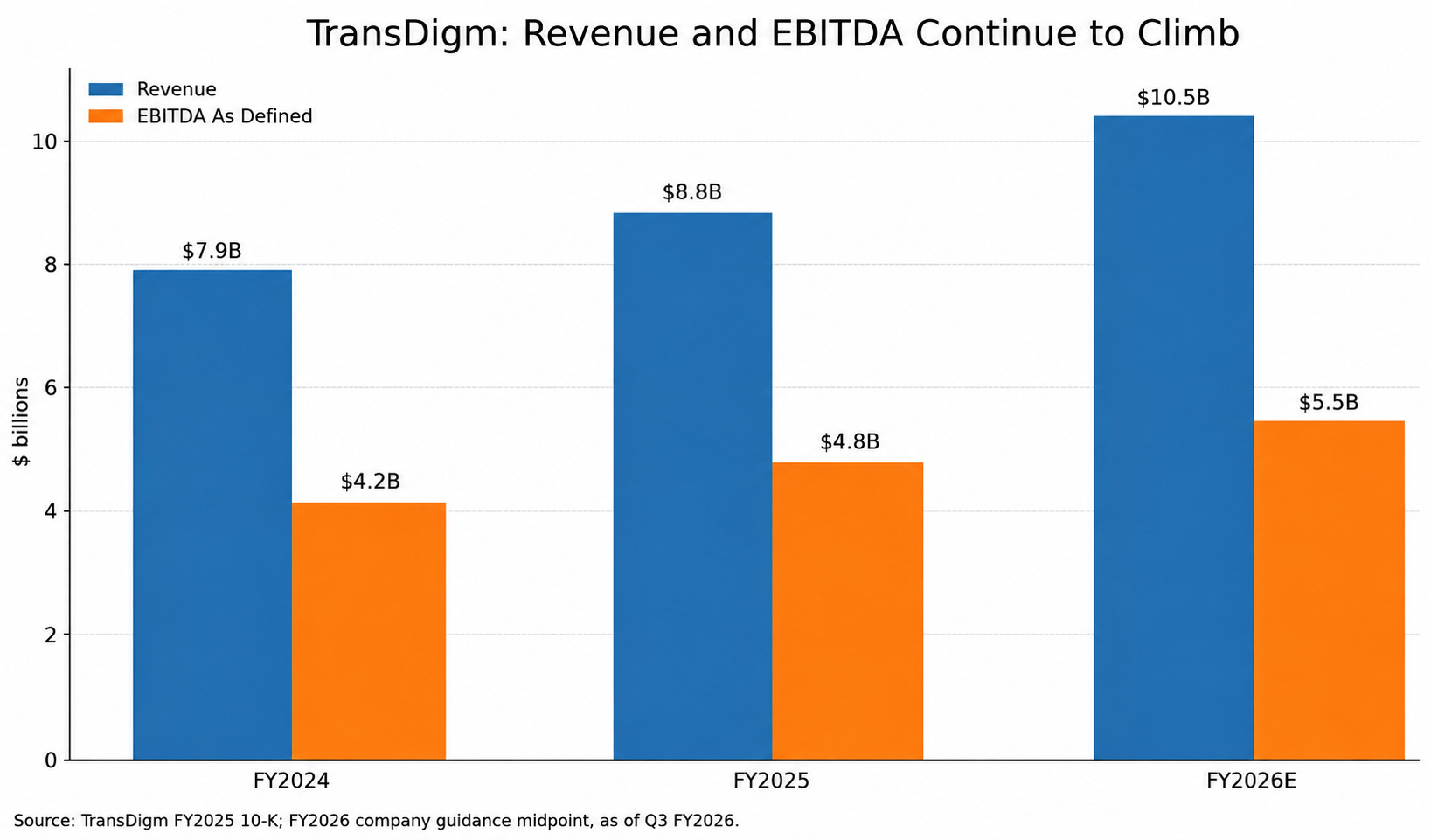
At the midpoint, TransDigm now expects fiscal 2026 revenue of $10.51 billion, EBITDA As Defined of $5.52 billion and adjusted earnings per share of $41.04.
Revenue would increase approximately 19%.
EBITDA As Defined would increase approximately 15%.
Adjusted earnings per share would increase approximately 10%.
The gap narrowed. It did not close.
And the guidance excludes Prince & Izant, which will arrive with its own financing cost before it arrives with improved margins.
The aerospace business can keep performing well while earnings per share disappoints.
TransDigm does not need to lose customers.
It does not need to lose pricing power.
The aerospace cycle does not need to turn.
Interest expense only needs to absorb enough of the additional operating profit.
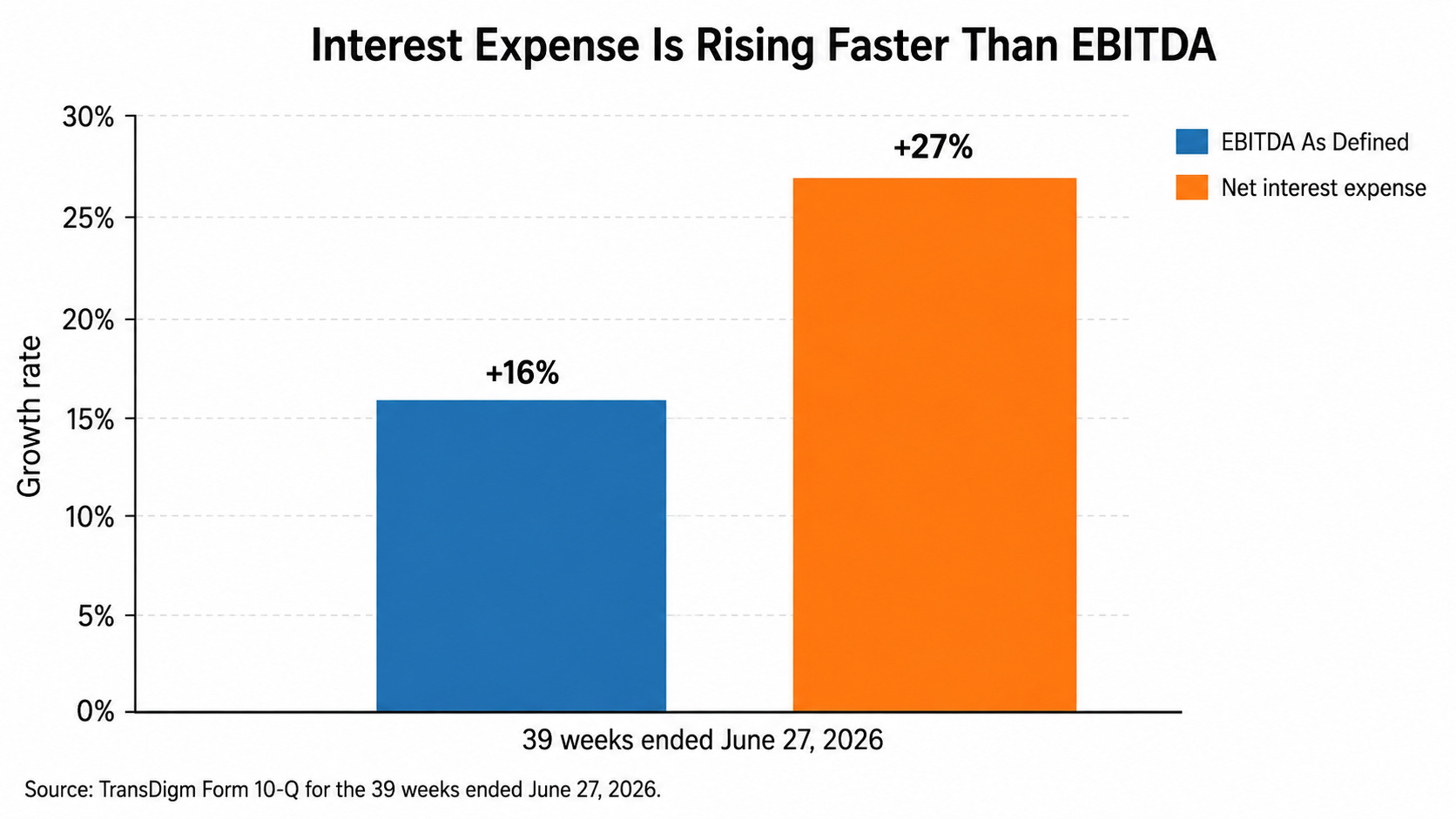
Interest expense consumed roughly half of TransDigm's $540 million EBITDA gain.
TransDigm had approximately $31.5 billion of gross debt at the end of the second quarter.
That number deserves attention.
It does not mean the company faces an immediate maturity wall.
Approximately 75% of gross debt was fixed-rate as of March 28, 2026.
TransDigm also uses interest-rate swaps and collars to reduce the effect of changes in short-term rates on portions of its floating-rate debt.
The company had no term-loan or note maturity before August 2028.
The first major note maturity is $2.1 billion of secured debt due August 15, 2028.
Other large note maturities extend through 2029, 2030, 2031, 2032, 2033 and 2034.
That gives TransDigm time.
It does not remove the cost.
The weighted-average cash interest rate increased only slightly, from 6.1% to 6.2% during the quarter.
Interest expense increased 28% primarily because TransDigm had more debt outstanding.
The current problem is not that old debt suddenly became unaffordable.
The company borrowed more.
That distinction matters.
A future refinancing at materially higher rates could make the problem worse.
It is not the main reason EPS growth is lagging today.
The debt already added is enough.
TransDigm did not arrive at this capital structure by accident.
In August 2025, the company priced $5 billion of new debt.
It said the proceeds would be used to fund a special cash dividend of approximately $5 billion, along with related payments and expenses.
During fiscal 2026, TransDigm repurchased 1,496,383 shares for $1.8 billion at an average price of $1,207, including $1.0 billion in the third quarter alone.
It completed the $2.2 billion acquisition of Jet Parts Engineering and Victor Sierra using cash and debt proceeds.
It issued another $1.5 billion of debt in April.
And it has agreed to spend $1.07 billion more on Prince & Izant.
Each decision can be defended separately.
The special dividend returned capital to shareholders.
The share repurchases were completed below the current market price.
The acquisitions added proprietary aerospace aftermarket businesses.
Together, they create a more demanding equation.
The acquisitions have to produce enough additional profit to cover their financing cost.
They then have to generate enough cash to justify the purchase price.
Only after that do they create additional value for the common shareholder.
Revenue growth alone does not prove that happened.
TransDigm generated $2,038 million of operating cash flow in fiscal 2025 against capital expenditures of $222 million — roughly $1.8 billion of free cash flow for the entire year. Nine months into fiscal 2026, free cash flow is already $2.1 billion, with full-year guidance at $2.6 billion. Unusual Whales
That comparison is stronger than a growth rate. Here’s the section:
Cash Flow Is the One Number Improving
TransDigm generated approximately $870 million of free cash flow during the third quarter and $2.1 billion through the first nine months of fiscal 2026.
The company produced roughly $1.8 billion for all of fiscal 2025.
Nine months into this year, it has already passed the prior full year.
Management raised full-year free cash flow guidance to approximately $2.6 billion.
That is better than the first half suggested.
Through six months, cash remaining after capital expenditures had grown about 4% while revenue grew 16%.
The third quarter closed most of that gap.
One quarter is not enough to declare the problem solved, just as one six-month period was not enough to declare it structural.
Working capital moves.
Interest payments move.
Taxes move.
Acquisitions distort comparisons.
The direction is right.
At TransDigm’s valuation, the company is not being priced merely as a good aerospace supplier.
It is being priced as a company that can turn acquisitions, leverage and pricing power into sustained per-share growth.
At $1,258.42, TransDigm trades at approximately 31 times the midpoint of fiscal 2026 adjusted EPS guidance of $41.04.
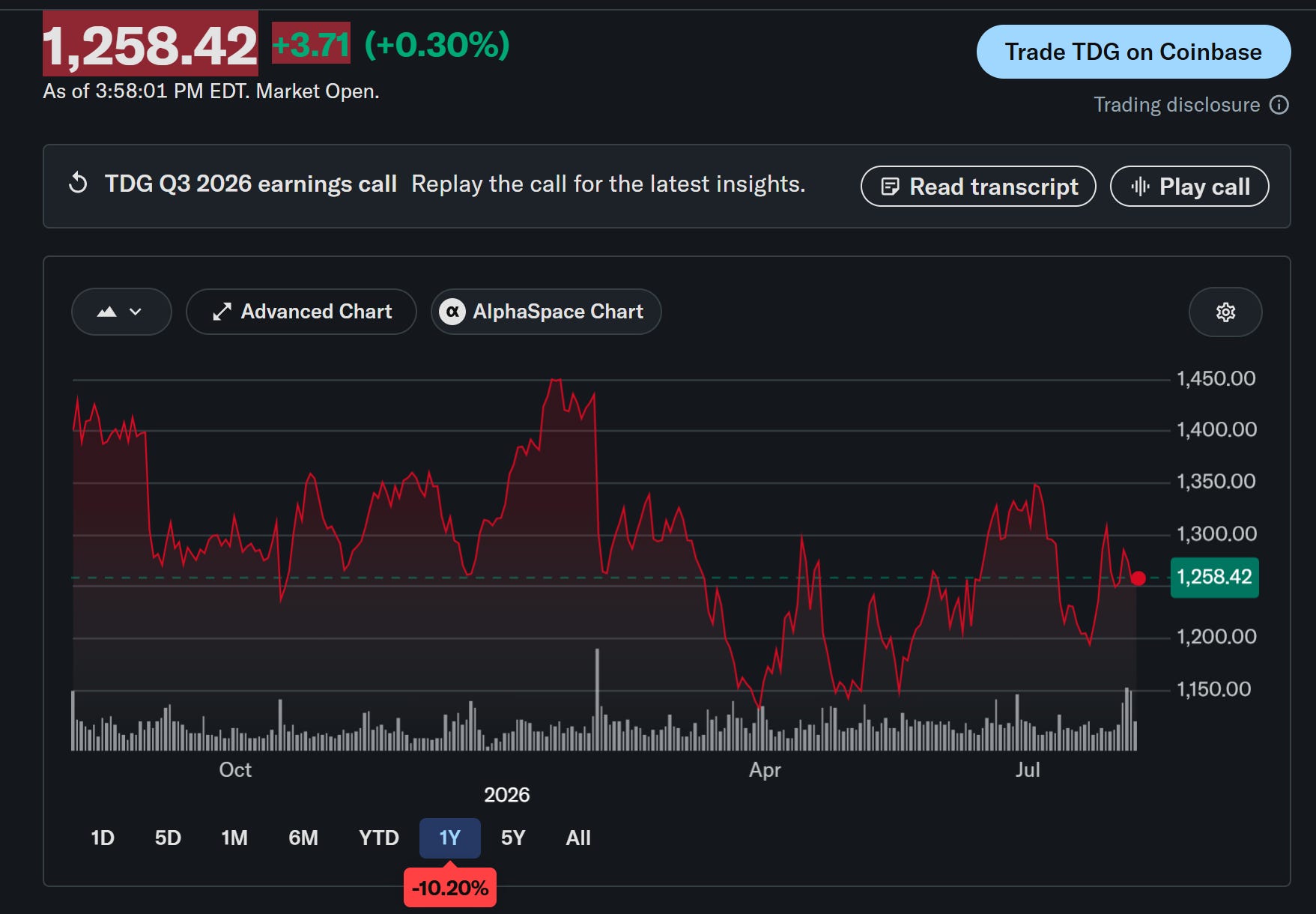
The stock sits between a 52-week low of $1,123.61 and a high of $1,466.13.
That is not a distressed valuation.
It is not an average industrial valuation.
The market still believes TransDigm deserves a premium.
The business has earned one.
The company owns proprietary products.
It benefits from certification and switching barriers.
It generates recurring aftermarket demand.
It has a long record of improving the businesses it acquires.
The stock fell 2.4% on a quarter that beat estimates and raised guidance.
That is not investors abandoning the story.
It means they are paying less for the certainty that those strengths will continue producing the same per-share results.
TransDigm’s Stock Has Fallen Despite Continued Growth
The stock trades roughly 14% below its 52-week high while revenue grows 23%.
At today’s price, investors are betting that acquisition dilution will fade.
They are betting that the newly acquired businesses will move toward TransDigm’s historical margins.
They are betting that interest expense will stop growing faster than EBITDA.
They are betting that cash conversion will keep improving.
They are betting that the PMA portfolio expands the aftermarket opportunity rather than exposing weakness in the existing portfolio.
They are betting that the next round of capital allocation will create more value than the debt required to fund it.
Any one of those assumptions is reasonable.
Two of them now have supporting evidence.
The current price requires the rest to follow.
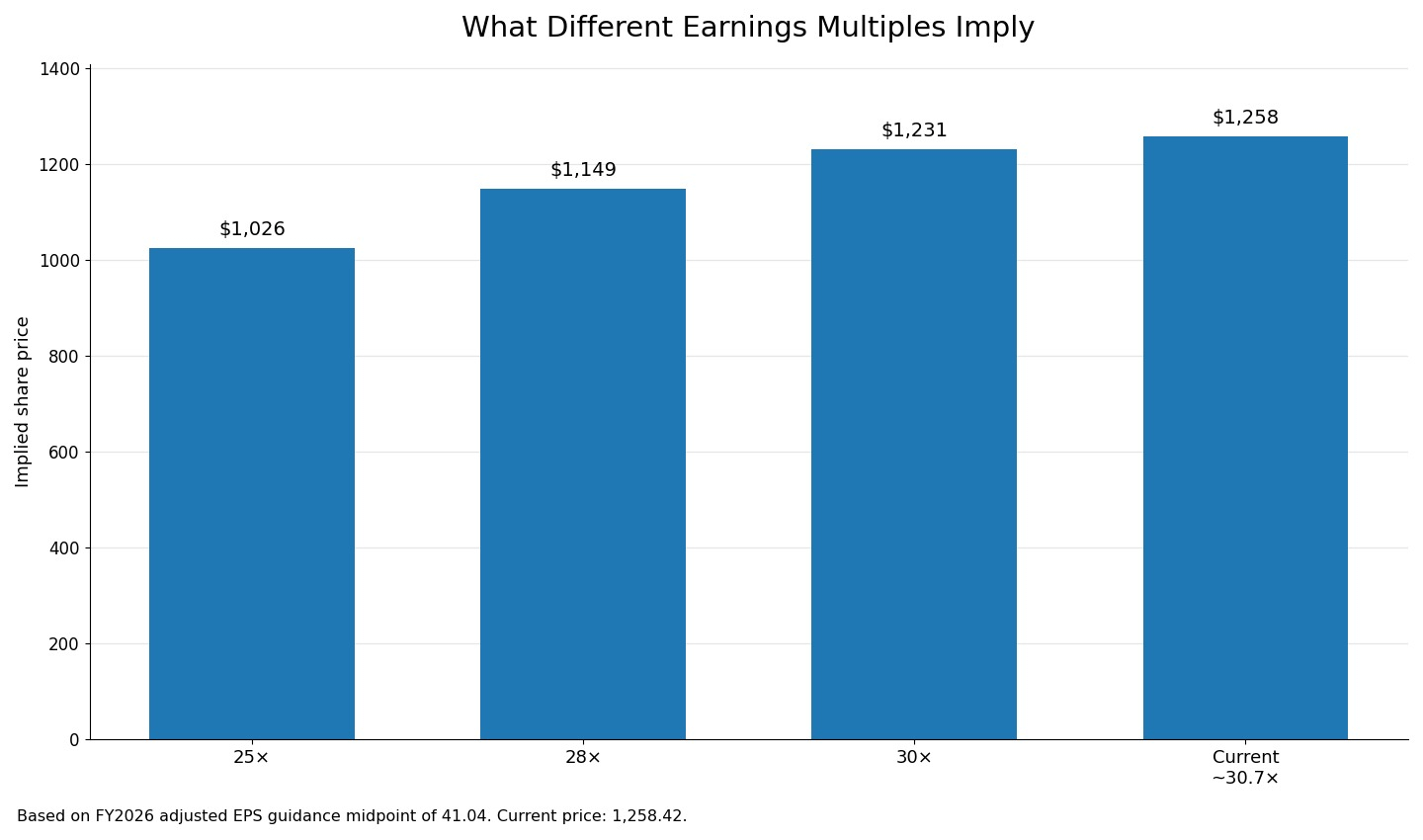
Footnote: Based on FY2026 adjusted EPS guidance midpoint of $41.04. Current price: $1,258.42.
I do not see evidence that TransDigm’s core business is weakening.
Commercial aftermarket revenue grew 17% in the third quarter.
Commercial OEM revenue is growing.
Defense revenue is growing.
Gross margin remains near 60%.
The existing operations appear stronger than the consolidated EBITDA margin first suggests.
The PMA acquisitions do not prove that the moat is failing.
They may expand TransDigm’s ability to profit when customers search for approved alternatives to OEM replacement parts.
The debt schedule also does not point to an immediate refinancing crisis.
Most of the debt is fixed or hedged, and the first large maturity does not arrive until 2028.
The problem is between EBITDA and the shareholder.
TransDigm has used debt to fund acquisitions, special dividends and share repurchases.
That strategy created enormous value when the return produced by the capital remained well above its cost.
Fiscal 2026 is testing whether that spread remains wide enough.
Revenue is expected to grow approximately 19%.
Adjusted EPS is expected to grow approximately 10%.
Interest expense is still growing faster than EBITDA.
Two of the four things I was waiting on have started to move.
Margins improved sequentially for a third consecutive quarter.
Free cash flow through nine months already exceeds all of fiscal 2025.
My current view is Watch.
The business quality is not the problem.
The price still requires evidence that has not fully appeared yet.
I do not need TransDigm to reduce debt simply because the balance is large.
I need the assets financed by that debt to begin producing visible per-share results.
I want EBITDA growth to outrun interest expense.
I want the margin improvement to continue rather than stall.
I want the aftermarket to retain both its growth and profitability as the PMA portfolio expands.
And I want to see what another $1.07 billion of acquisition does to all of it.
Until then, the investment depends less on whether TransDigm owns excellent aerospace businesses.
It depends on whether management can make this acquisition cycle produce another round of per-share compounding.
I may be giving too much weight to a temporary transition.
The financing cost appears immediately.
The operating improvements do not.
Jet Parts Engineering and Victor Sierra closed in April, midway through the third quarter.
Their revenue, expenses and interest burden are entering the numbers before TransDigm has had much time to improve their operations.
If those businesses begin moving toward TransDigm’s historical margins during fiscal 2027, the gap between operating growth and per-share growth could close quickly.
EBITDA and cash flow would begin growing into the debt.
The PMA acquisitions could also become more valuable than the current numbers suggest.
TransDigm may be adding another path to aftermarket growth by owning both traditional proprietary components and approved alternatives to other manufacturers’ OEM products.
Adjusted EPS growth has already returned to double digits, and cash conversion improved sharply in the third quarter.
If consolidated margins keep recovering while aftermarket demand stays healthy, my Watch view would be too cautious.
The evidence would then show that the transition was temporary.
The first kill switch is acquisition integration.
If consolidated EBITDA As Defined margin remains below 52% after Jet Parts Engineering and Victor Sierra have been included in reported results for four full quarters, I would stop treating the margin pressure as temporary.
If management continues blaming acquisition dilution without visible sequential improvement, that would suggest the newest businesses are not moving toward TransDigm’s historical economics.
The second kill switch is the relationship between EBITDA and interest expense.
If net interest expense continues growing faster than EBITDA As Defined for two additional consecutive quarters, or rises above 40% of EBITDA As Defined, the capital structure would be consuming too much of the operating improvement.
Strong revenue growth would no longer be enough.
The third kill switch is cash conversion.
If operating cash flow less capital expenditures grows by less than 5% over a rolling 12-month period while revenue continues growing above 10%, I would stop treating the cash-flow lag as normal timing.
That would mean less of the reported growth is becoming usable cash.
The aftermarket kill switch is broader than pricing.
If organic commercial aftermarket revenue growth falls below the mid-single digits for two consecutive quarters while flight activity remains healthy, I would question whether TransDigm is losing volume or market share.
If aftermarket revenue remains strong but gross margin or segment EBITDA margins decline by more than approximately 200 basis points after acquisition effects are separated, I would question whether product mix, competition or customer substitution is weakening the economics.
Evidence that customers are moving materially toward competing PMA products or dual-sourced alternatives would matter even before total revenue declines.
The final kill switch is capital allocation.
If total debt continues increasing while adjusted EPS growth remains below EBITDA As Defined growth and acquired-company margins fail to improve, I would no longer assume that additional leverage is increasing shareholder value.
Debt used for acquisitions, dividends and repurchases creates value only when the per-share results eventually outrun the financing burden.
TransDigm reported 23% revenue growth.
That is not the number that matters most.
The number that matters is the 13% adjusted EPS growth underneath it.
The aerospace business is doing its job.
The proprietary products remain valuable.
The aftermarket remains strong.
The margins remain exceptional.
The PMA acquisitions may expand the opportunity rather than signal that the moat is failing.
The debt schedule does not point to an immediate refinancing crisis.
But interest expense is still growing faster than EBITDA.
The gap narrowed this quarter. It did not close.
And another $1.07 billion of acquisition is already committed.
At approximately 31 times adjusted earnings, investors are not being paid to ignore that gap.
They are being asked to believe it closes.
I believe TransDigm can close it.
The current numbers do not yet prove that it has.
Phaetrix publishes research, analysis, and market commentary based on a personal investment process.
Nothing here is financial, investment, tax, or legal advice. Nothing presented is a recommendation to buy, sell, or hold any security.
The content reflects how decisions are analyzed, including what could prove a thesis wrong.
Markets move quickly. Setups fail. Losses, including permanent loss of capital, are possible.
Past performance and historical examples are not guarantees of future results.
Positions and views may change without notice as new information becomes available.
All content is provided for informational and educational purposes only.
Investors are responsible for their own decisions, research, and risk management.
Protect capital first.
Comments
Nothing yet. Say the first thing.
Sign in to join the conversation.