

As context for our report Inside the Mind of a Young Neet, Shuab Gamote and I went to the Netherlands to find out why they were doing so much better than us in the UK. They have 4% 16 to 24 year olds not in education, employment or training. We have 13%.
We met groups of young people in schools and charities in the Hague and Amsterdam.
It’s worth noting from the outset that many of them told us their system was far from perfect. Particularly contentious, is the high stakes exam Dutch children taken when they are twelve which determines whether they are on a university-bound academic track, a technical college track or somewhere in between. Many of the young people we spoke to felt this was too young to be making those decisions. Most of us in the UK probably agree.
But what we found was a system characterised by better prevention, clear accountability, joined-up working, trusted relationships and support for young people at vital transitions. More than that, paid work is valued from a young age.
In the Netherlands, young people are more likely to be seen, tracked, contacted, given practical routes and surrounded by adults whose job it is to keep them moving.
The Dutch system appears to have a stronger civic instinct around transition. Young people are not left to drift as easily. Schools, municipalities, employers and youth services are expected to form a bridge between adolescence and adult life. There are named organisations who are accountable and take responsibility.
As one youth worker in The Hague put it, their work is about:
“Preventing disengagement and supporting sustainable transition from education to work. Our target group is really growing, mostly between the ages of 16 and 27: early school leavers, young people without education or work, young people with complex, multi-domain challenges, young people from practical and special education and young people receiving social benefits.”
Being Neet is not treated as a single “employability” issue. It is a transition issue, a poverty issue, a confidence issue, a mental health issue, a housing issue, and often a family issue.
Prevention and early intervention is baked into the Dutch system. They use data in a smart way, but they know that data only matters if it leads to human contact. The Dutch tracking approach helps municipalities identify young people who are out of education or work. The UK has no similar tracking system. But the real strength is not just the dataset, but how they use it.
They learned quickly that bureaucratic invitations do not work - so they used the data to track young people, and then the personal touch to make the connection.
“A few years ago, we sent a letter to young people everywhere in the The Hague: come to us, we want to talk to you - and nobody came. The next step we took was to get in the neighbourhood, get closer to the people, because we knew they wouldn’t come to us.”
The UK needs this same shift - utilising trusted adults at key moments of transition to help young people navigate the next steps.
A youth worker described a move from passive tracking to active outreach:
“So we gathered the information from the data from the system, said, ‘Oh, these people don’t have education, don’t work, so we’re going to visit them.’ And now we literally ring the doorbell to get in contact with these young people. And say: ‘how are you doing?’ That’s the first question. Not, ‘Oh, I see you’re not working.’ No. ‘How are you doing? Can we help you? What’s the problem? Can we help you get back to work, get off your couch or out of your bed?’”
We visited Jongerenpunt070. It’s an organisation that is neither a state organisation, nor a charity, nor a private company. It is an arms-length one-stop-shop given responsibility by the municipality - in this case, The Hague - to provide joined-up services for young people. They have youth workers, the resources, the data and the powers to offer tailor-made provision to get young people into education or employment.
It is as if there was a local organisation in the UK that was an arms-length mayor-funded youth hub combining some of the old Connexions role, the local authority’s school-leaver tracking duties, college-based dropout prevention and Jobcentre-style employment support for the under-27s. (It is interesting that a new law has made 27 the cut off point for intensive support in the Netherlands not 24 - showing a renewed and deeper commitment to young people.)
In the Netherlands a young person can therefore go to one place to get the services they need.
That place then supports them every step of the way:
(i) Step one: Finds the young person
(ii) Step two: Meets them where they are
(iii) Step three: Provides one consistent adult - A coach or case manager becomes the young person’s principal contact and remains even when specialists become involved.
(iv) Step four: Assesses the whole context - assess the whole young person not one element.
(v) Step five: Agrees a personal pathway - back into education, into supported work, into a full time job.
(vi) Step six: Stays alongside the young person even once they have found a job or education place, because they often drop out in the first six months.
Perhaps the most powerful phrase we heard was: “relationship goes first, system goes second.” Jongerenpunt070 explicitly rejects an overly bureaucratic model:
“We organise around the young person. What do they need? How can we fill in their needs? We are always human-centred and context-driven. Relationship goes first, system goes second. If the computer says no, we’re going to work around it. We’ve always got to find a way to make it happen.”
This is what many UK young people describe as missing: one adult who sticks with them and understands the whole story, and can bend the system around the young person, rather than bending the young person around the system.
Jongerenpunt070 also stresses continuity:
“Most likely, you will get a case manager who will support you through the whole process until you are back to school or having another job, so we have the time and interest to build a relationship.
The Dutch evidence is refreshingly practical. Young people are not moralised for lacking money, transport, shoes, a laptop or childcare. Those barriers are treated as problems to solve and they are solved at pace.
Jongerenpunt070 described flexible local budgets that allow them to act quickly:
“It’s a way to get out of the system, because if we use the system, it will take days or weeks before we get some money. If we have our own money, we can say, well, we’re going to do this for you, and we manage it today. So you can have your computer or you can have your shoes for your work.”
Transport is treated in the same way:
“If transportation is a problem, we will get you a bike or a ticket to get the tram or train to get you to work. Not forever, but just to get started. I’ve got 14 bikes gifted to us by the fire department. We fix those bikes, and we can help them get to work.”
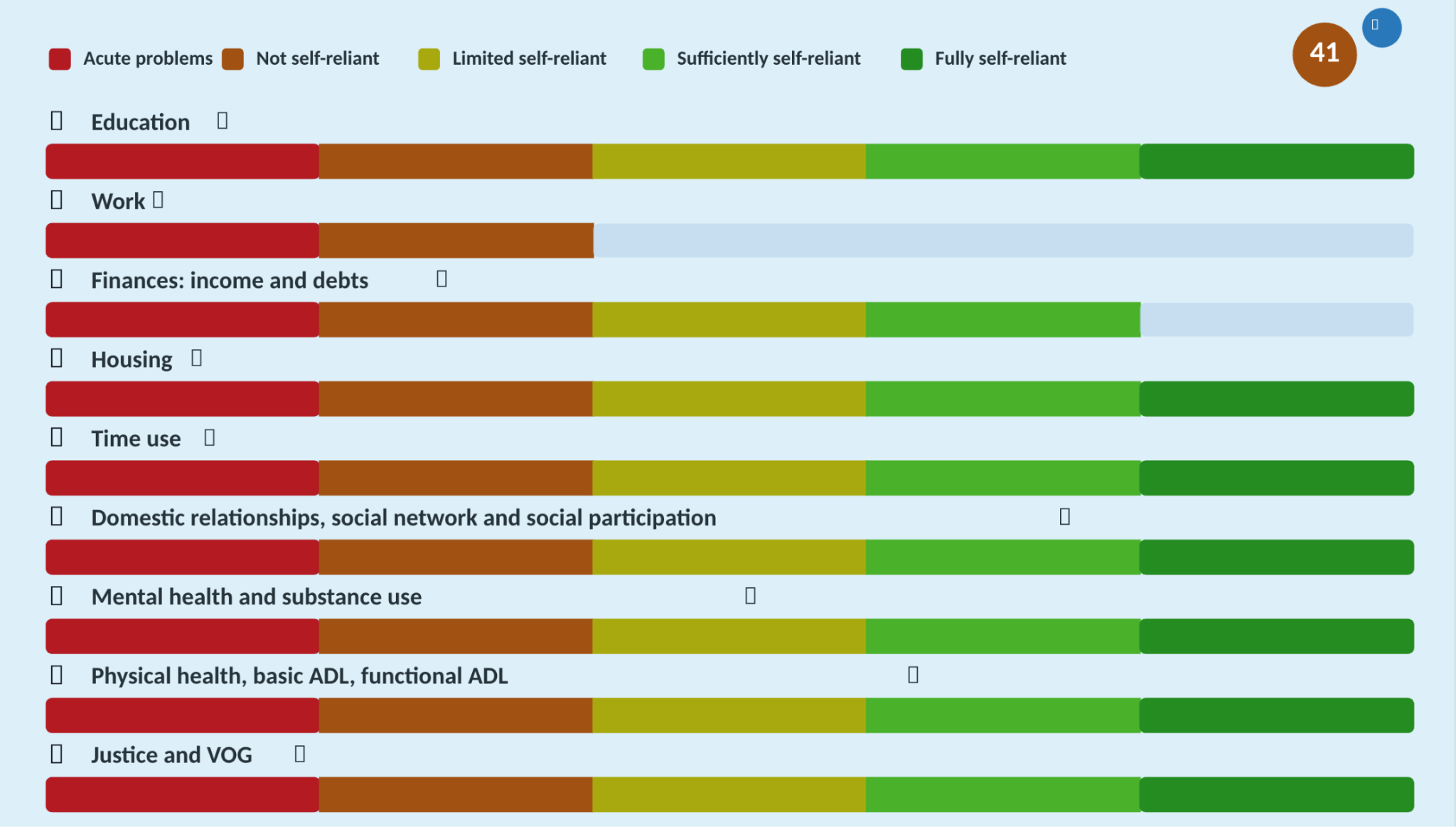
Jongerenpunt070 have a sophisticated nine-point score card to assess every young person. It covers what they see as the key barriers to being work ready and include: qualifications, hosuing, money, social networks and mental health. On the slide below, ADL is translated from the Dutch - Activities of Daily Life - meaning cooking, cleaning, shopping, budgeting, taking care of yourself. VOG is the equivalent of a DBS to check if the person has a criminal record. This scorecard provides the backdrop for a powerful conversation with the young person and an action plan to follow. So while the system is relational, the conversation is based on a very practical understanding of the young person’s circumstances.
The high school students in The Hague were strikingly articulate about the Dutch educational pathways. While there was a lot of stress about the exam at 12, and a desire to be on the university route, there was also a sense in which all the pathways had real status and genuine progression routes. Crucially, there was an ability to move between the pathways.
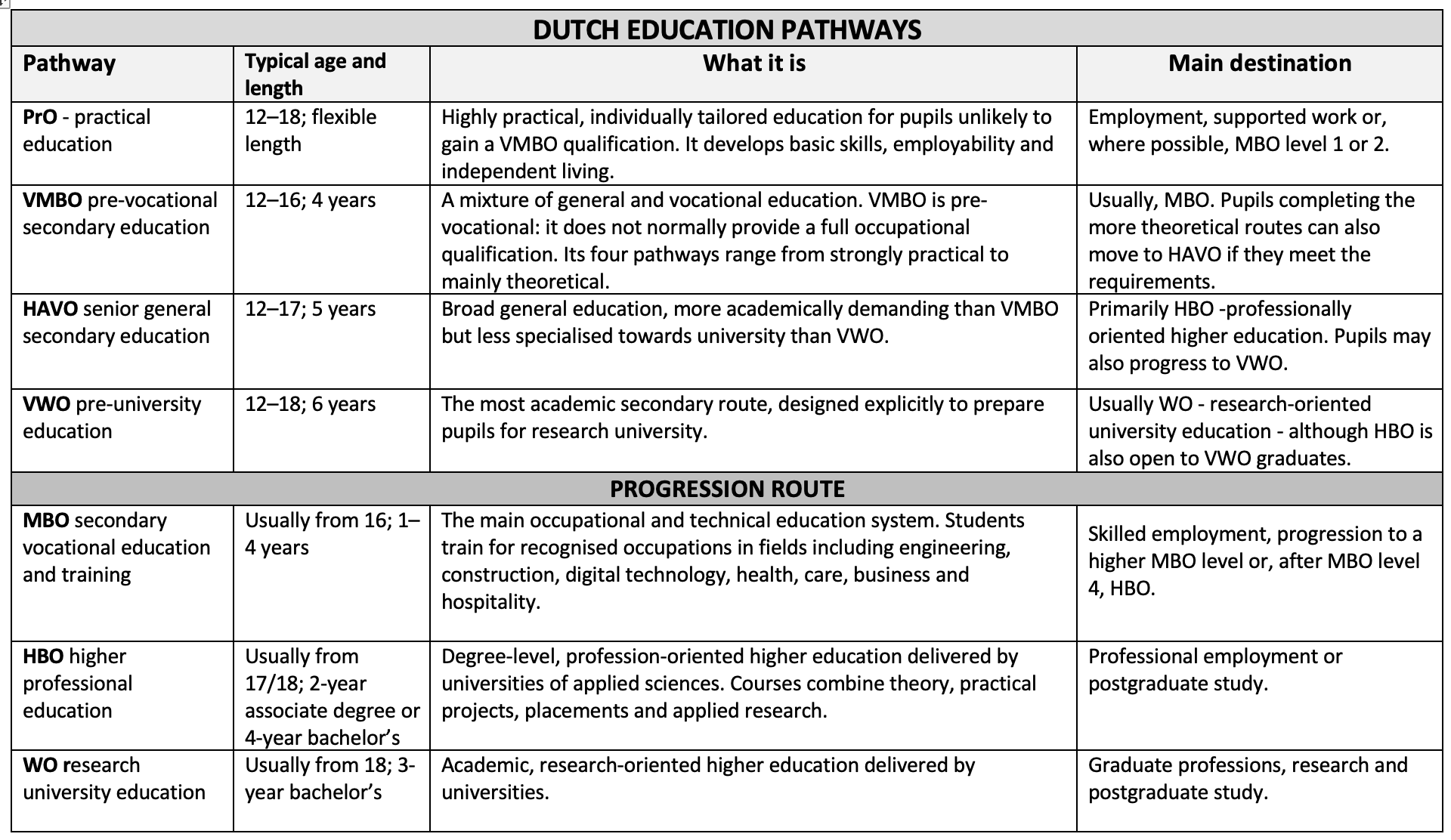
One student explained:
“It’s not about, oh, you’re in HAVO so you’re better than me. I don’t think it’s like that. It’s just a different kind of level. Yes, it is harder, but it’s not better.”
Another gave the clearest statement of the Dutch vocational ethic:
“MBO is meant more for people who do practical things, and they teach it as such. HAVO is a mixture between the two, and VWO is more theoretical teaching to become doctors, dentists. People from MBO typically can do electrical work or plumbing, and those jobs are respected because they earn a lot and they’re certified. So it’s not like they’re dumb or anything.”
One student commented:
“The system allows it so you can always progress up to university and there’s never a stop point. There are just pit stops, and those are quite nice to have.”
If someone leaves without a startkwalificatie, (starting qualification) the Doorstroompunt (“progression point” or “transition service”) tracks and offers support to help them return to education or move towards sustainable work.
The central Dutch idea is that completing compulsory schooling is not enough, young people should leave with a qualification that has recognised labour-market value.
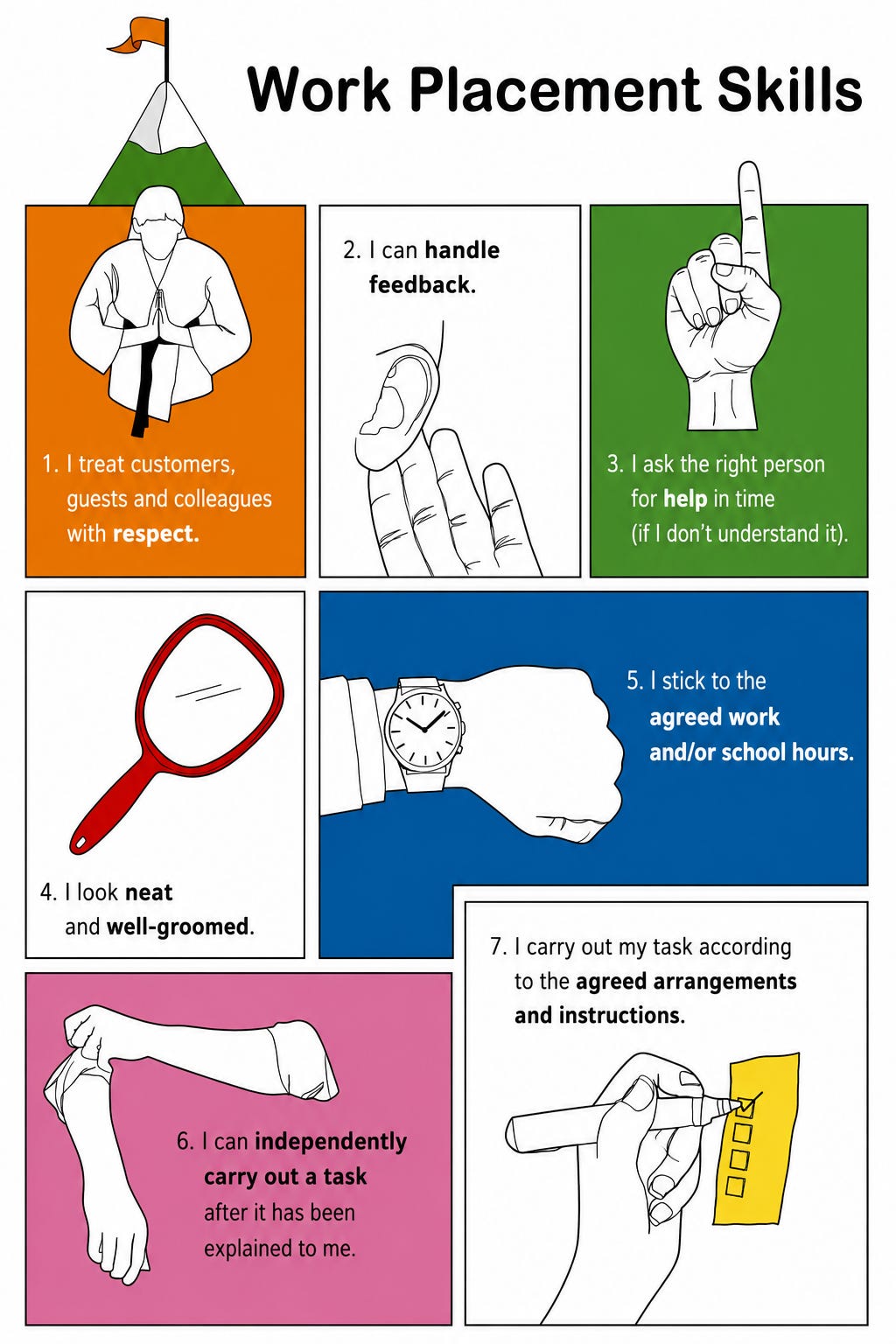
One of the most striking contrasts with the UK is how normal it is for Dutch teenagers to do paid work. Students talked about working in supermarkets, restaurants, bakeries, beach cafés, laundries, babysitting, and helping family businesses. And there was a value placed on work by young people from all the way up the income scale.
“I first started in the supermarket when I was 16, and then at 17 I did restaurant work for quite a while.”
“I started at 15 at a restaurant at the beach. It was just a summer job, worked for two months.”
“I was 15 and I worked in a bakery.”
But the important point is not just that they worked. It is what work taught them:
“Definitely a lot of responsibility for being on time. You have the pressure of doing stuff right and not missing out. I worked with food and customer service, so it was always really stressful. It teaches you to perform well under pressure.”
Another student said work taught:
“Responsibility, independence, and also how to manage your money and how you spend it.”
And one reflected that work changed how they saw adults:
“I started to see other working people not just as background characters, but as real people.”
Work is a key part of teenage life. It provides, they said, money, esteem, confidence, realism, empathy and respect.
The most powerful Dutch lesson is that no single service can solve the Neet problem. Jongerenpunt070 described the need to form a “circle around the young person”:
“We are from the municipality. Then you have the care, healthcare, physical or mental. And then you have the social workers in certain areas. And we all work together. The trick is to combine all the expertise so you form a circle around the young person, so you can work at the same time at many problems.”
That is the central message. The UK does not need a system that only intervenes when a young person is Neet. It needs one where every young person has a route to a working life that has status and purpose. Where young people get a taste for work early. And where those who struggle at transition points are spotted in time and have an adult who sticks with them and helps them find their feet.
Every country is different, every context is different. But we can surely learn from the success of the Dutch and move towards a system that is joined-up, relationship-led, data-informed, neighbourhood-based, practical, flexible, and multi-agency.
One million young Neets in the UK, and the many coming up behind them, need us to get this right.
Comments
Nothing yet. Say the first thing.
Sign in to join the conversation.