

“As a nation, we continue to put roughly a third of young people on the useless tip, and we’re happy about it. Or rather, those who exercise most influence are happy about it. I’m not.”
Sir Mike Tomlinson, 27 July 2026
“The biggest mistake the Blair government made was not to do Tomlinson. It could have been carried through, and it would have been a tremendous reform.”
Former Education Secretary, Charles Clarke who commissioned the Tomlinson report
It’s the biggest regret of many in the last Labour government that we failed to implement the Tomlinson report into 14-19 education published in October 2004.
In a nutshell it proposed:
Replacing England’s fragmented collection of academic and vocational qualifications with a single, coherent 14–19 Diploma framework combining a common core of English, maths, digital, personal skills and extended project with substantial academic or technical specialist learning. Its aim was to raise participation and standards and create clearer progression for all into university, apprenticeships and work.
If it had been implemented over 10 years, as was planned, (we would now be in the 10th year of it bedding in) I am certain we would not have more than one million young Neets, a persistent absence rate in secondary schools of a staggering 23%, only one in five pupils saying they were very motivated to learn, nor a total failure to close the achievement gap between the richest and poorest pupils.
Today we need to resurrect that report, modernise it, and implement it with skill so that we do right by the next generation.
I have tried to piece together what happened in those fateful months in 2004 and 2005. Inevitably, twenty years on, there are different recollections from the key players. That’s why this week I visited Mike Tomlinson at his home in Nuneaton to find out more – and to get his candid view on what we should do now.
Tomlinson is a respected educationalist and former Ofsted chief. He was a chemistry teacher and pioneered partnerships between school and industry. He was asked to review 14-19 education by the Education Secretary Charles Clarke and Schools’ Minister, David Miliband.
He had agreed with both Clarke and Miliband that he should try to build cross-party consensus, and they were happy for him to provide the opposition leader Michael Howard with the final report a couple of days before publication.
Tomlinson told me:
“I delivered the report to the then Conservative leader with the strict instruction that nothing in the report was to be made public before it was laid before Parliament - but it gave them enough time to make an informed comment on it. But Michael Howard couldn’t resist, and therefore literally hours before it was launched, Michael Howard made a speech in which he said basically that the Conservatives would defend A levels to the hilt, and he mentioned Middle England, as he was prone to do.”
His intervention and the scepticism of the CBI, who had been supportive all along but on the day pulled back, spooked Tony Blair. It was post-Iraq and the government was on the back foot. The election was around the corner and he decided the fight was not worth the political capital.
Tomlinson urged the politicians not to respond definitively on the day the report was published but to rise above the politics and let the report land. But that didn’t happen.
We lost the argument that evening. I was at a wonderful party for all of those who’d been involved and consulted, and we’ve got Charles and David standing up saying we’re going to implement this. Within an hour or two, Blair had stood up and defended A levels – he felt he had to counter what the Conservatives had said, and that was when it died.
Charles Clarke believes he could have still won the argument and that over time Blair was persuadable. But very soon afterwards Blunkett resigned as Home Secretary, Blair made Clarke his replacement and Ruth Kelly took over as education secretary. David Miliband in turn moved to the Cabinet Office to write the manifesto. The two main advocates for reform had gone. The white paper that followed in March contained some important elements of the Tomlinson report, but not the single diploma and the architecture that would have brought academic and vocational education together into a holistic system for the first time.
It was not until Rishi Sunak launched his Advanced British Standard before the last election that a political leader, ironically a Tory, had the guts to signal the replacement of A levels with a broader offer, (though this too had little to say about technical education). In the intervening years there have been T levels and now V levels but still no unified system, nor a properly signposted alternative to university. That is why there is a broad consensus for change; a recognition that the Neet crisis is too deep, the waste of talent too great, and the economy in desperate need of skilled employees.
Andy Burnham, the new prime minister, building on his MBACC reforms in Manchester, as well as examples across the world, has made a revolution in technical education one of his top priorities.
So, why is it worth looking at the Tomlinson report again? The simple answer is that it tackled a lot of the questions we are still asking today. Andy Burnham doesn’t need to start from scratch. He can take over where Tomlinson left off.
The Tomlinson report attempted to tackle six imperatives.
1. Raise participation and achievement – by tackling the educational causes of disengagement and underachievement and low post-16 participation.
2. Get the basics right – ensuring that young people achieve specified levels in functional mathematics, literacy and communication and ICT, and are equipped with the knowledge, skills and attributes needed to succeed in adult life.
3. Strengthen vocational routes – improving the quality and status of vocational programmes delivered by schools, colleges and training providers.
4. Provide greater stretch and challenge – ensuring opportunities for greater breadth and depth of learning. This will help employers and universities to differentiate more effectively between top performers. Stretch and challenge at all levels will encourage young people to think for themselves and be innovative and creative about their learning. Far from dumbing down standards, Tomlinson aimed to stretch the most able academically by allowing them to go way beyond the constraints of exam requirements and for example, take modules of university work while at school.
5. Reduce the assessment burden for learners, teachers, institutions and the system as a whole by reducing the number of times learners are examined
6. Make the system more transparent and easier to understand by rationalising 14-19 curriculum and qualifications within a diploma framework, where progression routes and the value of qualifications are clear.
As you can see, Tomlinson had high expectations of all pupils and rigour in demanding the basics for all and real stretch and challenge. It’s hard to argue against these six points still being just as relevant for reform today. And it’s depressing to think that we have made so little progress on them in the intervening 20 years. Today, however, with the AI juggernaut hurtling towards us, there is an additional requirement: to future-proof the curriculum for the changing world of work.
The one regret Tomlinson had was in not starting from a compelling opening statement of what education is for in his report. In his view, this would have helped to win the argument. He told me:
We should have started with what it is that we want. What should schools be doing to produce the sort of young person that will be moving to adulthood? It’s a simple question, but it needs answering because at the moment we haven’t got an answer for what our education system should be about. It’s not an inclusive system and that doesn’t mean that the excluded are always the least able. I think it would have been wiser if we had started from the end rather than from what we wanted to change in the present system.
As soon as you start to draw up a picture of the 18-year-old you want to emerge from 14 years of education, you realise quite how far away our current model is. That’s why it’s the vital first stage of any reform.
My favourite definition of the purpose of school comes from a group of teachers in 1959. (From The Education of the Average Child written by Albert Rowe) In one way it is dated (not least the use of he throughout), in another, it still has the breadth of ambition that feels a million miles away from today’s transactional, exam-obsessed system.
‘A pupil should be alive and alert, and interested in himself, his fellows and his surroundings. He (she) should be flexible and adaptable, able to cooperate with others, but able also to stand out against others when he believes he is right. He should be active, able, willing to work hard and eager during his leisure to cultivate his personal pursuits. He should be morally and socially sound and responsible, not anti-authority or too accepting of the established mores of society, but properly critical of them. He should be a giving and caring person, wanting to give as well as to receive, and recognising that one of the most deadly poisons in our society today is the “couldn’t care-less” doctrine. He should be as literate as his intellectual powers permit him to be, as fully informed as possible about the world in which he has to live, and able to find things out for himself and to form a balanced judgement on them.’
Where is such a statement of intent today? It certainly wasn’t included in the recent curriculum and assessment review. Without it, we are having sterile arguments about false binaries: knowledge versus skills, academic versus vocational. We need to shape and education system that truly prepares young people to flourish in life and work.
Tomlinson’s humanity comes across in his reforms and was immediately on show when I talked to him.
Why do we have so many kids who hate school? Why do we have so many kids who, at 14, bunk the system?
The whole point of the reforms was that we were recognising that the development of a young person could not be achieved solely through qualifications.
Tomlinson spoke movingly to me about one group of fifteen 16-to 24-year-olds (the Neet age group) who he met as part of the review, not one of whom had any form of formal qualification to their name:
It was the most challenging session I ever had because the crux of what they were saying was a unanimous view that never, ever in their school life, had anyone said you’ve done something right. They said it was just a barrage of criticism. Nobody’s ever told us that we could do something well or had done something well. You know, you were almost brought to tears by them, and I was really affected by that group. I still am. I would fight tooth and nail for them.
The Tomlinson report proposed a common core – the compulsory foundations for a good education for every child.
These are his six headings with my comments on how they could be taken forward today.
(i) The importance of functional mathematics, functional literacy & communication
Tomlinson told me:
“We had evidence that GCSE mathematics and GCSE English did not make young people numerate and literate.”
This is still the case.
“It is not the proportion that get English and maths at grade four or above, that matters most, but the proportion of young people who satisfy the functional literacy and functional numeracy demands. The easiest way to resolve it, and I hold still to this today, was that young people could sit the functional mathematics and the functional literacy at any point in their educational career.”
We need urgent action on this to ensure every young person is able to pass a basic literacy and numeracy exam before they leave school so they are not trapped in an endless cycle of resits.
Tomlinson was ahead of the game on oracy (communication) too, believing it was crucial to a young person’s development and should be included in the core.
(ii) Functional ICT (we would now include AI)
This is obviously even more important today than 20 years ago. Everyone needs to be competent and confident in understanding and using technology, particularly AI. They should have time and space to experiment, to wrestle with the ethical dilemmas and to understand how it both helps and hinders learning and creativity. The ICT curriculum has been woeful for decades and it was another weakness in the recent curriculum review that the march of AI was not properly addressed.
(iii) An extended project
“A major feature of our proposals is the inclusion of an extended project as part of core learning. Selected by the young person to pursue her/his interests and extend her/his learning in creative and innovative ways, it may take a variety of forms from an essay to a performance or artefact. Its completion will enable learners to develop and demonstrate a range of generic skills, such as problem solving, research and managing their own learning.”
The extended project qualification (EPQ) was a legacy of the Tomlinson report. It is a highly respected qualification - that young people of all abilities can take - and has three levels. 35,000 young people take it each year. The top level is worth half an A level and many universities think it adds an important dimension when selecting candidates. I have had the pleasure of mentoring students who loved the autonomy the project offered them. It is incredibly rewarding for the students, giving them the chance to really follow a passion and create something they are truly proud of – something that too rarely happens in school.
One of the added benefits is that the project would be marked on the thoughtfulness of the process not just the end product, with an oral presentation and questioning marking its completion.
It is now time to make an extended project compulsory for all young people.
(iv) Common knowledge, skills and attributes (CKSA) and personal review, planning and guidance
The Tomlinson report wanted learners to experience “a range of common knowledge, skills and attributes (CKSA) which should be integrated into all 14-19 programmes but with no requirement that they are separately taught or assessed. In addition, learners should be supported in reviewing their learning, with guidance to help them make choices about further learning and careers.”
Today employers are looking for critical thinking, creativity, curiosity, collaboration and great communication and oracy skills. These should be woven throughout the curriculum and embedded in subjects.
Careers guidance and a genuine range of pathways should be signposted for pupils earlier. I found in my conversations with young Neets across the country that technical options are often ignored and at 16 a pupil is too often told to show up at the local college without any guidance at all.
(v) An entitlement to wider activities and experiences
Again, this has even more salience today. Tomlinson says that all young people should have access to a wide range of sporting and cultural experiences and crucially also, to work experience. Young people need opportunities to be off their mobiles and enjoying real world activities. Schools and the wider community have an obligation to provide a richer set of opportunities for every child in every postcode. The government’s upcoming enrichment strategy will be important in taking this forward.
Tomlinson wanted young people to get recognition for all these elements of the core curriculum.
He proposed that diplomas would exist at four levels: Entry, Foundation, Intermediate, Advanced.
“Programmes shouldn’t be tightly age-banded: learners should enter at the right level, progress at their own pace and could leave and re-enter with credits.”
This is recognition that having one high-stakes moment at 16 that determines your future makes no sense when so many teenagers mature and develop their learning at different paces.
There would be three pathways:
(i) Academic
(ii) Technical (in schools and colleges)
(iii) Apprenticeships (in workplaces)
There would be proper progression routes for each pathway. As Tomlinson told me:
The problem with so much of our vocational education is that there is no continuity, no progression possible. You come to a bloody great end at level two, and there’s no level three to continue on. I’d want to ensure that within the technical route there are opportunities for progression to level three and beyond. It is unfair to set a kid on a pathway at 14, knowing that there’s nothing they can do at 16 that is continuity. I think that is morally indefensible.
Crucially, all the pathways in his plan would be flexible and there would be the option of moving between pathways. There would also be the chance to combine academic and technical in a blended pathway. Indeed, there is a case for saying this should be for the majority.
This is vital for countering the argument that some young people, particularly those from working class backgrounds, might be pushed into a vocational pathway despite being capable of getting to university - and be stuck there. Similar to Germany, Netherlands and Switzerland, Tomlinson wanted a pupil to be able to have the choice to got to university whatever pathway they had started out on.
Tomlinson proposed a learner transcript to capture the full range of every child’s achievements. This is something I have made the case for, with others, over the last few years (and I will write more about it in a separate Substack). I must confess I had not realised Tomlinson had recommended it more than 20 years ago. The idea is simple. Instead of leaving school with merely a set of letters and numbers (in the case of a third of pupils, not very good ones), young people need a record of all their strengths and achievements.
Tomlinson proposed a detailed transcript that would include:
all components, credits and grades,
wider activities and skills developed,
additional achievements beyond the classroom
with all linked to a rich portfolio containing work samples, projects etc.
This is now being piloted in schools across the UK, extensively in Scotland, as well as across the world, for example Australia. Some will remember a paper version of this called Record of Achievement. Today, with digital technology, the whole process is a lot easier and this is a reform whose time has come.
Tomlinson proposed that assessment should be conducted “through a range of different styles including time-limited tests and examinations, set assignments, and practical and written tests and observations, some of which should be externally assessed, both to reinforce teachers’ own assessments and to aid national monitoring of standards.”
He believed young people are over-examined – and they are. He believed too, that they should be able to accumulate credits between 14 to 19, often when ready, and not all in one go at 16 when you are forced to sit 30 to 40 exams in a month
That credit system was also crucial in allowing young people who stop a course halfway or move to another school to bank the credits and not have to start from scratch as is still the case today.
Today GCSEs are marked with a system called comparative outcomes which standardises each year’s results against previous years with the result that roughly 30% of pupils are branded a failure year after year. The last three years’ results are proof of this. This is the percentage who have passed:
2023 70.3%
2024 70.4%
2025. 70.5%
Even the architects of this system admit this has disproportionately hurt working class pupils.
Tomlinson admits that the future of GCSEs was left unresolved in his report. But the implication was that in the long-term they should be abolished. It’s clear that in a 14-19 system you don’t need a high stakes school leaving age exam at 16. Over time the government should consider having a far lighter check at 16 – that includes functional literacy and numeracy. In reality if GCSEs still exist in their current form in 10 years time, we will have failed to make the far-reaching reforms the country needs.
And one change that will make it easier to reform GCSEs, is to move to post qualifications admissions (PQA) which means you apply for university after you’ve got your A level grades or equivalent technical qualifications. That way, GCSEs stop becoming essential to university entry.
We need to be honest about the ‘parity of esteem’ argument that has plagued the education debate for decades. Many politicians, indeed, many parents, believe that there is a clear division between the ‘clever’ who go to university and the rest who make do with something vocational to occupy them.
While government can’t mandate what has esteem and what doesn’t – a view shared by Tomlinson – it can and should produce technical pathways that are such high-quality and high status and lead to well-paid careers - that young people from all backgrounds want to take them.
At the moment, one of the reasons for the condescension towards vocational education is that the comparison is often between a high-status academic education and low level vocational or technical education. But as one FE leader said to me the other day, it becomes a different story if you are comparing a regular graduate on the one hand and Gordon Ramsay on the other.
We need to be careful with the ‘graduation cap versus hard hat’ comparison in Burnham’s announcement this week. While we want and need more people in trades such as plumbing, bricklaying, technical education is so much more than that. As Burnham has said himself, it “includes advanced manufacturing, AI, digital and technology, clean energy, life sciences, construction, health and care, or the creative industries, depending on local strengths and where the jobs of the future are being created.”
What is rapidly changing the whole parity argument is that work is changing – not least because if AI. All jobs combine thinking and doing. And all young people need to do both academic and technical education while at school. That is why an overarching qualification – not separate lanes – must be the right long-term approach.
What matters most is that all young people, whatever their background, need a real choice - the chance to go to university, the chance too of a high-quality technical route. They are not in opposition to each other. Both are needed. Both should be high status. That is surely not too much to ask.
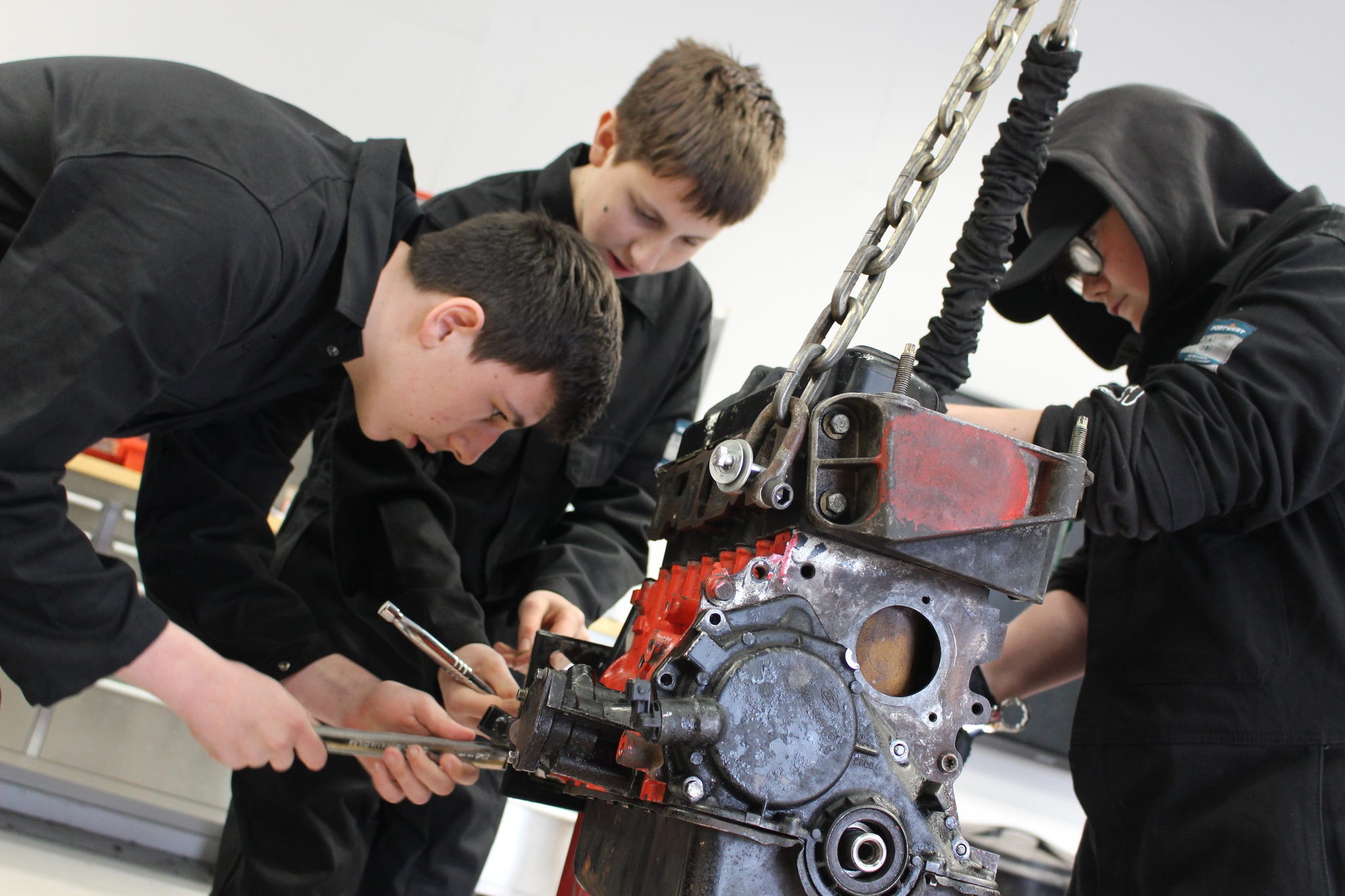
Getting more technical education into schools, not least from 14-16, is difficult and over time will require a lot more funding for facilities and better relationships with FE colleges. In my experience, what often happens is that pupils go to the local college for two days a week but that could fall on the days when they will miss a lot of english and maths lessons and so fall further behind in the basics. So there is a big timetabling challenge.
There has also been a cut-back in the amount of exposure of young people to the workplace with many of the young people I spoke to as part of the report Inside the Mind of a Young Neet, having done none at all. Work experience needs to become compulsory in the future.
But since Tomlinson published his report, new models of technical education have emerged as well as excellent partnerships between schools, FE colleges and businesses. They point the way to what the future might look like and need to be developed urgently.
UTCs
Former education secretary, Ken Baker, has been behind the growth of University Technical Colleges that provide industry -linked technical education from 14-19. After some teething troubles, they are now in many cases a model of the kind of education Burnham is looking to promote. There are currently 44 of them serving more than 20,000 young people.
UTCs are state-funded, all-ability secondary schools that have a core academic curriculum, normally English, maths, science and other GCSEs or A levels. The key is that they have a substantial technical specialism, such as engineering, advanced manufacturing, computing, cybersecurity, health sciences, construction, energy or creative media. They offer technical qualifications and practical work using industry-standard equipment. Employers offer a rich mix of projects, mentoring, workplace experience and careers activity. Each UTC is supported by at least one university and a group of employer partners. Universities contribute to curriculum design, governance, specialist teaching and access to facilities, employers help design and deliver projects and provide insight into real occupations.
For many young people, particularly disaffected boys, UTCs have given them a new lease of life. They have purpose, they feel they are treated more like adults and the things they often found hard when taught in isolation – like aspects of maths – suddenly become easier to grasp when linked to a real world problem.
The UTC sleeve
This is a new development. It is recognition that there are not always the resources to set up a brand-new UTC so instead there could be a ‘sleeve’ or unit within an existing secondary school offering a group of pupils a similarly high-quality technical education. In practice this means spending time in workshops and laboratories, and working on practical projects often set by employers. In addition, pupils receive careers guidance, work experience and employer mentoring. They also continue studying essential academic subjects such as English, maths and science.
Industry sixth forms
The model is best described as an industry academy: a small, specialist post-16 institution that attempts to reproduce the culture, working practices and expectations of a particular sector. There are some stand out examples like the London Screen Academy and East London Arts and Music as well as Ada, which specialises in digital skills. While a normal sixth form begins with a menu of subjects like history, biology, economics, an industry academy begins with a question such as: what knowledge, technical skills and professional behaviours does someone need to enter the screen, music, fashion or technology industries? Industry involvement is baked in from the start in terms of help writing the curriculum, setting live briefs and projects, providing mentors and masterclasses, assessing performances, portfolios or productions, offering placements and work experience, contributing equipment and facilities and helping students secure apprenticeships, employment and freelance work. The place feels like a more professional and purposeful working environment than a traditional school. At the moment, we just have a few. We could do with at least 100 of these across the UK.
So, what steps could the government take to build on the ideas of the Tomlinson report? Here are ten that could kickstart change.
1. Ensure there are progression routes and no dead-ends for all technical education
2. Fund a massive expansion of high-quality apprenticeships
3. Get all young people doing technical as well as academic work, incentivised through accountability measures and Ofsted
4. Make the extended project qualification part of a compulsory core so every young person can combine knowledge and skills, including critical thinking, problem solving and oracy, in an area of interest
5. Make work experience compulsory with Mayors partnering with employers to create high-quality placements.
6. Invest heavily in existing successful models such as UTCs and industry based sixth-form colleges.
7. Fund more pilots into a learner transcript for young people
8. Make functional literacy and numeracy - not GCSE maths and English - the key passport for the next stage
9. Give recognition – including digital badges/credits - and a boost to all the non-examined enrichment activities young people do inside and outside school
10. Invest in new models of assessment and curriculum and harness new devolved powers to create a culture of innovation and new thinking
All of these ten points could be steps on the way to a new 14-19 landscape, a modern version of Tomlinson.
But none of it will be easy.
Let’s go through some of the arguments that opponents are already putting forward.
First, there is the perennial ‘dumbing down’, ‘soft on standards’ argument. Former education secretary, Michael Gove recently branded technical education - as ‘bring back stupid’, showing an inability to acknowledge the possibility that you can have rigour in history and science and rigour in engineering, plumbing and robotics. He does not address the one million young Neets, many of whom want to get high-quality technical training to set them up for well-paid job.
Second, there is the logistical argument. It’s too expensive, it’s too hard to do both academic and technical in one school, so let’s not bother. There are logistical issues. But the fact that it’s difficult, is surely not a reason to abandon the idea. Many European countries do it well, surely we can too. There are, as this piece suggest, promising examples of how technical education is already making a real difference.
Third, there are those who just defend the status quo - ‘it’s the best we can do, so let’s not rock the boat’. They ignore the third who fail GCSEs each year, and turn a blind eye to the one million Neets, the levels of school absence, the polling that suggests motivation and engagement is low, and the employers that say that school is not preparing young people for the future.
But this time, I sense growing confidence to counter these arguments and a prime minister who wants to make change happen.
I’ll leave the last word to Mike Tomlinson.
“People have said to me, ‘How do I feel about it not being implemented?’ My answer has been, Well, as a child I would write a list of what I wanted Father Christmas
to deliver to me, but I knew that I wasn’t going to get it all.”
For the sake of the next generation, now is the time to implement a modern version of
the Tomlinson report.
Comments
Nothing yet. Say the first thing.
Sign in to join the conversation.