
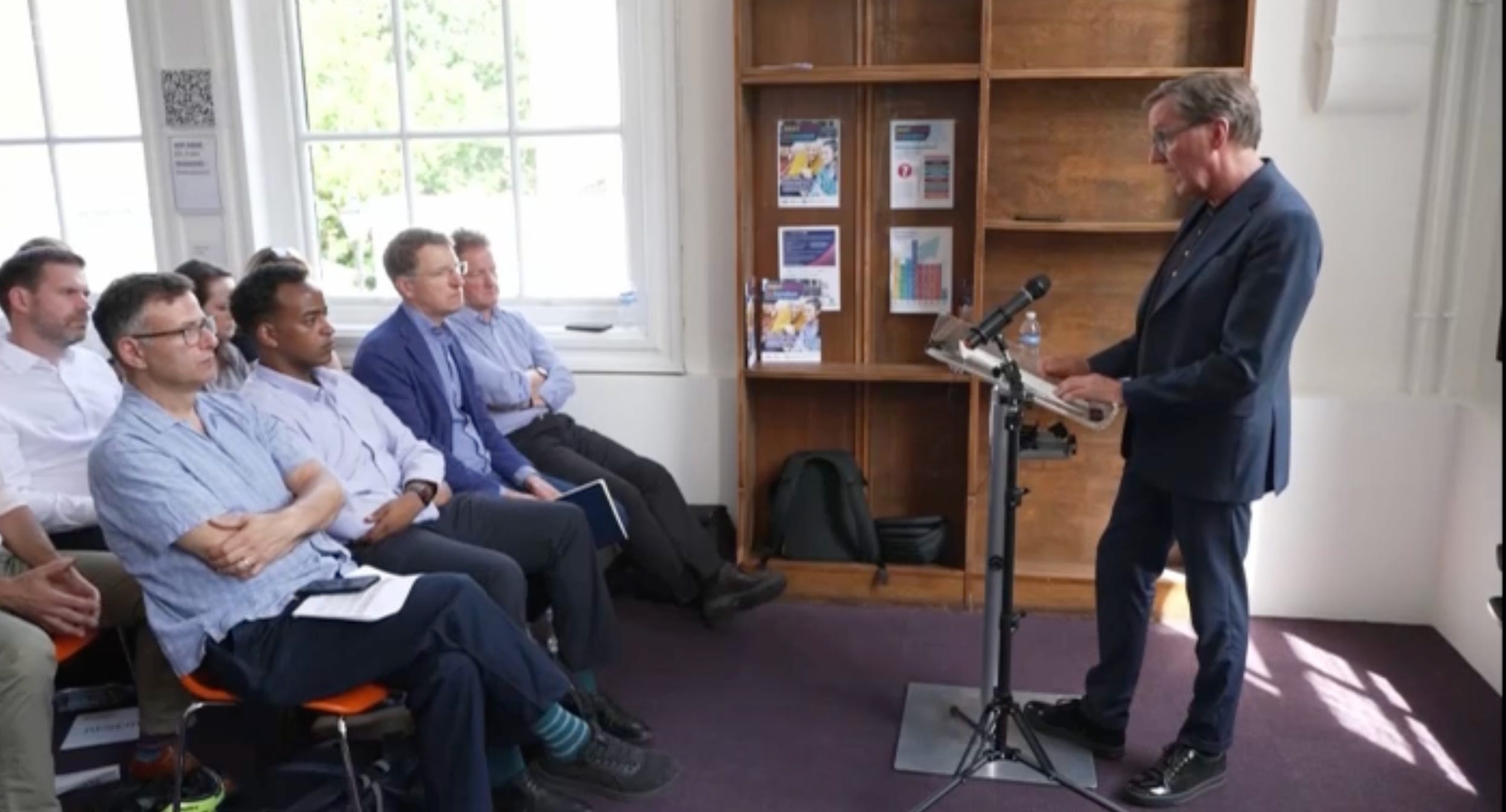
Mission-led government, built by the Labour Party in opposition, killed off in government, was briefly resurrected this week with the publication of Alan Milburn’s diagnostic report into young people aged 16-24 who are not in education, employment or training (Neets). His review is in two parts, with the solutions report coming in the autumn.
This was also the week Britain passed one million young Neets, a grisly landmark.
Secretary of State for Work and Pensions, Pat McFadden, deserves huge credit for appointing Alan Milburn to lead the review and to power ahead with welfare reform - knowing he would be truly independent, not pull his punches and at times say uncomfortable things for the government.
Milburn is providing a masterclass in how mission-led government could be done.
Mission-led government starts with a thorny problem and a big goal. The thorny problem: one million young Neets. The big goal: Neet Zero, abolishing Neets.
It then needs a dynamic leader to drive the mission and ask the vital questions. This is what Milburn did.
Is there something different about this generation or is this just a familiar cyclical problem? (Answer, yes this is different.)
Who are the Neets, by gender, geography, background, barrier to work? This data, as in so many areas in government, is not readily available.
What is the real diagnosis of what is going on? Not a collection of prejudices or hunches, but a combination of the lived experience of young people - packed with nuance and insight - and the data analytics looking at the system as a whole.
Next, Milburn built a powerful multidisciplinary team with different perspectives, with each member of that team willing to challenge each other on their findings.
Matthew Upton, the brilliant principal advisor to the review, describes it as a “a web of formal and informal networks. We asked the question: who is the best person in the country on this part of the problem? I couldn’t give a stuff who they work for. They can be inside or outside Whitehall. We needed to aim off for status quo bias and build in creative thinking.”
Upton explained that the review wanted academics and frontline experts to challenge each other and to ensure that any ideas would not fall apart as soon as they came into contact with reality. Whitehall civil servants from different departments have been seconded into a central team and are working closely together and at pace - something that is still too rare.
Upton said: “we need to let it be messy.” For me, this is a profound point about leadership in today’s complex world. Leadership is often linear and one-dimensional. It is set in tramlines and finds it hard to properly deal with complexity. Agile leadership allows for messiness. It knows that curiosity, challenge and refinement unlocks better solutions. It is a style of leadership that is comfortable with the uncomfortable – being able to sit with uncertainty until insights emerge. This kind of leadership requires courage and an intellectual confidence to let vigorous and healthy disagreements play out. It then needs real clarity to cut through the messiness and chart a decisive course.
At the heart of Milburn’s approach is getting the argument right. The argument flows from the searching questions. It is crucial to a) developing the right solutions b) building support among the public and stakeholders and c) dislodging people from entrenched positions.
Politics is all about winning the big arguments.
Milburn set out a compelling argument at the launch event which could be summarised as this:
Britain’s Neet crisis is no longer a marginal or temporary problem of youth unemployment, but a deep structural failure that risks creating a lost generation. More than a million young people are now outside education, employment or training, not because they lack ambition, but because the ladders into work - entry-level jobs, apprenticeships, alternative pathways to university, the school curriculum, work experience, mental health support and welfare-to-work pathways - have weakened or broken. The current system treats the problem too narrowly, if at all, keeping too many stuck on benefits, while failing to create real opportunities, or provide early support and shared accountability across education, health, welfare and employers.
Young people want to work and what Britain now needs is a whole-system reset: moving from a passive welfare state that manages failure to a “working state” that actively builds opportunity, participation and hope for every young person.
And because this argument is so strong and has real depth, when fielding tricky questions at the launch, Milburn was able to pivot skilfully back to the central message, the killer facts and the moral purpose behind it all.
Milburn then took the argument to the next level by turning it into a cause. This is how a mission truly takes off.
“Building a better future for the next generation can be the cause around which the whole country can unite - not just government, but employers and educators, local leaders and local charities, parents, and communities. Our country’s future relies on the next generation. It is the job of this generation to ensure that every young regardless of their background or the circumstances, has more opportunity to learn or to work. This, in my view, should be the priority for government. More importantly, it should be the priority for us all.
Mission government is also about bringing together qualitative and quantitative methods.
Shuab Gamote and I were asked by Milburn to listen deeply to young people across the country. This would become a sequel to our first report, Inside the mind of a 16-year-old and last week we published, Inside the Mind of a Young Neet.
To be clear, this is not the usual way policy is made. Again this review is doing things differently.
Listening to the ‘client’ is vital in most walks of life. In the technology sphere ‘user experience’ is at the heart of all product design. Yet in policymaking, both in government and think tanks, there is a deeply ingrained default position that the real policy work is high level data analysis and lived experience is there to ‘add a bit of colour’ or worse, deemed too particular, ‘emotional’ or unrepresentative, to be useful.
In contrast, this review has used the lived experience of young people to both highlight the complexity of the Neet challenge and to make the high-level data actually mean something that real.
The review has also listened to those on the frontline and deliberately sought to build a coalition of support that includes mayors, charities, businesses, teachers, parents, health professionals, and all the key stakeholders who interact with young people. It is this coalition that will provide national collective purpose to the mission.
The review has shown that it is possible to get cut-through media coverage without needing to have new policy nuggets or be spending money.
It is, as I have written in previous Substacks, about igniting debates that resonate with people.
Some of this is about creating phrases that encapsulate an idea, some of it about tapping into people’s views of what has gone wrong.
Here are some examples from the coverage of the last few months:
The death of the Saturday job.
The bedroom generation
Milburn rejects the snowflake generation label
Milburn’s interim review warns of ‘generational fault line’ as Neet numbers could hit 1.25 million without reform
The rejection economy
Exam obsessed schools leave pupils unready for work
Milburn is only half-way there. The really hard bit is yet to come.
Now people realise he is serious about reform, and realise too that Pat McFadden is backing him all the way, you can bet the forces of conservatism will whir into action. Like a panicky goalkeeper trying to put off a penalty kick taker, some of those who nodded enthusiastically to the claim that one million Neets are a national scandal, will fight hard to defend their patch of the current system for fear of something worse.
Failing systems are failing for a reason. People have got locked into operating within them. Those ways of working calcify. They become harder and harder to dislodge. This becomes the real test of mission-led government – can it make the goal so important and so necessary that opposition falls away? Can it combine a powerful argument, with the strength of its coalition, a set of workable solutions, and a timeline for effective execution, to drive change forward?
Here are ten things that would ensure the solutions are both radical and have a chance of succeeding:
1. Horizon scan properly. Get all the best ideas from around the world. The pool in which policymakers often fish is too small, with a lot of recycling of old policy. It is crucial that we don’t just copy from other countries but take the best of their ideas and lift them to the next level. We need a mindset not just of catch up but leap-frog.
2. Push new thinking as far as it will go. One way of doing this is to use a technique designed to enhance creativity. The aim is to take a specific lens (this can be done with more than one lens) and push its implications to the limits. It’s not that you then do everything that you come up with but the process has freed you up to be bolder. I would gather the best and most creative technology brains, particularly as young Neets are a digital cohort, and ask the question: how might technology better connect young people to work? I am sure there will be some brilliantly creative answers that include ways of motivating young people, providing advice, winkling them out of the bedroom and connecting them with volunteering, work experience and internship opportunities.
3. Test all emerging ideas with a panel of young Neets. The trap policy often falls into is to lose sight of the client in the final stretch. This is a point of real jeopardy, when policy becomes unworkable because it does not go with the grain of how people think. With young people this is a particular danger, because this is a generation wired in a different way from most policymakers.
4. Make the distinction between hundreds of small policy changes – and there will be many ideas thrown at Alan Milburn in the coming months – and the big ticket items that will really move the dial.
5. Provide a timeline for the changes with distinct short, medium and long term in mind. Reviews and commissions often have 20 recommendations with equal weight and no indication of the best sequence. It is important, particularly in this case, for the government to be able to act immediately on some of the ideas.
6. Use the traffic light model from Inside the Mind of a Young Neet to tailor solutions to young people who are close to employment (green), those who are a very long way away (red) and those who have some significant barriers (amber).
7. Understand the different pressures on small and medium-sized businesses compared with big businesses and tailor solutions to them. Small businesses collectively employ the most people but obviously find it harder to adapt to the specific needs of employees.
8. Design a clear accountability map with roles and responsibilities for all the main players – from mayors and local leaders, to businesses, government departments and charities.
9. Be clear where the biggest blockages lie and work with politicians to remove them. The Prime Minister has a huge role to play in this.
10. Keep the momentum behind the mission - energise it as a national cause and keep the voices of young people centre stage.
Making a powerful argument, igniting debates, building coalitions, getting Whitehall to work differently, listening properly to lived experience. This is how government should work. It’s what should be done for house building and knife crime, tackling violence against women and girls and reforming the outdated school curriculum and exam system.
For those, including former Prime Ministers, who say there wasn’t a plan for government, it’s worth pointing out, mission government was the plan. And as Alan Milburn showed this week, it’s not too late to bring it back.
Comments
Nothing yet. Say the first thing.
Sign in to join the conversation.