

People say Britain is ungovernable; the challenges we face are too big. That it is impossible being Prime Minister these days. Six prime ministers in ten years is all the proof you need.
But I just don’t buy it. The British state is in many ways stuck in the past, but it can be gripped.
All successful governments are in the end about talent. It needs a dynamic Prime Minister leading a group of key ministers, civil servants and advisors who are:
a) the right people in the right jobs
b) moulded into a high functioning team
c) given a powerful sense of direction and
d) empowered to lead, take risks and innovate
That requires three things for success: finding, recruiting and retaining the best talent.
Yet, each of those things is done badly in politics, and in recent years, particularly badly. There are too many incredible people who have been put off working in government. There are also too many talented people who are knocking on the door of government to offer their services but are ignored or rebuffed.
Finding talent does not just mean asking a few trusted people to cough up the names of their friends but doing a proper search beyond the usual suspects – genuinely encouraging applications from the widest possible range of backgrounds. It often requires persuading people to take a pay cut and be in the media firing line – all for the pleasure of serving their country.
Recruiting talent means having processes that genuinely try to ensure the best person for the job gets the position. One revolutionary (for government) but essential thing that should be done is to interview for all the key jobs with a proper field of applicants. And I include Cabinet posts in this.
Retaining talent means valuing people, trusting them, respecting them – and not throwing them under the bus if they make a mistake.
Large amounts of turnover suggest either bad appointments in the first place, the wrong people in the wrong roles, or a failure to treat people properly so they leave.
In politics, there is something else that can dominate and cause harm – and that is putting ideological purity over competence: better to have someone with no leadership qualities whatsoever, as long as they are in my faction.
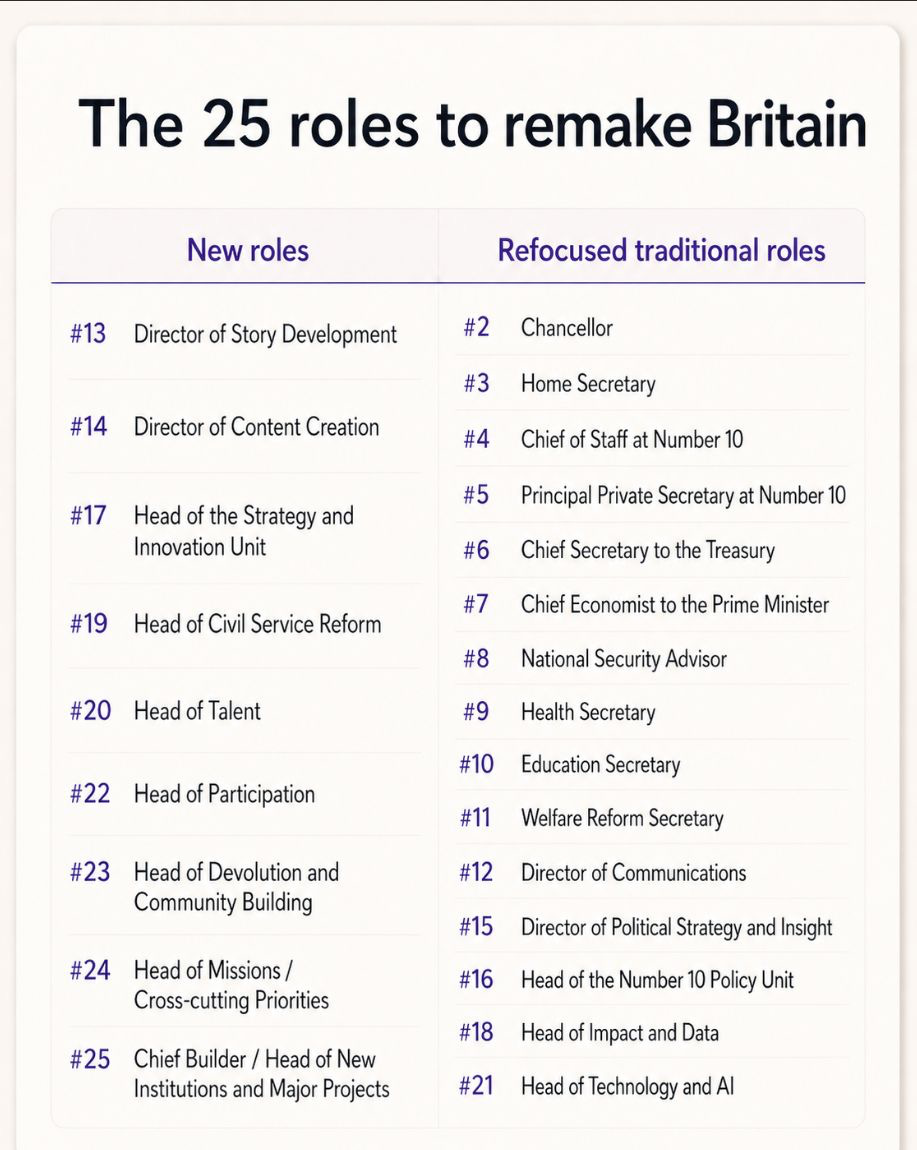
This post suggests there are a group of 25 roles which are crucial to making the British government effective. Get the appointments to these roles right, then let them build high functioning teams, and big change is possible.
Everyone will have a slightly different list. And of course, I could have named the entire Cabinet, because all of them wield immense power. I have instead chosen those I believe should form the engine of a state that could drive real change.
These will be the crucial appointments of any new Prime Minister.
For each role I outline the big change needed - changing the story - the kind of ‘A to B thinking.’ I wrote about in this Substack.
I then set out a brief job description for each. This, of course, would be shaped to the context and the political mandate of the government.
Too often roles have no job description at all, or the politician has no idea what the Prime Minister really wants from them, or the civil servant has a list of 15 responsibilities, none of which are prioritised, or the advisor is kept busy with meeting after meeting without a driving purpose.
So here’s the list. Some are about giving an existing traditional job a sharper focus. Others are suggestions for brand new roles to make government more effective (marked with an asterisk), e.g chief builder, a head of participation, a director of content creation and a head of devolution.
Changing the story: From pessimism and decline to optimism and possibility
Job Description
To set a powerful direction for the country
To understand the future and position the country to take advantage of the opportunities and mitigate the risks
To hold the space for a purposeful national conversation
To drive change with unrelenting pace and direction
To exercise sound judgement on vital matters including national security and unexpected crises
To attract the best talent and build high functioning teams
Working with a team of important growth Ministers including climate change, energy, technology business, housing and transport.
Changing the story: From a faltering economy that holds people back to an economy unleashed to grow and create new wealth for everyone
Job Description
To grow the economy
To create the best possible climate for wealth creation
To ensure every part of the country creates wealth and benefits from wealth
To ensure the tax and benefits system is fair and promotes work and higher living standards.
Working hand in glove with the Justice Secretary.
Changing the story: From fear and loss of control, to control over our streets, our communities and our borders
Job Description
To keep the public safe and promote social cohesion and an integrated society
To ensure that the criminal justice system works effectively from police to courts
To ensure the immigration and asylum system has integrity, speed and fairness
Changing the story: From noise and competing agendas to grip and a powerful sense of direction
Job Description
To grip the centre of government and make sound judgements – controlling the Prime Minister’s time, meetings, decision flow and follow-up; making sure the private office, policy unit, political team, comms team and delivery operation are aligned; and prevent drift, duplication and chaos.
To drive the Prime Minister’s agenda and turn political priorities into effective government action.
To act as the PM’s senior political operator and chief troubleshooter, managing relations with Cabinet, MPs, advisers, party HQ, and key external players. Ensure the right people are in the right jobs – including these 25. and these
To spot problems early, coordinate the response to crises, and protect the PM from political damage.
Changing the story: From Whitehall bureaucratic sluggishness to pacy, co-ordinated, timely, decision making
Job Description
To ensure Whitehall acts on the Prime Minister’s priorities and blockages are removed
To ensure the Prime Minister’s attention is sequenced on making the right decisions at the right time.
Ensure all meetings, papers, engagements are properly organised, high quality and effective
Changing the story: From managing the system to shaping a taxation and spending agenda that meets the priorities and values of the government
Job Description
To ensure that there is enough money to spend prudently on the government’s key priorities and on outputs and impact
To ensure that spending is under control
To root out wasteful spending
To make sure there is the right balance between taxation and spending.
Though for past Prime Ministers (notably Thatcher and Lawson) this can cause conflict, I believe it is important that both Number 10 and Number 11 have their own chief economist. Here I focus on the PM. The key here is that this is independent advice that is based on both expertise and an awareness of what the government is trying to achieve. He/she provides sound advice on how quickly or effectively the government can pursue its agenda, understanding the head winds, the context and the international situation.
Changing the story: From economic decline to economic renewal
Job Description
To offer the best independent economic advice – on growth, living standards, tax, spending, productivity, public investment, regulation, inflation, labour markets and fiscal trade-offs.
To shape the government’s economic strategy and turn the PM’s political priorities into a credible economic programme: what is the growth model, what are the key levers, what are the delivery bottlenecks, and where should No.10 push departments hardest?
To ensure that resources are prioritised, well spent, and if necessary reallocated. This could be a specialist appointment working closely with the chief economist.
To stress-test policies before they reach the PM or the public - acting as the PM’s internal challenge function: interrogate Budget decisions, manifesto promises, industrial strategy, upcoming risks, welfare reform, skills policy, infrastructure, housing and net-zero policy.
I have chosen the national security advisor but of course he/she is part of a triumvirate with the foreign secretary and the defence secretary.
Changing the story: From Britain adrift from Europe and America to Britain shaping new strategic, economic and security alliances.
Job Description
To advise the Prime Minister on security and co-ordinate the key players on national security, intelligence, defence and some foreign policy issues.
To co-ordinate the security machine: to bring together departments, agencies and officials across Whitehall so that threats, crises and long-term strategy are handled coherently.
To support national security and foreign policy decision-making
The health secretary and the CEO of the NHS (who it could be argued should be in this list separately) have to work seamlessly together to transform the nation’s health.
Changing the story: From a slow, expensive sickness service to a fast, responsive prevention service
Job Description
To ensure people live long and healthy lives
To transform the NHS into a modern, technology enhanced, public service
To prevent illness in the community before the need for expensive treatment in hospitals
To ensure the British workforce is healthy enough to work
Changing the story: From a system that fails to prepare young people for the future, to an opportunity springboard for every young person to find their calling
Job Description
To ensure all young people are prepared for the world they are going into
To overhaul the curriculum and assessment regime so that there are a range of high status pathways for all young people
To make lifelong learning a reality
Changing the story: From a system that keeps people – particularly young people – inactive to one that provides the dignity of work for all those who can
Job Description
To reform the welfare system to promote work and properly support those most in need
To create a system that works for young people – and Neets in particular
To end poverty
This role is changing fast. It needs someone who is pro-active not just reactive. Who is amplifying the government’s agenda in creative ways, not allowing it to be pushed onto the back foot. Crucially it is someone who gets a new comms environment in which digital, video-based content comes first.
Changing the story: From a ‘one and done’ mindset of carefully polished events to an ‘always on’ narrative that cuts through the noise.
Job Description
To ensure the Prime Minister grabs the attention of the public and tells a coherent story about the direction of the government
To ensure all events, activities, speeches, daily updates from the Prime Minister pack a punch.
To shape the message, big themes and big arguments of the government and ensure that all activities flow from them
To bring alive the central cause or causes of the government showing how its activities are values-driven and designed to serve working people
This is a new role I have written about recently, here. It sits at the intersection of policy and communications. It turns policy into debates, controversy, cut-through communications. It is a separate skills set which needs a dynamic leader and team.
Changing the story: From worthy and dull launches of policy nuggets to interesting, controversial, debating points that spark discussion of key issues.
Job Description
To create a ‘story factory’ that ensures cut through for the government’s agenda
To be the bridge between policy and communications – helping to ensure policy development has message and politics and communications has depth.
To lead a multi-disciplinary team of experts in marketing, campaigning, story-telling, news journalism.
This is a new role supporting the Head of Communications and delivering the stories that emerge from the story factory. Number 10 and all departments need to create a studio to design, video, edit, upload content multiple times a day.
Changing the story: From mainstream media first to video-led continuous story-telling
Job Description
To create a studio at Number 10 that produces rich, varied and compelling material throughout the day
To understand and shape new media activity
To provide long form – eg podcasts – and short form content for different audiences – all with the purpose of explaining the government’s philosophy, values and approach.
Changing the story: From short-term tactical politics to a long-term, strategic project
Job Description
To shape a coherent political strategy that is tested with the concerns and aspirations of working people using polling, focus groups and other methodologies
To bring together politics, communications and policy into a sustainable political project
To ensure focus, coherence and consistency to the driving central narrative and argument of the government
Ensure the government doesn’t drift away from the people it is meant to serve.
Changing the story: From being trapped by Whitehall tramlines to ensuring new thinking and ideas flourish and are shaped for maximum impact
Job Description
To curate a rich, expansive and curious intellectual conversation about ideas and policies – both inside and outside of Whitehall.
To commission new thinking and research from a range of sources.
To ensure policy has short, medium and long-term horizons and is robust, imaginative and workable.
To work with departments to shape a powerful and sustainable agenda
To join up policy across policy domains
There have been various incarnations of this role and unit under previous governments including when Labour was last in power. It is a vital role to ensure the government is constantly ‘looking around corners’ and seizing the opportunities of the future.
Changing the story: From closed, linear, predictable thinking to curious, expansive, and shaping a new set of possibilities
Job Description
To focus relentlessly on the future - spotting the trends, the coming crises, understanding the implications of major changes such as AI
To ensure government is drawing ideas and inspiration from the widest possible sources
To foster a culture of innovation - constantly testing new ideas and learning from experiments and pilots.
I have combined this role, but it could be separated into a head of delivery/impact and a head of data. The two are obviously inextricably linked.
Changing the story: From incomplete, slow data to fast, real-time data so there can be swift interventions to deal with blockages
Job Description
To create a system where all the key performance indicators for government are tracked systematically – housebuilding, knife crime, boats, etc – with enough granular detail to answer the question who, what, where, when and why are getting in the way.
To ensure that policy and legislation is turned into real impact for real people – and test that impact on the ground in communities, being clear that legislation and inputs are not the same as outputs and outcomes.
To create the processes and feedback loops to ensure precise accountability and fast action so that no blockage festers.
These are the people and teams that oil the wheels, improve systems, join up the different actors – in short help to get things done.
Without a reformed civil service, gripping the state is impossible. I have made the case for abolishing the role of Cabinet Secretary. It is antiquated and a distraction from the real and complex job of reforming the civil service.
Changing the story: from an institution constantly on the back foot to an organisation that has the skill to solve complex problems
Job Description
To reform the civil service so that it is leaner, more strategic and capable of delivering real impact
To overhaul the incentive structures for civil servants so what is valued is impact, reform, risk taking and experimentation
To create the structures for cross-Whitehall working.
There have been various versions of this role, but it needs now to be made more central, based in Number 10 and be more than ‘an appointments function’
Changing the Story: From ad hoc, last-minute recruitment to fill a gap to strategic talent spotting and development
Job Description
To ensure a pipeline of the best talent for the key roles (notably these 25)
To become a triage system to ensure offers of support are channelled to the appropriate place and harnessed
To ensure robust recruitment processes are used to unearth the best talent and to avoid a culture of favours, unsupported word-of-mouth, or poor last-minute decisions
This person needs to work closely with a chief software engineer who can tool up Whitehall to produce cutting-edge products to make govt work more effectively. eg digital ID.
Changing the story: From technology resisted or added as an after-thought to technology solutions embedded in all aspects of reform and problem-solving
Job Description
To ensure every senior civil servant, Secretary of State and Minister is equipped to make strategic technology decisions
To ensure all citizen-facing government activities use technology to ensure a fast, responsive service
To ensure all the processes and ways of working of the state are enhanced by technology and AI
A new role for someone to ensure the government is permanently engaging with the insights and lived experience of citizens.
Changing the Story: From a broken contract between politicians and the public to a renewed contract based on in-depth listening and dialogue.
Job Description
To build deliberative practices into all government decision making
To ensure feedback loops in all policy making
To ensure greater transparency in the trade-offs in decision making
A new role to lead on the centre giving away power
Changing the story: From an out of touch, over centralised state to one that is bottom-up, with power as close to people as possible
Job Description:
To shift power, wealth and opportunity out of Whitehall - to devolve as much power as makes strategic sense
To empower Mayors and local leaders to lead on growth, skills, education and opportunity
To rebuild local civic infrastructure and make place-based renewal central to the government’s mission with the tools and resources to achieve it
Changing the story: From government in silos without the right mix of talent, to mission-led multi-disciplinary cross-cutting teams making change at pace
Job Description
To build multi-disciplinary teams to tackle the thorniest problems eg knife crime, Neets, VAWG
To ensure these projects have all the resources, talent and freedom needed to get the job done
To be the champion of these projects across Whitehall and to challenge any Ministerial or civil service resistance
This is a special new role and potentially the most important. It is someone who is in charge of building the new institutions of state capacity: the new delivery bodies, new public companies, new digital infrastructure, new markets, new funding vehicles, new partnerships, new digital products, new civic infrastructure and new capabilities inside and outside the state. It is the engine of a reformed state. This role would sit at the intersection of engineering, institution-building, procurement, public entrepreneurship and delivery.
Changing the story: From a state that announces things to a state that builds things
Job Description
To ensure the government has the capability to build new institutions
To act as the Prime Minister’s senior builder: stress-testing whether the machinery exists to deliver the government’s biggest promises, and creating it where it does not.
To lead a small, high-quality, multidisciplinary team of engineers, product leaders, designers, financiers, commercial experts, procurement specialists and institution- builders.
To bring engineering discipline to government: clear goals, prototypes, milestones, accountability, iteration, risk management and rapid problem-solving.
To ensure major projects are not trapped in endless process, consultancy, procurement delay or departmental turf wars.
Of course, this list implies overly top-down government. This is not the intention. It is meant to indicate how government and the state can work more effectively. I am a huge believer in devolution – and maximum devolution – and mayors and local leaders are crucial to Britain getting back on its feet. There are clearly other vital players as well – from the governor of the Bank of England to the CEOs of key regulators like Ofgem and Ofcom. Regulators that are currently badly failing the country. And of course there are essential people to making sure legislation is passed at pace - most notably the Leader of the House of Commons and the Chief Whip.
The job of the Prime Minister is to build, inspire and hold this team to account. His or her job is to ensure that all the key people are working seamlessly together.
In today’s fast paced world, silos kill effective government. For two days a week, the majority of the 25 should be in the same open-plan office together. Those informal conversations, by-passing weeks of bureaucracy, would ensure things get done a lot faster. And the trust that would be built up from deeper relationships would ensure better working.
In the last few years, the country has too often looked ungovernable. But it isn’t. Get the talent right, build a collaborative culture, provide a clear direction – and then anything is possible.
Comments
Nothing yet. Say the first thing.
Sign in to join the conversation.