
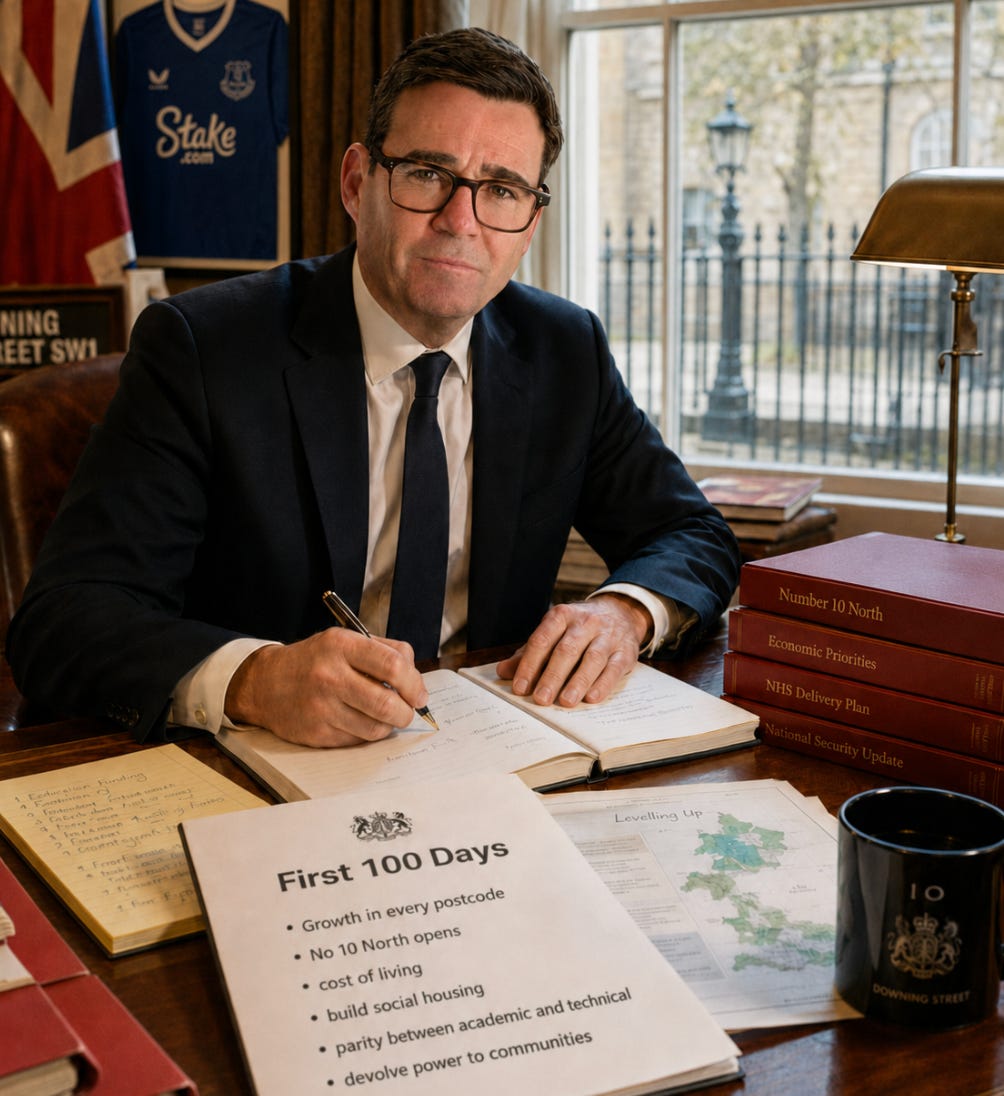
The ‘first hundred days’ have become a thing in politics. The term originates from Franklin D Roosevelt who became president in 1933 and embarked on a special congressional session that lasted 100 days in which he passed 15 major bills – the New Deal - that ensured the United States recovered from the Great Depression. Ever since, it has been seen as the model of “hitting the ground running.”
Today – the ‘first 100 days’ is acknowledgement that first impressions count. In the case of Andy Burnham – seventh prime minister in 10 years and the Labour Party deeply unpopular – this is the chance, maybe the last chance, to turn around the government’s fortunes.
There is, of course, no magic to 100 days as opposed to 90 or 110, but seeing each term (to use the unit of time I’m familiar with as a former teacher) as a key strategic period is a useful way to govern. Thinking in 100 day or three-month chunks forces the government to think beyond getting through the week.
Of course, all of these three-month periods should be part of an overarching strategy that Burnham puts together with a 2/3 year horizon, working back from where he wants to be at the next election. This in turn will need to fit into the 10-year plan that he has promised.
I used to write these strategies in Number 10. They require pulling together several inputs from different parts of the building: the policy announcements, the big events, a speech programme – all in pursuit of the key strategic objectives for the period.
Done well, the plan gives purpose and direction to Number 10 and the government. Rather than the prime minister’s diary being filled with activities from those who shout the loudest, this is a strategic way of ensuring he spends his time (his most precious commodity) in the most effective way possible.
What follows is what a three-month plan could look like; a template for the kind of short document that ultimately needs to be interrogated and then signed off by the prime minister.
This is the key starting point. What does the prime minister want to have achieved in the first 100 days and how will he measure success?
I have given some examples below of what the objectives might look like (ideally there would be 3 to 5 - I’ve done a menu of 6) and the kinds of steps that might exemplify them.
(i)To establish that Burnham is an insurgent and his government represents a ‘circuit breaker’
e.g
a. Appoint a Cabinet with the biggest reformers in the key positions and an instruction to work at pace.
b. Structural changes – reforming the centre of government plus creating task forces/mission teams to deliver the key priorities. (Instead of assuming that new Ministers and one more heave from departments will get there)
c. Make No10 North work as a new centre of power outside of Westminster
d. Signal new policy directions e.g on education
(ii)To bring to life his big idea about devolution and ‘rewiring the state’
Burnham’s big idea is to hand power back to the people and tackle an overly-centralised state. This needs to be worked into a narrative that lands with the public, accompanied by a set of speeches, activities and policies that bring it alive
e.g.
a. A new devolution settlement with new powers and resources to communities
b. A massive reduction in Whitehall numbers and functions.
c. No 10 North opened and staffed and Burnham working there each week
(iii)To demonstrate a willingness to take tough decisions
If the perceived weakness is that Burnham is not willing to take tough decisions, he can establish the reverse in the first few months. And there will be many opportunities to do so.
e.g.
a. The zeal with which he gets stuck into public service and welfare reform
b. The tough choices in the first budget
c. the message of trade-offs to the faithful at party conference
(iv)To connect with the electorate and get them to take a second look at Labour
e.g.
a. Design a new communications strategy
b. Use Labour Party conference for a reset with the public
c. Use No10 North as a platform for keeping in constant touch with the public.
(v) To show economic credibility and a plan for a new economy
e.g.
a. Deliver a successful first Budget giving confidence there is a credible economic
plan for stability and growth in every postcode
b. Unleash the power of business – particularly small and medium sized businesses - to create wealth
c. Take the first steps to making the tax system fairer
d. Take tough decisions on spending eg welfare spending
(vi) To show he is sure-footed on the international stage
e.g.
a. First meeting with Trump
b. First meeting with European leaders
c. First visit to Ukraine
d. First armed forces visit
The narrative – or washing line – is what all (or most) announcements should hang off. The narrative has to be big and go way beyond – ‘this is a cost of living government’.
It needs to capture three things:
1. The big argument about an overly-centralised state and an unequal society requiring a new politics and a new economy - connected to the future and personal aspiration
2. A story about Britain’s place in the world – how it gets its reputation back - after the last 10 years of instability
3. A personal story about Burnham and his values and purpose
The narrative should be turned into a message note that gives Cabinet Ministers the context for all their communications and shows everyone pulling in the same direction.
Speeches still matter. They are where arguments are honed and stakeholders and the public get a sense of clarity and direction. Continuous explanation (long form and short form) is essential for a government to be effective in the attention economy. For a new prime minister this is particularly important.
e.g. He should make a series of big reforming speeches in the first few months that might include:
a. How I will rewire the state
b. Why we need to rethink education providing parity of esteem between academic and vocational.
c. How I will give young people their future back – building on Neet review etc
d. Why we need to change our economic model to ensure living standards rise
e. The part you can play in renewing Britain
f. My vision of Britain in the world
There will be key moments during the first 100 days that need to be planned for. Some are already fixed: the leaders’ speech at Labour Party Conference, the first PMQs. Others are still to be scheduled (I have guessed when they might be in the table below). Some, not yet scheduled, are likely to happen in the next few months – for example, the first meeting with Trump, and the first major engagement with EU leaders.
The key is to build a strategy around them.
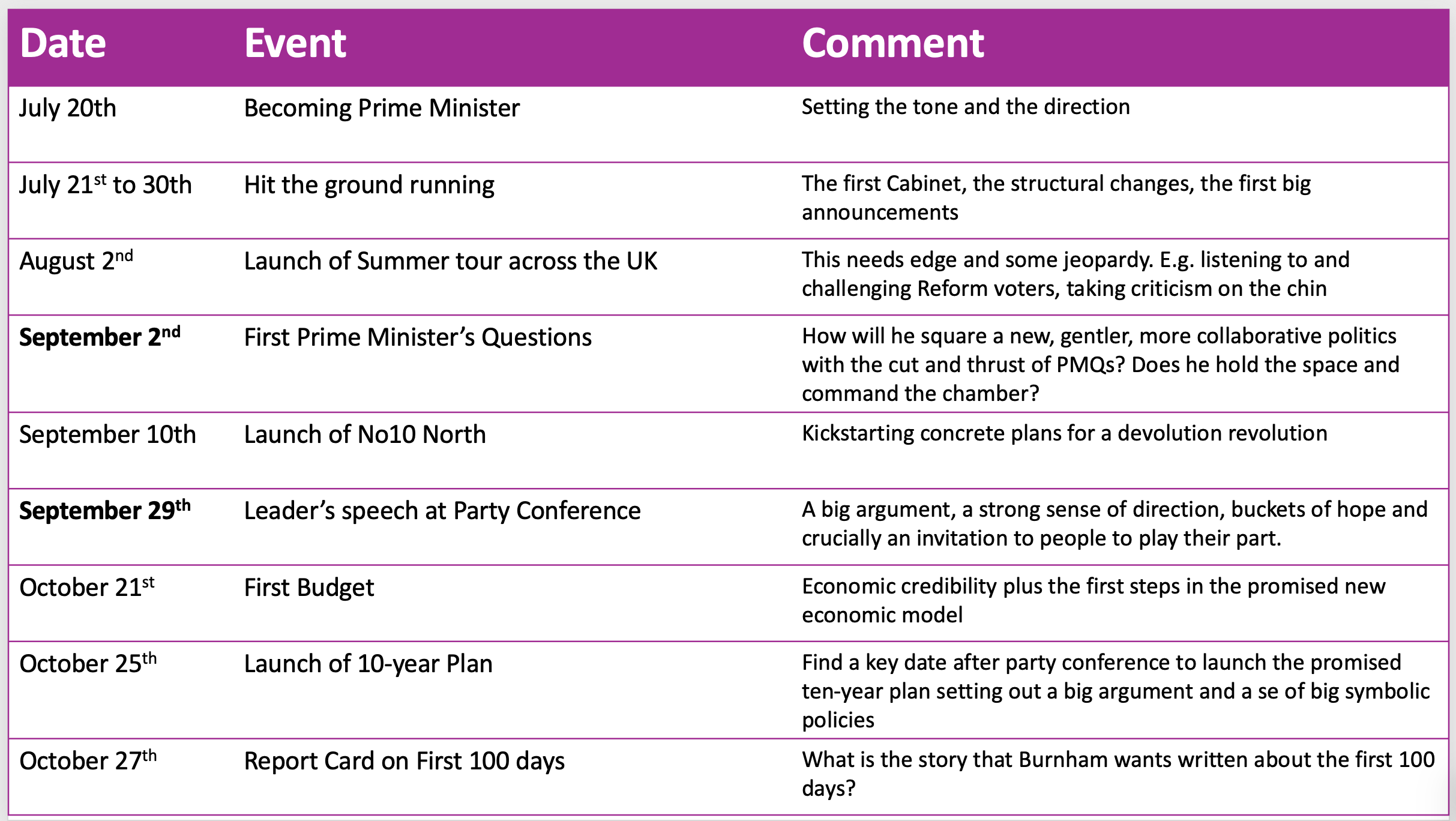
Burnham needs to define himself as prime minister before opponents do it for him.
The public do not know Burnham well. While he is loved in Manchester, the rest of the country needs to get to know him. Some of this will come in his good use of social media and his successful narration of his premiership. But there needs to be a strategic view too of how he is seen to be making the shift from Mayor to Prime Minister.
The sort of questions that need answering are:
a. How does he want to tell his own personal story - his family, his political journey, his hopes and fears, his interests and passions?
b. What media vehicles best suit his new style of politics?
c. How does he best engage with opponents? How does he demonstrate his aim of greater cross-party working? How should he handle PMQs?
d. How does he remain an insurgent and not become just another incumbent? Should he have weekly/fortnightly town hall meetings? How should he use No 10 North as an antidote to Westminster business as usual? One sign of success would be that the political lobby has to create its own ‘Lobby North’ to reflect the amount of activity going on outside of London.
What are the four or five big things that the government is fighting for on a daily/weekly basis? This is where the idea of a story factory comes in. Each of these needs a constant stream of media stories to win the argument and show progress. How does the prime minister’s diary reflect these priorities?
E.g.
a. Building more social housing
b. Growth in every postcode
c. Fairer utility bills
d. Parity of esteem in education between academic and technical
e. Reform of social care
One of the many reasons why the British government has been so unstable in recent years has been the lack of strategy and strategic capacity in Number 10. Short-term tactics have dominated over long-term strategy. Now is the time to reassert the importance of having clear objectives for each three-month period and relentlessly pursuing them. That is a good way of showing ‘grip’ and providing the clarity and purpose Britain so desperately needs.
Comments
Nothing yet. Say the first thing.
Sign in to join the conversation.