
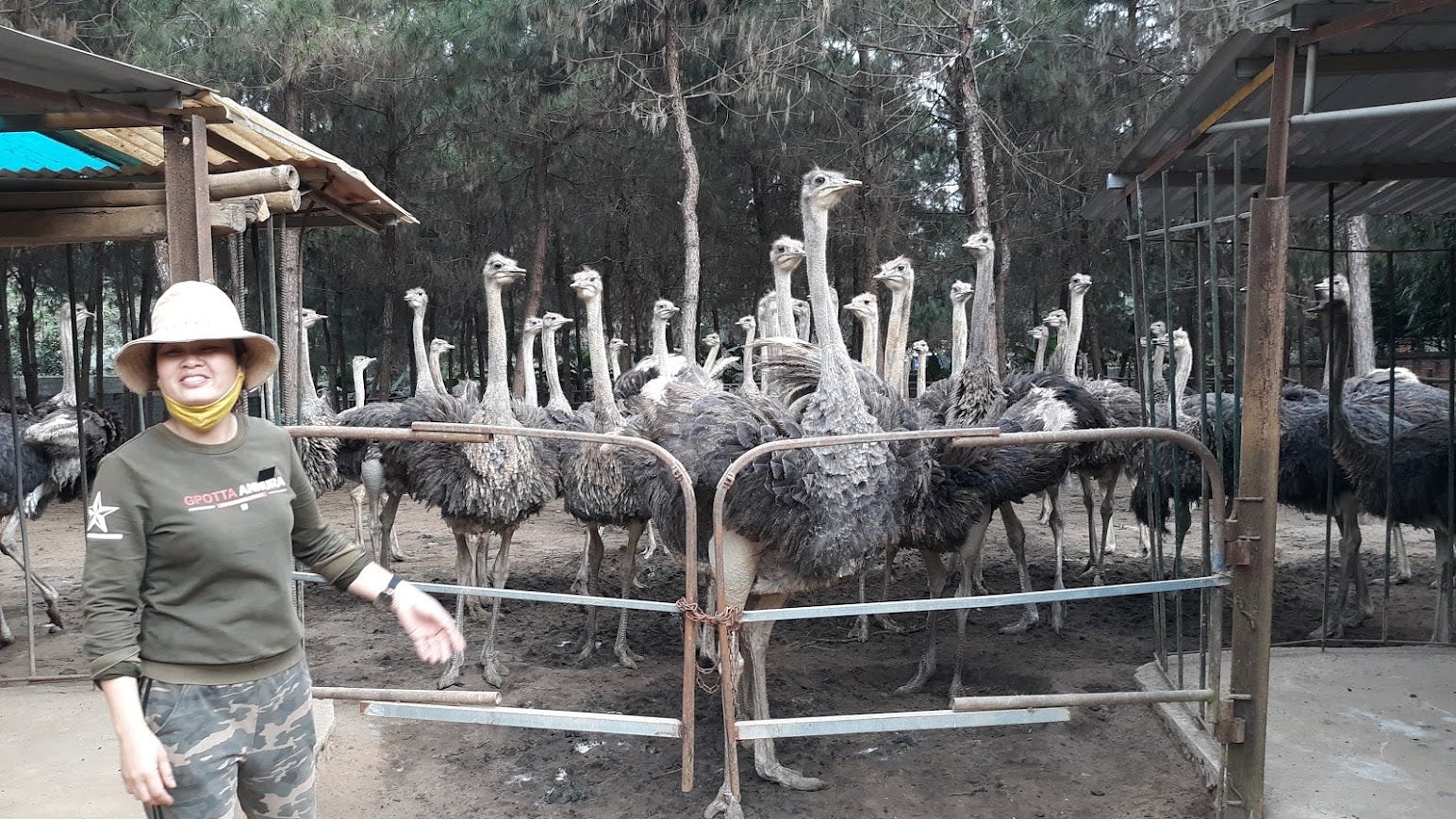
A cheerful ostrich farmer here in Vietnam. This was taken a few years ago.
Greetings,
I am still in Vietnam, keeping busy (I really considered resubmitting an old post this week instead of writing a new one, due to business), but felt people would never forgive me if I did, so here is a Vietnam related post. If you are interested, as I said, I decided it was time to start working on the book on the Chinese in the California gold rush and early American Old West. Yes, after more than two years of promising, it’s now time to start putting that book together. And there will be speaking engagements and presentations and I will share the news here as it develops.
So here’s a brief essay on ostrich farming in modern Vietnam and its history. followed by some advice on living in heat. By the way, I have not covered medical emergencies such as heat exhaustion and heat stroke and heat cramps. I recommend you go learn those on your own. This focuses on my views on prevention of heat problems.

Yours truly visiting an ostrich farm in Vietnam a few years ago. (Some people in the picture did not wish to have their photo put on the internet.)
As I assume most of you have heard, there was a war here in Vietnam back in the 1960s and early 1970s. And it was a big, ugly war where the American military industrial machine pretty much began with the premise that because we as a nation were very, very big and powerful, and Vietnam was not, we could use military force to make their nation conform to our wishes. And, it did not work, but before that was figured out, a huge number of people were killed, maimed, and psychologically scarred in all kinds of ways, on both sides,
And a lot of people, at least from the USA, sort of assume that the war was the last thing worth mentioning that happened in Vietnam. But that’s not where Vietnamese history ended. (At one time in the Old Hanoi neighborhood where many Vietnamese vendors sell t-shirts targeted to tourists and foreign visitors, there was a popular t-shirt that said “Vietnam is a country, not just a war.”) But if you want more of that, I have placed a link to an interesting video I found and watched this week that details how in 1976, a few years after the Communist takeover, the Vietnamese government decided it was time to expel any and all Americans who were still known to be living in the country, and sent them all to Bangkok, Thailand by charter plane. Very interesting. 1 It also provides some good background if you are considering researching the POW/ MIA claims, something i have written about here more than once, and wish to know about people from the USA who voluntarily stayed and tried to live in Vietnam long after the war including one soldier who had been presumed and pronounced dead. But enough of the humans, lets look at the ostriches.
Of course, a lot has happened here since the end of the war, over 50 years and half a century ago, and two of those changes are the birth of the Vietnamese coffee raising industry and the birth of the Vietnamese ostrich raising industry. Today I am going to write about the Vietnamese Ostrich raising industry and share a video on the history of their coffee raising industry.
Ostriches are really cool and funny looking creatures. They are reportedly the world’s largest and fastest running birds, and just very interesting creatures. (See https://nationalzoo.si.edu/animals/ostrich ) Not only that, and I just find this really cool, ostriches, while being more intelligent than often credited, are the only animal whose eyes are bigger than its brain. ( see https://www.nhm.ac.uk/discover/amazing-eyes-vision-champions.html )
It takes about a year to raise an ostrich chick from hatching to the economically optimal time of slaughter. Their meat is good and marketable, nice tasting if cooked properly, although it needs to be said that as a very lean meat it is unforgiving and often benefits from a marinade. The eggs can be cooked and eaten although it must be said that they are huge and when scrambled one ostrich egg is equal to more than a couple dozen chicken eggs in volume. The shells and the leather can also be used for producing marketable products such as jewelry and clothing. The feathers, of course, are also marketable. (As a piece of historical trivia, during the 18th Century American Revolutionary War, the British considered ostrich feathers to be a valuable trade and gift item when negotiating with the American Indian nations who they worked to form alliances with. Yes, way back then, there was a global trade in ostrich feathers.)
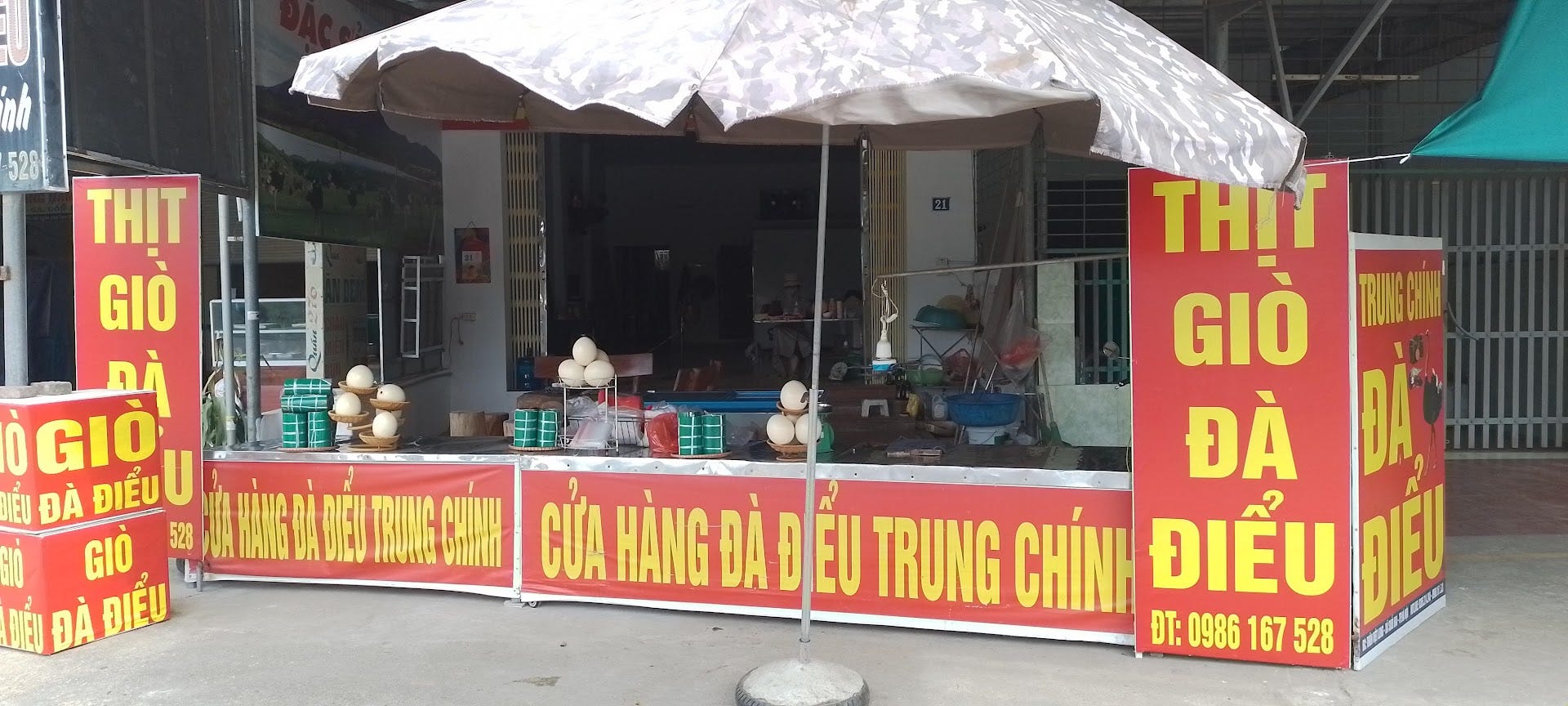
A roadside stand selling ostrich products in Vietnam. “đà điểu” is the Vietnamese word for “ostrich.” (Yes, daddio! Hip, huh? Maynard G. Krebs would be so proud. 2“Thit” is meat, and while “Gio” is sometimes translated as “sausage” instead of being cooked in a standard sausage case, the ground meat product is instead steamed or boiled in a tightly wrapped banana leaf. While such stands are not common in most places of Vietnam, they can be seen in areas where ostrich is raised.
But how did these amazing animals, native to Africa, of course, wind up in Vietnam as domestic farm animals?
There are a couple stories, contradictory stories, and while it’s difficult to reconcile them, they both date the beginning of Vietnam’s ostrich industry to 1996, 30 years ago, with 100 ostrich eggs intended for creating an ostrich farm. Of these 41 successfully hatched and this led to the start of ostrich farming in this nation. But whose idea was it? Reports vary and I am afraid deadlines kept me from digging to a solid conclusion. (At this time.)
According to an article from February 8, 2006 in The Saigon News:
In 1996, Viet Nam’s then Agriculture Minister Le Huy Ngo, during a working trip to Africa, recognized the effectiveness of ostrich farming in the continent. He bought 100 eggs. Returning to Viet Nam, he assigned the eggs to the State-run Thuy Phuong Poultry Research Center for experimental breeding. The center got 38 birds after hatching.
(see https://en.sggp.org.vn/ostrich-raising-a-lucrative-business-post1545.html )
Another story also agrees that 100 ostrich eggs were given to Vietnam in 1996, but has a distinctively different source. According to a 2008 news story in www.poultrysite.com, a leading source of news on the international poultry industry:
For the first time the Vietnamese Ministry of Agriculture and Rural Development received 100 ostrich eggs as gifts from the Tate & Lyle group (Britain), which led to the establishment of an ostrich farm in Ba Vi, Ha Tay. Since then, ostriches have developed and can be seen in over 30 provinces.
(See https://www.thepoultrysite.com/news/2008/02/ostrich-tourism-in-vietnam )
From what I have been able to learn, the Tate and Lyle Group’s primary interest in Vietnam was in sugar refining.
According to the Ba Vi Homestead website,
“History, It all began when the Vietnamese Ministry of Agriculture and Rural Development received 100 ostrich eggs as gifts, which soon led to the establishment of an ostrich farm in Ba Vi, Ha Tay. Since then, ostriches have developed and can be seen in over 30 provinces in the country.”
( See https://www.bavihomestead.com.vn/farmer/ostrich.html )
A while back I did some looking into the origins and status of Vietnamese ostrich farming, and I thought I recalled that it had something to do with Cuba and that nation’s activities in Africa. However, this week, for whatever reason, my research says just the opposite. Not only is there no evidence that Cuba brought ostrich farming to Vietnam, but when Cuba took up ostrich farming itself, a few years after Vietnam did, the Vietnamese provided expertise and education to the Cuans on how to raise these amazing birds.
Now while I do not use AI as a writing or editing tool, I have begun using it as an adjunct to internet searches, but each time I do, I ask it for a complete set of citations and then go to the citations. With most of the search engines I use, this seems to be the only way to get them to give me older sources or information on older events that tend to get buried in the search results. And there is some evidence that the eggs came from Zimbabwe. And in 1996, Zimbabwe (formerly Rhodesia) had a flourishing ostrich farming industry. Unfortunately, this industry collapsed when Mugabe, the then leader / dictator of that nation, decided to nationalize and redistribute much of the nation’s farmland, and the mostly or entirely White Rhodesians who had known how to raise the birds, lost huge portions of their farms, and the land was turned over to non-White farmers who apparently did not have the required expertise. Two comments, first being a modern farmer who uses technology to its fullest requires a vast array of technical skills and knowledge. It’s not something one can just easily pick up and requires a lifetime of training and its hard work. Second, yeah, decolonialization is complex and not easy, isn’t it?
https://en.sggp.org.vn/ostrich-raising-a-lucrative-business-post1545.html
https://www.foodagribusiness.world/poultry/ostriches-bring-vietnam-many-advantages
https://www.thepoultrysite.com/news/2008/02/ostrich-tourism-in-vietnam
https://www.foodagribusiness.world/poultry/ostrich-farming-in-vietnam-developing
https://vietnam.vnanet.vn/english/tin-tuc/the-ostrich-business-in-quang-binh-48556.html
https://en.sggp.org.vn/ostrich-raising-a-lucrative-business-post1545.html
It’s hot here now. Very hot. Now, if like me you are an American raised with the Fahrenheit system who finds the Centrigrade scale awkward -and, yes, i know everyone, everywhere else uses it, and I also know that Centrigrade is a more logical system than Fahrenheit, but for some of us it is still a bit awkward- let me off the following tips. Just find a few points and then you can determine roughly how hot it is outside. Zero is of course freezing. So if it is 0 degrees C or lower, it is cold and you should dress accordingly. 22 degrees C is comfortable and nice. (That’s 71.6 F but I had to look it up. I just know if it is 22 degrees centigrade the temperature is comfortable, at least if you are from upstate New York. 37 degrees Centigrade is human body temperature (and if that’s tough to remember 3+7=10 and that’s not a bad memory cue. If it’s hotter than that, it’s really, really hot and if it’s anywhere near there you should adjust to the heat.
How to adjust to the heat? There are many theories, but they all involve protecting yourself from the sun and drinking lots of water. So make sure you have access to lots of water. Sweating is how your body responds to serioius heat and for your sweat system to function properly you must be properly hydrated. Since in a lot of places in Asia you can’t easily drink the water from the tap or wherever, you should make sure you have enough small change and cash on you to buy bottled water if you need it, and if you are away from stores that sell bottled water than bring your own drinkable (potable) water in larger quantities than you are likely to need just to be on the safe side.
Now I have read a lot on survival in difficult situations although I will be the first to admit most of what I know is book knowledge and not actually practiced. i.e. drop me in the jungle or forest, and I would know WHAT to do but I might not know HOW to do it. And while I would like you to put this recommendation in that context, I am going to plug an interesting book I read years ago.
As a couple asides before I do, first, speaking of beverages, I enjoy drinking diet cola and diet soft drinks. In rural parts of Asia, they can be very difficult to find. Seems hardworking Asian farmers and laborers and such, just really do not see the value to zero calorie drinks that one must pay for, and instead want something that has some honest to goodness calories in it. So if I want diet cola, the store that sells them is about a mile away. But I am drinking lots of water and they say water hydrates much better than diet cola anyway although it is a wonderful feeling to pull a cold diet soda from the refrigerator and start drinking it on a very, very hot day.
Second, I have a FB friend, a Vietnamese woman and native Vietnamese speaker, who translates professionally for high level conferences in both English and Chinese, but she tellls me she is down in Ho Chi Minh City (formerly Saigon) where she has relatives and the temperature is better. In the meantime . .
by Cody Lundin (Author), Russ Miller (Illustrator) Publisher : Gibbs Smith, Publication date : June 23, 2003

Going from memory, and its been years since I have read this but it sits proudly in my survival books section of my personal library unlike many similiar books that have been put in storage, basically what he says, is that while its common wisdom that you will die in three minutes without air, three days without water, and three weeks without food, that’s really not where you should focus. And the numbers are questionable anyway. What he says instead, is that your normal core body and brain temperature is around 98.6 degrees F (37 degrees C) and as long as you are able to keep it somewhere around that temperature, you should do well in extremes of heat and cold. So if it’s hot, very hot, drink lots of water and wear a hat that will protect you from the sun and try to keep that core body and brain temperature within normal range. And if you drink water and sweat a lot, that’s okay as long as you drink enough water to replace it and keep the brain and body core temperature within normal limits you should be fine, all other things kept normal. My two cents.
Thanks for reading Mostly Asian History! This post is public so feel free to share it.
FOOTNOTE
See https://en.wikipedia.org/wiki/Maynard_G._Krebs If you were deprived and had no idea who Maynard G Krebs was, then you can thank me in the comments. ——————————————————————————————————
No posts
Comments
Nothing yet. Say the first thing.
Sign in to join the conversation.