
Greetings,
Still in Vietnam, still super busy. Again, I considered skipping a week, but it just wouldn’t be fair.
Last week, I wrote about the way some people weaponize anti-racism and use this important cause to bully others, rise to the role of “Alpha Primate” in their chosen tribe when the tribe’s fundamental and foundational ideals include being anti-racist and pro-equality and support of DEI initiatives when in fact they know nothing about how to cross intercultural boundaries and function under stress outside their natural home culture. (Something I am learning way more about this week and the past one than I wished to be honest.) It needs to be said that most such people have no idea how to function in a volunteer fire house or a biker bar or a football or baseball oriented gathering without calling attention to themselves and trying to change the vibe.
Now shortly before I began this substack in March of 2024, I was working on several writing projects at once. My writing was terribly scattered. Yet among these unfinished projects are a hundred pages and an outline of a non-fiction book with the working title, “Overcoming Racism, Tribalism, and One Upmanship – A Practical, Non-PC Guide to Getting Along with Diverse People and Peoples from All Over the World without Being an Asshole About it.”
As for the future of this project, we live in a strange and often truly disturbing time. I am quite concerned that while there’s much to be said here, such a book could encourage the evil forces in America that literally capture harmless Mexican children who often have broken no laws, and then pay corrupt and evil corporate entities with funds taken from our tax dollars,, tax dollars that could and should be used to make the nation and the world a better place and help people, and use those funds to put those children in cages. So for the moment, the book sits on a word processor and in cioud storage unfinished. So it sits, unfinished but it’s a subject I wish I had more time to return to.
But enough of that. Let’s focus on my trip to the Hanoi Military History Museum and the lessons learned.
Let’s start with a few fundamentals. I have been coming to Vietnam for about twenty years now. During the past ten years, I have taken several trips to the old Vietnam Military History Museum, the one reportedly established in 1954. While there were many things in that one that I found “quirky” or “politicized,” it was a national museum in a less developed country, newly unified and finding its way forward, trying to sort itself out and find its own economic and political system. While there was a definite sense of “rah! rah! we’re the good guys and we won the war and now we rule our own country and can make our own decisions as a nation,” along with a lot of cultural quirks, of which i will say more later. It was a large museum, perhaps, and I am estimating, a hundred yards long with two stories of exhibits most of which were devoted to events since world war two.
In front, there was a large collection of old tanks, armored personnel carriers, trucks, planes, and helicopters of both American and Soviet Pact manufacture. Such collections of old military vehicles are commonplace in the parks and museums of Vietnam. After all there was a multi-decade period when the most militarized nations in the world vied and competed with each other to ship the most tanks, aircraft, cannon, and trucks and military vehicles and equipment of all kinds to Vietnam and its neighbors and when the fighting ended, and the whole southern establishment collapsed upon itself, it left a lot of people in Vietnam asking the then-urgent question “Hey, now that the war’s over what do we do with all this stuff anyway?” And a common answer was to put it all in the local park or the local museum. “If only we had a bigger field behind the museum we could put in these extra half a dozen abandoned American tanks and two helicopters that Mr Phuong wants off his farm ASAP.” And that was sort of the feel of much of the exhibits of the old museum, and it sort of helped that most of the history museums in Vietnam had an exhibit somewhere that focused on the anti-Vietnam War protests and demonstrations around the world including in the USA so you knew they didn’t really hate us as a people, just so long as we were opposed to drop bombs from airplanes on their houses, families, farms, and livestock. (We’ll let it just slide for the moment that such protests would be illegal in Vietnam itself, at least for the moment. (See https://en.wikipedia.org/wiki/Vietnam_Military_History_Museum )
Now as a historian, my thoughts on Communism sort of fall in two broad categories.
The first, if your nation or people are being oppressed by Colonialist forces and your national economy is under foreign dominance or dominated by the very wealthy who are making choices about the forces that affect your life and your families future and making those choices for THEIR personal benefit, not those of you or your people, and lawlessness and corruption are rampant, and people are literally considering selling their own children into slavery, possibly sexual slavery, so that there will be food for the other children, and a vast change in the entire economic and political structure is needed ASAP, and you do not have much to work with, then maybe Communism is the least bad choice and the best and surest path to making major changes ASAP. So, in that sense, as a historian, there are times and places where people not just knowingly choose Communism, but are highly motivated in advocating for it to the point of being willing to kill and die for it.
HOWEVER . . . my second opinion is once in power, focusing on the issue of doing history, Communism inevitably leads to a total fabrication of a pseudohistorical narrative about a nation’s past and there is no legal or societally acceptable means within most Communist states to debate, discuss, or argue about political facts or interpretations of events. In other words, within a Communist state doing history properly is actually illegal and punishable. .
The state and the party release an official version of history, and no one can argue it or discuss it, at least not in complete safety. And people become scared to research and explore their own history. And this is a problem in Vietnam and China today and will be for some time. I have written about this problem before here, particularly when I wrote about the Son Tay Citadel where an entire 10th Century citadel was restored amidst announcements that this historically important structure was being rebuilt to show the wonders and importance of Vietnamese history. However, nowhere in the project was any attempt actually made to teach the history of this citadel, probably because it is best known as the site of a battle between the French and the Chinese in the 1880s, a battle in which both sides had Vietnamese allies and auxiliaries and the Communist party has seemingly removed mention of that conflict from official histories. (see https://en.wikipedia.org/wiki/Sino-French_War ) There is, for the record, no mention of the Sino-French War in this museum. In fact, there were several things there that made me unconfortable ro disappointed,
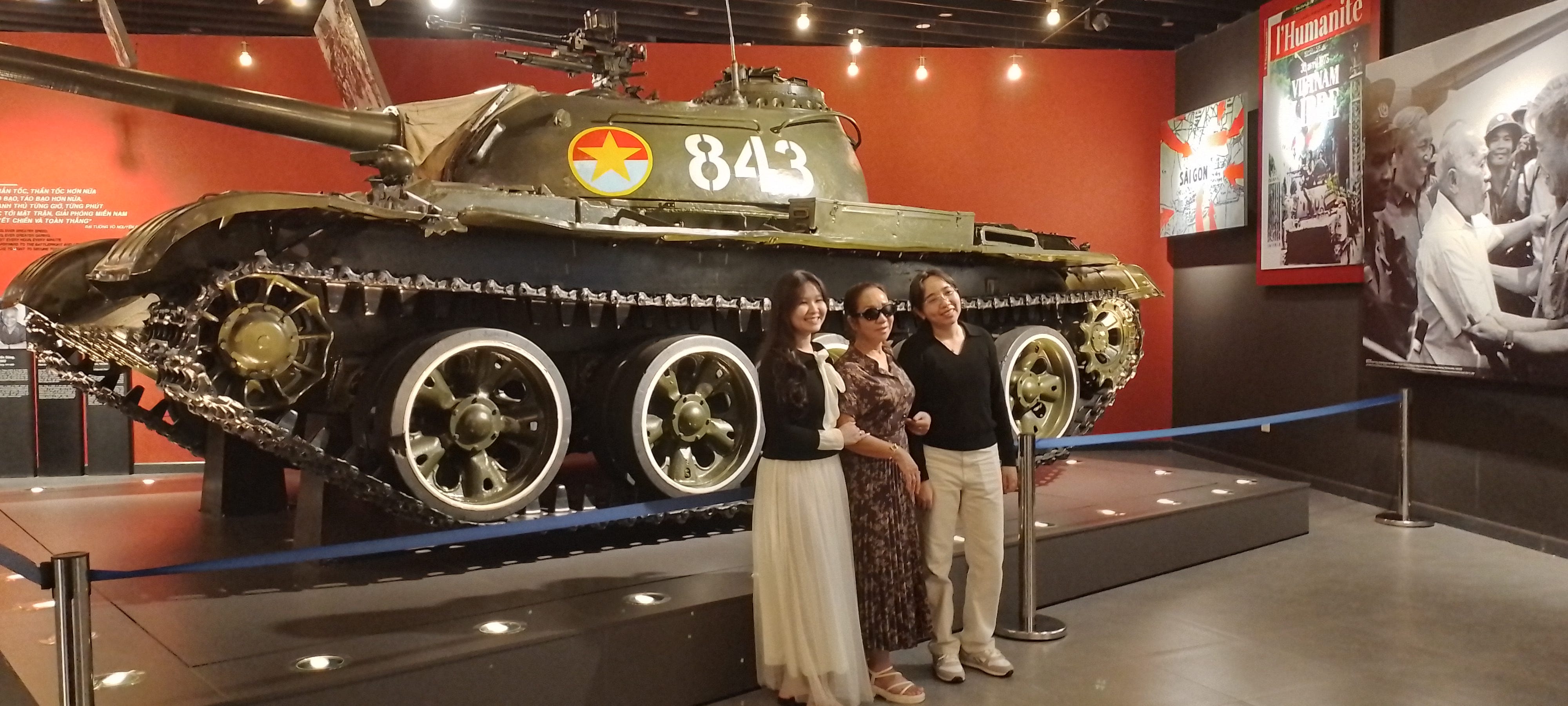
Happy Vietnamese tourists posing cheerful in front of a war era tank
(My understanding is that aside from one small battle — it may have been Khe Sanh and they may have used PT-76s but don’t quote me on that— the North Vietnamese Army never used tanks against the Americans but when the Americans left and they over ran the south they used tanks, including as many of the abandoned American tanks as they could get their hands on.
And what, exactly do I mean by that? Well, as one can see from the video below, the museum is huge. It’s four stories tall and an immense concrete structure designed to awe and overwhelm critics with its size and girth. Someone of importance clearly said “Make it huge!!” “Surely,” someone said, “if our museum is physically bigger than other nations’ museums, than it will cause our nation and people to have the international status they deserve!” And no one dared to disagree.
However, once inside tghe museum complex, problems begin to emerge. For instance, while, its four stories tall and has been open for over half a year, three of the four floors are closed. And the interior clearly shows that it was designed by people appointed without attention to their knowledge of history or museum procedures,
Imagine trying to plan your visit with these signs.
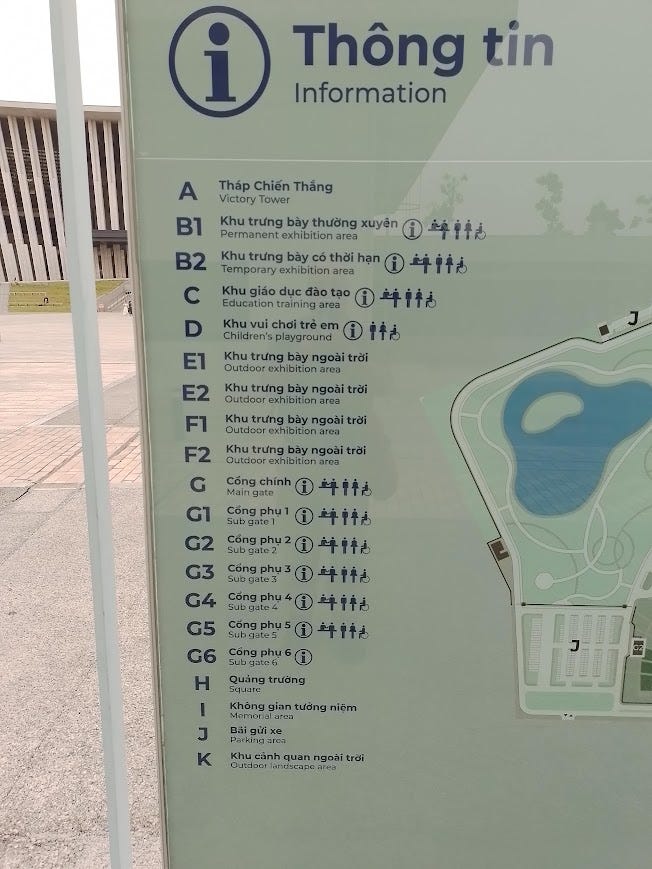
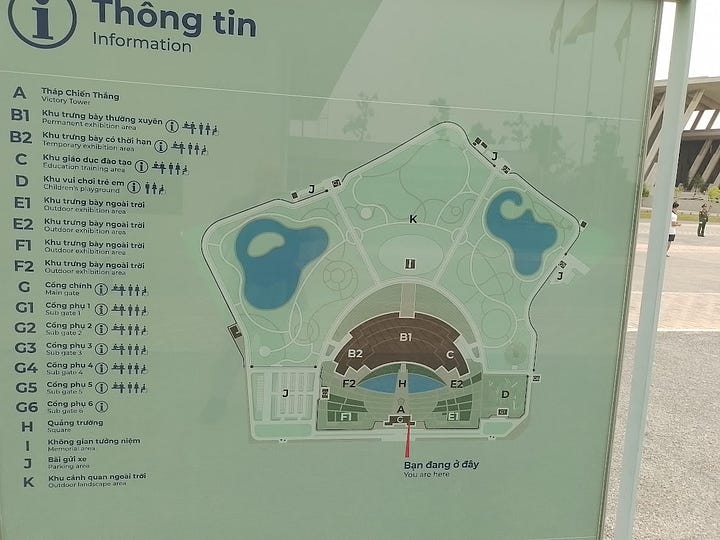
These signs appear to be put in place to guide visitors. However, there is almost no useful information that could truly help a visitor on them. It appears that an appointee somewhere said “Make some signs and don’t put anything on them that will upset our bosses.”
Throughout the museum, while there were soldiers in brightly pressed dress uniforms holding SKS rifles with shiny bayonets and shiny shoes to guard the doors (from what I have no idea) but there was very little useful signage to guide visitors. “Armed guards!” Someone said. “Our museum will be improved with armed guards in shiny shoes with shiny bayonets!” And this was decided, it seems, despite the fact that most museums function fine without armed guards with shiny shoes and bayonets.
There was a poorly labelled visitors information desk with, yes, eight people sitting there some in military uniforms and women in pink dresses and no visitors asking questions. I had to go to them and ask where the bathrooms were. When I did, I asked about an elevator and learned most of the museum was empty or at least not open to the public. There were no signs anywhere saying this either. When I asked if they had a map of the museum that I could take, they gave me a pamphlet that was half in English and half in Russian. And it is very strange these days to see anything in Vietnam these days in Russian. And while there were no signs that I saw clearly stating when the museum was going to close, at 4:20 a young woman came and told me in English that it was closing time.
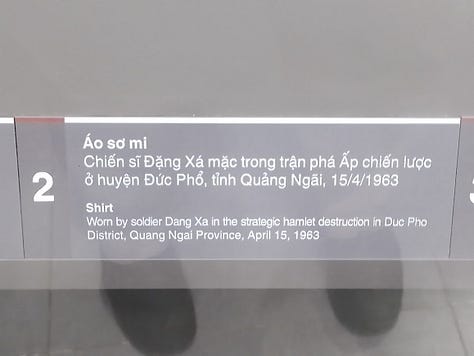
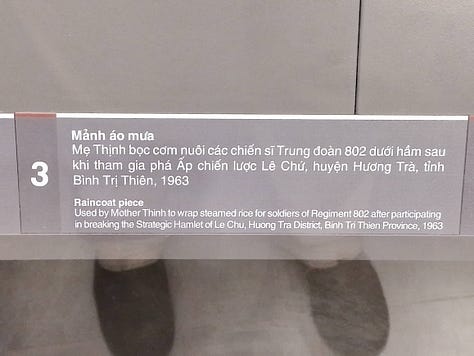
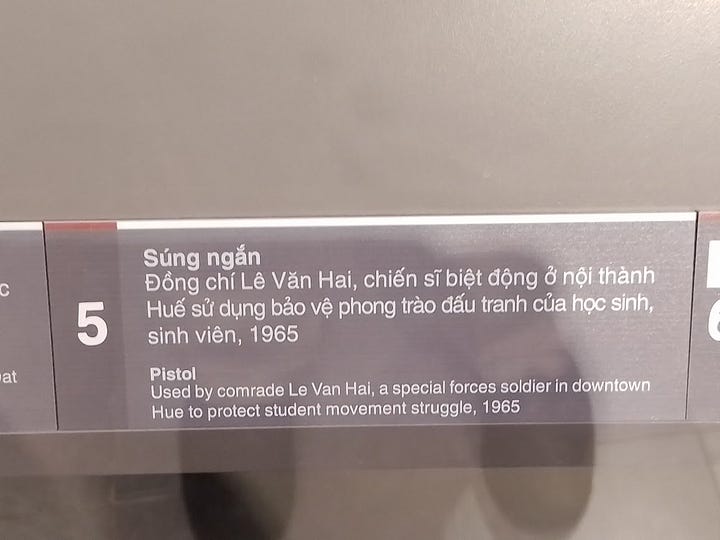
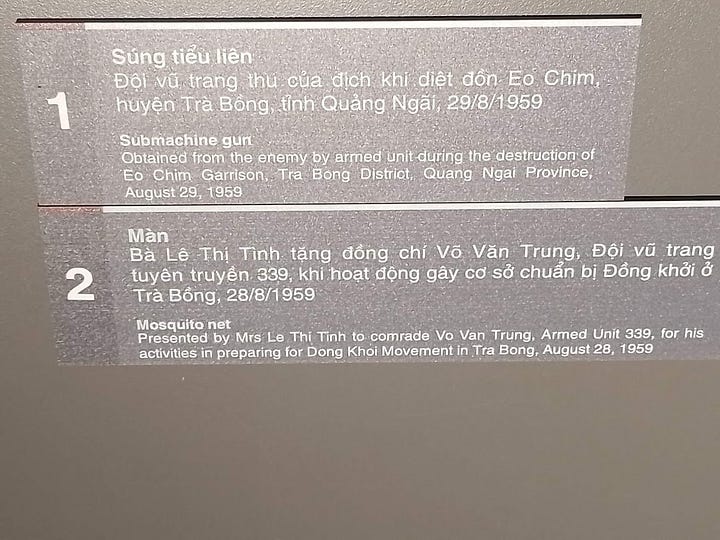
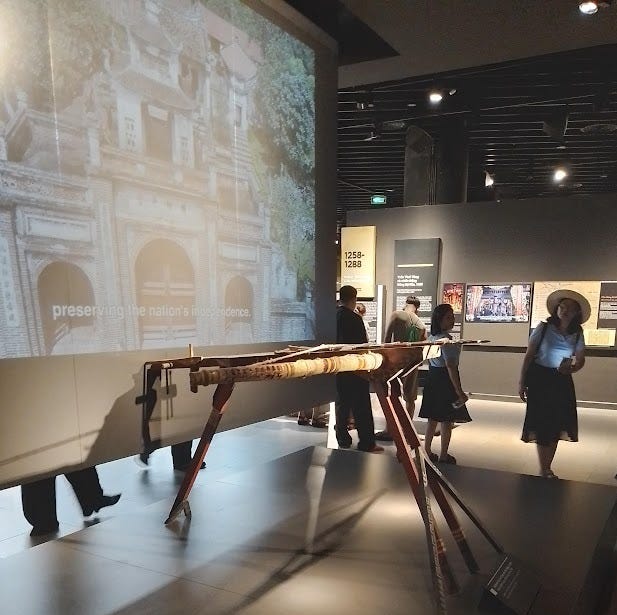
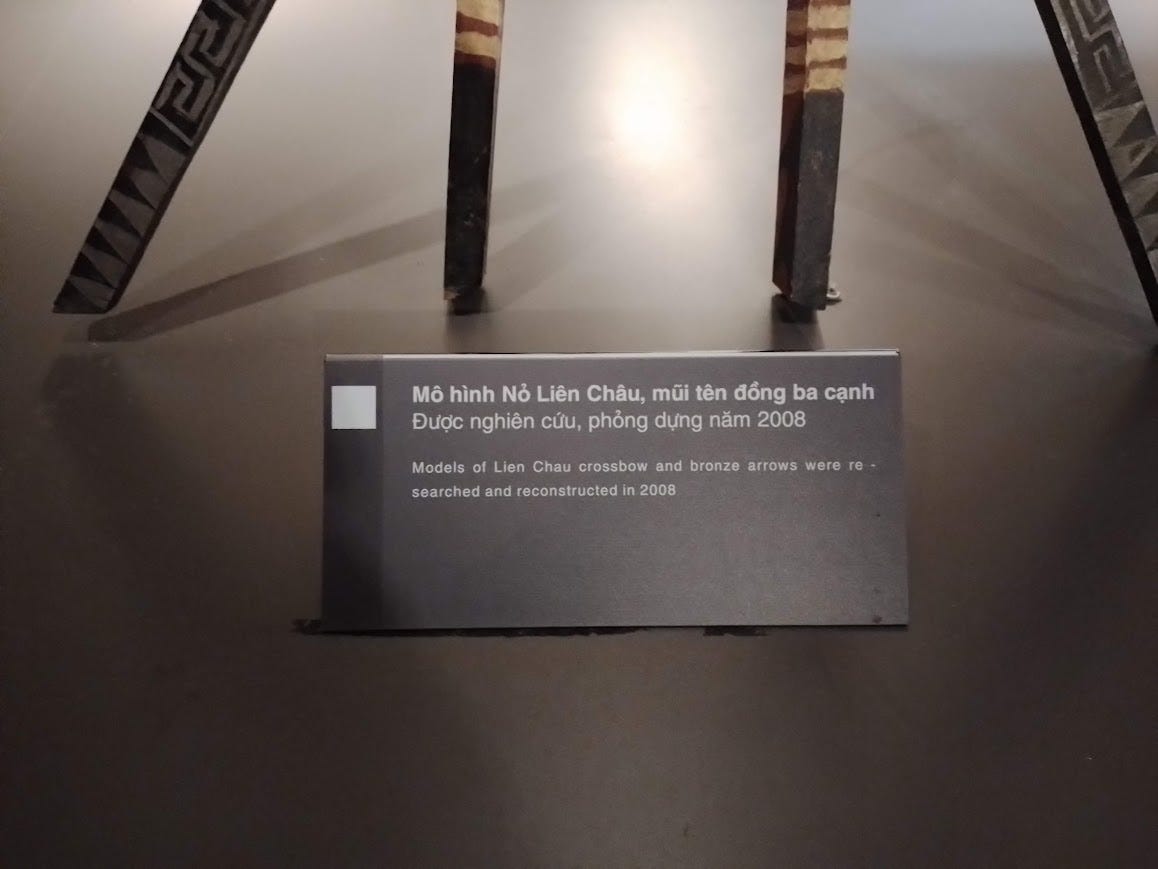
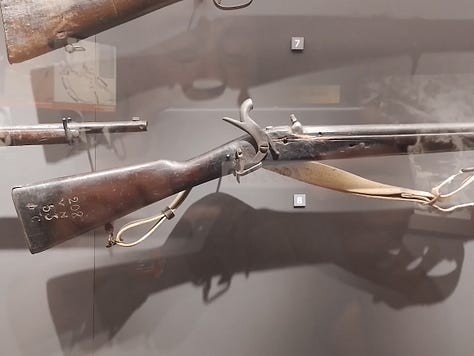
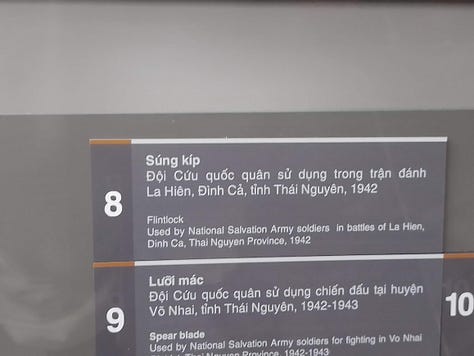
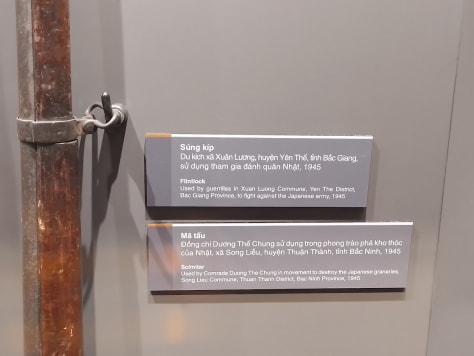
It is a quirk of Vietnamese museums, one I noticed first about ten years ago, that for some reason instead of giving you a detailed history of the make and model and so on of the item in the display, they often prefer to skim over that part, doing it sloppily, and then focus on who owned it and what they did what it and often what a patriotic and wonderful thing, it was that they did when they did what they did with this thing. And it’s really kind of quaint when you are dealing with what appears to be the local history museum put together by local people but one would hope that if they are trying to build an international quality museum, they might up their standards.
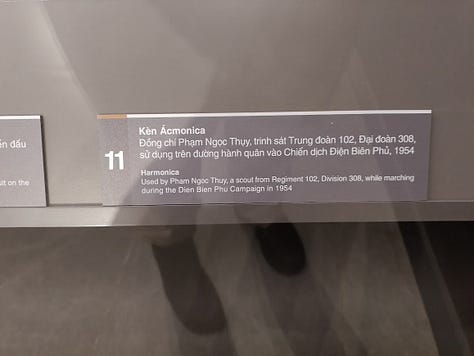
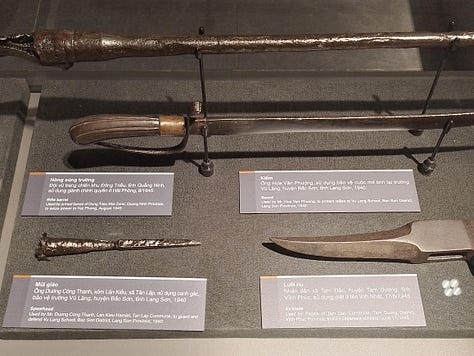
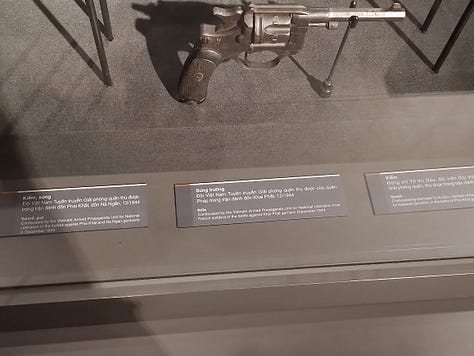

The new museum has many statues of people heroically defending their statues. And this was the one I personally found the most interesting
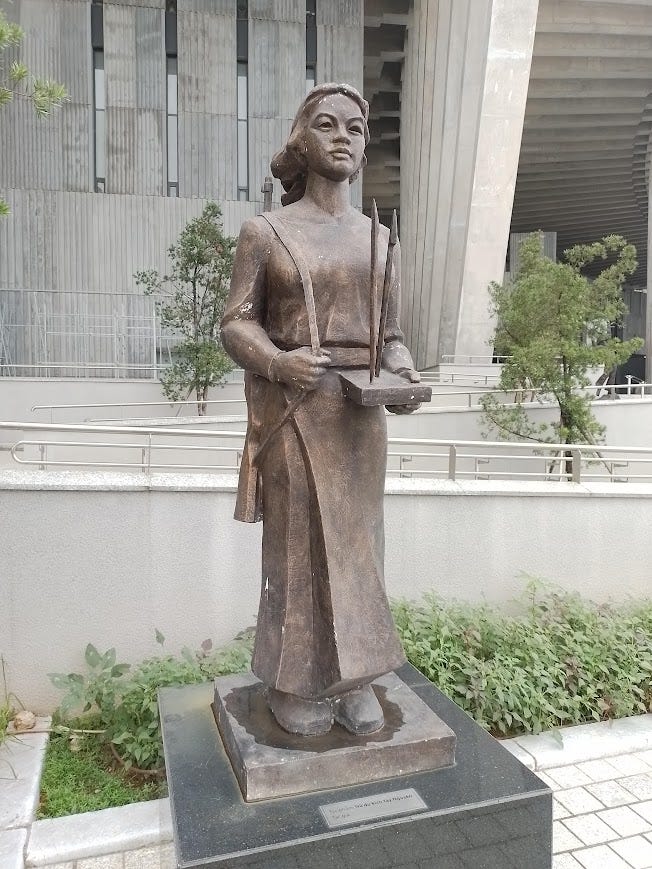
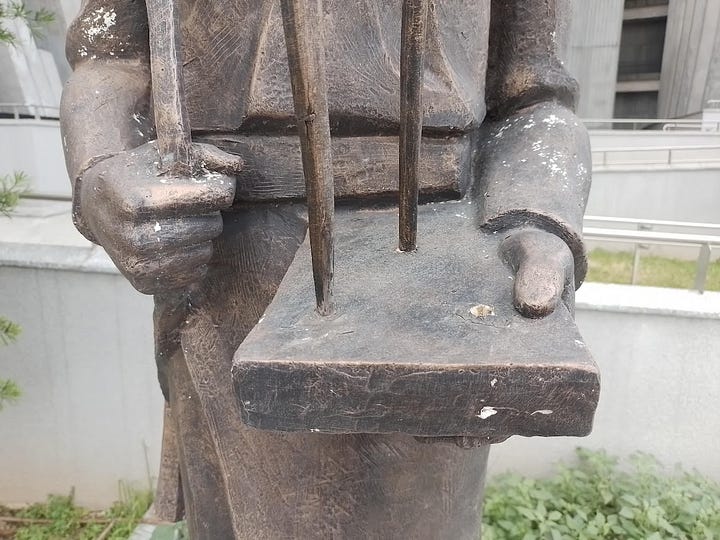
This shows a Vietnamese woman carrying a set of pungee sticks to be used as booby traps against American and other enemy soldiers. What’s are “pungee sticks”? Basically, an improvised booby trap commonly used in the French and American Wars. Sharp, often barbed as in this case, long pointed object made of bamboo, wood, or metal, often smeared with feces to increase the chance of infection when someone steps on them. They were inexpensive, easy to make, and very stressful and demoralizing to enemy forces. Unfortunately, someone at some point vandalized the statue and took one of its original three sticks. Having no idea when this happened. I cannot blame the museum for that.
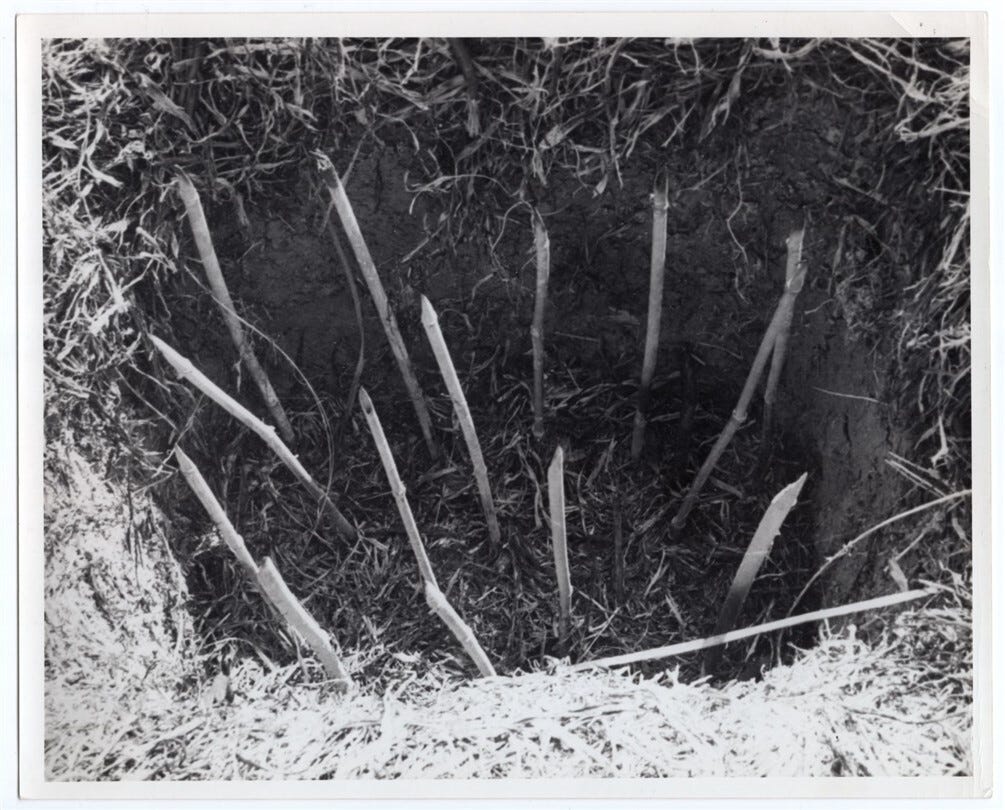
While not from the museum collection, this is a photo of some Vietnam era pungee sticks. They would be hidden and covered so that an unsuspecting enemy would step on them and become incapacitated and unable to fight.
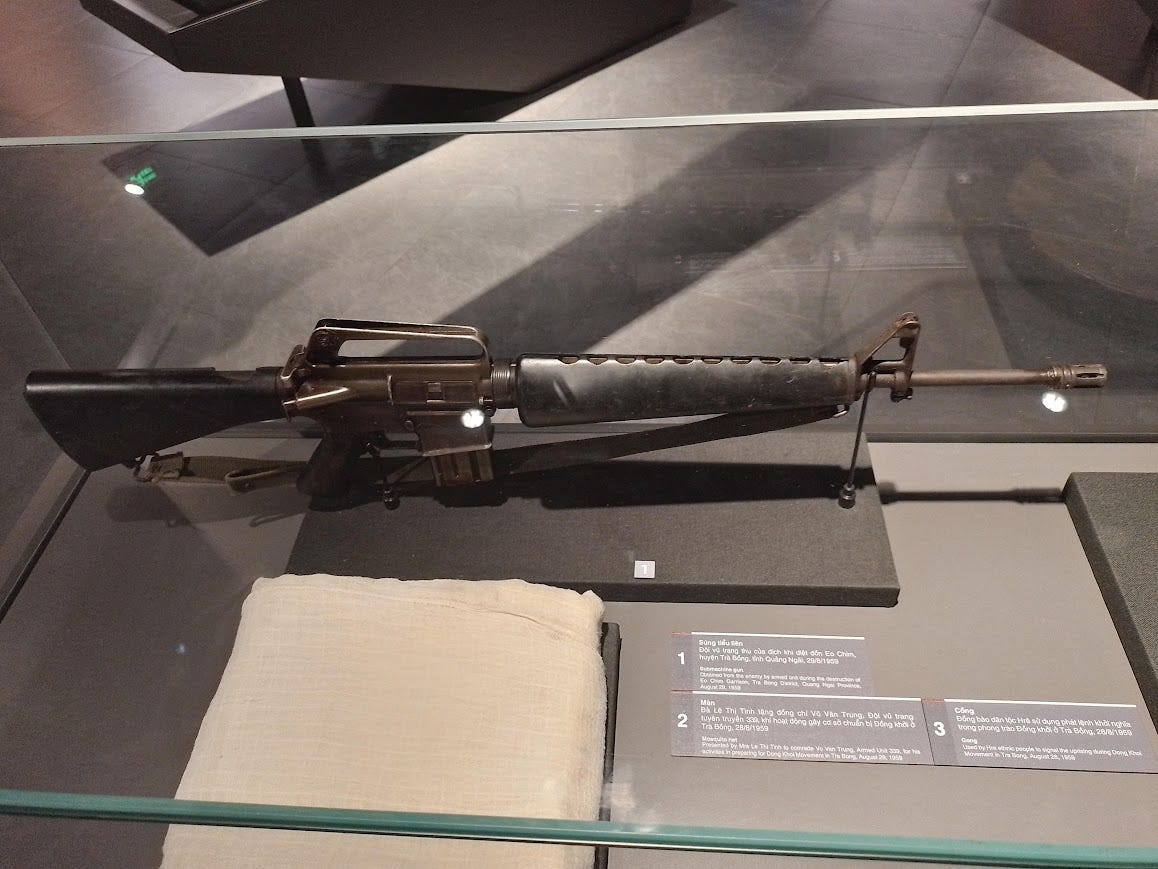
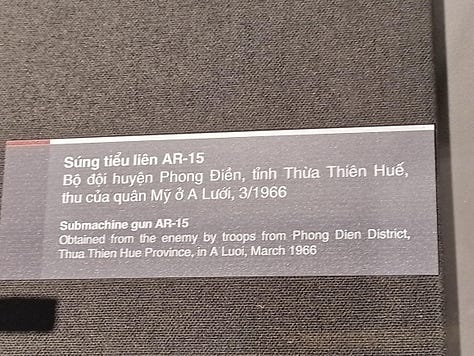
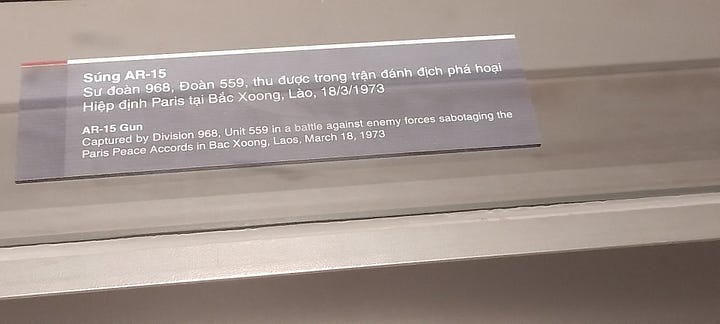
First, while the US military began the war in Vietnam using a rifle known as the M-14 as their primary battle rifle, a decision was made a few years into the war to consider replacing it. This was considered for several reasons. As I understand it, this project was begun by the Armalite company who soon produced something called the “AR-10,” which was much like the later M-16 or AR-15, but used the same large, 7.62 mm .308 bullet that the M-14 had. Upon request, the Armalite company then redesigned it for the smaller 5.56mm .223 bullet that the US military was considering switching to, and thus came the AR-15. The US military decided to adapt it as their standard issue firearm and with a few modifications and some different parts designated it the M-16. (for “Model 16 rifle”). However, despite the existence of the M-16, the AR-15 rifle continued to exist, and both are still in existence today in large numbers throughout the world. They look very similiar, some would say identical.
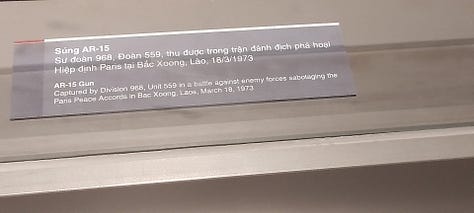
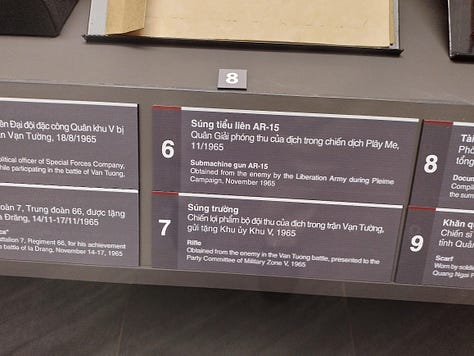
Now it seems that determining what is the exact difference between an AR-15 and an M-16 is extremely difficult. If you had asked me casually last week, I would have told you that the AR-15 can only fire semi-automatic (one shot with each pull of the trigger) while the M-16 is selective fire (aside from the safety switch, it can also be fired both semi-automatic and fully automatic. And I could find this answer online and cite it. But when I went to confirm that this week, it seems there are selective fire versions of the AR-15. Ultimately, I found myself faced with an overwhelming amount of often contradictory information from sources that I was not able to evaluate. So while I will go the record as someone who has fired both the AR-15 and M-16 rifle (and they felt very similar, I will admit that today at this time i cannot tell you the difference.
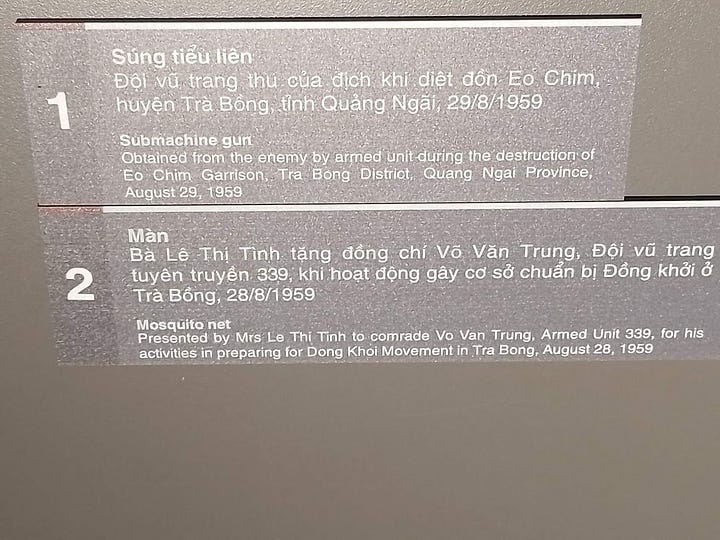
However, I am not a professional museum worker, and I will tell you that this museum has many that are mislabeled one way or the other. If nothing else, the fact that these were soetimes rifles and sometimes “submachine guns” and sometimes just “guns,” indicates lack of attention to detail when labelling exhibits. (And, for the record, there was an is a carbine version of the M-16/ AR-15 rifle called the CAR-15 and none of these “submachine guns” were CAR-15s. Now do I consider myself a firearms expert? By no means, but I seem to know more than the people labelling the exhibits.
Thanks for reading Mostly Asian History! This post is public so feel free to share it.
No posts
Comments
Nothing yet. Say the first thing.
Sign in to join the conversation.