
A quick acknowledgement. Erin Brockovich’s record needs no defense — she has spent a career making invisible toxins visible and making the people responsible answer for them. That’s exactly why the omission below feels so consequential, and why, with data-center driven high-voltage lines pushing back through neighborhoods at a pace never seen before, this is a fight where her contribution would be very welcome.
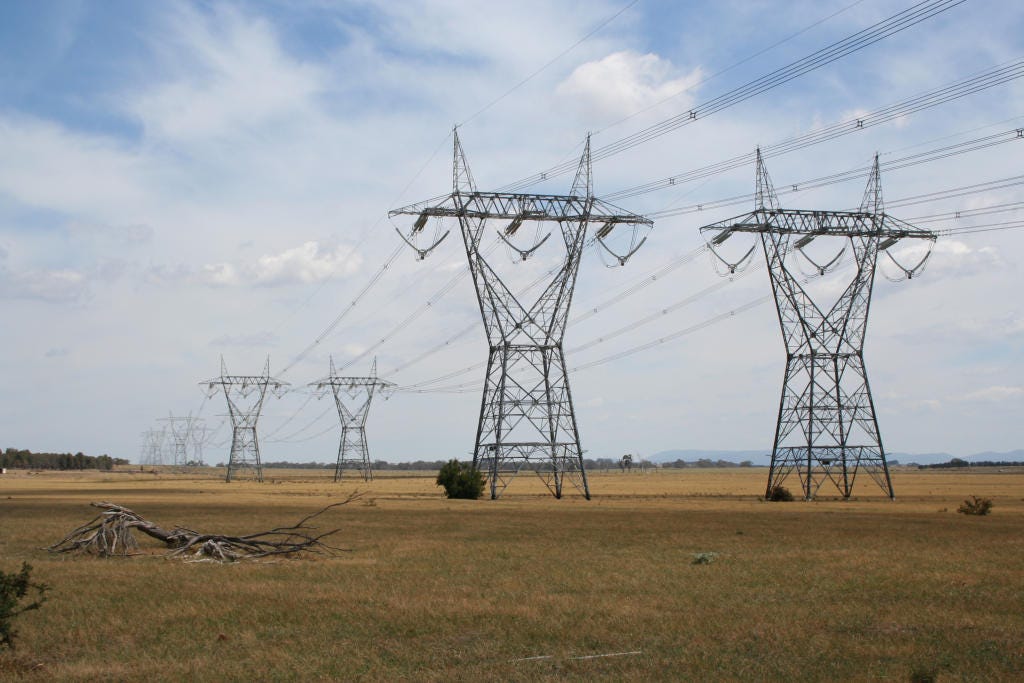
Erin Brockovich published a two thousand word article this week about a 500-kilovolt transmission line cutting through a family’s backyard in Loudoun County, Virginia. The line will stand 185 feet. It will run less than 100 feet from some bedroom windows, to move power to the data centers of Ashburn –– aka “Data Center Alley” –– home to the largest concentration of data centers in the world. The essay is well written and sympathetic. It names the voltage, the trees lost, the eminent-domain statute, the wildlife corridor, the eleventh-hour land deed to the school board.
The term “magnetic field” does not appear in it. And forget about “EMF.”
Brockovich’s reputation comes from her proving that an invisible, toxic, industrial exposure can move through a community for years while the people responsible look away. Hexavalent chromium1 was the toxin in Hinkley, CA where she sued PG&E. A 500-kilovolt line is the textbook case of an invisible exposure running in close proximity to children’s bedrooms, and the piece treats it as a zoning issue and an aesthetic problem. Real problems, to be sure, but not the one her career was built on exposing.
The guest author, Madison Taggart , is a trained science writer, whose childhood home is within striking distance of the powerline, and the reporting is good on its own terms. This is not a failure on Taggart’s part; the blind spot, if it’s anyone’s, is Brockovich’s. Power-line fights in 2026 are fought over property lines, eminent domain, and what the towers do to the view. Fifty years ago they were also fought over what they do to our health.
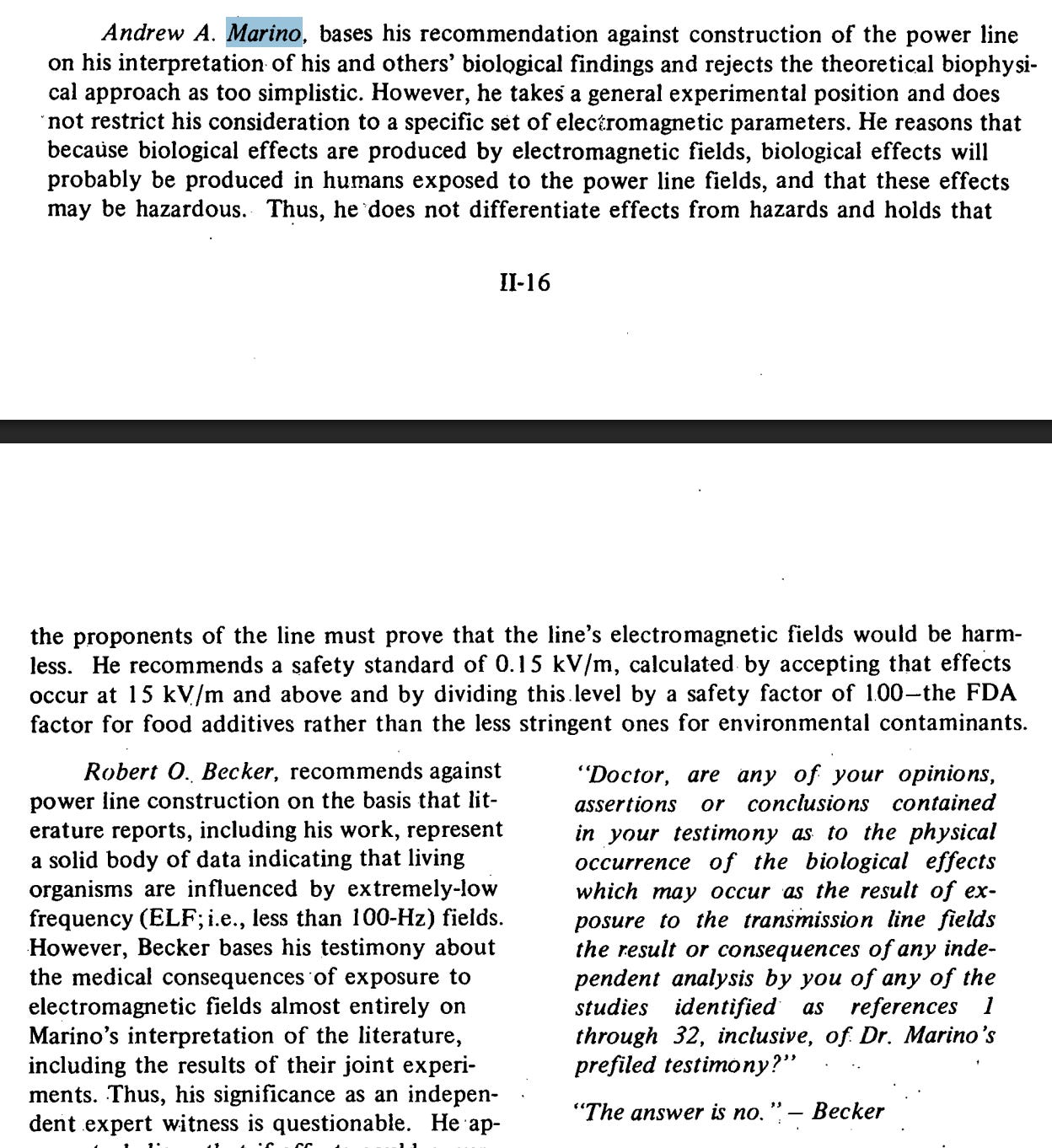
In 1976 the New York Public Service Commission opened hearings on whether 765-kilovolt lines could hurt the people living under them. Cases 26529 and 26559. The central witnesses were Andrew Marino and his supervisor Dr. Robert Becker, out of the VA hospital in Syracuse, who had exposed rats to low-frequency fields and found stunted growth. The utilities cross-examined Marino for ten days. By Marino’s own account of the hearings from his book The Electric Wilderness, the Commission’s health report then devoted a significant portion of its length to discrediting his experiments and his character.
And then the Commission conceded the point anyway.
Its final finding, cited at the time, was that the lines would “probably produce biological effects in people exposed to them on a chronic basis”2. The Commission took that seriously enough to widen the right-of-way — 350 feet, excluding every home — and set the country’s first limit on field strength at its edge3. Then it moved on. That concession is still sitting there, unretracted, in a 1978 government document that has largely been forgotten.
At the same time, in western Minnesota, farmers were fighting a 400-kilovolt DC line running coal power from North Dakota to the Twin Cities suburbs. The CU Project. They exhausted every legal channel and lost. Then fourteen transmission towers came down in the night, unbolted at the base by people who called themselves bolt weevils, and ten thousand insulators were shot out with rifles. Paul Wellstone, before the Senate, co-wrote the book Powerline on it. Their stated objection was not the view of the towers, it was, among other things, what the line would do to their families and their land.
Those fights receded, and the frame that regulators would hear narrowed to real estate and public necessity. Then the recent data-center buildout started dragging 500-kilovolt lines back through backyards at a scale the country hasn’t seen since Marino was on the stand.
The Loudoun families want the line buried. So did the New York farmers. So did the Minnesotans. It is the oldest demand in this fight, and it is worth understanding what that actually gets us, besides better views.
Magnetic fields pass through soil, concrete, and the walls of a house. It is extremely difficult to shield them the way you shield an electric field. It is much easier to cancel them out with geometry. A power line’s magnetic field comes from the current running through it. When you put two conductors carrying the same current in opposite directions close together, their fields fight each other and mostly cancel out. The closer they sit, the more complete the cancellation is.
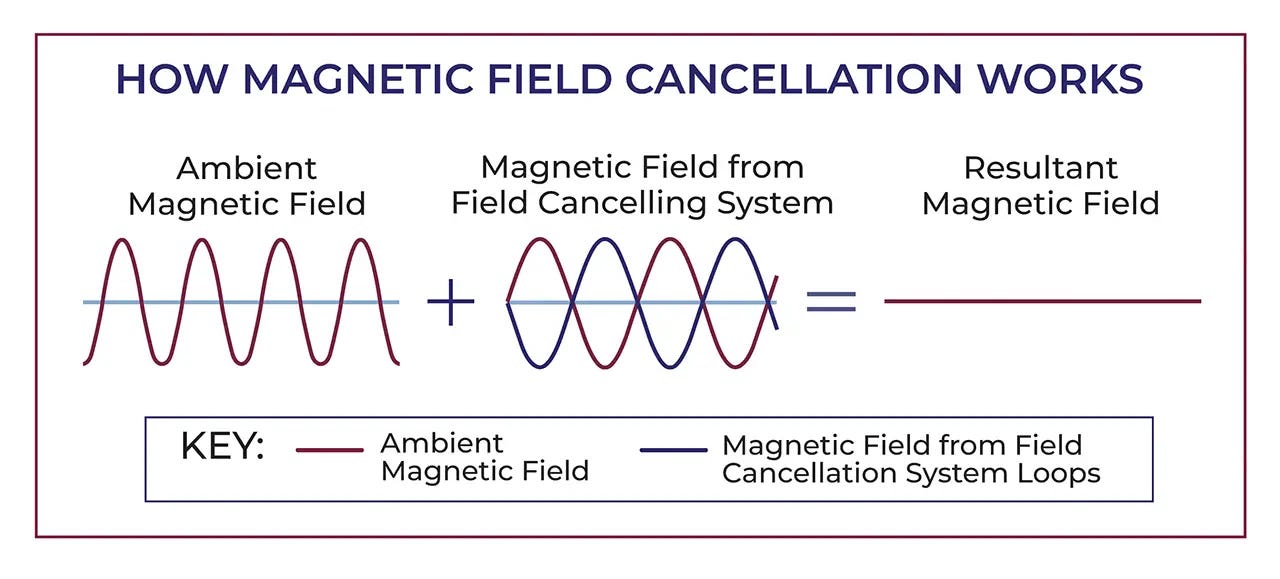
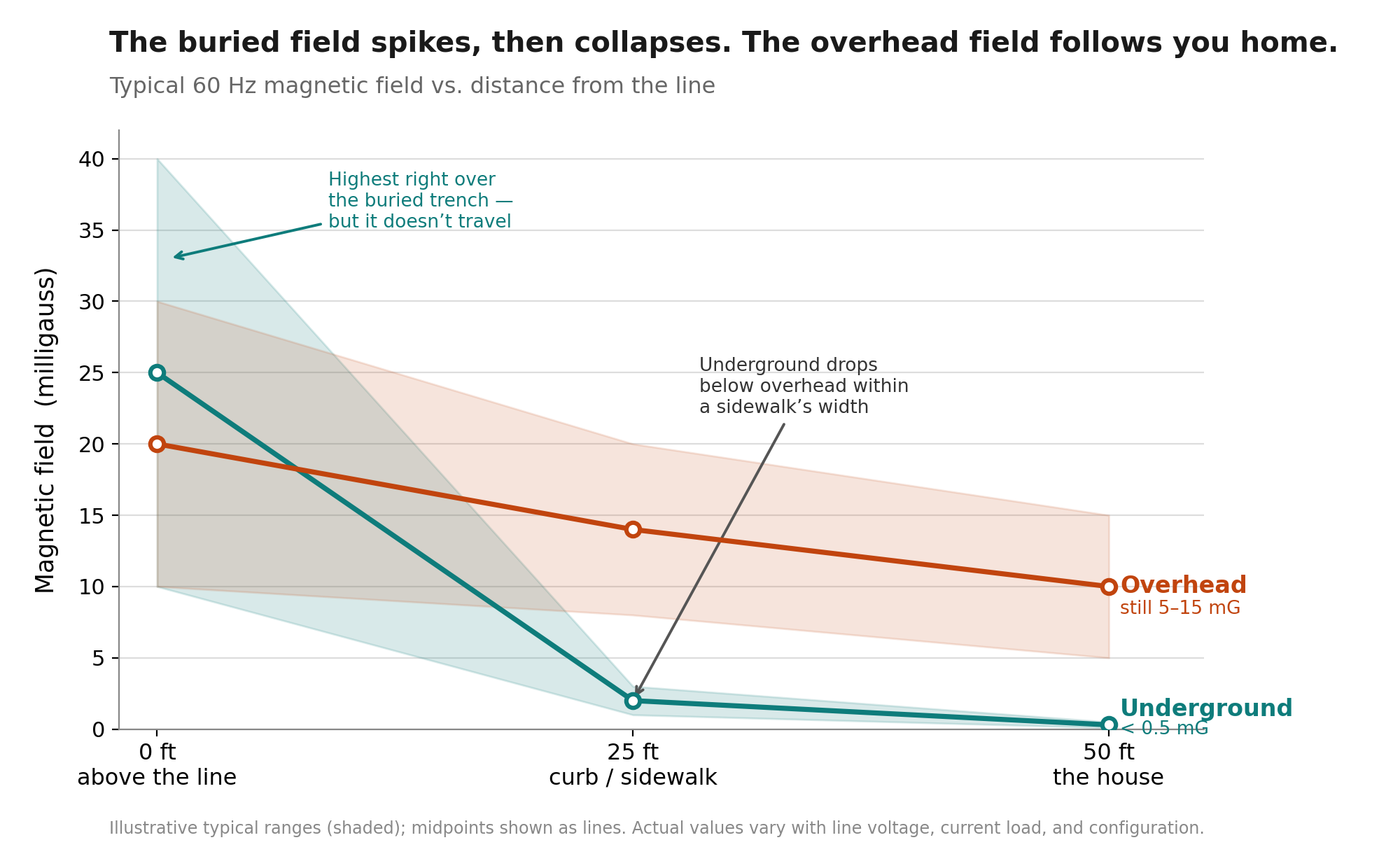
High-voltage lines carry three conductors, the three phases of AC power, and the same rule governs them. What determines how far apart they sit is the insulation. Overhead, the only thing holding the conductors apart is air, and air is a poor insulator. If you place high-voltage lines too close in open air, the current can arc across the gap, releasing intense light, sound, and extreme heat. So overhead the three phases hang meters apart, cancel poorly, and cast a wide field that diminishes slowly, reaching homes at still-elevated levels. Burial swaps that air gap for solid insulation wrapped around each cable, letting the three sit inches apart in a tight bundle called a trefoil where the cancellation is much more effective. The field directly over the trench in the middle of the street can run higher than the street under an overhead tower, but by the time it gets to the sidewalk line it is minimal, and by the house line it typically will have collapsed into the background. For a home similarly situated in relation to the right of way, burial means less exposure, not more.
It stays overhead for one reason: cost. Dominion’s main argument against burial was the price and the number of homes each route would touch. Undergrounding runs five to ten times the upfront number.
That number is upfront capital. It leaves out what overhead externalizes.

In November 2018 a worn hook on a PG&E transmission tower dropped a live line, and the Camp Fire destroyed the town of Paradise, California. Eighty-five people died. PG&E pleaded guilty to 84 counts of involuntary manslaughter and filed bankrupty, citing liabilities of at least $30 billion. In 2021 the same company pledged to bury 10,000 miles of line4, the undergrounding its earlier management had resisted for years as too expensive. Its new CEO reversed the position in one sentence: it was too expensive not to do it. When you price in a town burning down, burying wires stops being the expensive option.
Though PG&E has energized a little over 1,000 miles of underground lines so far, the cost curve has changed significantly. Undergrounding ran about $4 million a mile when the program started, and by scaling it PG&E pushed that under $3 million. The work that was considered too expensive to imagine got cheaper in the execution.
Sweden and Denmark ran a version of this math and landed on burial. After the storms Gudrun in 2005 and Per in 2007 left rural grids down for weeks, Sweden wrote hard limits on outage duration into law, and utilities buried tens of thousands of kilometers of line because that was the only way to comply. Denmark committed to putting essentially its entire distribution grid underground. Neither did it for beauty. They did it because the regulator finally priced in the full cost of the overhead lines that were getting paid by others.
Fire is the externality the market finally forced onto the ledger, and only after the bodies piled up. The magnetic field is the externality still off the ledger because no one is liable for it. Fire gave PG&E those 84 felony counts because the causation was undeniable — a hook, a spark, and a town reduced to ashes. The magnetic field gives no one anything. Personal-injury suits over power-line EMF have gone nowhere for decades — not because a judge weighed the science5 and found it wanting, but because no one with the power to act on it is allowed to. Siting regulators rule on cost, need, and reliability; health of the fields isn’t theirs to decide. And when homeowners took it to court instead, they were sent back: in 1996 the California Supreme Court threw out a San Diego couple’s claim against their utility over the power lines beside their home, holding that power-line EMF belongs to the utilities commission, not the courts. The one EMF harm the law will price is the hit to a home’s resale value from the public’s fear of the lines — real estate, again. New York’s highest court ruled in 1993 that a landowner can be paid for that lost value without proving the fear is even rational.
The physics of burial hasn’t changed since the 1970s, but the accounting has. Overhead lines are the cheaper option only as long as their two largest costs stay off the utility’s books: the fires, which we now count, and what the fields are doing to our health, which we still don’t. Erin Brockovich, of anyone, could have named the second one.
A 2026 study in Biochemical and Biophysical Research Communications found that hexavalent chromium — the toxin from Brockovich’s landmark case — and 1800 MHz radiation, together produced double-strand DNA breaks that neither caused alone. The environmental exposure she hasn’t publicly acknowledged, and the chemical that made her name, damage the same DNA, and produce worse damage together than either does alone. https://www.ehn.org/wireless-radiation-chemical-dna-damage
From the Mother Earth News, Power Struggle: the Public and the Power Line https://www.motherearthnews.com/sustainable-living/nature-and-environment/power-struggle-zmaz80mazraw/
https://ewts-ny.com/assets/document-library/NYSEG_RGE_EMF_Brochure_March_2026_Update.pdf
https://undergroundinfrastructure.com/news/2023/july/pge-gains-ground-on-undergrounding-10-000-miles-of-power-lines
There’s a reason the science was never the deciding factor. When David Carpenter sorted the post-2000 childhood-leukemia studies by who funded them (Environmental Research, 2019), the split was clean: government and independent studies almost all found a significant association, or a risk ratio of at least 1.5; industry-funded studies almost all found none. The most recent pooled analysis, in 2021, found none too — and its lead author’s career runs through the industry’s own research arm. Rebuttal, or Carpenter’s point restated, depending on who signs your paycheck. https://www.sciencedirect.com/science/article/abs/pii/S0013935119304852
No posts
Comments
Nothing yet. Say the first thing.
Sign in to join the conversation.