
In 2019 the Oregon legislature passed SB 283, ordering the Oregon Health Authority to review the peer-reviewed, independently funded science on the health effects of wireless radiation – radiofrequency radiation (RFR) and electromagnetic fields (EMF) – in the state’s schools. OHA released the report late on the afternoon of New Year’s Eve, 2020. Its lead author had deleted hundreds of lines of text documenting evidence of harm. The first draft, the one that still contained that evidence, was allegedly withheld from a citizen’s public records request. Both issues are detailed in Part One and Part Two of this series.
This article is about what happened next – about the body legislatively charged with overseeing OHA, and its response to public criticism of the report from around the world. That body is the Oregon Health Policy Board, OHPB, its members appointed by the governor.

Four days before he was to face the public over OHA’s discredited wireless report, David Bangsberg, M.D., chair of the Oregon Health Policy Board, emailed the agency’s senior staff about the statement he would read.
Bangsberg, the chair of an ostensibly independent board charged by the legislature to oversee a multi-billion-dollar state agency on Oregonians’ behalf, wrote: “LMK if you want me to read part, none or the whole thing tues. I am perfectly happy w all of the above.”
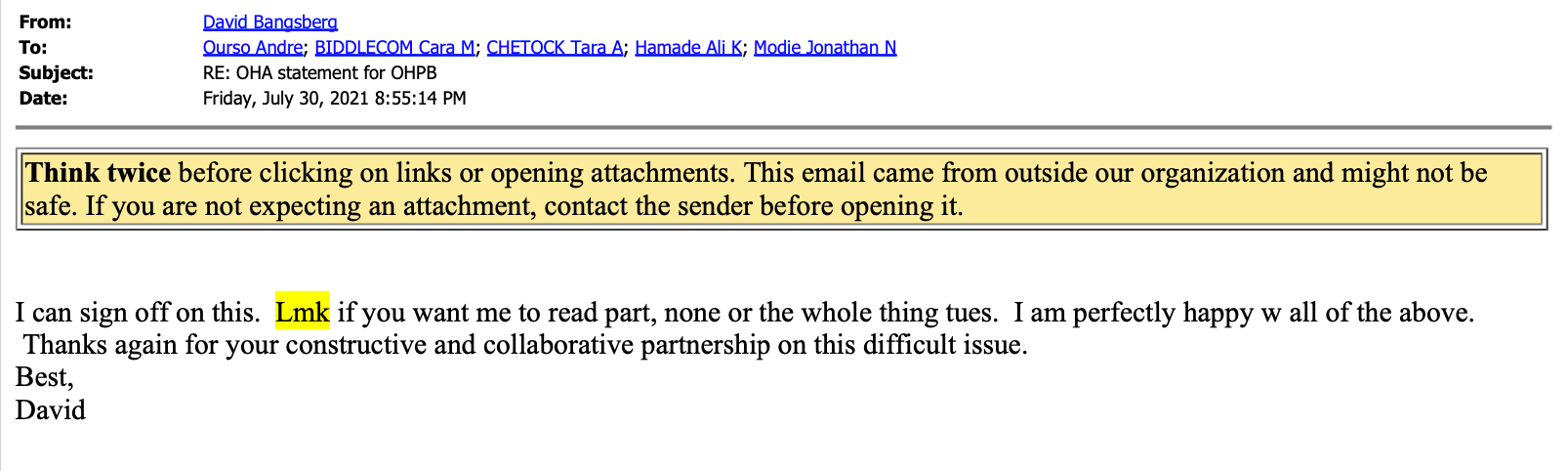
This expert who’d long strode the august corridors of public health, thought it proper for OHA to determine what, if anything, he should read at a meeting he chaired. “tues.” referred to the upcoming OHPB public meeting August 3, Bangsberg to reply to July’s public criticism (at the 2:44 mark) of the OHA report.
Bangsberg’s quote about dancing to OHA’s tune was taken from a 68-page file of emails – “OHA Communications to/from David Bangsberg Related to SB 283” that I received in November 2021. Remarkably, more than half the file is taken up by what the email subject line becomes: “Response to Dan Forbes”.
Author of some 500 academic papers, holder of numerous prestigious academic posts, respected researcher combating AIDS/HIV here in America, Africa and India, Bangsberg is no shrinking violet. That’s one reason he served as chair of the Oregon Health Policy Board, the body legislatively mandated to exercise oversight of the Oregon Health Authority.
Back in 2021, OHA was seeking to unburden itself of its wireless risk in schools report should it find a rug and broom big enough for the job. Required to make some semblance of a reply to the bitter public uproar over the report’s scientific fraud, an OHA policy maven (not a scientist) provided Bangsberg with a template for his statement seeking to assuage public concern and dampen the calls for the report’s retraction. A template that Bangsberg reworked with a fair bit of window dressing, but did indeed change in one crucial respect.
So it’s a mite surprising, that email, from a man with credentials as long as your arm. He was signing off on the statement that he and Ali Hamade, Ph.D., the OHA staffer largely responsible for the biased, unprofessional report, had worked to craft, building on that template. Bangsberg’s July 30, 2021 email to several senior OHA staff sported the telling subject line: “OHA statement for OHPB.” This was after Hamade finished his edit, and two other senior OHA managers indicated they had no edits to make.
The oversight board members were charged by the law that established that body, ORS 413.011, To “Be the policy-making and oversight body” for OHA. But all but one OHPB member said not a word as Bangsberg white-washed the already white-washed report. That’s two thick coats of paint if you’re counting.
Though fraudulently geared to hide evidence of RFR/EMF’s link to harm – indeed because of that – the OHA report as published was of real importance. That’s one reason many activists from around the world called for its retraction. Theodora Scarato, currently Wireless and EMF Program Director, Environmental Health Sciences, notes that the report was the first effort by any public agency or private body to provide an overarching assessment of RFR/EMF safety regarding essentially all human endpoints.
Never mind that it was lousy science jury-rigged to arrive at a foregone conclusion. Scarato says the OHA effort was of paradoxical importance because – both then and since – “No health or environmental agency has ever issued an opinion on the full body of [RFR/EMF] science.”
That is, she told OHPB in her public comments, that neither the Environmental Protection Agency, nor the Food and Drug Administration, the National Cancer Institute, the Centers for Disease Control and Prevention, or the World Health Organization have issued a blanket opinion on wireless risk and safety.
Scarato elaborated last week by email. Not since the EPA was defunded back in the mid-90s, has any agency with health or environmental expertise “done any kind of expert opinion based on a review of the full body of science.” By that, “I mean all the science on health effects. You look at all the science, assess the key endpoints studied, and do a risk assessment or offer an opinion on the various endpoints.”
That void gave the OHA report its weight. Both the report and the coverup of its malfeasance matter since, should it have stood unchallenged, other departments and agencies, as well as the telecom and wireless industries, might have seized on it for their own ends. ‘See, look what [supposedly] liberal Oregon did – nothing to see here, folks.’
Or as one written comment to OHPB put it, “[T]his report will serve to promote false safety assurances and promote the unrestrained use of wireless in schools in the state and nationwide.”
Cara Biddlecom, MPH, was the agency’s Deputy Public Health Director. Jonathan Modie was a Lead Communications Officer, the man who answered when reporters called – or didn’t. Neither is a scientist. Both would help decide what the State of Oregon said in public about a scientific report.
Neither Bangsberg nor Biddlecom were blindside by the problems with the report. Working as a freelance reporter in 2021, I sent three emails out variously to Biddlecom, Bangsberg, other OHA staff, the several OHPB board members and staff in the governor’s office. The first email, June 3, was an eleven-hundred word summary of my article in The Washington Spectator, which it linked to, an article that detailed the report’s problems.
A version of this email was sent on June 4 to Cara Biddlecom. She was copied on Modie’s reply on her behalf telling me that they’re “deferring to what’s in” the report – never mind that there’s nothing in the report on some issues I’d asked Biddlecom about, including the alleged criminal withholding of a document, or the fact that the report’s main reviewer, State Epidemiologist Dr. Dean Sidelinger, offered “no edits” and only saw it well after the report was fully completed. (That last is the subject of the next installment in this series.)
The point is, Biddlecom was aware of the issues handcuffing the report’s acceptance, sins against science that led to calls for its retraction from numerous countries around the world.
The second email, sent to Bangsberg on June 15, basically reiterated the first, but was, perforce, longer. The third, sent July 2, was similar to the first two, but sent to six members of the OHPB board, including Bangsberg.
So Biddlecom knew of the issues with the OHA report before she wrote the template that she provided Bangsberg. She addressed none of them.
Bangsberg would go on to dismiss both the OHA report’s machinations to hide evidence of RFR/EMF’s link to adverse health effects and the public’s concern over the deleted findings. That dismissal began with a document he did not write. He accepted a template from Biddlecom for the statement he would make in August. On July 22, 2021 Biddlecom wrote Bangsberg, “We also drafted the statement below for you and/or Jonathan Modie, our Public Information Officer, to read during the meeting. We can make any adjustments and discuss this with you when we meet.”
“Adjustments” may imply that OHA’s language would be largely followed, as indeed it was, additions and deletions notwithstanding. Biddlecom’s version of the statement uses language found in the OHA report: “OHA found insufficient evidence to indicate a causal relationship between cell phone exposures and cancer….” That a quote from the OHA report’s Executive Summary, she left out the summary’s next sentence: “Some studies found an association between long-term cell phone use and various brain cancers.”
With a two-word exception, Bangsberg’s public statement copied Biddlecom’s paragraph word for word. He used the sentence Biddlecom supplied regarding supposed insufficient evidence of cell phone use and cancer. But he followed her lead by also failing to include the OHA report’s next sentence on an association between cell phone use and brain cancer.
A significant omission on both their parts.
After listing various maladies and bodily functions, Biddlecom concluded this paragraph of her template by saying, “In fact, most studies found no association between long-term use and these health effects and functions.” Long-term use – specified in this paragraph as cell phone use – leaves aside the massive, growing, passive RFR/EMF exposure of basically all of us.
As has been stated many times, it’s the largest experiment in human history, industry’s coffers the sole Institutional Review Board. Still, Bangsberg used the “no association” claim he was provided with the exception of two words: He deleted, “In fact.” Freudian slip?
More importantly, the statement, “Most studies found no association between long-term use and these health effects and functions” is simply not true, even by the OHA report’s own internal evidence. This was detailed in my May 2021 article dissecting the report in The Washington Spectator, which I sent separately to Biddlecom and Bangsberg many weeks prior to Biddlecom writing her template, and then Bangsberg delivering his public statement.
From The WashSpec:
“[A]n analysis of the papers included in the OHA report indicates that more of them actually indicate RFR’s link to harm than those that do not. Of the 166 scientific articles (out of 218 total) where the OHA risk report makes a yes/no determination as to whether the paper in question found RFR linked to an adverse health effect, there were 84 Yesses and 82 Nos. So, even by its own lights… – science being in part the weighing of evidence – there actually was sufficient evidence to conclude that RFR is associated with bad medical outcomes.”
The WashSpec article also notes Bandara and Carpenter’s 2018 analysis of 2,266 studies which found that 68 percent “demonstrated significant biological or health effects associated with exposure to anthropogenic electromagnetic fields.”
Bangsberg adopting Biddlecom’s language left him out on a limb.
One might assume Bangsberg, the other OHPB members and OHA were under pressure to respond to the public’s scornful statements at the OHPB meeting July 6. But that’s a stretch given the collective sketchy response that addressed none of the fatal and very apparent issues with the report.
And it’s curious that the task fell to Cara Biddlecom to usher forward the template for Bangsberg’s statement. She was more of a policy expert than a scientist, the sort of policy wonk OHA called upon to testify to the legislature.
Biddlecom copied two colleagues on her early-morning July 22 email sending Bangsberg the template: Stephanie Jarem, OHA’s Health Policy Director, and Tara Chetock, an OHA program manager who handled logistics for board meetings. An hour later Chetock, “for awareness,” copied three more: OHPB vice chair Oscar Arana; Jeremy Vandehey, director of OHA’s Health Policy and Analytics Division; and Vandehey’s deputy, Trilby De Jung.
Then, copying Jarem, Vandehey, De Jung and Arana on the email, Biddlecom scheduled a meeting with Bangsberg and her “content experts” – apparently the folks just mentioned. Should they all show up, Bangsberg would ZOOM with four very senior OHA administrators to hash out how to respond to the public outrage over the report.
All these folks have substantial jobs involving policy, planning and budgets, but with no apparent focus on epidemiology, risk assessment or scientific literature reviews. Kids’ health not to the fore, what seemed to matter was the nuts and bolts of running the state’s schools, plus how to minimize the report’s blot on OHA’s escutcheon.
OHA was wise to assemble a team, albeit one lacking scientists – where was Sidelinger while all this was going on? – since a dozen polite, pissed-off members of the public from across the country, plus a physicist from Israel, spoke at OHPB’s July meeting (2:44 mark) about the report’s manifest inadequacies.
Theodora Scarato took the report apart in her typical trenchant fashion, her criticism detailed above.
Testifying before OHPB back in 2021, Portland activist David Morrison was his usual unvarnished self. He said the report’s “final draft is a great threat to Oregon’s children. It needs to be retracted and replaced with the repressed first draft.” He charged that “crimes were committed” in the withholding of that first draft from a public records request. And he said that “scientific misconduct was practiced by OHA.” Finally, he argued that:
“Those responsible – Ali Hamade, Andre Ourso, Dean Sidelinger [and a fourth staffer] – should be fired for their part in this politically motivated whitewash.” - Activist David Morrison
(As administrator of OHA’s Center for Health Protection, Ourso managed the report’s creation.)
Measured in tone, but also taking no prisoners, Environmental Health Trust founder Devra Davis told OHPB that the report should be retracted. Having authored 220 publications and served in senior posts at the U.S. National Research Council, the National Academy of Sciences and the University of Pittsburgh, Davis said that had such a study been submitted to those institutions, “we would have sent it back.” She spoke of “efforts to manufacture and exaggerate doubts about wireless radiation [harm] just as happened with asbestos, tobacco, lead and, most recently, Roundup.”
Davis concluded that by ignoring evidence and, as other commenters noted, eschewing real-world RFR/EMF measurements in schools, “This review betrays public health. Under the precautionary principle, the duty of public health is to prevent harm and not to prove that damage has taken place.”
Other commenters were equally biting in their remarks, not an easy accomplishment given the truncated two-minute time limit OHA/OHPB imposed, not the norm at such public meetings. Ariel University’s Paul Ben-Ishaei, Ph.D., a physicist, declared the OHA report “wholly unrepresentative of the current science of exposure and the worries that we in the scientific community feel exist.” And Uloma Igara Uche, Ph.D., at the Environmental Working Group called for the report to be revised with more systematic research and updated.
If Bangsberg was to answer these critiques even in performative fashion, he had his work cut out for him. Recognizing perhaps that Biddlecom’s “content experts,” the OHA policy orchestrators, knew beans about the report (and why should they, none of them involved in its production), he turned to its lead author, Ali Hamade, the man with fingerprints all over the discredited effort.
On July 28, Bangsberg wrote Hamade regarding a phone consultation they’d previously had which resulted in Bangsberg’s first whack at the statement he would read. He copied Biddlecom, the manager tasked with overseeing the effort; plus Ourso, who’d managed the report’s creation; and Modie, who would help police what emerged as OHA/OHPB’s public stance.
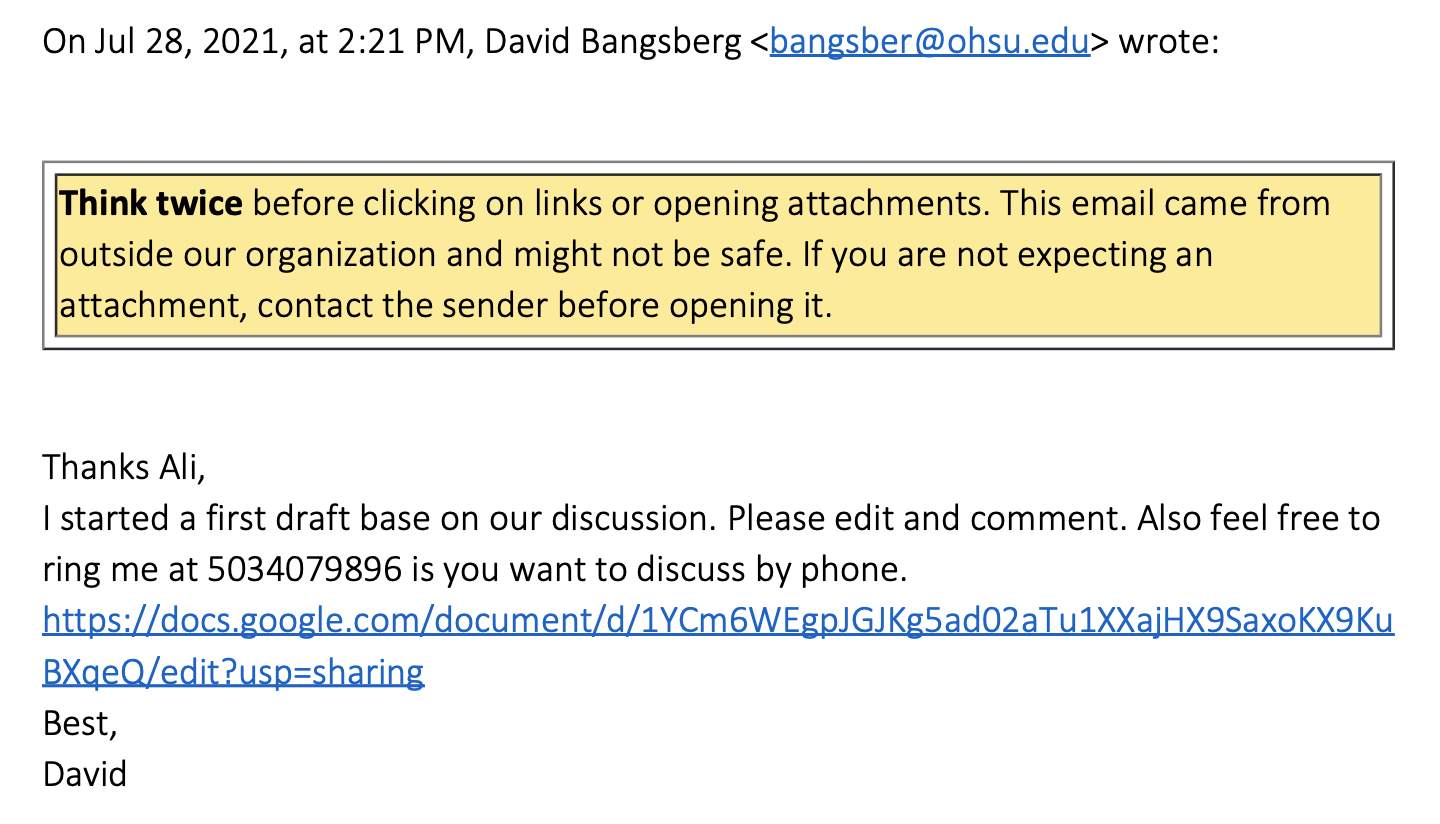
Time growing scant, Bangsberg appearing before the public in less than a week, as nonscientists, the policy experts, Jarem, De Jung and Vandehey were kicked to the curb, Vandehey to resurface later. Bangsberg wrote:
“Thanks, Ali,
I started a first draft base[d] on our discussion. Please edit and comment. Also feel free to ring me at 503 – XXX-XXXX i[f] you want to discuss by phone. https://docs.google.com/document/d/1YCm6WEgpJGJKg5as02aTu1XXajHX9SaxoKX9KuBXqeQ/edit?usp=sharing
Best, David”
Consider Hamade’s history with the report. He had deleted many pages of evidence of RFR’s link to harm from the report. And he was involved in the alleged withholding of the first draft from a public records request.
According to this email, he got to weigh in with a discussion at some unspecified date prior to Bangsberg starting to adapt Biddlecom’s template. Then Hamade was invited to edit it, which he did, according to this emailed statement to several recipients from Tara Chetock: “I see that Ali has made edits – thanks, Ali.”
The content of Hamade’s edits is unknown. The only edit visible is unsigned, a sentence that Bangsberg employed in his public statement about the school environment and relevant exposures.
That Modie, Biddlecom and Ourso got this email was perhaps an implicit invitation for them also to “edit and comment.” The invitation was made explicit in a July 30 email from Chetock, who helped the trains run on time this entire project. Writing to Ourso, Modie and Biddlecom, and after thanking Hamade for his edits, she said “Andre, Jonathan and Cara – are there additional edits or considerations to include?” Considerations – that’s a fairly broad invitation in regard to what the public might view as the OHPB chair’s statement.
Modie didn’t answer, but the latter two indicated their approval. On July 30, Ourso wrote to Bangsberg, Biddlecom, Hamade and Modie to say, “The statement looks good to me. Thank you.”
That same day, Biddlecom wrote the group, including Ourso, “I do not have anything else to add. Thank you, everyone.”
Bangsberg, plus a total of eight very senior OHA staff devoted time to crafting the joint response. Yet there’s no indication of any consideration of the public’s damning criticism of the report and OHA itself, no response to critiques lodged by scientists from Germany, Sweden, Greece, Ireland, Australia, Brazil, Canada and America, nor any sign of reacting to the charges I laid out in black and white in The Washington Spectator.
There was, however, much empty talk of welcoming public input and giving it every due consideration – not that there was any indication of that in the email chain nor in Biddlecom’s template or in Bangsberg’s statement.
Bangsberg knew the report’s failings too, as well as the meaty public critiques offered at the July meeting. That public comments were repeatedly paid all due respect was a sham, respect honored in the breach, not the observance. Similarly, the charges in my WashSpec article were totally ignored.
Both before reciting his public statement on August 3, and at its conclusion, Bangsberg made a show of valuing public comment. Referring to “significant public comment,” he said initially, “We have taken that public testimony very seriously. I have deliberated over that public testimony for the last month.” He then described how the statement had been written: “in partnership with OHA, we’ve drafted a public statement.” He had gotten together with OHA, he said, and “discussed my impressions with the OHA Public Health Division.” His and OHA’s statement, he added, is in response to the public testimony. Then his formal statement repeated the importance of this testimony more than once. At the end, he declared that “All the team at the Public Health Division were very thoughtful in reflecting on the public comments.”
He doth protest too much, methinks.
OHA reigned supreme in its refusal to address the manifest problems in its wireless risk report, and why shouldn’t it, the office of Governor Kate Brown turning a blind eye. The one serious, potential hot potato Bangsberg did raise, he immediately doused with cold water and slipped in his pocket. In his August 3 statement, he said in regard to RFR and EMF in schools that,
“While the available data do not prove a causal effect, neither do they exclude the possibility of a causal effect.”
That’s quite a departure for a joint OHA/OHPB statement to officially admit that the state’s children may be at increased risk of adverse health effects from RFR/EMF in schools. It diametrically contradicts the SB 283 report, OHA’s review of the literature. In the Executive Summary of that report, OHA had stated that it lacked “sufficient evidence to conclude that RFR exposure in school settings is associated with adverse health effects.”
In an email in September 2021, Devra Davis told me that Bangsberg’s “statement certainly would lead unbiased, reasonable experts to seek a radical revision and retraction of that report. Period.”
By most lights, Bangsberg’s bombshell statement on RFR’s possible causal link to adverse health effects was a call to action: a revision and/or retraction; more and sounder research than the rampant, unabashed deletion of evidence that marked the published report; and consideration by the Oregon Department of Education of the steps needed to safeguard the state’s children.
An ODE response to any adverse OHA finding was mandated by the report’s enabling legislation, SB 283. The law said ODE “shall develop recommendations to schools in this state for practices and alternative technologies that would reduce students’ exposure to microwave radiation that the [OHA] review … identifies as harmful.” (ODE’s response – or lack thereof – will be covered in a future installment of this series). Yet, neither Bangsberg, OHA, nor the office of Governor Kate Brown pursued any of the self-evident responses required by his new statement on the “available data.” His very next sentence pivoted to embrace the status quo. “OHA recognizes the many benefits of wireless technology….” This was followed by the ever useful call for more research, can kicked down road.
It’s remarkable really. The YouTube of the August 3 meeting (starting at the 12:40 mark) underscores the State of Oregon’s admission in an official OHA/OHPB statement that it cannot rule out increased risk of harm to schoolchildren. And then, without drawing breath, in the very next sentence, it launches into the benefits of the ever burgeoning technology placing kids at risk.
Yet this statement was a rare official instance of staring reality in the face, a single, important sentence’s worth. It questioned the wisdom of bathing young kids with thin skulls in ever increasing amounts of RFR/EMF, twenty-five Chromebooks with multiple antennas in a room with a powerful WiFi router, phones in virtually every pocket, students circulating about the room. Bangsberg’s statement even, should state law be closely followed, have charged the Department of Education with addressing RFR in schools.
But no, Bangsberg the medical doctor turned immediately to the “many benefits of wireless technology.”
OHPB member Jessica Gomez, a southern Oregon business owner, offered the sole brake on the rush to consider the matter closed. New to the board and perhaps spurred by her recently announced, long-shot campaign for the Republican nomination for governor, she apparently didn’t get the message to merely salute once Bangsberg finished his statement. She asked, “It sounds like there’s going to be an additional investigation into this, am I getting that correctly?”
Ah, a newcomer’s naïveté, Gomez not yet schooled in how things work. There’s actually no commitment or funding for additional research she was told, as OHA honcho Jeremy Vandehey confirmed. But worry not since Bangsberg quickly reassured her and her fellow Oregonians that, “OHA is committed to following the scientific literature, and if scientific literature evolves that suggests a change in policy, then I think OHA would be very open to considering that.”
There was no mention of how that commitment would be manifest, no discussion of funding for the effort, no indication of who at OHA would be responsible for following the literature and bringing the matter to leadership’s attention.
Dispensing with the entire issue at the end of this segment of the August 3 OHPB meeting, he said, (at 15:15) “There’s no commitment to sponsor additional research or funding to support that at this time from OHA.”
He then turned to Vandehey. The state’s director of the division charged with formulating policy deferred to an OHA press person for details, if needed. Vandehey then offered his entire response to Bangsberg’s airy dismissal of the need for any further research: “This report came from a legislative request for us to review the evidence that was out there and so on.” Indeed, “so on” – as far as policy and analytics were concerned. OHPB Vice-Chair Oscar Arana jumped in with a nice red bow to tie atop the proceedings August 3, and that was that, on to a discussion of the board’s own committee membership.
The August 3 meeting constituted performative oversight, including the many faux nods to full consideration of the public’s outrage – consideration that is nowhere in evidence.
Given July’s public invective, did the members of the OHPB roll up their sleeves, investigate the public’s dissatisfaction with the OHA report, call its authors and OHA leadership before it at a subsequent public meeting and quiz them as to what it was all about?
Sorry to say, the OHPB board seemed an empty shell. They were aware of the issues at hand, did nothing to investigate them, and allowed Bangsberg to run the show with no input from them. (Arana appeared in the email chain, but remained mute as far as I can tell.)
Nor was Bangsberg the only board member to hand his voice to the agency he was appointed to oversee. I queried him and the other OHPB members about the report, most of them twice. There was a single reply aside from Bangsberg’s pale recitations. It came from OHA’s Jonathan Modie, noting my query to board member Bill Kramer and advising that the agency would speak on Kramer’s behalf.
At least Kramer reached out to OHA to complain about contact from a reporter. The other board members just ignored my questions. In any event, I put the question to Kramer directly: How does that constitute oversight, letting OHA speak for you?
No reply to that either.
No one would say, including Bangsberg, why he took it solely upon himself to work with OHA to craft OHPB’s reply, this from a board with eight members.
OHA’s report said there was nothing to see. And then there became literally nothing to see after OHA disappeared it without a whisper after David Morrison, Living Energy‘s Peter Anthony Cowan and others started parading around the state capitol building earlier this year asking awkward questions.
Nor did OHA have much to say back in 2021. What Bangsberg read aloud was titled, “OHA STATEMENT.” And its URL read: “OHA Response to July 2021 Public Comment.” But rather than the agency issuing a news release on its bells-and-whistles OHA website, the statement was posted deep within the bowels of OHPB’s obscure website.
Back in 2021, you’d have to know about OHPB; know that wireless risk was addressed at its August 3 meeting; find the video link to that meeting; and then if you wanted to read the statement, burrow among the twelve documents on offer for that particular OHPB meeting. Here in 2026, you’d have to file a records request for a meeting this old. Apparently, Oregon didn’t want the state’s parents to know there was real doubt about wireless-tech safety in schools.
Asked back in 2021 about the lack of notice, Davis said:
“Its significance depends on how seriously people take it and whether people are aware of it. Obviously, it’s buried right now. But it’s there. Any intelligent public health person has to understand what this means. Risk to children cannot be excluded. So now the question is do these people have the courage to communicate this to the public? Do you want to run your schools exposing children to a risk that can be prevented? That many expert groups believe poses serious irreversible threats?”
Surprisingly, the second half and more of the 68-page OHA/Bangsberg email file that I obtained through a FOIA request concerns their “Response to Dan Forbes.” I blush. It’s worth mentioning given the remarkable amount of effort crafting a response to a reporter.
Trying to write a follow-up article that’s only now come to fruition, I emailed Bangsberg, OHA director Pat Allen, the governor’s Communications Director and her deputy, the ODE director and others with questions in August and September.
My questions referred to the OHA/OHPB’s joint statement that declared that “available data can’t exclude the possibility of a causal effect” of increased risk from RFR/EMF. I asked why this significant change had been buried deep within the OHPB website and whether Oregon parents deserved to know of this revised risk assessment. I also wondered if the change meant the SB 283 report should be retracted and revised, and asked about the Oregon Department of Education’s potential new responsibilities under the law.
Bangsberg sought guidance from Tara Chetock, Jonathan Modie and Jeremy Vandehey, presenting them with his draft reply. Chetock steered clear, Modie offered a copy edit, but Vandehey had something interesting to say.
In an email October 5, 2021 to the group, with Arana copied, Vandehey offered the OHPB chair an edit so his reply to me would “be more framed as OHPB needs to move on with its priorities so it’s clear that you’ve consider[ed] [Forbes’s] feedback but aren’t going to continue to respond to his request and will refer him to Jonathan moving forward.”
Never mind that I wasn’t offering feedback, I was asking questions. Regardless, there was nothing from the Director of Health Policy about replying to the real questions raised by a universally condemned risk assessment that arose from a first draft with hundreds of lines of text simply deleted by the lead author, text that proved the existence of increased risk.
Bangsberg’s reply to me the next day referred to the joint OHA/OHPB public statement he delivered in August as mere “technical clarifications” to the report. He asserted that he based them on review of the public testimony with input from Arana – though there’s zero evidence in the email file of any consideration of the public’s concerns or of any contribution by Arana, the OHPB co-chair, soon to be chair.
Bangsberg declared himself “a public health professional” twice in consecutive sentences – got that, reporter? Listing some laudable public health goals, he said simply, “I have advised OHA to move on with what I believe are more pressing priorities.”
As per usual, not one iota of substance. OHA had long wished to wash its hands of the irksome risk assessment foisted on it by the legislature in 2019, an assessment slated to run afoul of vast economic forces. Never mind the possibility of increased cancer and other risks lurking years down the road. Our children’s safety, plus the state’s potential liability, still up in the air, OHA declared the matter closed, Bangsberg helping to swing the door. A public health department in a progressive state reporting to a supposedly progressive governor simply turned its back on schoolkids’ safety.
I followed up with David Bangsberg more than once following his August 3 statement. I also reached out to him here in July 2026 with a detailed query memo. No longer working in Oregon, but having scored another prestigious academic post, I thought perhaps he might be willing to comment.
Here’s his reply:
“I reviewed the material you sent me including the original OHA statement as well as the email correspondence regarding preparing and drafting the statement. I believe the statement accurately summarizes our understanding of the information we had available at the time. I also stand by my recommendation at the time that OHA dedicate their attention to more pressing public health challenges at the time, particularly COVID.
I have no further comment.”
Three times he uses the phrase “at the time.” And he’s correct that the science of increased risk from RFR/EMF has advanced mightily since the report was written in 2020, with hundreds of studies published since then. Does that mean Bangsberg will join the hundreds of scientists worldwide calling for a reevaluation of the risk and a resetting of the current exposure limits? After all, OHA drafted the statement he stands by; the template was OHA’s.
Usher aside the possible exclusion that Bangsberg referred to – with the passage of time, the “available data” embrace “the possibility of a causal effect.”
Given that OHA now formally states that the possibility of a causal effect of harm from RFR in a school setting cannot be excluded, what is Oregon Department of Education’s responsibility to act in light of the 2019 law, SB 283, that mandated both the OHA report and ODE’s response?
That law requires ODE to “develop recommendations … for practices and alternative technologies that would reduce students’ exposure to microwave radiation that” OHA “identifies as harmful.”
ODE never developed the recommendations. OHA never revisited the report. And in the five years since, no state official has informed a single parent in Oregon that the state looked at the wireless radiation in its classrooms, could not rule out harm to the children sitting in them, and decided to move on.
Turn out the lights on your way out, kids.
Daniel Forbes’s novel, a dystopian noir entitled Derail this Train Wreck, was sparked by an NYPD assault on he and his wife at New York’s Lincoln Center at an Arlo Guthrie concert of all things. (Free-speech case law was made, and they paid.) He testified before the House and Senate at hearings his journalism caused, castigating the White House after exposing its $24-million of sub rosa propaganda inserted into television scripts to demonize marijuana. His scoops on a glass factory spewing arsenic and hexavalent chromium into the air helped change Oregon state policy; scoops on lead dust from housing demolitions helped change policy in Portland.
The investigation continues on my personal website, where the documentary record behind this article is laid out in full. Each entry below opens an interactive page where you can step through the evidence yourself.
The Removal Record — Every URL OHA pulled offline, its current status, and the date of its last live capture. Tracks the original February 25, 2026 cleanup and every subsequent removal since.
Inside the Drafts — The line-by-line change log of OHA’s SB 283 report: every deletion in red, every margin note, every sentence cut on the way to “insufficient evidence.” Read the version that came first.
The Investigation Timeline — The full chronology, from the 2011 lawsuit to the 2026 removal. Every key date in legislation, manipulation, concealment, and recovery, in one navigable sequence.
OHA’s Response — The full text of the agency’s account of the February 2026 removal, including the inquiry sent to OHA’s press office, the response, and the Web Governance Plan policy cited as authorization.
No posts
Comments
Nothing yet. Say the first thing.
Sign in to join the conversation.