

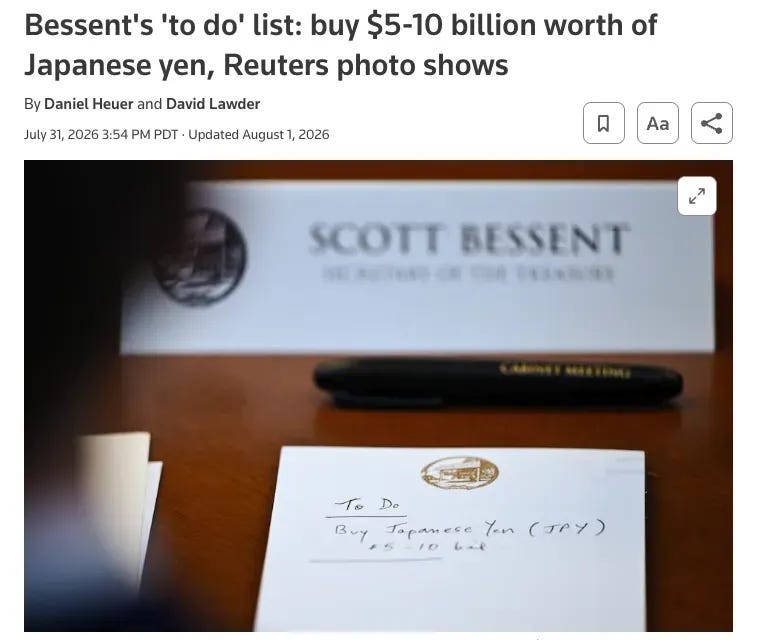
Scott Bessent was photographed at a Camp David cabinet meeting on July 31st with a notepad that read, in his own handwriting: “To Do, Buy Japanese Yen (JPY) $5-10 bil.”
A Reuters photographer caught it at 11:33 AM, and within hours the New York Fed had executed exactly that, on behalf of the Treasury, selling euros to buy yen for the first time since 2011
.That, on its own, would be a notable story.
Two allies coordinating on currency markets happens maybe once a decade. But it’s not actually the important part of what happened last week.
For the first time ever, Tokyo didn’t sell its Treasury holdings on the open market to raise the dollars it needed. Instead it went to a little-used Federal Reserve lending window called the FIMA repo facility, posted its Treasuries as collateral, and borrowed the cash instead.
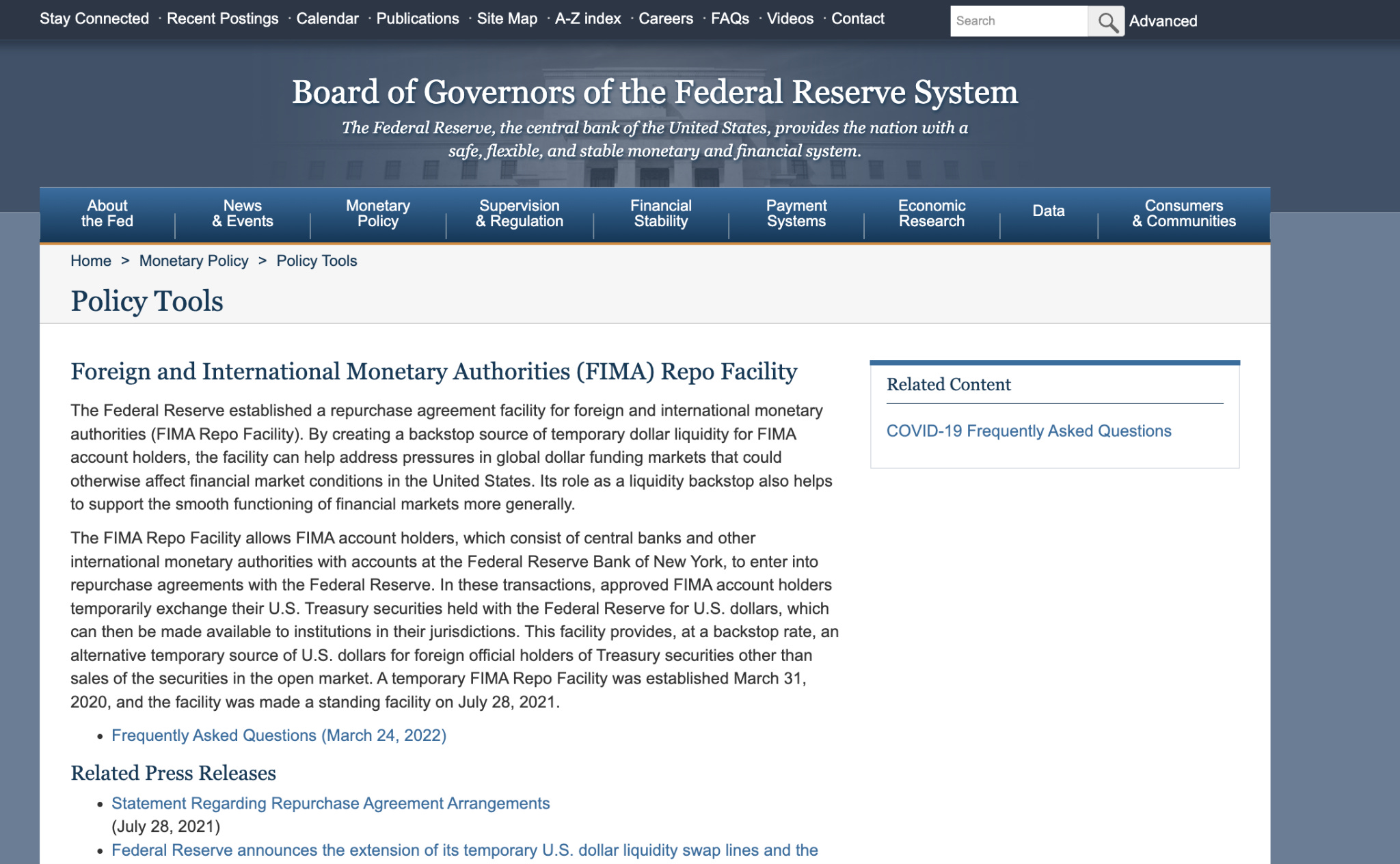
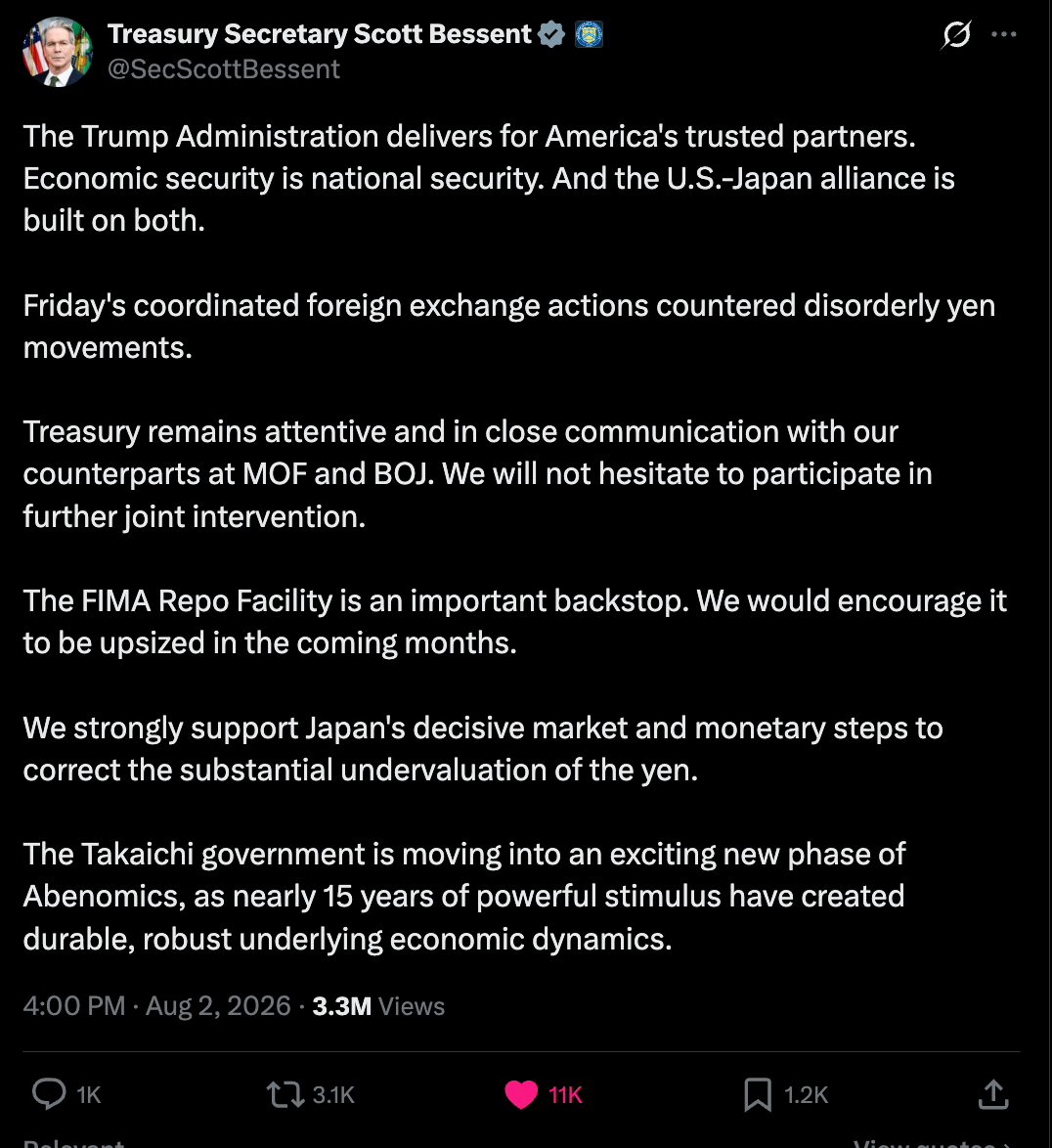
And Bessent immediately went on X to say the quiet part out loud: this is going to happen again, and the facility that made it possible should get bigger.
I’ve been writing about Japan’s worsening currency problem for two years now, and making the assertion that the land of the rising sun has crossed an event horizon it can’t escape from.
Here are the posts to read to catch up, in chronological order:
The Japanese Maginot Line
Tokyo Drifting Into A Currency Crisis
The Shoguns
Godzilla Returns
Japan’s Liquidity Trap
Flipping the Yen
Drought in the East
Panic in Tokyo
The Ghost of Yentervention
Sana-mania
Burning Yen
Last Warning
No Exit
The Hollow Truce
Panic of the Yen
Calling Up the Reserves
On July 24th, USD/JPY touched 163.99, the weakest the yen has traded since 1986. That’s despite a rate hike the month before which brought the policy rate to 1%.
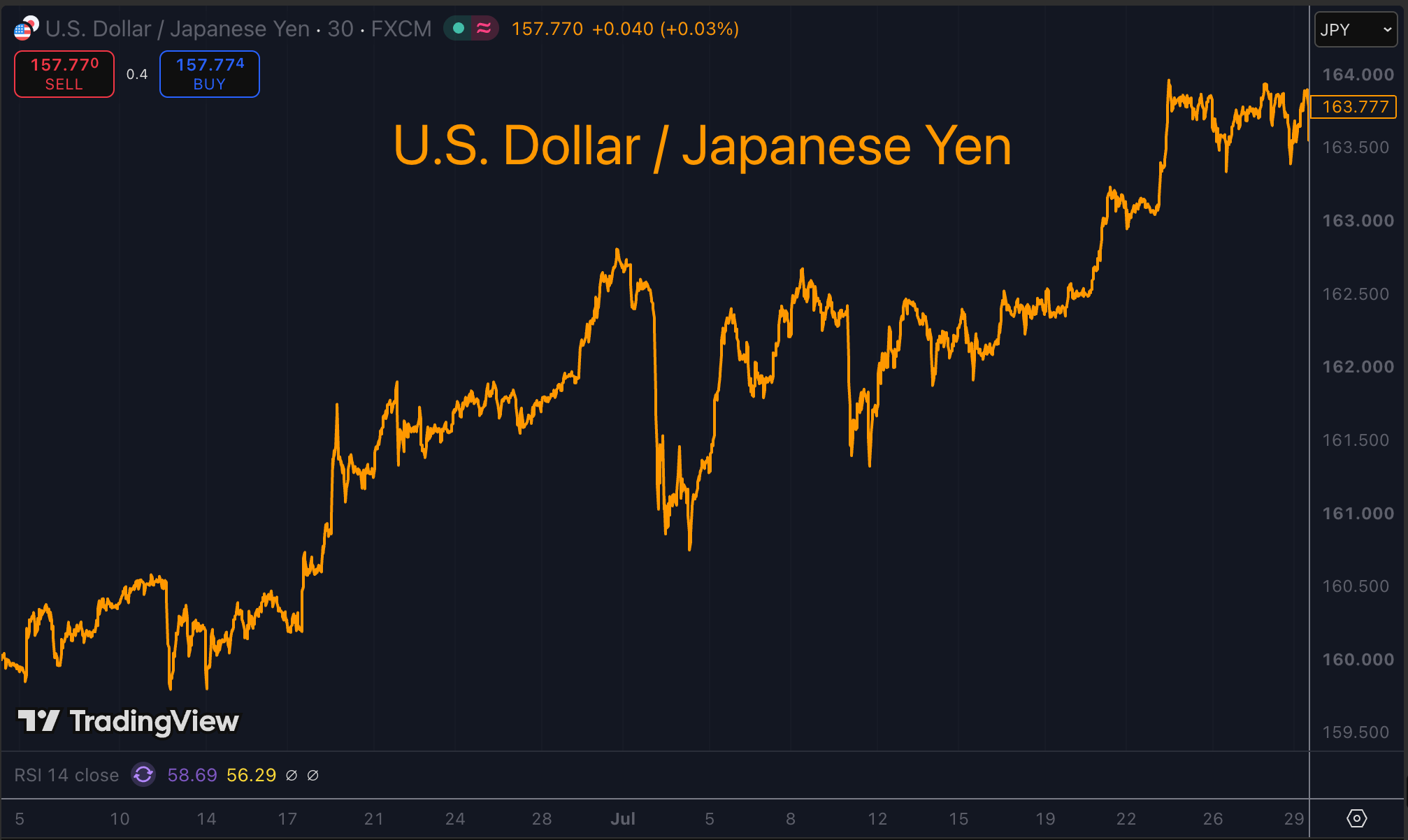
The week that followed was a genuine circus.
On July 30th, US officials ran what traders call a rate check, quietly phoning banks to gauge market conditions, a move that’s usually a tell that intervention is imminent.
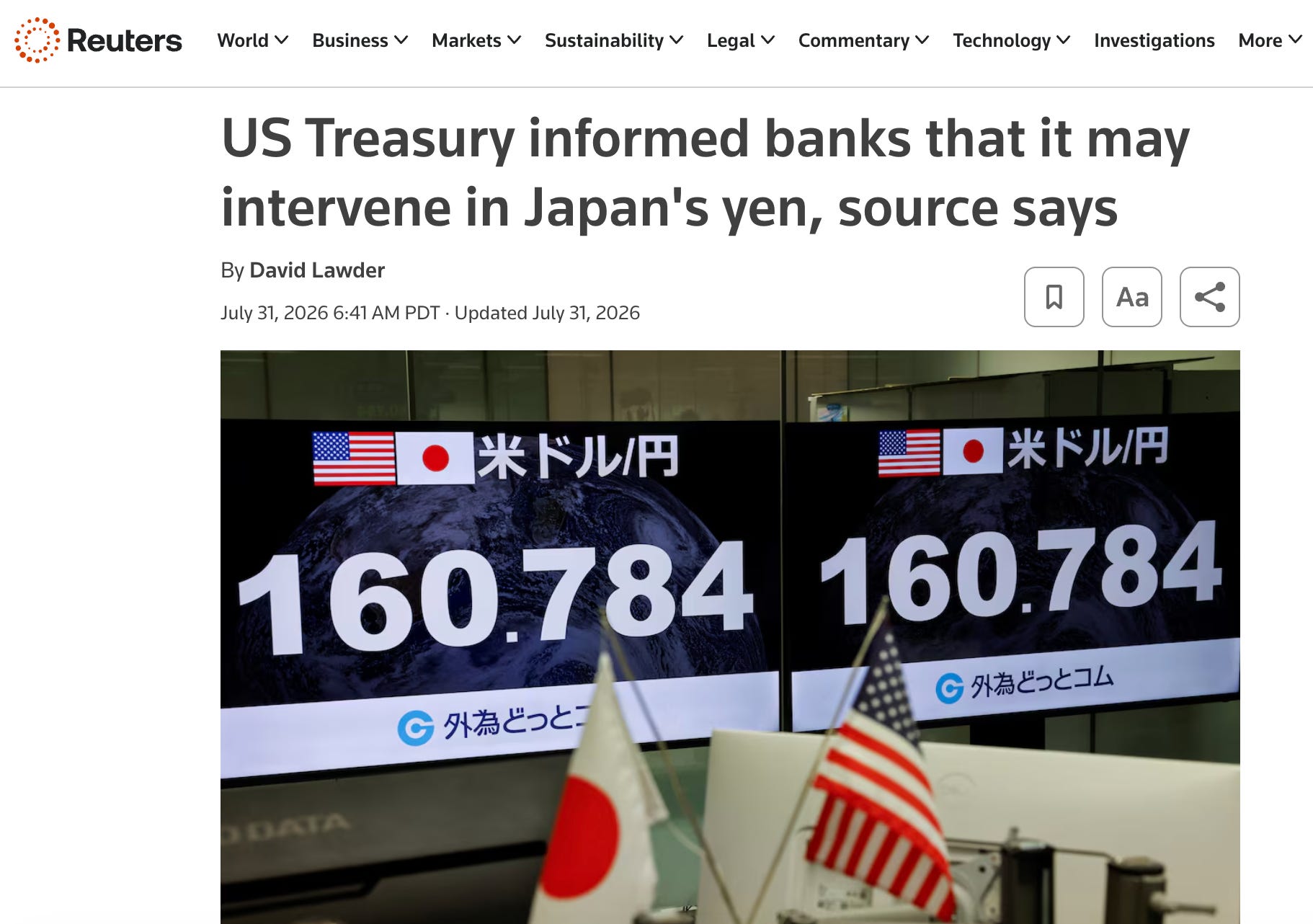
Hours later, Japan moved alone: the yen jumped from around 163 to the high 150s in the New York session, with BOJ data suggesting Tokyo may have spent as much as $58.97 billion in that single push.
By Friday morning the currency had drifted back toward 160, proof that Japan couldn’t hold the line solo.
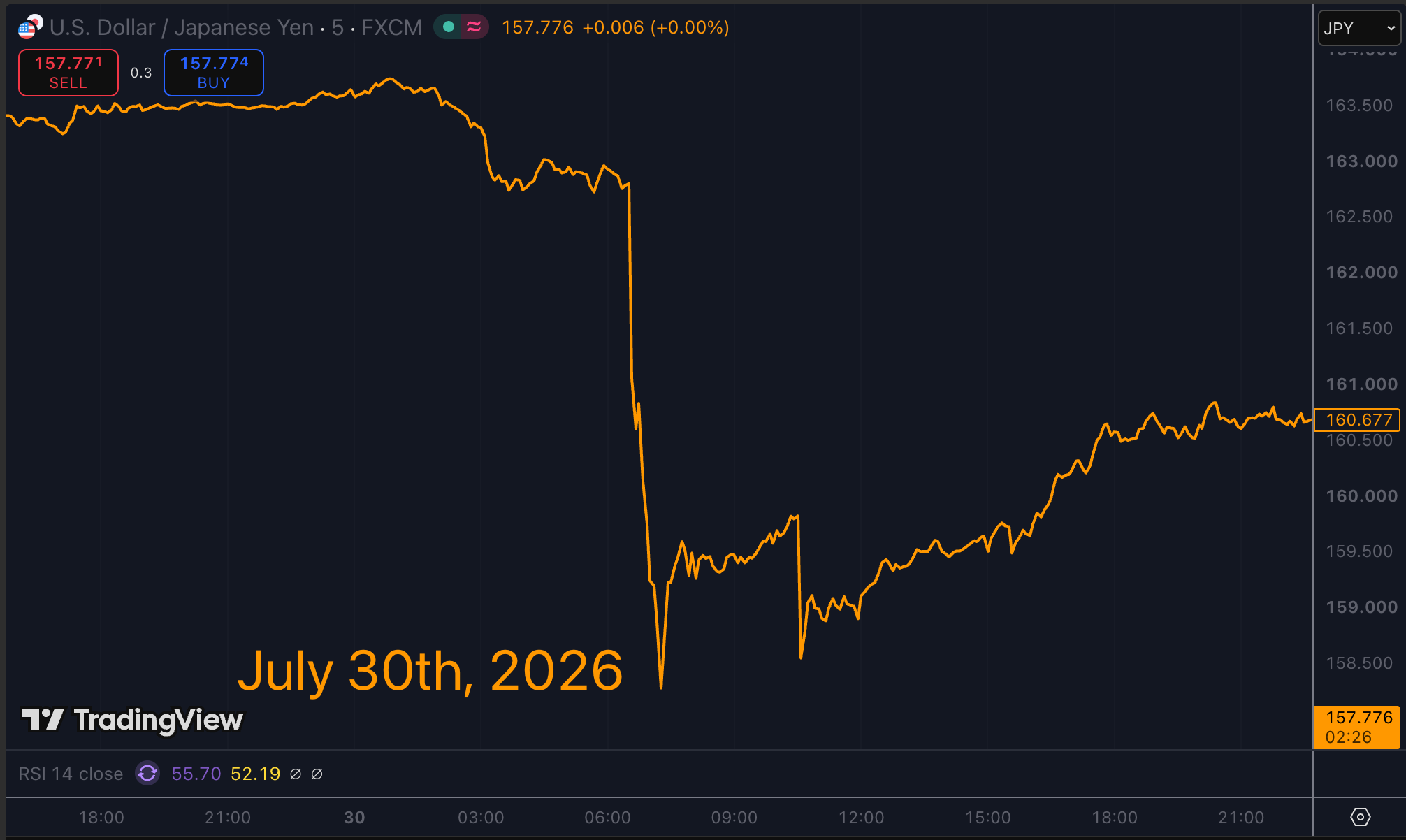
So Washington stepped in directly, Bessent’s notepad and all, with the Treasury’s Exchange Stabilization Fund selling euros and buying yen through the New York Fed.
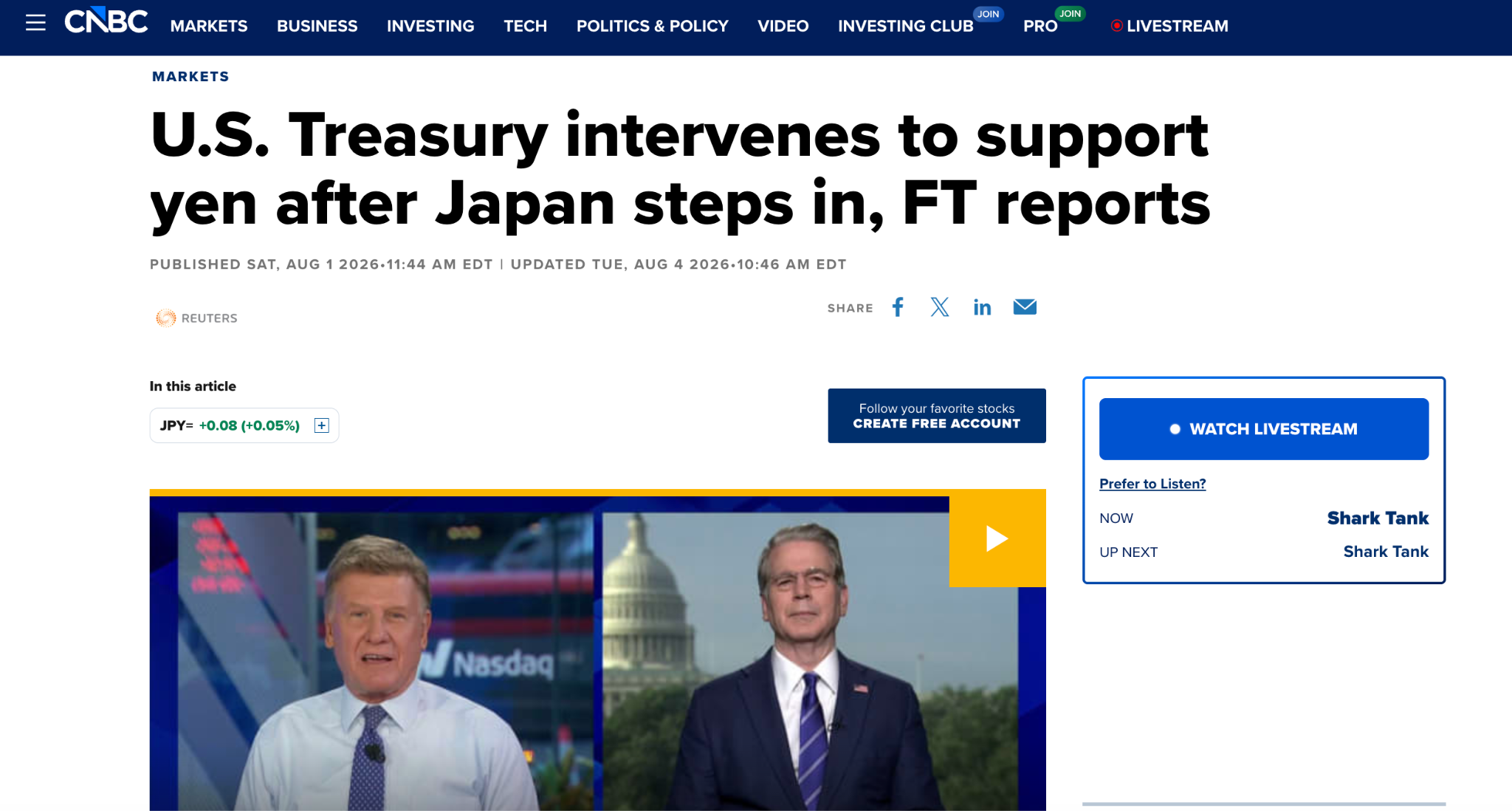
Japan added roughly another $32 to $37 billion on top, this time drawing on the FIMA window rather than dumping bonds. Add the two days together and you’re looking at somewhere north of $91 billion moved in 48 hours, the most expensive two days of yen defense in the four-year history of this fight.
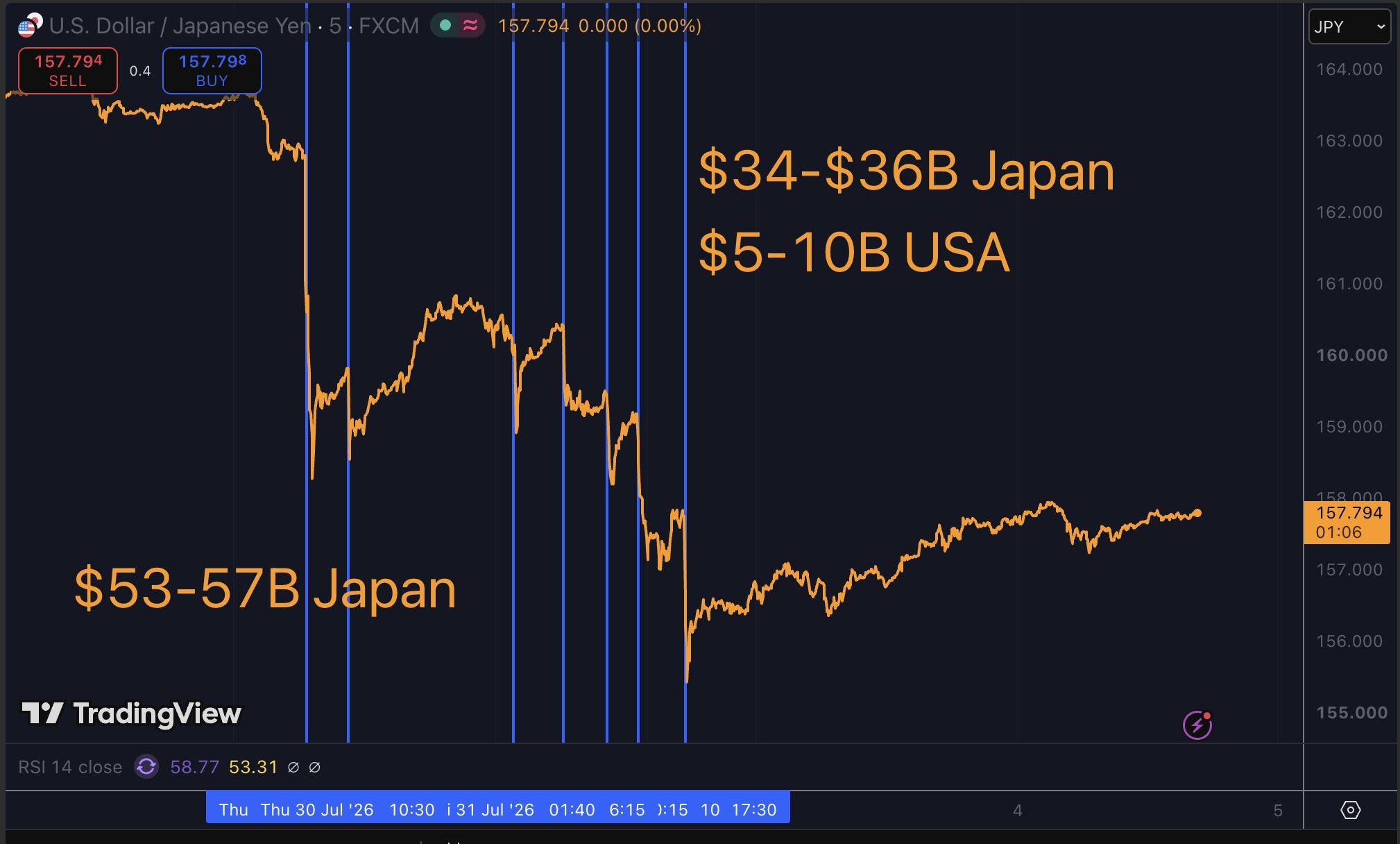
By Monday the pair had settled around 156.5. Japan’s Finance Minister Satsuki Katayama called it a response to “excessive volatility” and said Tokyo would not hesitate to act again. Bessent, in his own statement, called it the kind of thing allies do for each other. State Street’s Masahiko Loo offered the more useful read for anyone trying to trade this going forward: MOF’s actual line in the sand is probably a zone around 162 to 165 rather than one hard number, which means every close above 162 from here is a live intervention risk.
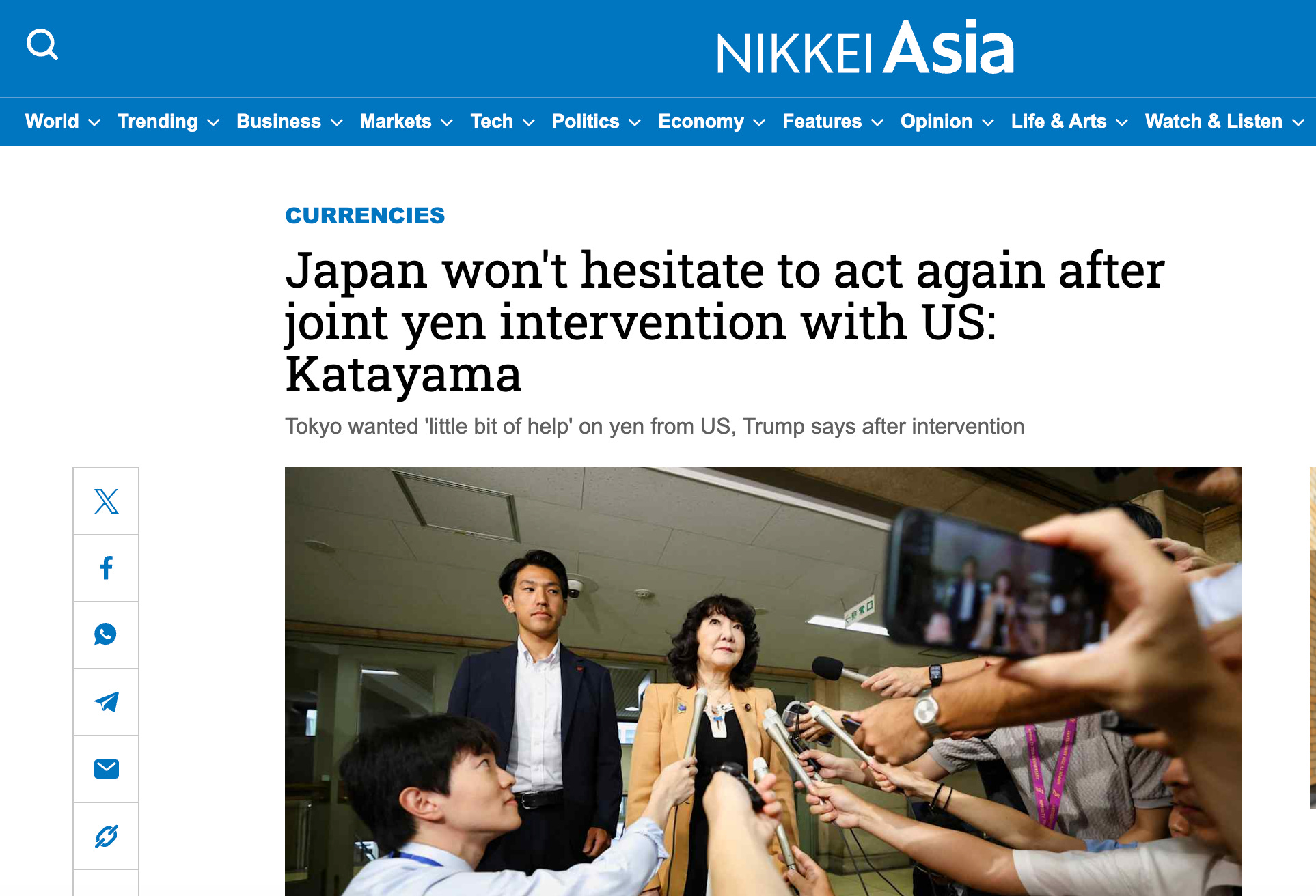
Allies help each other. Sure.
But you don’t sell euros to buy a partner’s currency, and you don’t open up a Fed lending facility to keep them from having to sell your own government’s bonds, unless you’re worried about what happens if you don’t.
Which is exactly what I was saying years ago.
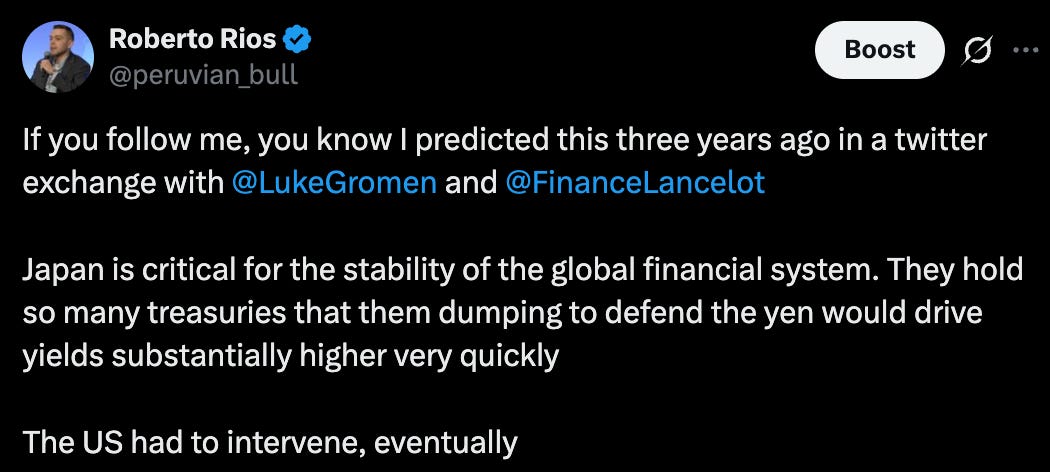
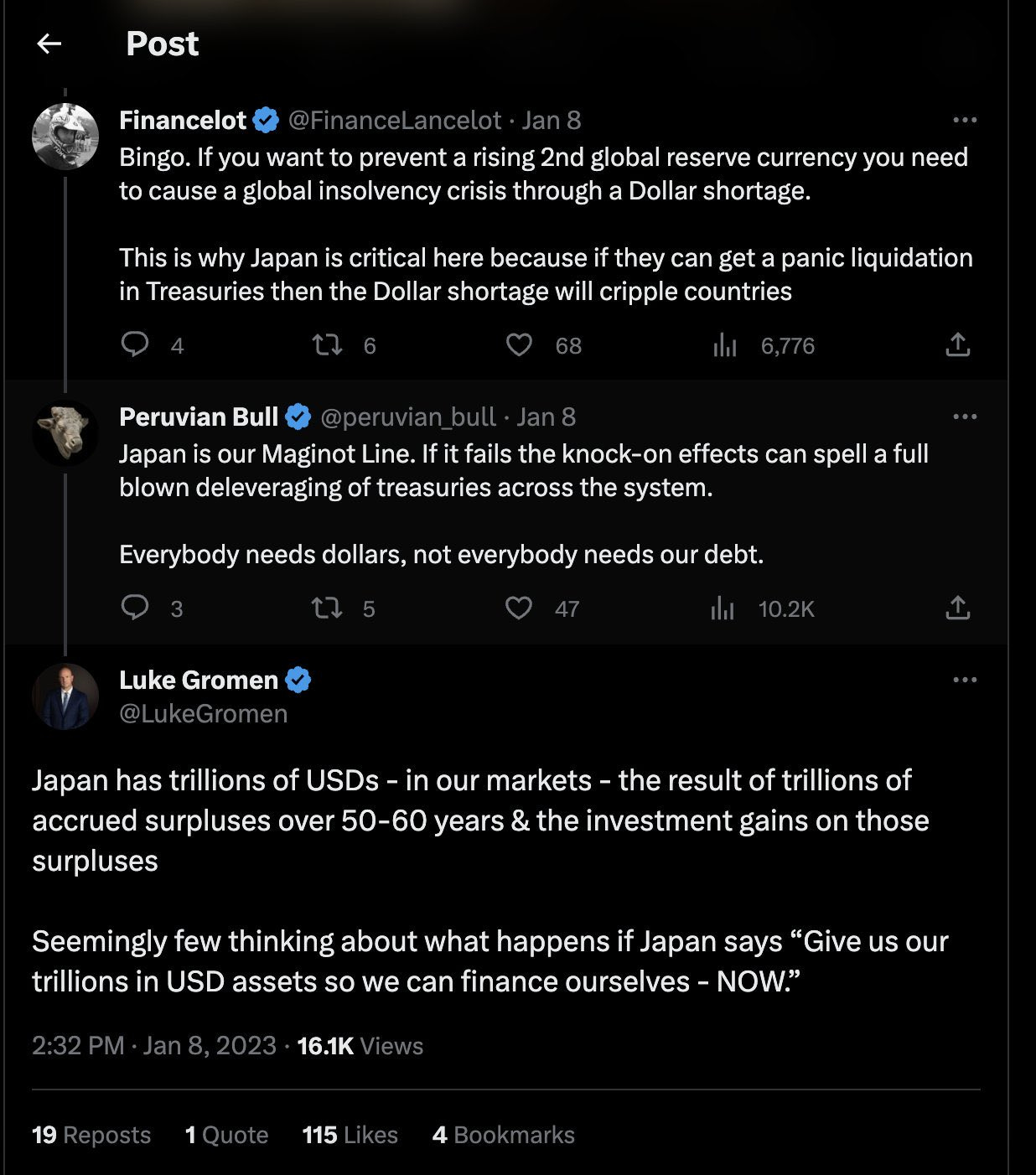
None of this is new, exactly. It just keeps getting bigger, which is its own kind of story.
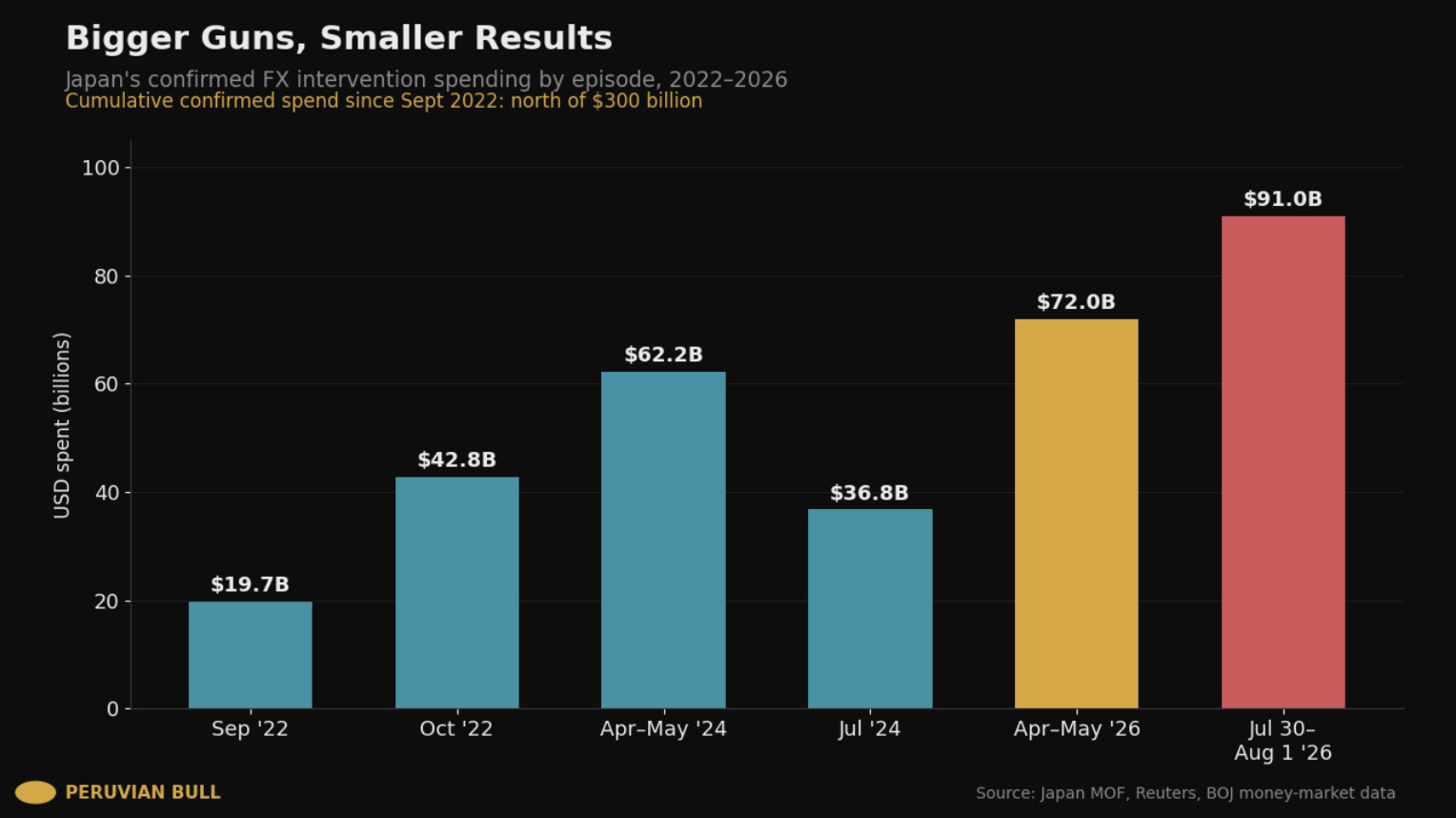
Back in September 2022, Japan did its first currency intervention in 24 years, a $19.7 billion single-week operation that at the time felt enormous.
A month later they came back for $42.8 billion more. Then it went quiet for eighteen months, until April and May of 2024, when the yen hit a 34-year low and the Ministry of Finance confirmed it had spent $62.2 billion defending it, the largest intervention on record at that point. Everyone assumed a number that size would settle things.
It didn’t. Two months later they were back for another $36.8 billion.
Then this April and May, Japan blew through ¥11.73 trillion, roughly $72 billion, smashing the 2024 record. And now the $91 billion two-day operation from last week. Six episodes since the fall of 2022, and the size of each one keeps growing while the effect on the currency keeps shrinking.
The April-May 2026 operation held the yen down for exactly one month before it retraced every inch of ground and printed a fresh 40-year low anyway.
Add it up and you get a cumulative confirmed spend of north of $300 billion over four years, which is more than the entire GDP of a country like Finland, spent entirely on trying to hold a number on a screen in place.
For the last four years, I counted a total of 14 interventions over 6 periods, some lasting up to 8 days, with multiple interventions over the course of the week.
There’s an old line about insanity being doing the same thing repeatedly and expecting a different outcome. By that standard, Japan’s monetary establishment has been certifiably insane since 2022, and the irony is they know it.
They just don’t have a better option, because the real fix (closing the interest rate gap from either side) is politically or economically unacceptable to both governments involved.
And if you look at how quickly each fix has failed and the pattern gets even starker.
The 2022 interventions bought roughly eighteen months of relative calm, mostly because the Fed’s hiking cycle itself paused not long after. The April-May 2024 record didn’t even hold two months before the July 2024 follow-up was needed.
The April-May 2026 record, the biggest yet at the time, held for barely eight weeks before USD/JPY was back above 163 and setting a fresh 40-year low. Each victory lap gets shorter.
That compression, not the dollar totals themselves, is the real tell that this is a losing pattern rather than a series of one-off shocks.
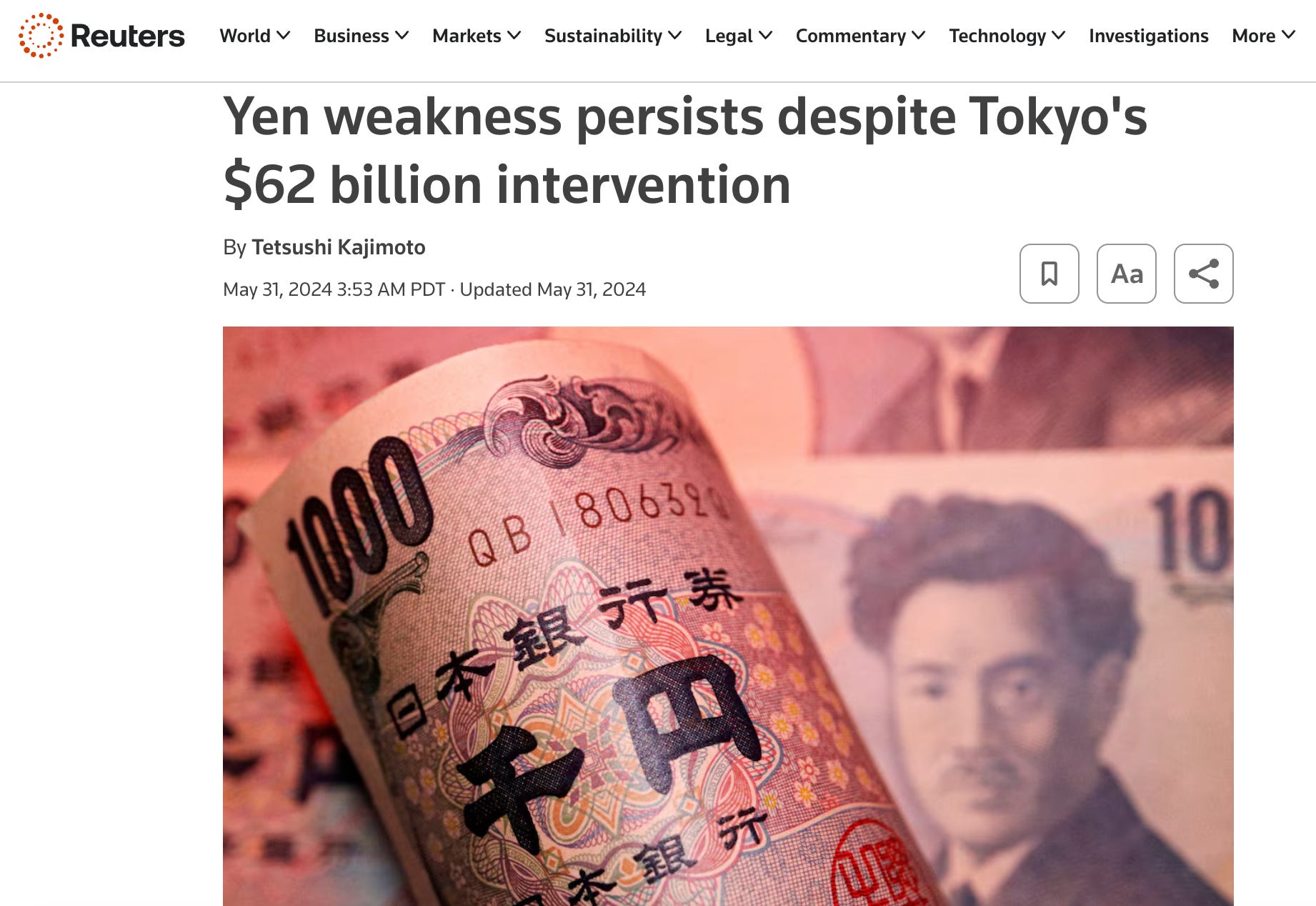
And it gets worse- the interventions themselves are having less market impact during the move itself. Last September, BofA analysts put out a report estimating that USDJPY falls 1 handle for every 1 trillion yen spent (so 3 trillion yen could drive USDJPY from 160 to 157, for example).
However, this April and May the BoJ spent almost 12 trillion yen on intervening in forex, and USDJPY only fell from 161 to 155, making that intervention about half as effective as the ones from just 20 months before.
More money isn’t solving the problem.
For readers who’ve followed this story since Tokyo Drifting, you already know the mechanics here, so I’ll compress it.
This whole thing traces back to March 2022, when Fed hiking collided with a Bank of Japan that had spent decades pinned at the zero bound fighting deflation.
As US inflation ripped higher off the COVID stimulus, the Fed launched the fastest hiking cycle in 40 years, north of 500 basis points in roughly a year. Japan didn’t follow.
It couldn’t, really; with government debt sitting above 237% of GDP, the highest of any developed economy on earth, a rapid rate hike cycle risks blowing up the interest expense on the sovereign balance sheet itself.
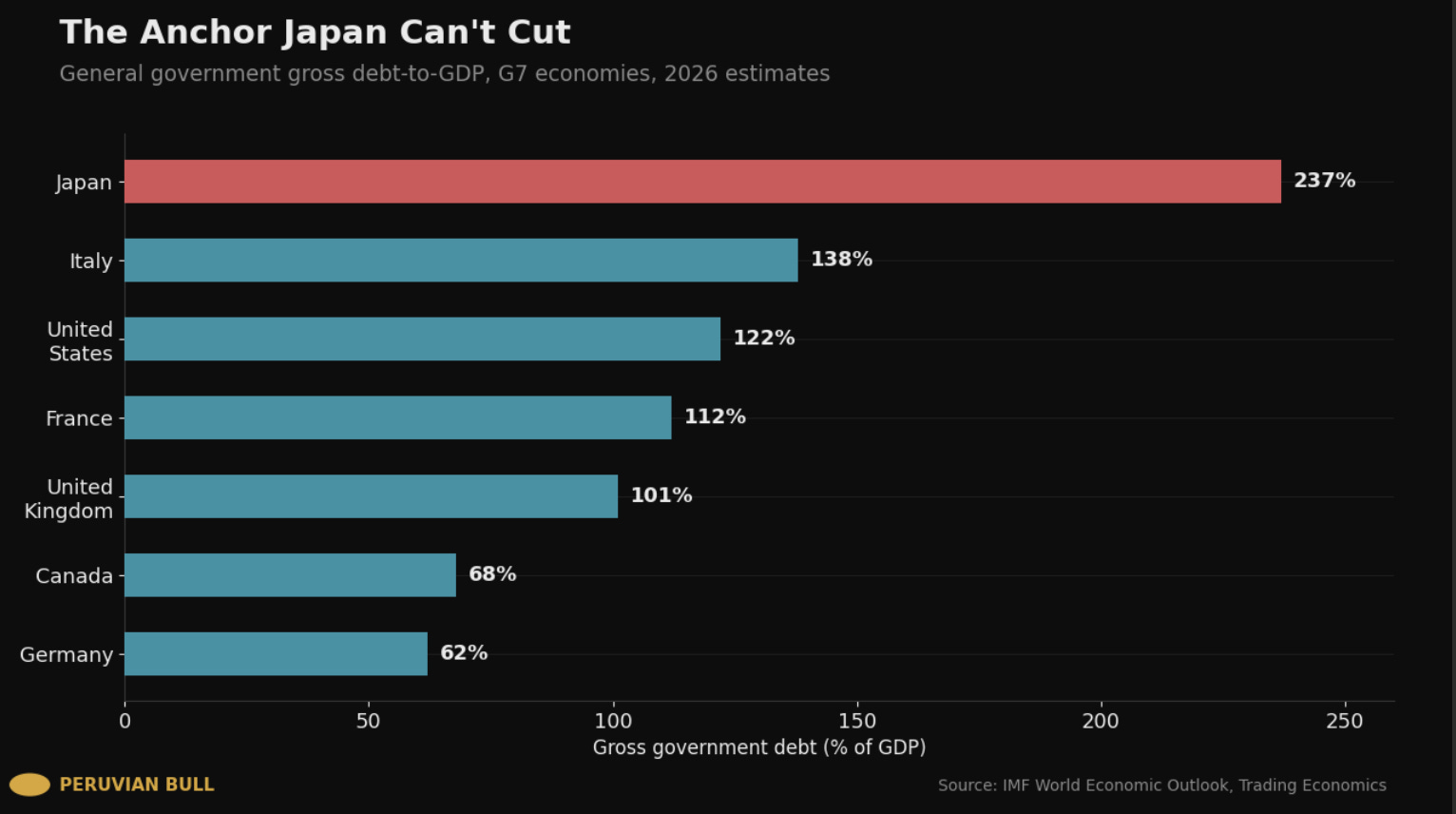
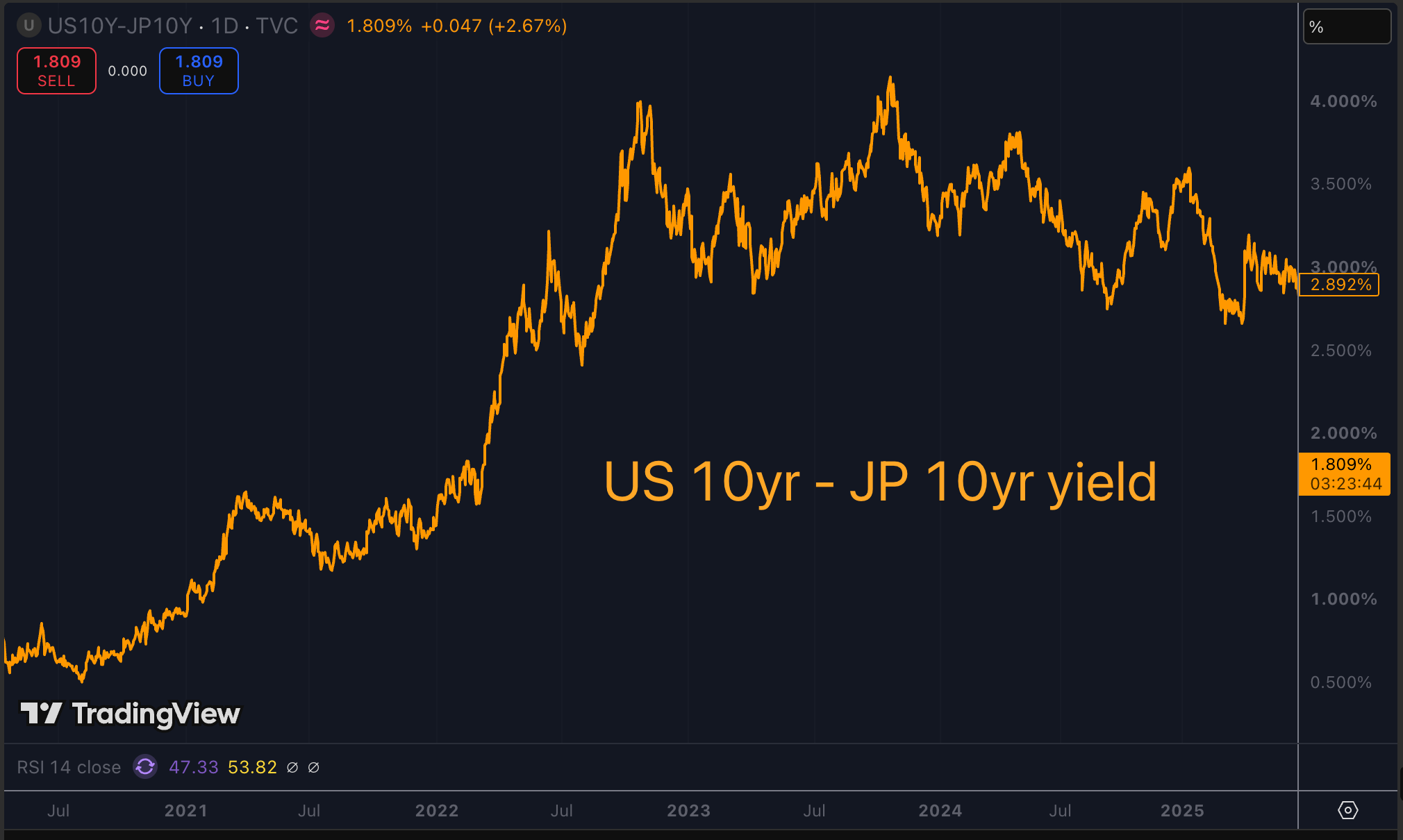
So while American rates screamed upward, Japanese rates sat parked near zero, and a gap opened up between the two that hadn’t existed in the same way before.
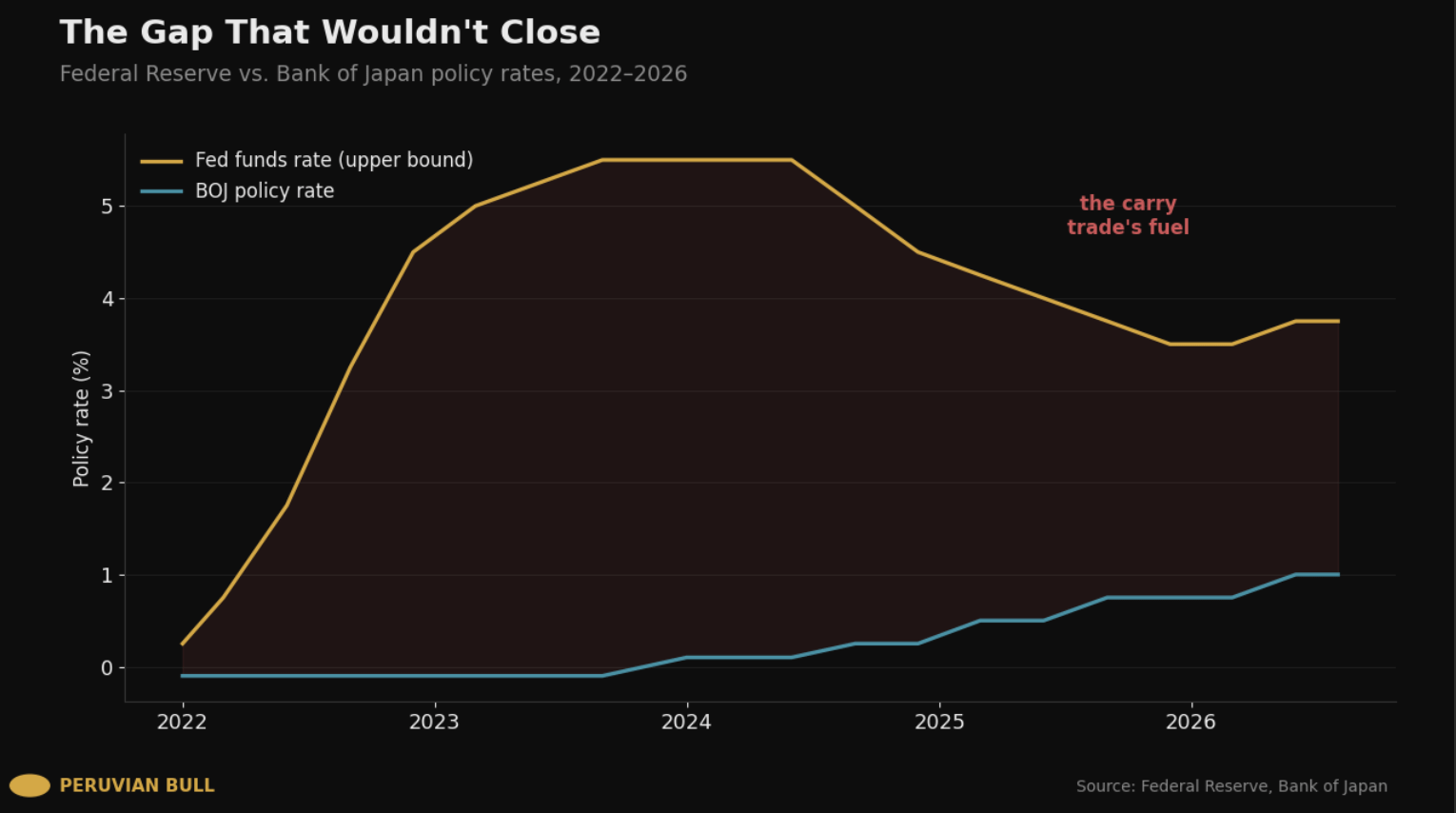
Deutsche Bank analysts once sized this trade, aggressively, at $20 trillion equivalent, which tells you the scale of the pressure sitting on one side of this currency pair. Even conservative estimates put it at $2-$4 trillion.
Every basis point of widening spread makes the trade more profitable and pulls in more capital shorting the yen to fund it.
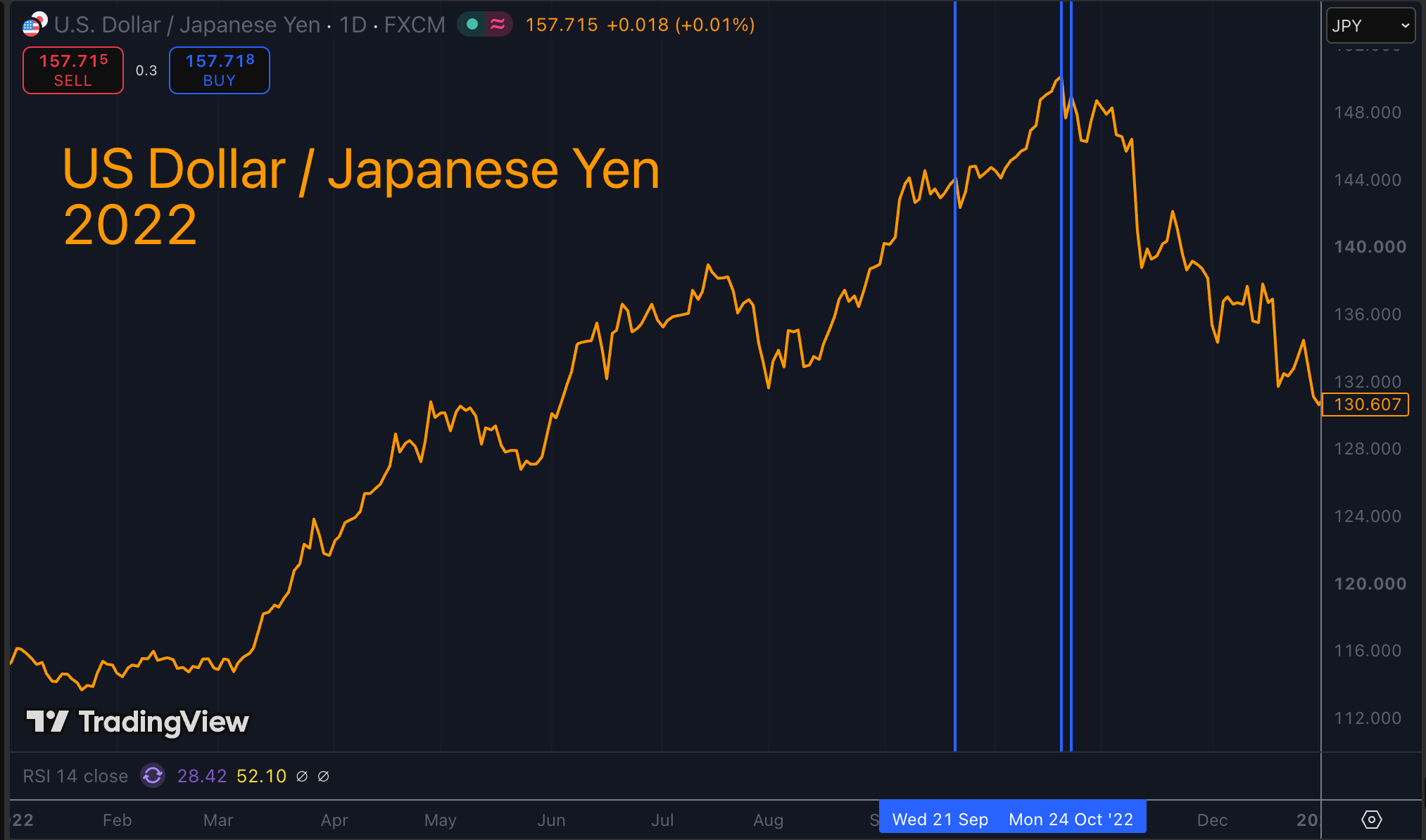
The dollar-yen rate went from 114 in January 2022 to 148 by that September. Then the first intervention happened, and the whole four-year cycle we’ve just walked through kicked off.
What made this particular carry trade so much bigger than the usual currency arbitrage is that Japan’s benchmark rate had barely moved in years.
The BOJ was fiddling with quantitative easing and adjusting its yield curve control bands, but the actual policy rate itself sat at negative 0.1% from early 2016 all the way until it finally went positive in 2024.
They were buying so much long term debt that it shoved down yields across the curve towards the zero bound, as you can see in this chart of JGB yields from 2006 to 2020 here.
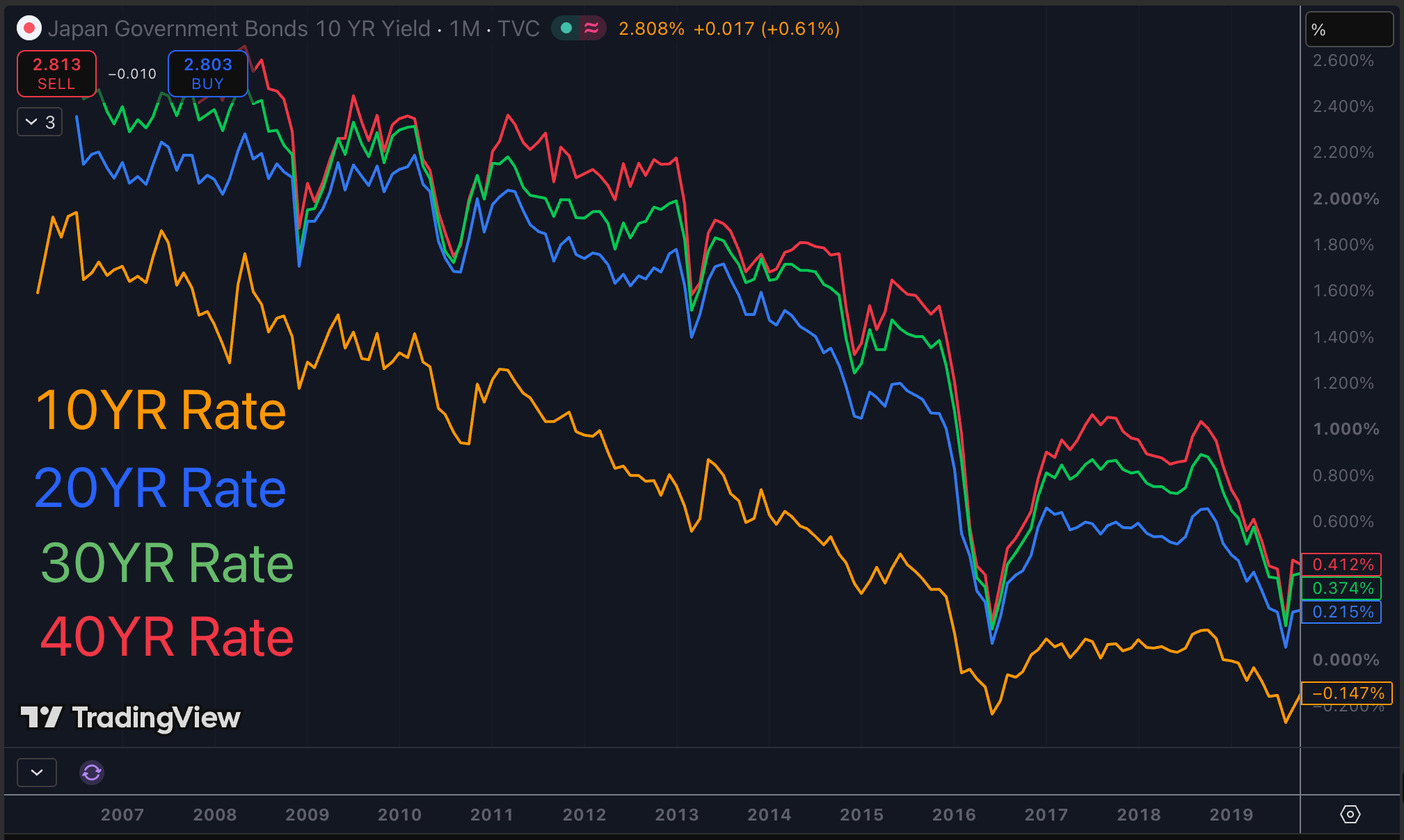
That meant almost a decade of essentially zero volatility on the funding leg of the trade. That stability is what made borrowing yen to fund dollar positions such an obviously profitable, low-risk bet for so long: traders didn’t have to hedge a leg that never moved, so the carry stayed fat and the trade kept growing.
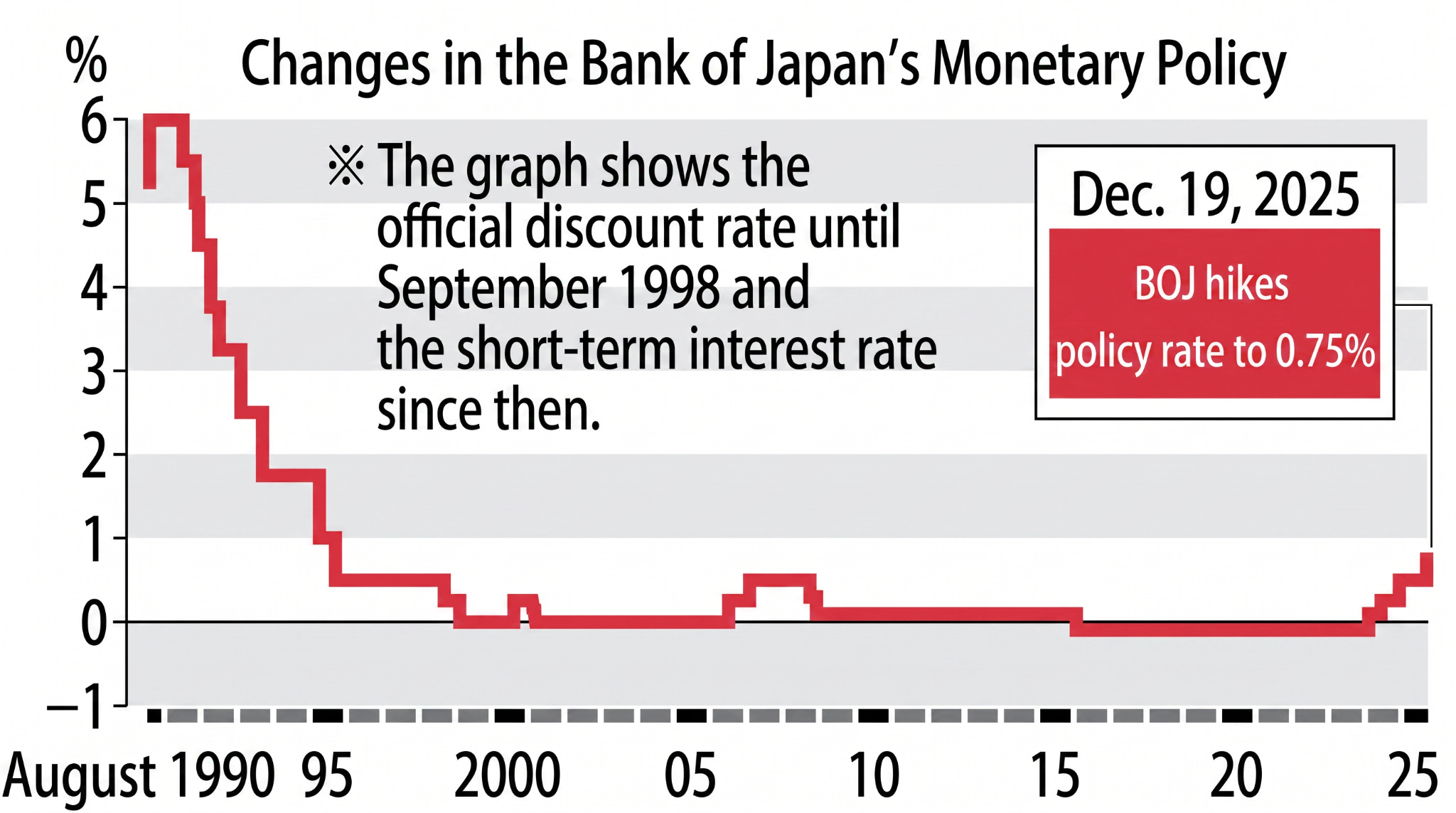
The Japanese public paid for that stability in the form of a currency that lost roughly half its value against the dollar inside two years. The traders running the carry trade paid for it in nothing at all, until now.
But here’s the part that doesn’t get explained well anywhere else, and it’s the reason every single intervention before last week’s actually made the underlying problem worse.
Comments
Nothing yet. Say the first thing.
Sign in to join the conversation.