

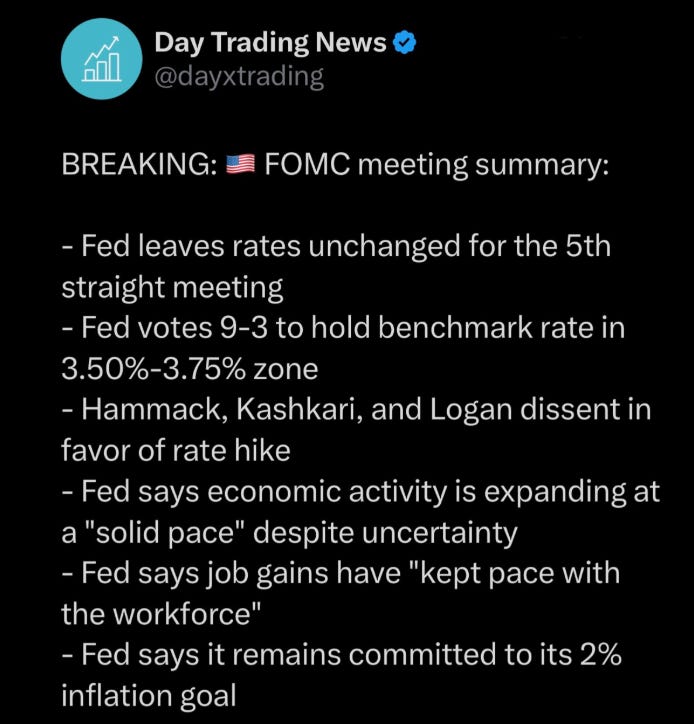
Kevin Warsh wanted you to think he asked for a fight, and yesterday he got one. The Federal Open Market Committee voted 9 to 3 on Wednesday to hold the federal funds rate at 3.50% to 3.75% for a fifth straight meeting, and for the first time since September 2016, three policymakers dissented in the same direction, all of them demanding a hike.
Not a cut. A hike.
Every dissent we’ve tracked through the Powell years came from the dovish side: governors who wanted easier money faster, board members worried about labor cracks, a Treasury that needed the printer running.
Wednesday’s dissent came from three regional bank presidents, Cleveland’s Beth Hammack, Minneapolis’s Neel Kashkari, and Dallas’s Lorie Logan, who all think 3.625% isn’t nearly restrictive enough, and Warsh held the line against them anyway.
For those of you who read QT is Dead when it published, you’ll remember I expected Powell’s successor to be “explicitly politically aligned,” a chair installed to support fiscal expansion with no pretense of independence left standing.
Instead we got a man auditioning for Volcker’s old job. The question is whether that audition survives contact with what the Treasury needs from him starting in about six weeks, and everything below is really just that one question asked six different ways.
He’s used the phrase “family fight” in five public appearances now, reaching for it again Wednesday to describe the growing split on his own committee:
“I asked for a good family fight, and I got one,”
he told reporters after the decision. Cute line. It also does a lot of work to make internal dysfunction sound like a design feature rather than a chair losing the room.
He can afford the framing because of who he is.
Warsh spent two decades positioning himself as the sound money alternative to the Powell era, and the first thing he did with the chair is strip out forward guidance entirely: no dot by dot promises, no data dependent hedging, just a short statement and a press conference where he gets to freelance.
Ambiguity, in his read, buys him more room to maneuver than clarity would.
It’s also exactly what’s fueling the dissents underneath him.
Analysts at Employ America flagged the dynamic days before the meeting, noting that Logan and Hammack had “become more forthright” in calling current policy insufficiently restrictive, while the rest of the committee ranged from Waller’s conditional hawkishness to Governors Williams and Daly favoring an extended hold.
Logan has been the most direct of the three, arguing rates should move “modestly” higher, a position she’s now voted on twice in four months, and that’s not posturing. It’s a genuine three way split: a chair betting on optics, a hawkish bloc betting on credibility, a dovish remainder betting on patience.
That split didn’t appear out of nowhere Wednesday. At the April meeting, four officials dissented, the first time that’s happened at the Fed in more than three decades, with Hammack, Logan, and Kashkari pushing for tighter policy while Governor Stephen Miran wanted a cut in the other direction.
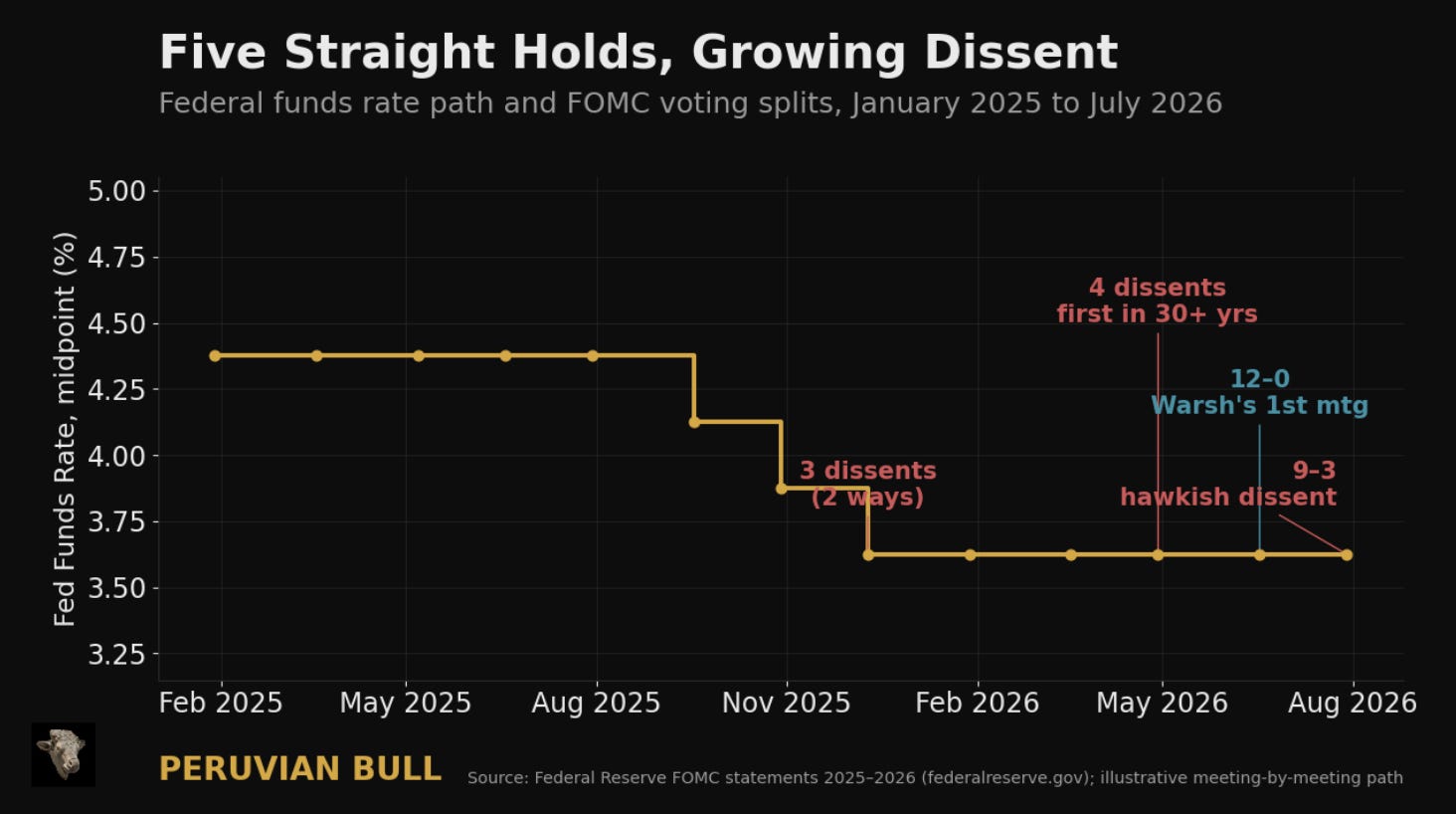
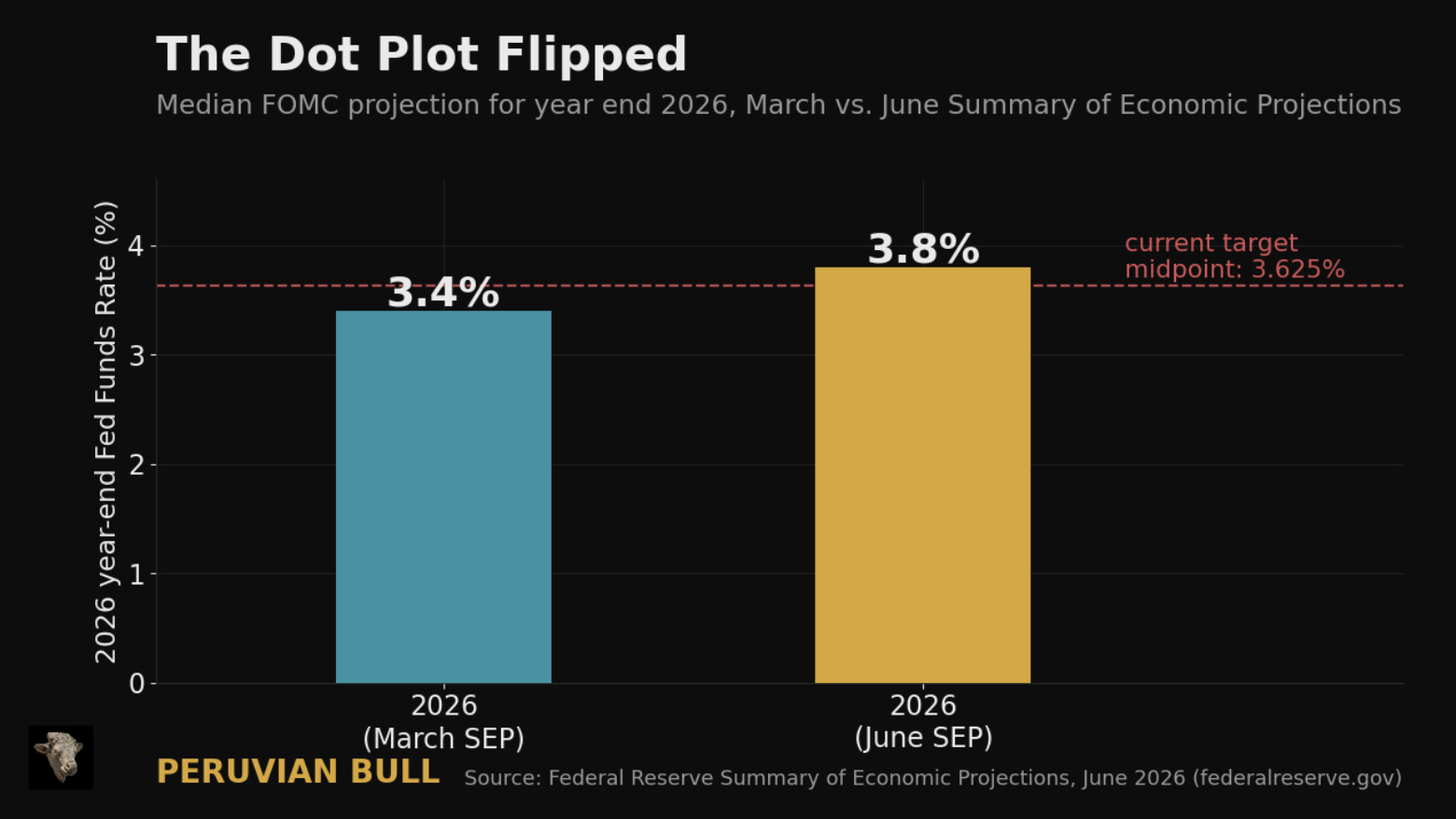
June brought a rare truce: Warsh’s first meeting as chair produced a unanimous 12 to 0 hold, alongside a dot plot that quietly turned hawkish, lifting the median year end 2026 projection from 3.4% in March to 3.8%.
Then July arrived and the truce broke.
Hammack, Kashkari, and Logan dissented again, this time unified, all three preferring to raise the target range by a quarter point at this meeting, while Governor Christopher Waller, who’d spent weeks publicly warning that persistent inflation could force his hand toward a hike too, sided with Warsh and held anyway.
You have to go back to September 2016 to find the last time three FOMC members dissented in the same hawkish direction on a hold, which tells you how unusual Wednesday actually was underneath the calm vote count.
Ian Lyngen, the head of U.S. rates at BMO Capital Markets, described the committee as full of increasingly open hawks even as the majority keeps siding with Warsh on timing rather than direction, and positioning ahead of the decision backed that read up: open interest in the August fed funds futures contract hit a record 967,136 contracts heading into Wednesday’s announcement, the kind of crowded positioning you get when nobody trusts a committee to behave the same way twice in a row.
Which is exactly what the dot plot was already signaling before anyone got near a vote count.
A committee that spent 2025 cutting rates three separate times, bringing the funds rate down from 4.375% to 3.625% by December, has now told markets it expects to end 2026 higher than it started, not lower.
Nine of eighteen officials penciled in at least one hike this year, seventeen of eighteen see inflation risk tilted to the upside, and none of that squares with the Fed chair markets thought they were getting five months ago.
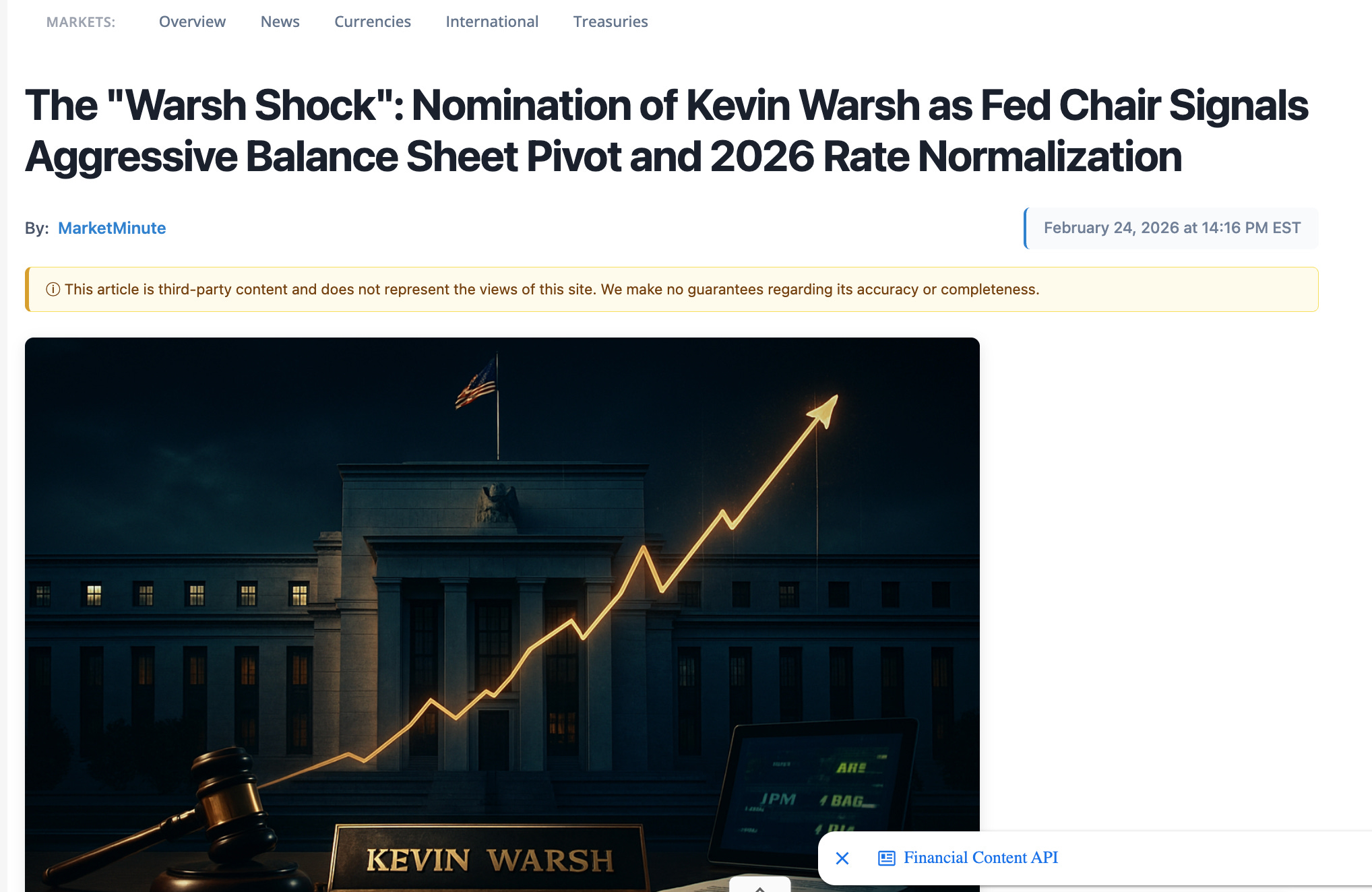
When the White House nominated him back in February, the reaction across fixed income was described as a genuine shock, with markets pricing an aggressive pivot toward both rate normalization and an active shrinking of the Fed’s balance sheet, a doctrine some analysts nicknamed “QT for cuts.”
Five months later, the cuts haven’t happened, the QT hasn’t restarted, and what markets got instead is a chair who dropped forward guidance and is stress testing his own committee’s patience for higher rates. He is, as one Johns Hopkins economist put it this week, a fairly consistent hawkish pragmatist rather than the secret dove some traders keep waiting to discover.
Fine. A pragmatist can still be tested, and the test starts with whether anyone outside the committee actually believes him.
Stocks didn’t, not entirely.
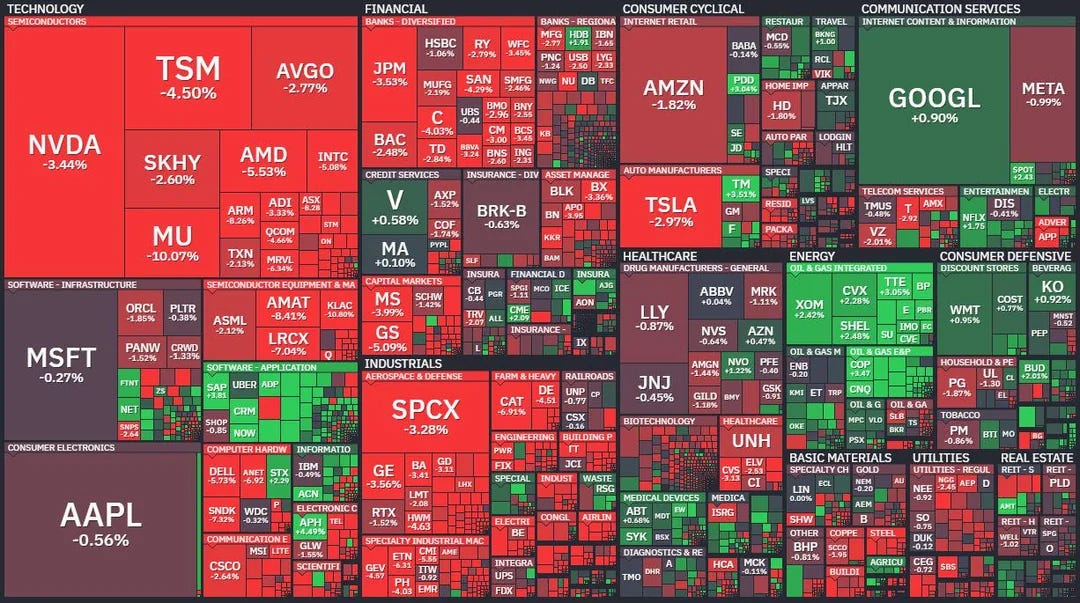
The Dow fell more than 840 points by the close, off about 1.6%, while the S&P 500 slid 0.6% and the Nasdaq gave back 0.5%, with the selling accelerating specifically after Warsh wrapped his press conference rather than after the statement itself.
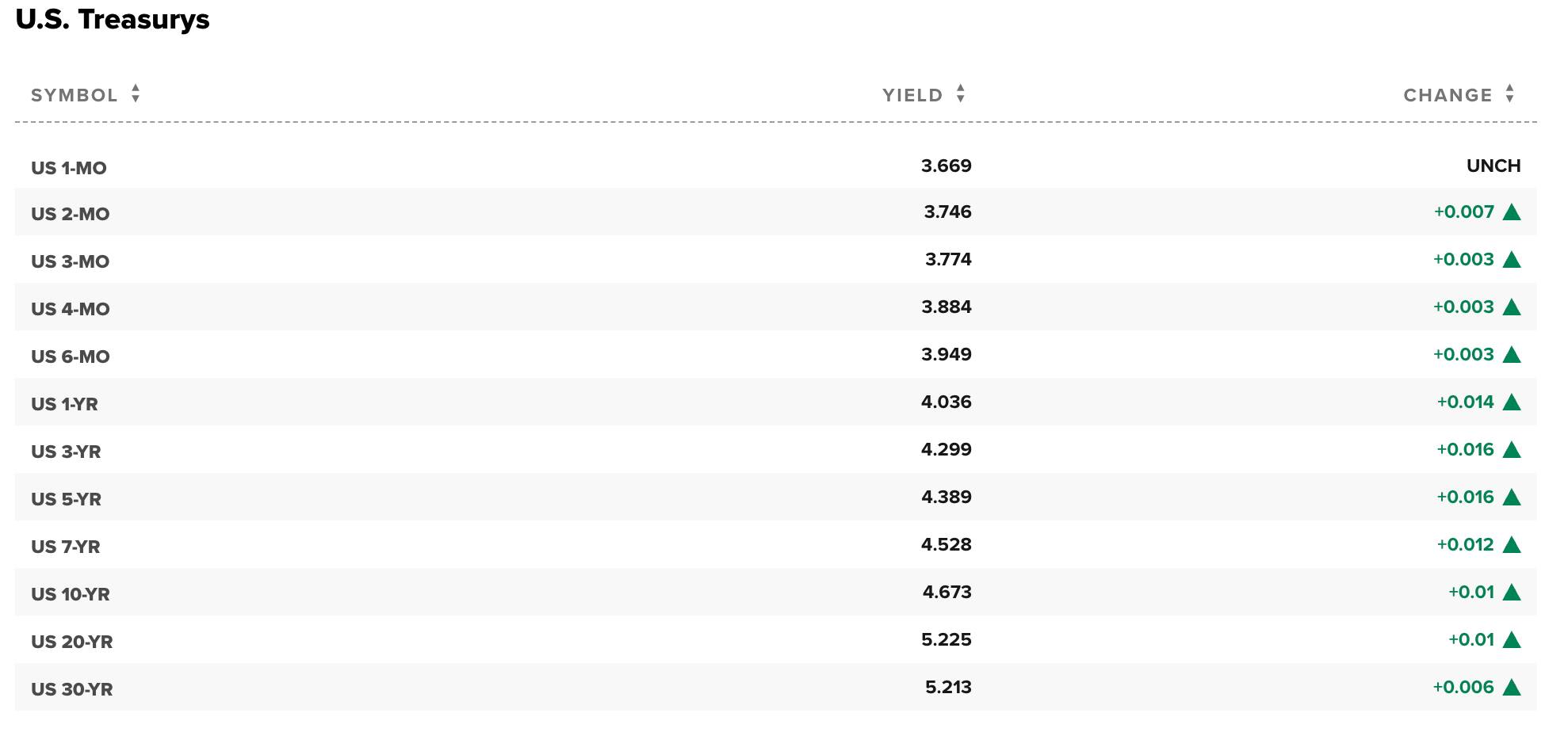
The 2 year yield fell 4 basis points to 4.236%, while the 10 year rose 5 basis points to 4.657% and the 30 year jumped more than 9 basis points to 5.193%.
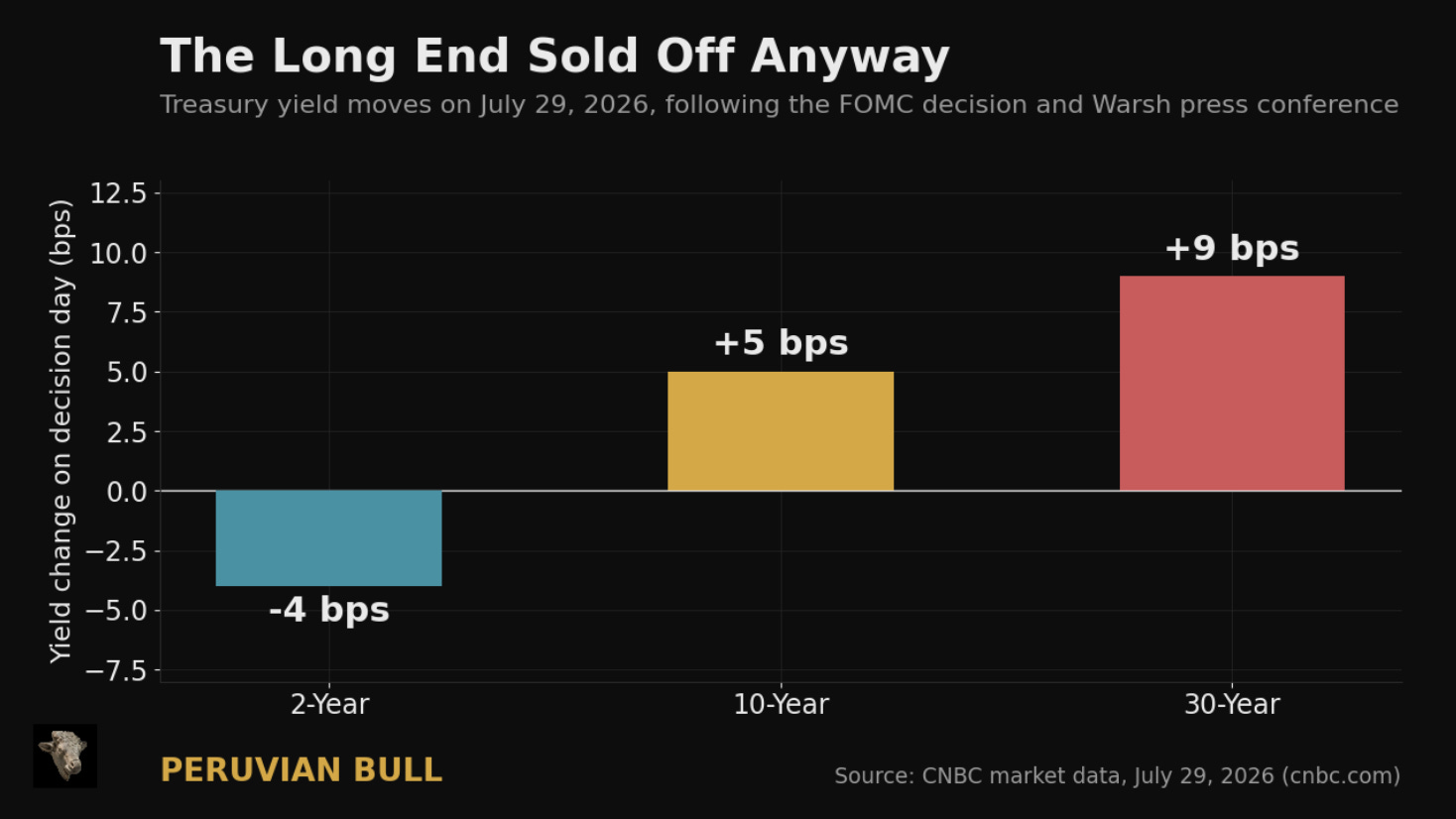
Short end down, long end up: that’s not a market betting on more near term tightening, that’s a market pricing a Fed that might squeeze harder for a little while against a Treasury that’s going to need to sell an ocean of debt.
I’ll say the quiet part: a bond market that steepens on the long end into a hawkish surprise isn’t scared of inflation being tamed. It’s scared of who’s going to buy the paper.
And the blowback has continued today. Here’s the CNBC bond yields for July 30th:
The equity selloff wasn’t spread evenly either.
Semiconductor and chip names have fallen almost 20% over the past month even as the broader S&P sat roughly flat over the same stretch, according to Block Scholes data tracking the divergence: a market rotating out of the most rate sensitive, most crowded trade of the last two years while leaving the rest of the index comparatively untouched. Concentrated pain, not broad panic.
The dollar index, meanwhile, sat firm near 101.64 heading into the decision, close to a one month high, which is what you’d expect if traders believed Warsh’s hawkish talk. At least for an afternoon.
If Warsh’s hawkishness were the real story, gold should have gotten smoked.
It didn’t: spot gold spent Wednesday trading a tight range near $4,020 to $4,030 an ounce, essentially flat on decision day despite a firmer dollar and rising yields working against it, and it’s up roughly 21.6% year over year as of July 28, holding above $4,000 through a stretch that included renewed Iran and U.S. military strikes reigniting hostilities in the Gulf the very morning of the Fed decision.
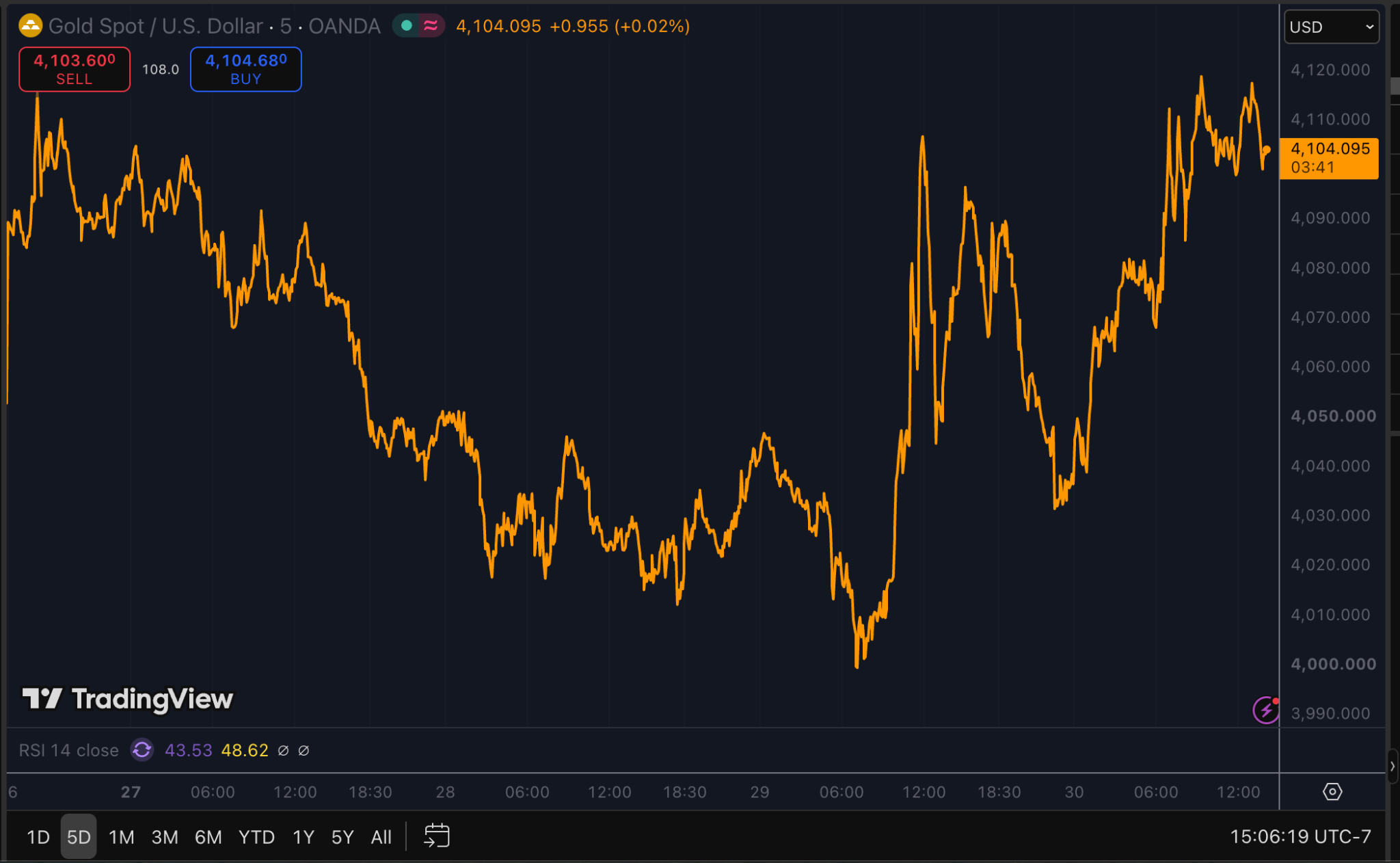
Gold backed ETFs bled $8.9 billion of outflows in June alone, Western paper positioning getting nervous about carrying a non yielding asset into a higher for longer regime, while central banks bought a net 244 tonnes in the first quarter, Poland and China leading the buying in May specifically. Retail and institutional paper markets are trimming.
The official sector doesn’t buy gold because it’s cheap.
It buys gold because it doesn’t trust what’s coming out of Washington’s printer, hawkish chair or not, and that distrust doesn’t reprice on a Wednesday.
Bitcoin ran the same script with different vocabulary.
The asset traded around $64,400 through the decision, up roughly 9% for the month even as the hawkish shift built through July, holding well above its recent low near $57,000 and shrugging off Warsh’s opening line at the press conference that “there is no soft inflation target.”
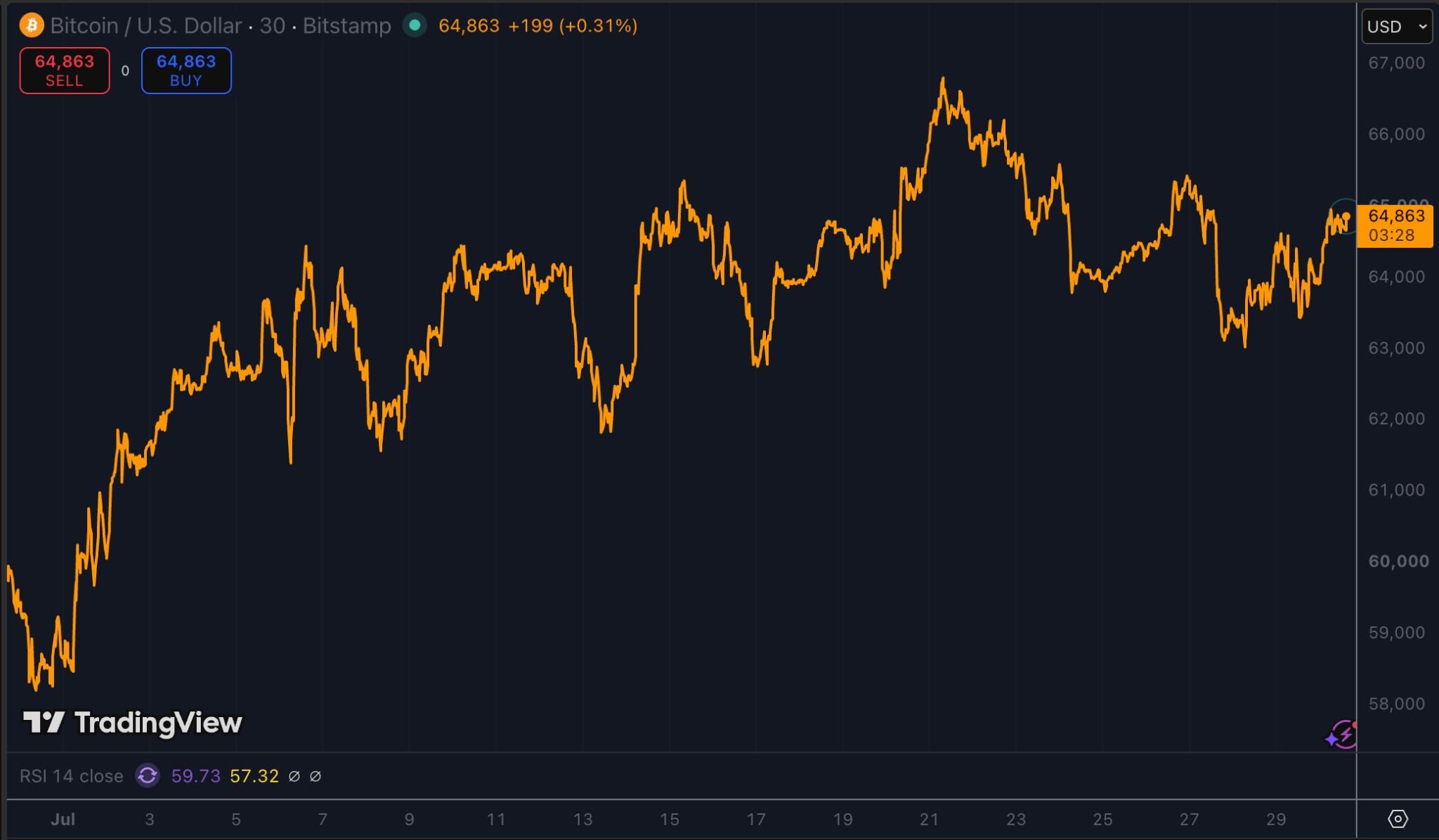
Sentiment doesn’t match price here either: the Crypto Fear and Greed Index sat at 37, squarely in fear territory, even as bitcoin held its ground rather than breaking down, still 49% below its October 2025 peak near $126,000, so nobody should mistake this for a triumphant recovery story. But an asset that’s supposedly the most liquidity sensitive instrument in markets just absorbed a real 30% market implied chance of a rate hike and barely flinched.
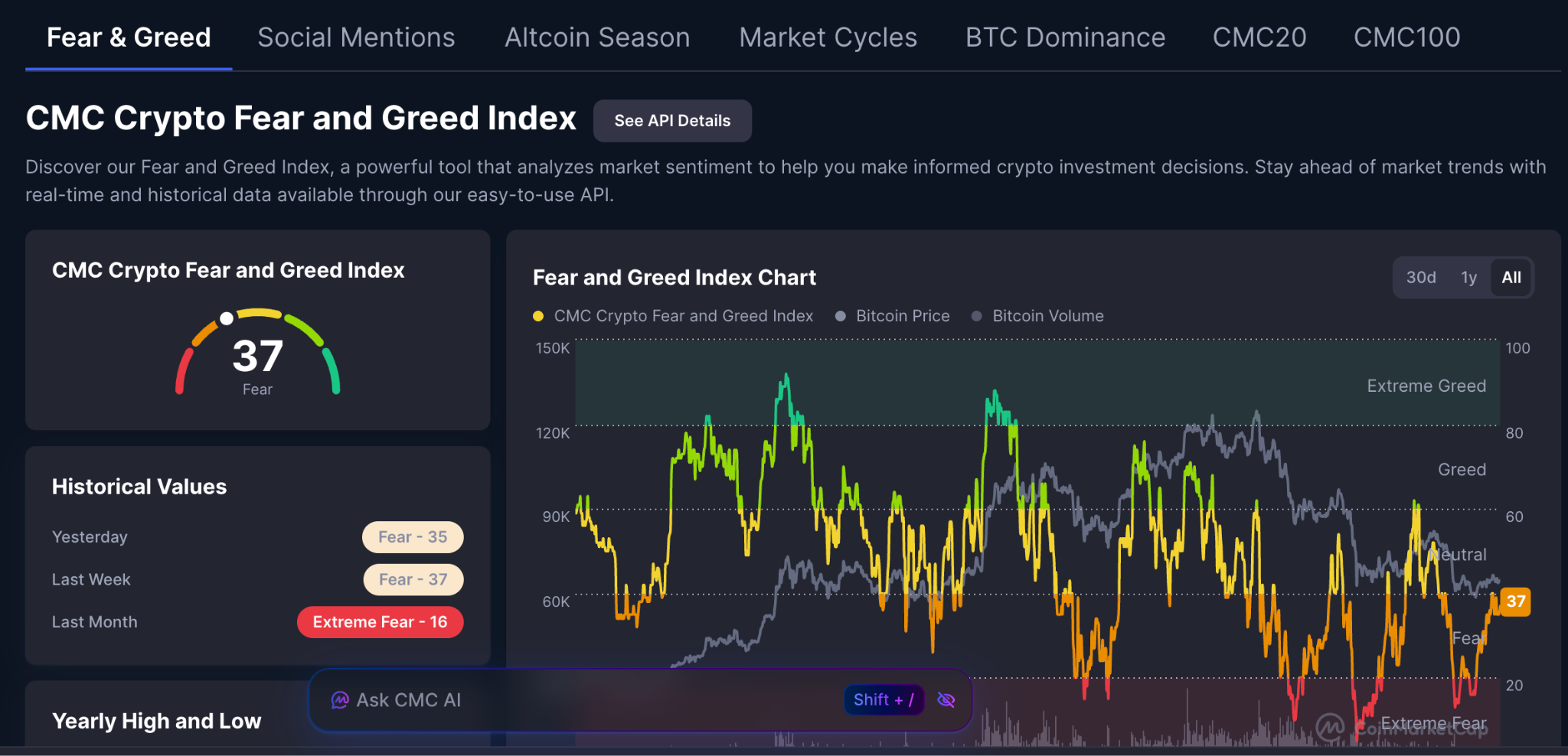
Bank of America estimated a surprise hike could have pushed priced in 2026 tightening from roughly 45 basis points to 60. Bitcoin didn’t care, because bitcoin, like gold, is pricing something further out on the horizon than one press conference.
That horizon is where this actually gets decided, and it has a number attached to it.
The U.S. Treasury has already told the market, in writing, what that number is: $671 billion in privately held net marketable debt during the July through September quarter, an enormous jump from the $189 billion estimated for the prior quarter. Treasury is assuming its cash balance ends September near $950 billion, and separate guidance from Treasury officials put the peak of that cash buildup, the Treasury General Account, at roughly $1 trillion by late July, which is to say right now, this week, while Warsh is busy talking tough.
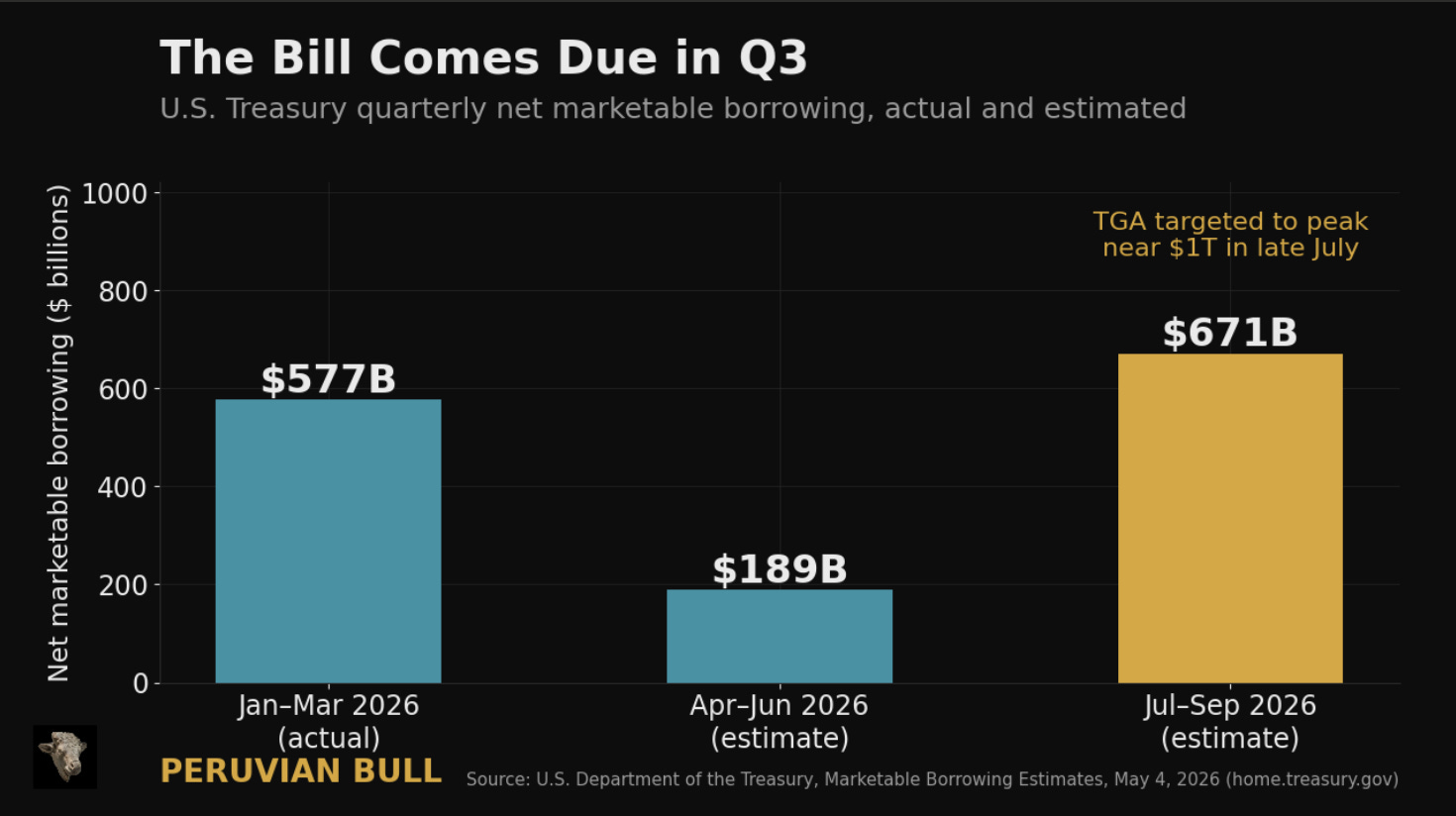
Source: U.S. Department of the Treasury, Marketable Borrowing Estimates, May 4, 2026
Building the TGA back up to $1 trillion isn’t a neutral accounting exercise, and this is where the hawkish talk starts costing something real. Every dollar that flows from the banking system into that account is a dollar pulled out of bank reserves, at least until the government spends it back out. Long time readers of the Net Liquidity framework already know this mechanic cold, so I won’t re-teach it, but the timing is what should bother you: this refill lands in the same quarter Warsh is trying to convince markets he’s serious, against a record issuance calendar that Treasury itself flagged as $249 billion higher than the comparable stretch a year earlier, driven heavily by short dated bill issuance.
Four week bill auctions are averaging $101 billion apiece so far in 2026, more than double the $47 billion average seen throughout 2016, making the four week bill the single largest security Treasury sells by volume.
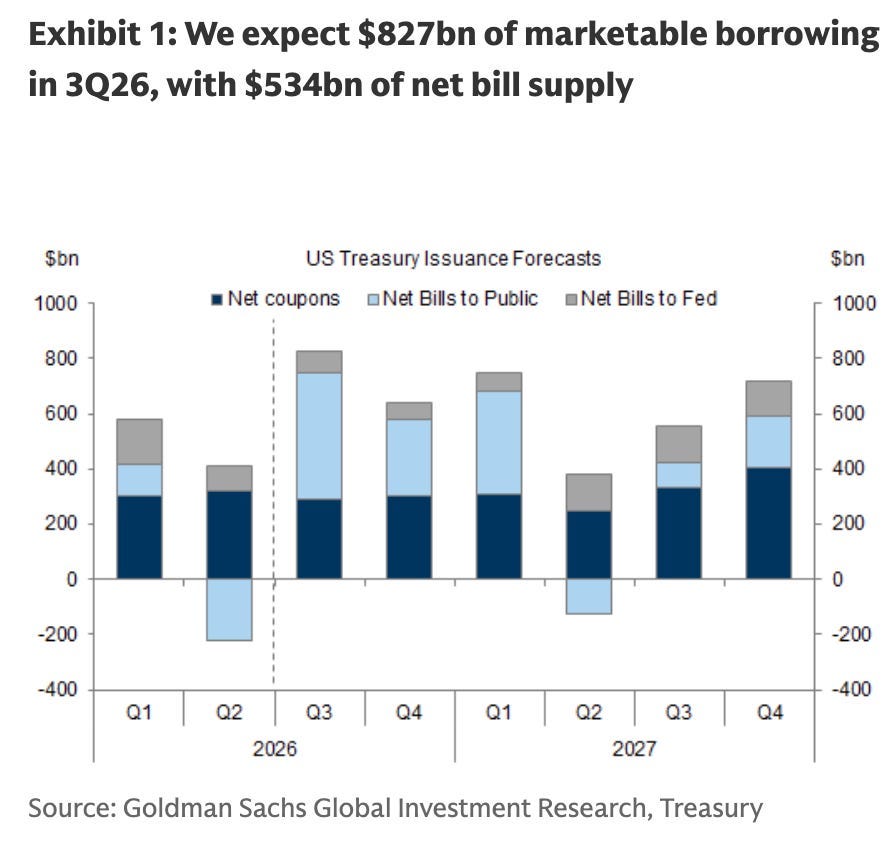
Financing a growing share of a $38 trillion debt load at the shortest possible maturity means the government’s interest bill resets to whatever Warsh’s committee decides almost in real time, so every basis point he holds onto out of hawkish conviction rolls straight through to next month’s Treasury auction.
So they’re stuck-
Hold rates higher for longer to fight a still sticky inflation print, and you raise the government’s own interest bill on $38 trillion of debt outstanding.
Raise the interest bill, and you widen the deficit. Widen the deficit, and Treasury has to issue more paper into a market that’s already digesting $671 billion in ninety days.
Every hawkish word out of Warsh’s mouth makes the arithmetic on the other side of Constitution Avenue worse, not better.
Michael Howell at Capital Wars called this exact tension the “Warsh Pivot” back in February, framing it as a shift from Fed driven QE toward what he termed Treasury QE, and warning that bank reserves would likely settle into a gray zone somewhere between genuine QT and genuine QE. Five months on, that’s exactly where we are, and the reserves side of that gray zone is worth looking at directly.
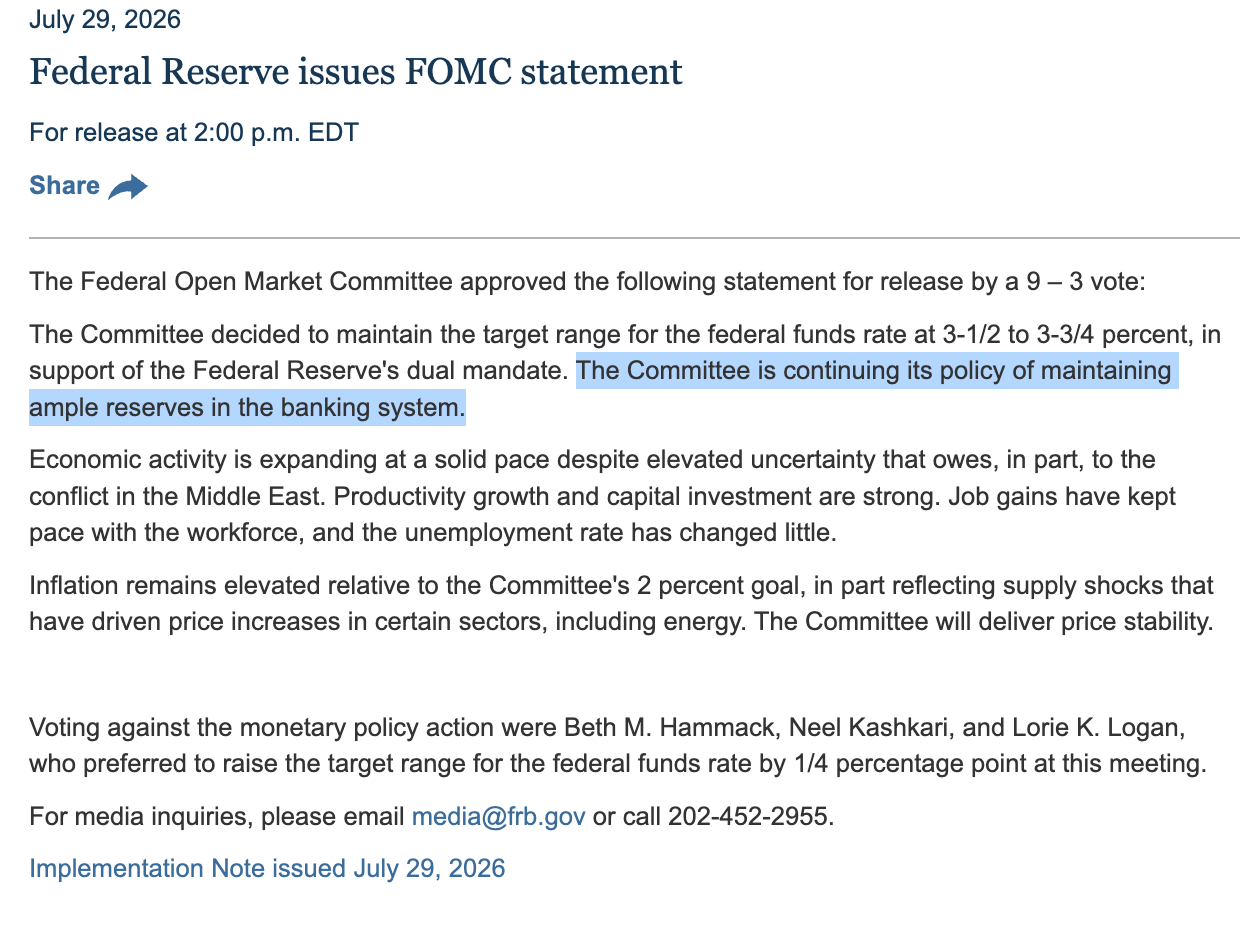
But if we go back and read the actual FOMC statement, buried in the second sentence, unchanged from June:
“The Committee is continuing its policy of maintaining ample reserves in the banking system.”
That’s not a throwaway line.
That’s the Fed telling you it isn’t actively shrinking its balance sheet right now, full stop, regardless of how hawkish the vote or the dot plot looks, which matters enormously given what the TGA is about to do to those same reserves.
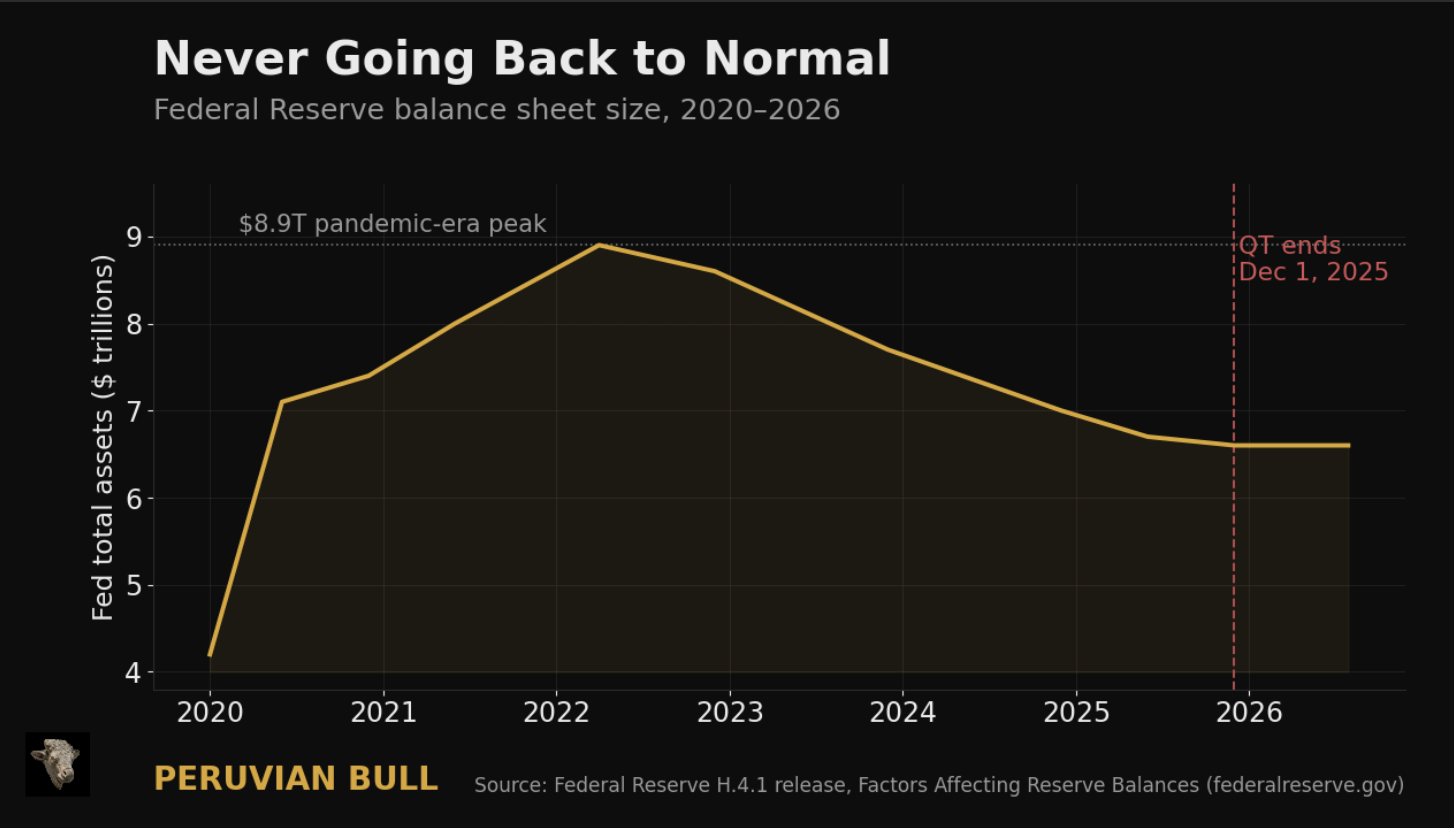
The balance sheet ballooned past $9 trillion at its pandemic peak before quantitative tightening dragged it down toward $6.6 trillion by the time the Fed formally ended QT on December 1, 2025, a decision Powell justified at the time by pointing to repo market strains and heavier use of the Standing Repo Facility. It’s been essentially flat ever since, sitting at about 22% of GDP, nowhere close to the sub 6% norm that prevailed before 2008, with no credible plan on the table to bring it lower while reserves sit this close to what the Fed itself calls ample.
Ample is a word doing a lot of quiet load bearing, because the plumbing underneath it has already cracked once this year. The Standing Repo Facility spiked to $75 billion in draws on New Year’s Eve as SOFR jumped as high as 4.0% during the year end funding crunch, before unwinding within a couple of trading days. Small, contained, on its own. But it’s exactly the kind of pressure valve that gets tested harder once $671 billion in fresh issuance and a trillion dollar TGA rebuild start competing for the same shrinking pool of reserves this quarter, and Warsh can talk tough about inflation all he wants: he doesn’t get to talk the plumbing into holding.
As I covered in Stuffing the Coffers, regulators have been quietly rewriting bank capital rules to make sure someone shows up to buy all this paper regardless of what the FOMC does with rates, and the timing lines up too well to be coincidence. The enhanced supplementary leverage ratio proposal that regulators floated back in July 2025 finally cleared the Federal Register on December 1, the same week the Fed ended QT. Freeing up bank balance sheets to hold more Treasuries at the exact moment the central bank stops shrinking its own is two different agencies solving the same problem from opposite ends: somebody has to absorb $671 billion a quarter, and if the Fed won’t print for it directly, the banks get nudged into doing it instead.
None of which touches the other half of Wednesday’s problem, the half that has nothing to do with plumbing and everything to do with a war.
This brings the whole thing back to the one question this piece keeps circling.
Warsh has two more meetings this year with a dot plot attached, September 15 and 16, then a final one December 8 and 9, both landing right after two of the heaviest Treasury issuance stretches in years work their way through the market, with an October meeting sandwiched in between giving the hawks one more chance to force the issue quietly before December makes everything official.
If the hawkish talk is real, it shows up as an actual hike, not a stern press conference and a repriced dot. If it isn’t, the same forces that ended QT last December and pushed Powell back into Treasury bill purchases come for Warsh too, just on a different calendar.
Comments
Nothing yet. Say the first thing.
Sign in to join the conversation.