
David Bessis has an exquisitely written post on what he thinks drives the cognitive / attainment divide, and he is strongly anti-hereditarian.
I truly enjoyed reading the post, as he is an artful and talented writer, and lays out his arguments with such articulation and clarity that you don’t even notice the hidden assumptions and shell games.
I also think that he’s pointing at something very interesting (metacognitive approaches and practices), that is genuinely underexplored and utilized in our societies.
But I also think that like all anti-hereditarians, he’s blowing smoke at mirrors and furiously handwaving to try to avoid the gloomy prospect. Let me lay out the case.
He begins by framing mathematical performance as a power law - there are mathematicians and thinkers out there that truly seem hundreds, thousands, or millions of times more capable than average people.
“As detailed in an earlier post, the heuristic is that highly heritable polygenic traits are typically Gaussian—the canonical example being height, where people cluster in a narrow ±25% band around the mean—while the distribution of math talent has a much fatter tail, like a Pareto distribution.”
But how could a Gaussian (IQ) ever result in a power law differential in performance?
I think this is kind of funny, because obviously it happens. Power law outcomes are nevertheless prevalent everywhere, and this is becoming more true every day, which I’ve written about before.
I’m not sure if this is some sort of performative bafflement (heyo!) for the rubes, or if he’s genuinely puzzled, because you really wouldn’t expect him to be.
But he is epistemically virtuous enough to give us a falsifiable prediction! So thank you and kudos, David. He goes on to say that he thinks that if we assembled an array of 1-in-a-million intellectual talents, they would not come from the top 1% of within family IQ PGS, and thinks that them coming from a much more dispersed top decile is more likely.
I think this is a straightforwardly weak prediction, and says more about the weakness of IQ PGS’s and gaps in our genetic knowledge than anything real. We know there are large gaps there, because they’ve been getting slowly filled in over time with methodological improvements, and in that filling in, the percent attributable to genes kept climbing. I personally think it will keep climbing, ultimately ending near twin studies when we have millions of whole genome sequences that can pick up rare variants, but that’s unfalsifiable at the moment.
What would a stronger prediction or claim be from David’s position? If you did it with just IQ, and not IQ PGS.
But he probably doesn’t want to do that, because it’s pretty obvious that they would be much more tightly clustered than top decile in IQ by that measure. Just as a first pass, the overwhelming majority of them will have attained Ivy degrees, and the SAT threshold for the Ivies is about a top 2% cutoff.
But let’s keep going. He handwaves about synaptic connectomes and people’s different mental habits and metacognitive approaches. He points out that those habits and approaches are acquired, not innate (I guess it’s always nice to state the obvious?).
As an aside, the topic of mental habits and metacognitive approaches is a genuinely under-investigated and interesting one, I fully agree! We should be exerting a lot more effort here for the slice of people capable of higher performance, as our current “apprenticeship model” with PI’s and grad students and post-docs has a lot of weakness, opportunity cost, and non-fungibility holding it back. I have high hopes for AI on this front, because deliberately and iteratively training better thinking at scale across billions of people and optimizing towards what works best per person-cluster is now possible, and we can now surface insights on those fronts that are simply impossible to surface at the nugatory scale of academia.
But to continue, he points at thinking and avers that some people will do the thinking equivalent of training for a marathon, while others are couch potatoes.
“The conjecture predicts that, if we make a reasonable effort to categorize these “brain modes” and the distinct strategies one could employ to switch from one to another when accomplishing certain tasks, and if we produce statistics of how much time different people spend on distinct “brain modes” over weeks and months, we will find shocking differences.
Metaphorically, my prediction is that some are walking 100,000 steps a day while others are constantly doomscrolling on their sofas.”
And yes, I fully agree. I mean, this is obvious if you just look around you. But I aver that those differences will largely bottom out in underlying hardware capability differences, not software - to his credit, he admits that this view can be fully explained by hereditarianism as well, and it’s not indicative in either direction.
Then he points to his lycée mathematical experience as an example of transformative learning that installed genuinely new capabilities / software:
“A simpler version would be to follow older students through predictably decisive stages of their progression. The French preparatory classes system is a good example. It takes “gifted” 17-18 year-olds and submits them for two years to an incredibly ambitious boot-camp-style math curriculum, a make-or-break experience that produces remarkable outcomes as well as disastrous ones (with less than 1% of the world population, France has received nearly 20% of all Fields medals ever awarded; but many students are left traumatized.)
These were transformative years for me, in the most profound sense. Something radical changed in my attention mechanisms, imagination techniques, and ability to suppress intellectual fear. The only expression that I can think of is cognitive transmogrification.”
What he elides over is that the initial selection into the science / math CPGE (you have to be in the top 1% nationally), and the “make or break” is filtering out all the people whose hardware weren’t up to those software upgrades.
To hark back to his own analogy, there are all kinds of apps that will ONLY run on newer / better hardware! Even if we take it to literal minds, you cannot quantize an LLM to run on arbitrarily small hardware. A Snapdragon 8 instead of 7 may actually be necessary, even if none of us have H200’s!
Then he drops this deuce of wisdom on us:
“Conjecture 5. Differences in mental habits and metacognitive approaches compound, over time, into measurable differences in cognitive ability. “
So this is about where I noped out and got fully adversarial to his post and started composing this rebuttal post in my head as I kept reading.
This is transparently wrong, and the picture he’s building has been cleverly (and delightfully! He’s a great writer!) assembled to obscure the important moving pieces.
I would like to reframe every single one of his points into another domain we know very well, which is extremely legible, to step outside of all the handwaving and smoke and mirrors - I’m talking about athletics.
“How can a power law result come from a Gaussian?? Clearly everyone is equally capable and it’s just hard work that makes people smart!”
OR we’ve tried that for the last 200+ years, it’s called “schooling,” and there’s still irremediable gaps in performance across individuals and groups exposed to the same “hard work” that never close, no matter how much money and effort we pump into it. And we see an exact mirror of this trend in athletics!
So let me introduce you to the other domain with power law results that is driven by Gaussians - competitive athletics.
An Olympic caliber athlete is a million times better at their sport than an obese sedentary, ie the median person. And I mean this literally, you can stack up a million randomly selected people, make them all do athletic trial X, and the Olympic athlete will be on top in terms of performance. Yet their height, mass, muscle fiber type and distribution, and mitochondrial density are all Gaussian in distribution!
What a conundrum! How could those athletes ever have attained a power law differentiation when they started with Gaussians?? Or was it a fake conundrum to begin with?
We can take it back and draw athletic corollaries to David’s conjectures, but now they are more clearly legible:
Conjecture 3. People have vastly different mental habits and metacognitive approaches.
Athletic Conjecture 3: People have vastly different athletic practice regimes.
Conjecture 4. Most of these differences in mental habits and metacognitive approaches are acquired.
Athletic Conjecture 4: Differences in athletic practice are acquired, not innate.
“Conjecture 5. Differences in mental habits and metacognitive approaches compound, over time, into measurable differences in cognitive ability. “
Athletic Conjecture 5: Differences in athletic practice compound over time into differences in athletic performance.
Absolutely 1-1 and completely obvious, right?
Now let’s take it back to his principle thesis, so we can see where he’s playing “hide the hardware:”
Conjecture 1. Some differences in the structure, volume, speed, and efficiency of neural tissue result from genetic variability, but they cannot account for the magnitude of the observed cognitive inequality.
Athletic Conjecture 1: Some differences in physical attributes result from genetic variability, and combined with practice, they absolutely CAN AND DO account for the magnitude of the observed athletic performance inequality.
He’s tried to hide “hardware + practice” fully determining results by hiding it behind the illegible concepts of metacognitive practices and different types of thinking. Surely, if we could just teach people the metacognitive practices and ways that Newton or Einstein routinely spent their time thinking, everyone can be a Newton or an Einstein? Right, guys?
I mean, I can see why he has more than a thousand likes - it’s free fuzzies AND virtue signaling. Hereditarians are wrong AND we’re all just temporarily embarrassed Einsteins!
We don’t have this problem with athletics, it’s crystal clear.
You can take a median person and build them up to following the exact same training regime as Sebastian Sawe, or Usain Bolt, and they will never even come close to their performances, because physiologically, elite athletes are out on multiple tails of genetically determined physical attributes, and that allows their performances.
Five time Tour de France winner Miguel Indurain had a 1/10k V02max. The majority of basketball players are 5-7SD out on height. Donald Thomas came in with zero prior experience in high jumping, and not only qualified for the national championships, he set his college’s high jump record AND, on the 7th high jump of his life, broke the meet venue’s record, with by all accounts, rigid and terrible high jump form. What was his secret? He had a top percentile achilles tendon length for his height, and high general athleticism. I have a whole post of these. Physiology matters. Hardware matters so much it determines the frontier of your capabilities.
By taking it back to a fully legible domain, we can entirely disperse the fluff and smoke. Because “metacognitive practices” are illegible, he’s trying to use that to cover the underlying fact that people are more or less capable than each other because of base physiological variation, and that even with normalized practice, you will not attain normalized results.
Well, training regimes are not illegible, in fact many are fully public, or close enough. Want some Olympic training regimes? Here, have some. Now according to David, you have everything you need to become an Olympic medaling athlete! Good luck and godspeed!
We can continue, with his Conjecture 5 “bis” and “ter” points, and point out that most people never even approach their athletic performance ceiling (bis), and that elite athletic performance is the outcome of unusually rigorous practice regimes sustained over long periods of time (ter) ALONG WITH elite genetics which put their physiology out in the tails, the point that he ignores and is trying to elide.
But why bother?
I think at this point we’ve shown the fundamental error with this approach - that software isn’t the only thing that matters, and that trying to argue that this is true relies on the fundamental illegibility of qualia and thinking to try to pass that off.
I think that THE question that all anti-hereditarians should be asked is - “If environment and teaching are most of what matters, can you point to **any** intervention that will positively raise my child’s IQ in any noticeable amount (as opposed to avoiding brain injury via lead or concussions)?” Anything at all?
And of course, the answer is always “no.”
Directly counter to his entire post, which is all about how hopeful it is that we could train better metacognitive practices and habits to do exactly this, David backpedals and draws the line here, because he knows that making a prediction here would sink him:
“There is ample evidence that key aspects of cognitive inequality have already crystallized by the time children acquire the language capability to make sense of metacognitive guidance. Whether it’s the genetic lottery, the socioeconomic lottery, or the idiosyncratic neurodevelopment lottery, the conclusion is basically the same: you cannot train your kid to become the next Einstein.”
It’s always over some distant horizon, when we’ve finally cracked “equity” or understand teaching better, or environments better, or some complicated multifactorial thing they won’t even articulate.
OR it doesn’t exist, because hardware matters more than they’re comfortable admitting, and indeed, fully determines the frontier of what diligent practice will allow anyone to attain.
But we actually have answers to that question over here on this side! How do you make your kids smarter? You need gengineering and embryo selection, and you need it yesterday! We know a lot of genes that raise IQ, and we should be dumping “space race” amounts of money into getting better at gengineering them into actual kids.
We need embryonic gengineering and massively parallel CRISPR at scale. We could have been doing this for SNP’s for nearly 10 years now, and the fact that we’re not is an indictment of pretty much all developed societies worldwide in my own opinion.
You might be able to get 6 IQ points from Herasight today, and that’s just selection, not improvement. Calculating the median, that’s halfway to Jewish medians, and Jews famously dominate intellectual and creative attainment in fields all over the world with only ~0.2% of the global population. How much better would society be if we were collectively halfway there already?
If we came up with a way to select from much larger sample pools, like iterated meiosis or other methods, or compound selection across generations, we could potentially get 20 standard deviations higher in phenotypic IQ, or IQ 400+.
There are literally answers today that could ACTUALLY create “equity” and actually move us to a world where your actions and the quality of your character and decisions determined your life outcomes instead of your immutable genetics!
But if we keep listening to anti-hereditarians, we’ll never get there. They deny the problem exists AND would block any efforts to gengineer, the worst of both worlds. But every single one of them is a eugenicist at heart.
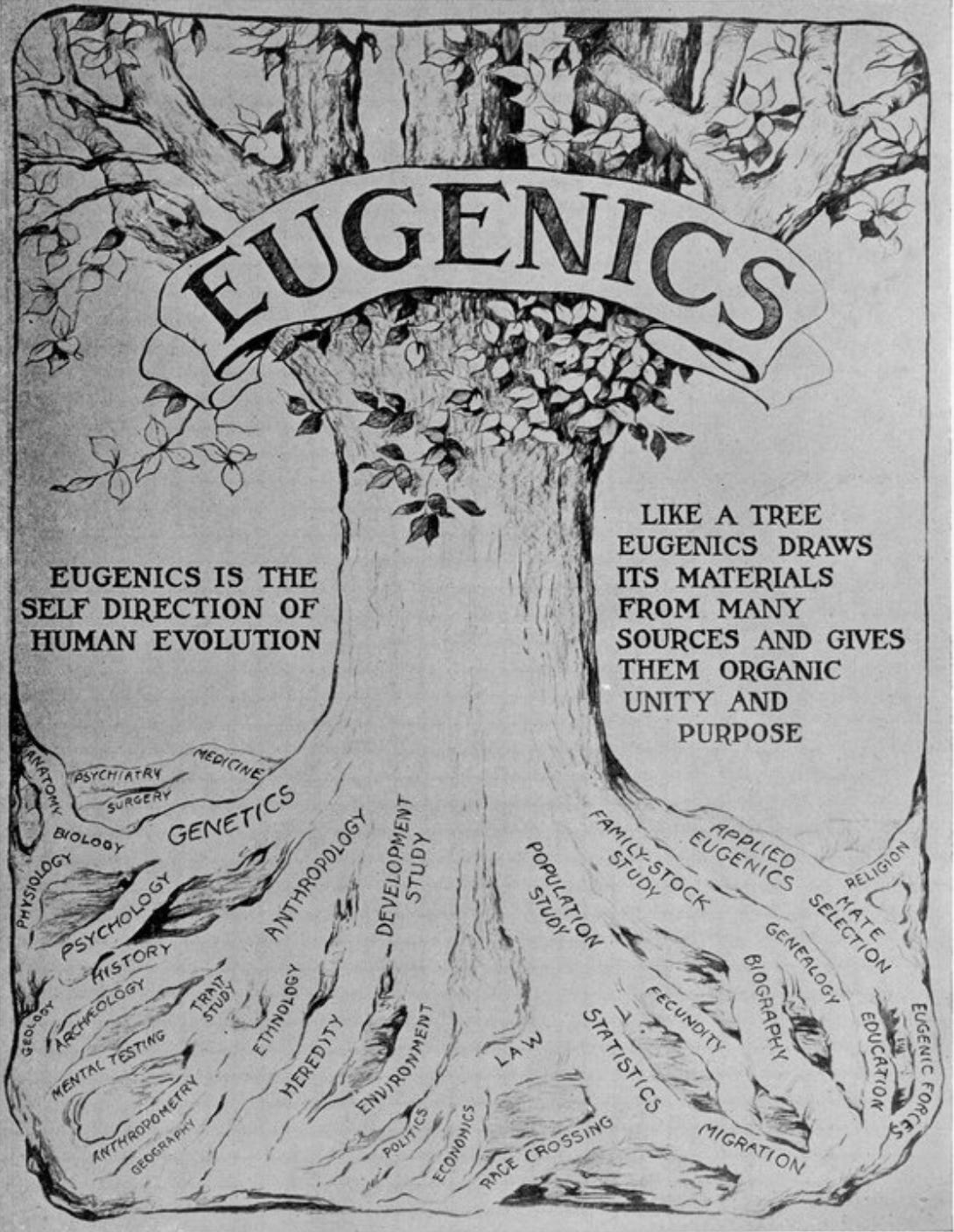
Of course, people already know that genes and lineage matters - what is the one thing that is THE most rigorously optimized problem in every high attainment person’s life?
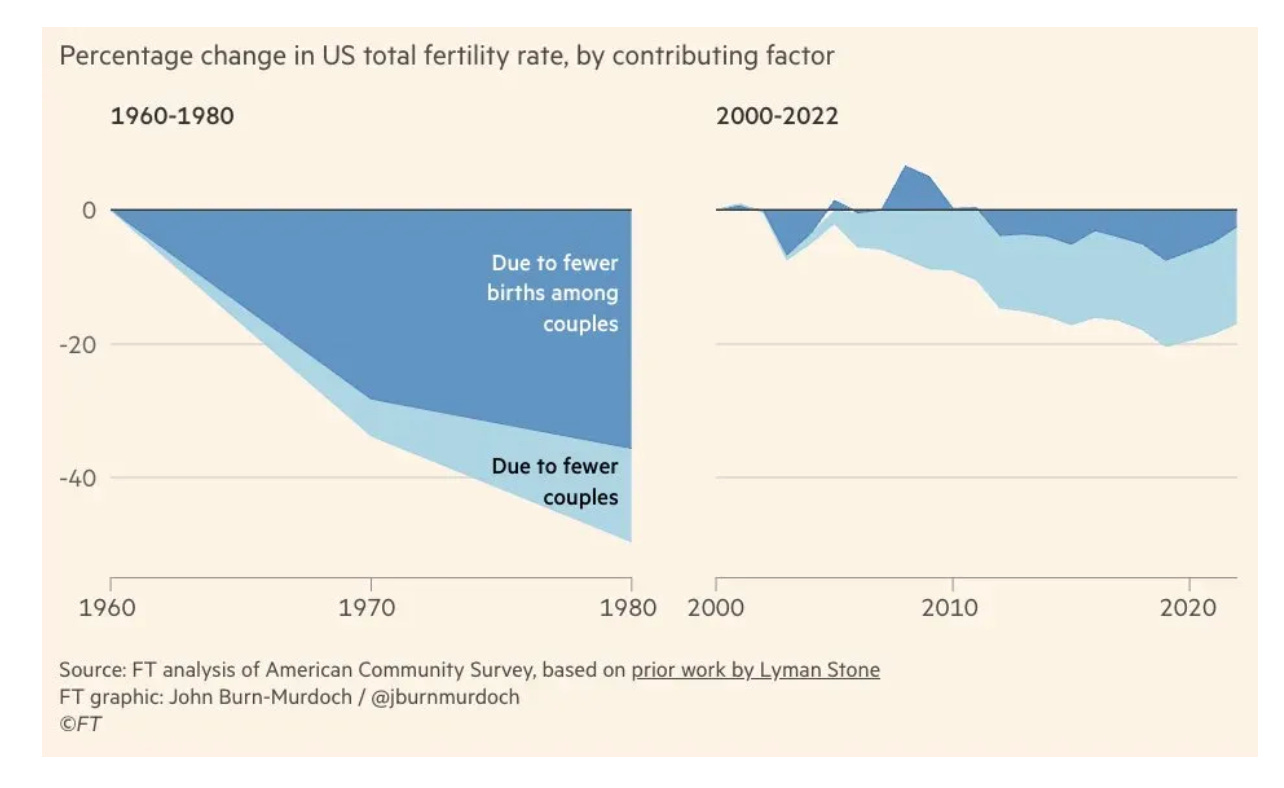
Mate quality. Every single high attainment person optimizes this so hard they spend a literal decade on it, on average. It’s the highest stakes and most agonized-over domain in anyone’s personal life. It’s so high stakes that huge portions of women are fully opting out, because the quality of men available to them is so low, and this is directly driving the fertility crisis.
Not pairing and marrying actually explains the majority of the fertility gap since 2000:
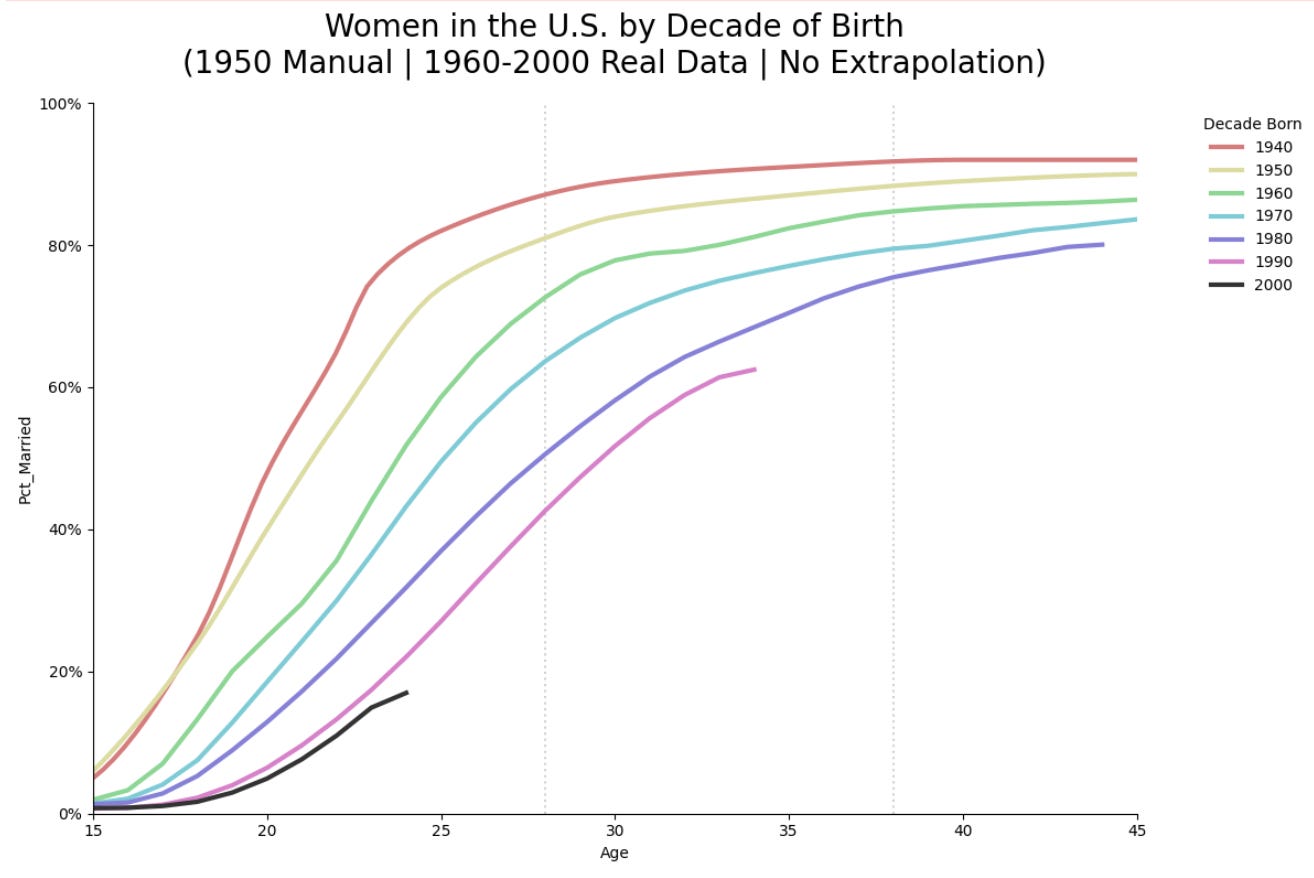
Women are increasingly opting out of marriage more, every single generation:
And for the high income and high attainment women who can access expensive technological solutions to this problem? Estimates in Spain are that ~40% of IVF pregnancies are single mothers with donor (ie massively optimized sperm bank) sperm, and 54% at one clinic in the UK (link). A similar number (54%) is estimated for one US cryo bank, too. Sounds like the women who are putting their money where their mouth is think genes matter a lot!
Mating is so absurdly optimized that we match to a ~93% fidelity in the US! We have already differentiated into castes, and there are people pretending that the right education can make everyone equal, WHILE they themselves adhere at ~93%+ fidelity assortation in their own mate matching.
Every high attainment person in their hearts is a deep and unforgiving eugenicist, and it’s so true most developed countries are literally going extinct because of it.
I thought it was hilarious that David, a mathematician of all things, pretends this befuddlement on how Gaussians can result in power law results.
Once again, we have athletic attainment as our more legible guide.
What does top athletic attainment require? I’d say it’s something like top percentile grit coupled with top percentile build / phenotype (for your sport, this varies hugely), coupled with top percentile “a,” the athletic equivalent to “g.”
What’s the best argument that “a” exists? That places like Australia take warm weather sport elite athletes, many of whom have never seen snow, and convince them to switch to winter sports, and those same athletes start winning medals within a few years.
But back to our quandary here. We have three top percentile things.
We’ll assume the three attributes are independent, we’re just ballparking here.
And what does that get us? 1/100^3 = 0.000001.
What’s the actual Olympic qualifying incidence? About 1/500000 = 0.0000017.
Huh! Funny how that works, isn’t it? This mathematical mystery wasn’t such a mystery after all, was it?
Similarly, what do the terrifying one-in-a-million geniuses of our world, the Newtons and von Neumanns and Grothendiecks have going on? I’d bet they have a suite of brain-impacting physiological attributes out in the tails, like better myelination, faster nerve impulses, bigger skulls and brains overall, and of course, lots and lots of practice, just like elite athletes.
Hardware matters. Practice matters too, especially for peak performance, I don’t dispute that at all, I’ve even written about deliberate practice. But your hardware literally defines the boundaries of what you can attain with practice.
We could line up a thousand random people of whatever age you want and get them all to follow a literal Olympic training regimen for years in whichever sport most suited their phenotype or build, and the odds are that not a single one of them could even qualify, much less medal.
Similarly, we could make a thousand random people of whatever age you want go through David’s rigorous mathematical lycée program that gets France winning so many Fields medals, and the odds are that not a single one would become a well-regarded mathematician, and are vastly against any single one earning a Fields medal. The selection happening at each step between “gifted and talented,” “opting and being selected into the mathematics CPGE,” and “surviving the ~30% dropout rate” all winnowed away everyone whose hardware wasn’t up to the task.
I wish we did live in a world where hardware didn’t matter. We CAN live in that world, if we get our societal priorities in order and prioritize gengineering. Actually, you don’t even need to prioritize it! Just get out of the way, legislatively, in any country in the world. Let gengineers cook, and let people have the babies they want to have.
But pretending genes don’t matter, that all hardware is equal if we just install the right software, isn’t ever going to get us to that world.
No posts
Comments
Nothing yet. Say the first thing.
Sign in to join the conversation.