
It is often said that men think about rucking every 7 seconds, an implausible statistic only outmatched by their obsessive fascination with the Roman empire, which has been measured to recur at a rate of many times per second for those actively reading Plutarch or who are most RETVRN-pilled…
Wait, what? Oh, sorry - slipped a letter there. We’re talking about rucking, or walking with some weight in a backpack here, not the other thing. Although on that topic, did you know the University of Ohio determined it was ~19 times a day for men (with women clocking in at ~10), rather than every 7 seconds? Well, the more you know.
It’s been a while since I’ve written a fitness post.
But I’ve recently been trying to convince my parents to get more Zone 2 time, and that touches on “walking with resistance,” one flavor of which is rucking (walking with weight in a backpack), and another flavor of which is occlusion bands, which we’ll also touch on here.
This is the very best form of Zone 2 training, and this post is to make the case why.
And just for clarity’s sake - Zone 2 is heart rate Zone 2, solidly below your aerobic threshold, and the heuristic I use for whether you’re in it is '“you can say any simple sentence in a single breath, but you can’t say a compound sentence with 2 clauses or commas without needing to take an additional breath.”
So if you’re anything like me, lifting is fun and a reward-in-itself, and cardio is a drag you’ve generally needed to force yourself into.
But you absolutely want cardio training! One of the headline longevity results is that exercise is just absurdly, massively overpowered when it comes to positive health impacts, THE single biggest intervention you can do. I’m talking 3-5x all cause mortality benefits over sedentary people, an effect size 2-3 times as big as “not smoking.” The measurement here is generally “take people in the top quintile (or top 2%) on V02max or training hours and compare them to the bottom quintile (sedentary people), and that’s where you get your headline result. And of course, there are similarly large effect sizes on preventing morbidity (various chronic health conditions that lower quality of life, like diabetes, CVD, etc), and so increasing your quality of life over literal decades.
Relevantly, this is a statistic that is specifically cardio-driven. There are similar results for “fat free muscle mass” and “grip strength” as a proxy for overall strength, but they are not as big - they generally top out at 2-3x (at the top 2%) instead of 3-5x. So if you actually want those headline results on your health and longevity, you need to do your cardio.
My solution there for a long time (decades) was HIIT. We know HIIT is the closest thing to a magical wonder drug in terms of cardio capacity impact (and much else), and it’s the most efficient “cardio bang for time buck” possible.
HIIT is generally of the pattern “do an all out sprint or effort for 30-60s, then go slow or rest for 30s, then do it again, and do this at least 8 times.” That fits pretty nicely with my innate preferences - I like lifting heavy because it’s a big effort, but it’s time bound, and part of that is that I probably personally have a lot more fast twitch than slow twitch fibers.
But a lot of people won’t do HIIT! It’s hard to do true all out efforts, especially 8 or more of them back to back. You get sweaty and hot and breathe hard, and it’s just more effort all around than most people want to put in.
Also, even if you’re really good about doing your HIIT, it’s not going to lift your “functional fitness” as much in terms of being able to put out more watts over a longer term 30-120 min time period. A lot of cardio adaptations are intrinsically driven by the longer-term execution pattern of “true” cardio. You can probably get into the lower reaches of the top quintile of cardio fitness with just HIIT, but you definitely can’t get into the top 2% with only HIIT.
So if you’re like me and get dumb enough to try a triathlon at some point, or if you care about your ability to put out power over longer time periods for reasons, you want HIIT and Zone 2 training.
And of course, if you’re not going to do HIIT at all, then Zone 2 training is your best bet, too.
And here again we might ask “why Zone 2? Isn’t Zone 3 or 4 better? Isn’t it about breathing hard and sweating?” And I’ll say NO! Zone 2, the lower zone, is better for the vast majority of people, whether they’re casuals or serious about cardio, because it allows you to do a lot more without fatiguing yourself or burning yourself out, while still building your V02max and overall cardiorespiratory capacity.
There’s a whole intertangled bundle of reasons “walking” is the first line recommendation for anyone looking to get more fit or move more.
The primary thing that separates hominins (basically H Erectus to modern H Sap) from the rest of the hominids (us, chimps, gorillas, orangutans) is our ability to walk and run for a much lower metabolic price. To get specific, humans can both walk and run for ~100 calories a mile, and a size-normalized chimp would spend ~400 calories even walking a mile, and likely considerably more running (but we can’t estimate this because chimps can’t actually run for a mile). That result has actually been measured! Herman Pontzer and others have done it for a number of animals (and a lot of humans).
We have numerous adaptations making us significantly more efficient at this - hip socket and toe positions, nuchal ligaments, HUGE butts, foot arches and tendons optimized for spring return at each step, inner ear adaptations, and our hairlessness and ability to sweat, among others.
We are actually SO optimized for it that we suffer significantly if we don’t do it, and this is why exercise is such a huge health and longevity buff!
Hunter gatherers like the Hadza generally walk 3-7 miles a day for men and 2-5 miles a day for women, just to serve the ends of “getting enough food to live.” This has been such a recurring and inbuilt pattern in our food economics through the ~2M years of hominin evolution that our body tuned itself around it.
Chimps and other hominids in zoos don’t get fat. Did you know that? Even leading an entirely sedentary lifestyle relative to wild chimps, AND eating at a noticeable calorie surplus relative to those wild chimps, they do not get fat. Famously, zoo chimps are effing ripped if you ever see them without their fur!
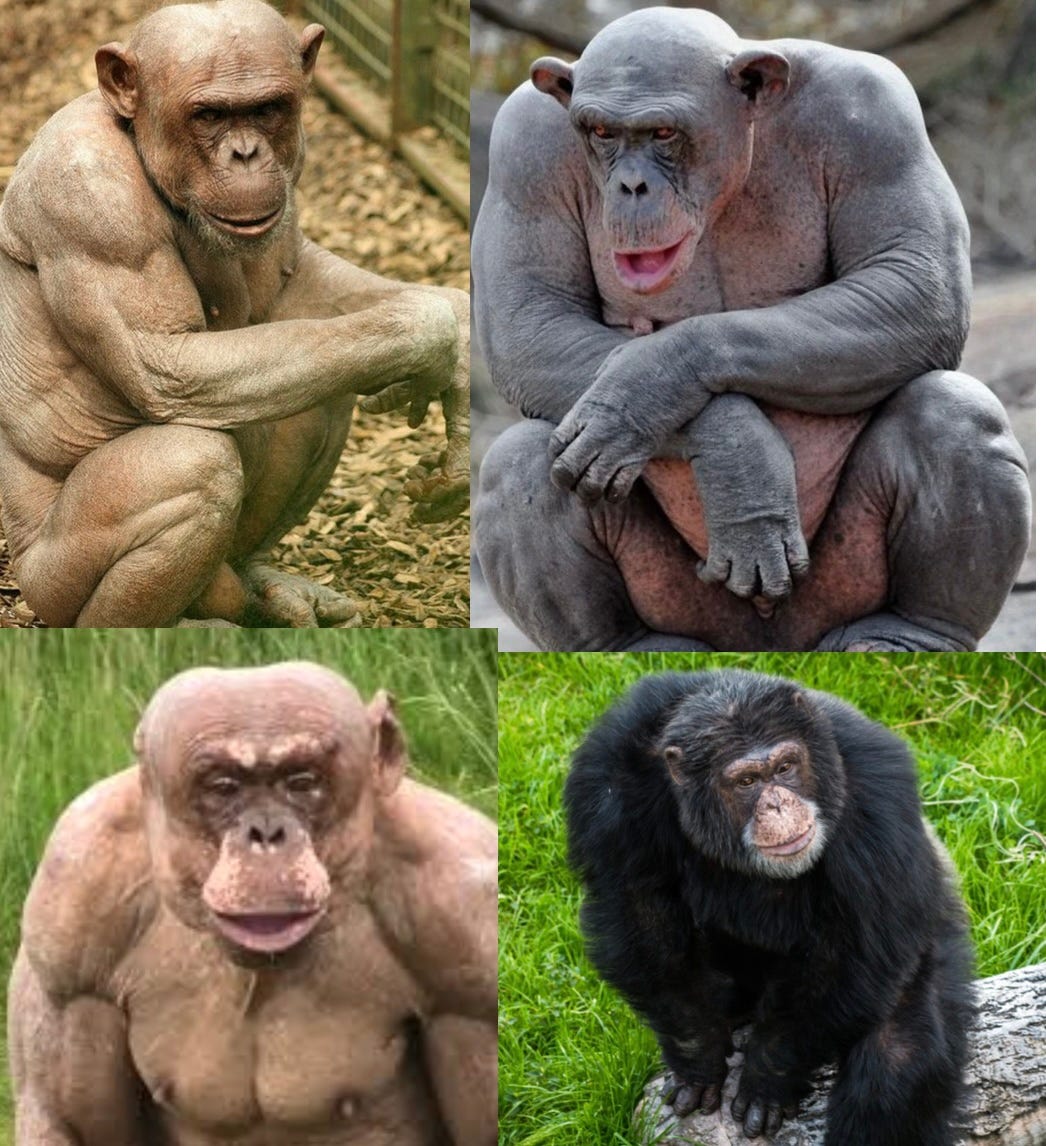
Wait, so our closest extant kin don’t get fat and we do?? Seems unfair! And they can just sit on their asses and get ripped? Just what kind of operation are you running here, on this so-called Earth? In fact, come to think of it, we have a shared sense of fairness from primates all the way to us, and then these happen on top of that?? Okay, okay - once is happenstance, twice a coincidence, but the third is definitely enemy action.
But no, if anything we’re the enemy there, because we wiped out all the closer extant kin we had over that 2M years in the last ~50k - 70k years, after we expanded out of Africa. Chimps are so much farther away from us they weren’t any competition for the ecological niches we wanted to fill, and so are still around.
Okay, so why do chimps get away with that?
Because accumulating body fat in conditions of caloric surplus and lower activity is a uniquely human thing! This is another hominin-but-not-hominid specific adaptation, that was undertaken to handle the more “feast or famine” conditions of the savannah, versus the tropics. So when we ventured out from the tropics and into the savannah, we picked up the adaptations for adding hugely higher percentages of body fat in times of surplus, and our other hominid kin do not have that adaptation.
That’s great for our hunter gatherer ancestors, but pretty bad for modern people today, because at least in America, we’re at ~40% of the population being overweight and ~40% obese.
So back to those ancestors. Our bodies were literally tuned around the large amounts of daily physical activity, specifically walking (often with weight, ie kids, prey, water, or stuff), that hunter gatherers throughout history needed to get enough food to live.
We have a suite of adaptations around cleaning up the metabolic costs of that activity, which make us healthier overall. A good analogy would be if you spill something on the floor - when you go to clean that up, generally you clean that up plus a little more, and that patch of floor ends up cleaner than before you spilled anything. Exercise works the same way - you incur cellular damage, rips and tears, tired mitochondria, and more. Then afterwards, your body goes in to clean all that up, and does that plus a little more - and in that “little more” is written the absurdly massive 3-5x health and all cause mortality benefits.
So that’s why walking ends up being one of the the best baseline activities. Close to everyone is capable of it, no matter their weight or health status, it’s low impact, and your body has literally been built and tuned around it for ~2M years, so it’s one of the most unlikely physical activities to fatigue you excessively.
Now the real problem with plain walking is it’s not a big enough stimulus to actually increase your V02max. So that’s how we get to rucking - walking with resistance.
When you have more than a “sedentary” baseline of fitness, walking with resistance is still very nearly free in terms of fatigue and other opportunity costs, and that’s exactly why we do it!
Okay, first, walking is easy and not fatiguing, and getting enough resistance into it to achieve Zone 2 heart rates is still relatively easy on the body.
Second, walking is massively parallelizable. You can do practically anything while walking - participate in meetings, call people or businesses, chat with people you’re walking with, read your emails, listen to podcasts, eat something, and more.
Moreover, the great majority of people in your life socially are able to walk, too. Your spouses, kids, dogs, friends, coworkers / employees, and more. Walking can be free social time, too!
So basically, you can pair walking with much else that’s good in life, so you can get “free” Zone 2 time while going about your daily life, and that’s a huge deal.
The more Zone 2 hours, the greater your V02 max and cardiorespiratory capacity, and that is the name of the game when it comes to better health, longevity benefits, and quality of life.
So if you have a flavor of easy Zone 2 activity that you can do for only an hour a day while doing other stuff, that’s a free 7 hours of cardio training in a week! HUGE deal.
And to everyone saying “wait, I live somewhere hot, I don’t want to get all sweaty and gross in my work clothes,” yes, I feel you - I live in the tropics, you better believe I’ve been whacked by that countless times. The answer there is indoor walking meetings or a treadmill desk.1
So by simply adding some weight to a backpack, you can get a FREE 7+ hours of cardio training a week! Not convinced to ruck yet?
From today and going clear back to the Romans (nod to the men in the audience, who were getting a little antsy), and even the Greeks and Chinese thousands of years before them, rucking has been the first line intervention for basically every competent military on earth to train their soldiers and get them fit.
The recurring pattern throughout history is for sergeants to get a crop of gormless, underfed, actively skinny 18 year old boys who have zero grit and zero fitness, and to have some relatively short amount of time, usually 2-4 months today/historically, to get them into fighting order.
What does EVERY military choose as their first line intervention in this effort? Rucking. Walking or marching or jogging with weight. True for thousands of years, and still true to this day.
Why is this, do you think?
Back then, it tracked what soldiers physically needed to do - march long distances with a bunch of stuff. But it’s still the firstline for every competent military today, in our age of attack helicopters and ships, so there must be more to it.
I think it’s because rucking is the ideal combination of cardio + strength enhancing. It’s low impact enough that people can do it for many hours a day without being so fatigued and debilitated that they can’t recover physically from it, it improves cardiorespiratory capacity, AND it improves strength, muscle mass, and inclusive fitness. It is literally the fastest and best way to build overall fitness and grit quickly, for approximately everybody.
Seems pretty great, right?
I’m personally always a fan of something that moves several important areas in positive directions at once. Well, rucking is that thing, and it’s got a very Lindy 5k year track record proving it!
For beginners:
All you need is a backpack and stuff that weighs something, the barrier to entry is nil. And you don’t need some super special rucking specific backpack either, most of them will do. I routinely load a regular Swiss Gear laptop backpack I’ve had for 15 years with 50-60 pounds and go, and it’s none the worse for the effort (although Swiss Gear in particular is a good company that stands behind their stuff).
Most people won’t be using that amount of weight, and so can get away with pretty much any backpack they buy or have laying around.
How do you know you’re in Zone 2? Well, if you really want to be sure, get a heart rate monitor. I favor the Polar line, and this is also built into any Apple watch and most fitness devices (oura, fitbit, etc), but you don’t even need it. You can take your heartrate yourself by periodically pressing your fingers to the carotid artery in your neck for 10-15s and multiplying by 6 for 10s and 4 for 15s.
You can get by just with heuristics, too. Again, the heuristic I use for whether you’re in it is ‘“you can say any simple sentence in a single breath, but you can’t say a compound sentence with 2 clauses or commas without needing to take an additional breath.”
Start slow.
All you really need is enough weight to get your heart rate into Zone 2, so start slow. The heuristic for beginners I go with is “enough that you definitely feel it, but not so heavy that you actually think ‘god that might be too heavy’ while putting it on.”
When I first started rucking, I was putting books, chains, locks, whatever random stuff I had laying around that seemed heavy and would fit. I was overstuffing the poor backpack so much it would unzip itself while walking, and I had to carabiner the zippers together so stuff wouldn’t fall out. And that worked great! Anyone else can do the same. You don’t need literal weights, anything will do.
That’s pretty much it for beginners.
Start slow
Put in enough weight to feel it, but not to actively think it’s heavy
Pay attention to your heart rate or Zone 2 heuristic
Add weight if you’re not reaching Zone 2 after 10-15 min of walking
Shoot for 1 mile at first, then 2, then 3
3 miles / ~1 hr is a good steady state per session, because it aligns with the study-verified ~7k steps daily that has noticeable positive impacts on health.
Intermediate and advanced tips:
So if you’re more fit or have been doing it for a while, here’s my tips for intermediate to advanced rucking.
I ruck with 25-33% of my weight, generally, but I’ve built up to this and am pretty fit to begin with.
1) Avoid Zone 3 creep.
First, if you’re doing it with a noticeable amount of weight, your heart rate tends to creep up, especially if you walk more than 3 miles. This is bad. You want to keep your heart rate in Zone 2, because the more time you spend in Zone 3 (or god forbid, Zone 4), the more fatiguing that walk will be and the more it will cost you in recovery. And that fatigue and recovery comes out of your budget for “real” workouts like HIIT or lifting, which are actually fun and move the needle more. You want your rucking to be a steady Zone 2 base that’s slowly adding to your overall cardio capacity, and nothing more.
So given that, you need to actively optimize for this. If your heart rate is creeping up, you need to walk with less weight or elevation. If you see it creeping up and staying in Zone 3 relatively early out, avoid hilly routes and / or cut your walk short, or turn around, take weight out, and continue.
2) Maintain good form
One thing I’ve noticed in myself is that your form tends to deteriorate faster at higher loads. This is usually because you’re not attending to it, but you very much want to attend to it.
If you ruck with the same form you jog or run, and you should absolutely do this, you get a large number of benefits:
a) You are directly training in the groove, and logging more hours in correct form and so achieving the neurological and proprioception adaptations that comes from that.
b) You are directly strengthening the exact muscles and muscle chains that you use while jogging or running, and that directly contributes to your ability to go faster and with less fatigue when doing longer or more intense cardio.
c) You are directly strengthening your core, which is generally the weakest point during long form cardio and the first source of form breakdown, which is going to allow you to keep better core tightness and form in longer form cardio.
Now, is this kind of awkward because your cadence is so much lower rucking? Yes, and I’ve caught myself unconsciously increasing my cadence and creeping into Zone 3 because of it many times! But that’s an execution issue, and all you need to do is notice it and dial it back so you stay in Zone 2.
Versus if you ruck in a different form than you jog, you’re strenthening different muscles chains, strengthening a different overall physical and neurological form pattern for many hours a week, and it’s obviously worse. So a small thing, but definitely worth attending to.
3) Hitting Zone 2 sooner
Part of the reason I end up rucking with so much weight is that I want to hit Zone 2 right away, I don’t like 10-15min of dead time while my heart rate comes up. But this also makes hitting Zone 3 more likely towards the tail end of a given walk!
So there are other ways to avoid that dead time. On a treadmill, crank the elevation up. Outside, I favor walking on grass, going for hills right away if possible, and sometimes speed-walking / light jogging.
You want to be careful with this - there’s no easier way to hurt your knees than running with a significant weight load (ask me how I know!). So trying to keep a foot on the ground at all times, and / or only light jogging on grass vs cement is a good idea, to protect your knees.
But on that topic, and for anyone who is recovering from an injury or who is interested in Zone 2 for somebody less fit and thinks that rucking may be a bridge too far, there is a great alternative.
Occlusion straps / bands. These are big belts you strap tightly around the middle of your quads, and then walk / jog with.
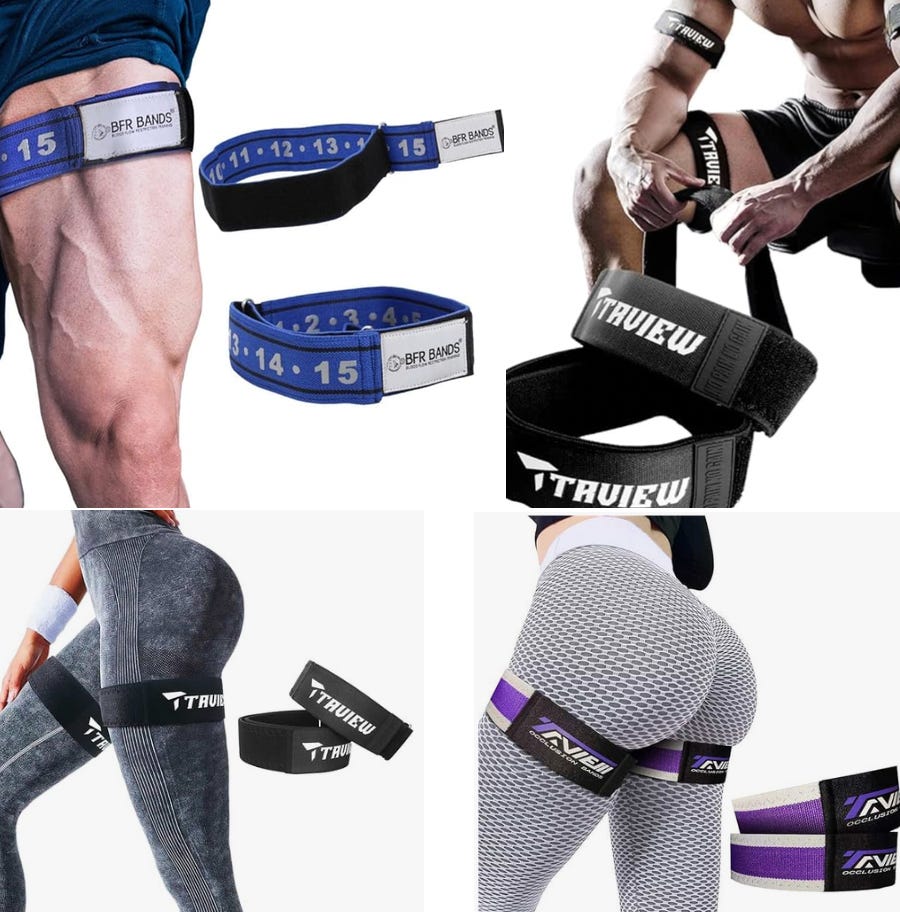
They’re amazing!
Occlusion bands work by restricting venous return, thereby increasing the heart rate. They can get you into Zone 2 for free, more or less, and with less fatigue and effort than rucking.
Is rucking still better? Yes, absolutely. You get a bunch of strength benefits from rucking you don’t get with occlusion straps. You’re not going to get those juicy asses in the pics from just bands, you need weight to get there.
But as an option for people who are less fit, who are recovering from an injury, for whom rucking is too much load at the moment, or who’d like something more portable and office friendly than a giant backpack with weight in it? Occlusion bands are your go-to!
The main advice I’ll give is that you want to make them tighter than you think you need to, and to aim for the middle of your quads, not higher up, because you can pinch your femoral artery a little closed unintentionally if you’re too high. You should not have numb feet or light headedness or dizziness, if you do, you located them too high.
One of the nice things about them is that you absolutely can run or jog in them to get your heart rate up quickly and with zero dead time. There is zero incremental injury danger, unlike running with a weight load.
Alright, so rucking is the first line thing for every military throughout history, it enhances cardio and muscle growth and strength, and it gives you a bunch of free Zone 2 time, letting you achieve those headline 3-5x all cause mortality and health advantages.
Do we get anything else from this magical wonder intervention?
Well, for one thing, if you ruck instead of running you avoid the 50% - 80% injury rate from running per year.2 Rucking is way safer than running in terms of injury risk and wear and tear.
Anything else?
I’ll highlight two additional things.
Remember how I said that one of the adaptations we got that chimps don’t have is big butts? Giant butts are another uniquely human thing! Sir Mix-a-lot was a true anthropological scholar and gentleman when he created his paean to this distinctively and majestically human trait.
Well, rucking is a butt builder extraordinaire! It works the glutes with weight, at high volume, for many hours per week, and that’s the ideal recipe for posterier shapeliness and magnificence. And I think we would ALL benefit from more magnificent butts in our lives and in the world at large, truly a public good and positive externality the world needs more of overall.
Second - I feel like I don’t have a great feel for the age distribution of my readers, I should really do a poll sometime. So I’m officially an old, as they say, and so was too old for the anime craze that really picked up around the late nineties / early 2000’s.
But I come from a numerous and belligerent family, and was exposed to enough via my younger brothers that I’m aware that it’s an ongoing trope that when it’s really about to go down, the protagonist suddenly takes off the absurd training weight that they’ve apparently had on them the whole time.
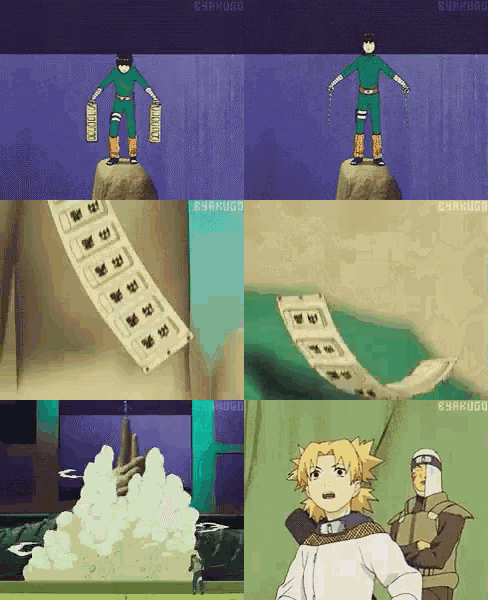


It’s the universal sign for “oh, you done did it now, son” and is the prelude to what is sure to be an epic ass-whupping, to proceed forthwith.
This is invariably accompanied by breathless commentary from onlookers along the lines of “my god, his power level must be above 7 thousand Ctesiphons!”3
This is unironically and literally you when you’re regularly rucking. Most people are struggling just to get through the day, and you’re Harrison Bergeron-ing yourself for fun for 10 hours a week.
It actually feels amazing to take the weight off when you’ve finished your 3-5 miles - you feel like you just got a 20-33% energy burst, everything feels light and easy and amazing, and it’s like you’re walking on gossamer clouds. You feel absurdly overpowered, nigh superhuman.
And if you use it right, it’s a nootropic. Much like energizing up from a coffee, your mind is more active, you’re more creative, and you have more gumption and willpower in that window to tackle anything. In fact, I wrote this entire post in the afterglow of a rucking session, because I thought to myself “what’s the best way to use this window of feeling great and having higher productivity?” Well, this is it - I’m trying to create more of those windows out there, in the world, and in you.
And this is a buff you can get anytime, every day, even!
That’s pretty amazing.
So I’ll close there.
Rucking - the easy road to better health, a higher V02 max, daily nootropic buffs, longevity, and a magnificent ass, just waiting for you to pick it up and get all of that!
On getting a good treadmill desk, I think the first consideration is space / footprint. There’s quite small treadmill desks and treadmills out there, and it’s relatively easy to rig up a desk yourself if you’re trying to fit into a smaller space.
After footprint, I’d recommend considering incline capability, because being able to up the incline gets you optionality for burning more calories, higher heartrates, and keeping up with your own fitness as it increases.
Probably the easiest “just buy it and start walking” one I’ve had has been a Sunny TD7704, which is unfortunately no longer sold on Amazon. Limited incline, but you can raise the front higher with books or wood and get whatever incline you want, mine’s at 11%.
My best treadmill desk is a standing desk I rigged over a commercial grade, 700 pound Freemotion that has up to 18% incline, that I got from a gym that was going out of business. Also thousands of miles, and a delight to use.
Budget or low-space option, I’d go for a cheap under-desk treadmill or “walking pad” and a cheap standing desk, both of which you can get on Amazon, just make sure the dimensions work for you. I did this in my RV with a folding one called “FYC walking pad” that is still on Amazon at only $100, and the desk I made for that I used wood I already had laying around to rig up a desk that also folds down, but a standing desk or a “treadmill laptop desk” is generally <$100 on Amazon too.
A meta-analysis of injury rates in runners clocks in at a ~50% average injury rate overall, and ~80% average for those training for marathons (my own study-quality adjusted weighted averages by number of runners). And remember this is over a time period of 1-2 years!
“Depending on the type of runner, definitions of injury, and follow-up periods, running-related injury incidence rates range between 2.5 and 33.0 injuries per 1000 h of running.”
But this is also why I like HIIT, because injuries are directly correlated with how many miles you put in, and there’s actually very little incremental improvement over 50 miles per week. Whereas something like 80% - 90% of marathoners incur an injury while training, and typically log 100-150 miles a week.
Why are power levels named after the ancient and long-term Persian capital?
Straightforward “American Gods” style attention shift and coagulation! For “Ctesiphon” sounds like “cell phone” if you’re drunk and/or Middle Persian isn’t your first language, and cell phones are the one thing that everyone these days stares at for hours per day, WHILE worrying about power levels. What cleaner connection can there be??
No posts
Comments
Nothing yet. Say the first thing.
Sign in to join the conversation.