

When Phil Scott ran for governor in 2016, he asked Vermonters to expect more of their state. His Comprehensive Blueprint for Economic Growth promised a Vermont that would grow more affordable each year. A young family could find a house within their budget. Health care would cost less not more. The workforce would stop shrinking. The most vulnerable would be protected. And young adults would stop leaving. He put these promises in writing and asked Vermonters to hold him to them.
“My entire administration will set clear and achievable economic goals, stay focused on the fundamentals, and prioritize areas where we have a regional, national and international edge. Most importantly, we will not overpromise and we will always follow through.” Phil Scott in 2016
Ten years later, many of those same Vermonters feel quietly let down. The most vulnerable have not been protected. Vermont has the second-highest homeless rate in the nation. And Governor Scott admits that Vermont is not more affordable today than when he became governor.
In February, Scott told the Boston Globe what he hears from the people around him. His own friends and neighbors, he said, tell him “I just can’t afford it anymore. I just can’t stay here anymore, because I’ve talked to my cousin in Tennessee or Florida, and things aren’t as bad there as they are here.”1 Asked directly about the record, he conceded the point: “When I talk with Vermonters today, they certainly don’t think Vermont is more affordable than it was 10 years ago.”2 He added that they did not think it was affordable then, either — which is true, and which is rather the point. Vermont’s affordability problem is exactly the problem he was elected to solve. He diagnosed it, named it the highest priority of his administration, and told us how to measure whether he was fixing it. A decade on, the man who made the promise agrees it has not been kept.
In the first essay in this series I called Phil Scott Vermont’s No Plan Man, and closed by pointing to a plan he presented to Vermonters in the 2016 election. This essay is about that document — what it was, what it promised, and why it remains the fairest standard by which to judge him.
The Comprehensive Blueprint for Economic Growth was the most detailed governing plan any Vermont candidate had put before the voters in recent memory. It ran to a twelve-part economic growth plan and a set of addenda — on truth in budgeting, government modernization, transportation, restoring faith and trust in government, and the opiate epidemic — and it carried, by its own count, “more than 50 specific ideas, initiatives and proposals.”3 It was organized under three words: Progress. Affordability. Opportunity. It may have been the deciding factor in his defeat of Sue Minter, with whom he was polling neck and neck just three weeks before the election.
The Blueprint did not hedge about the stakes. It diagnosed a “Crisis of Affordability” and declared that making Vermont more affordable for families and businesses “must be Montpelier’s highest priority.” Around that diagnosis it arranged its pillars: protect the jobs we have, expand a shrinking workforce, put health care reform “back on track,” revitalize the economies of every county, build housing working families could afford, reform taxes to keep people here, modernize a costly government. I will address each of these in a separate essay in this series, because each came with commitments specific enough to check.
Near the front of the Blueprint, Candidate Phil Scott wrote: “We will not overpromise and we will always follow through.”4 Throughout the document he returns, again and again, to a single demand — that government be judged by “measurable results.”5
“[The Agency of Commerce and Community Development] will propose a budget, define aggressive and measurable goals, and establish milestones to measure the effectiveness of this effort.” p. 28
Scott told Vermonters how to grade him, and he set the bar himself. So, this series takes him at his word. The essays that follow will hold up the yardstick he handed us and ask the question he invited: did he follow through?
He framed Vermont’s slow-motion crisis in three numbers — what his administration came to call “6-3-1.” Every single day, he said, there are on average six fewer workers in our workforce, three fewer children in our schools, and nearly one baby born exposed to opioids.6 It was an effective appeal precisely because it was not just a statistic. It was six neighbors gone, three empty desks, a newborn shaking in a hospital crib — every day.
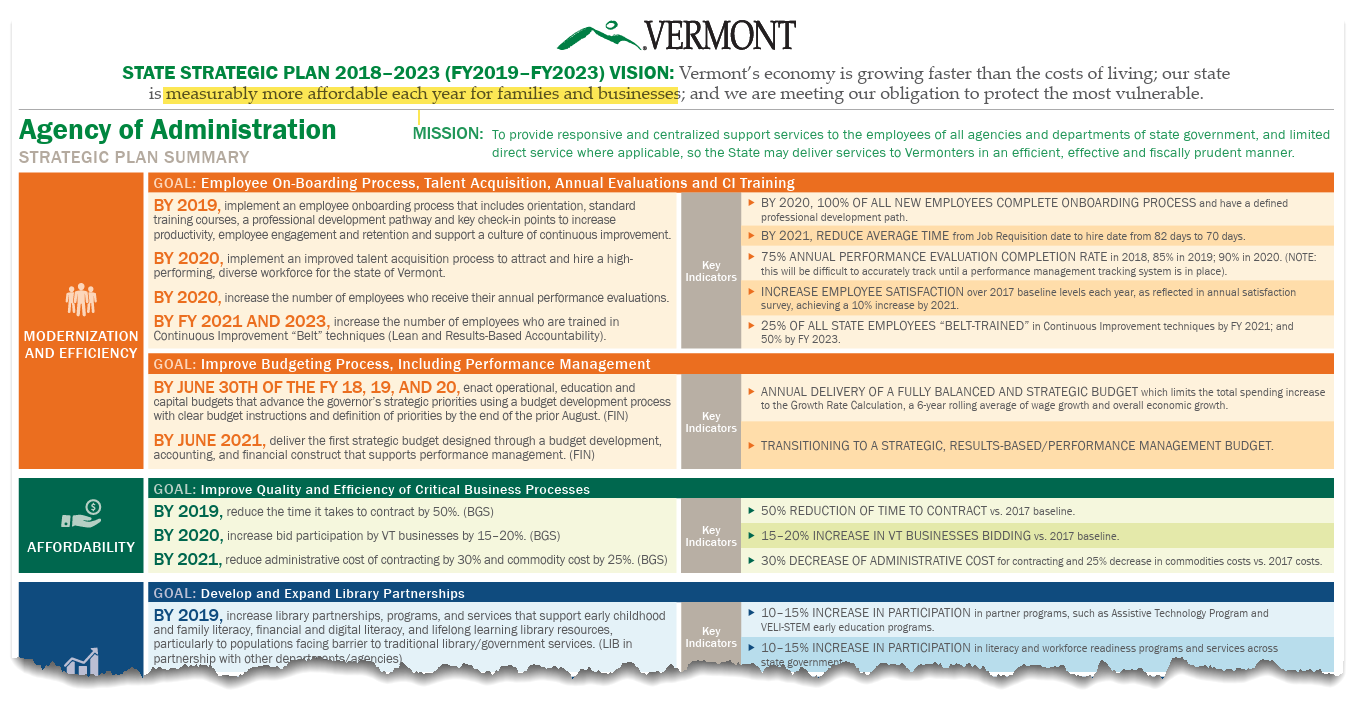
On his first day in office, Governor Scott signed an executive order built around reversing the 6-3-1 trends, and his administration then translated the Blueprint into the formal machinery of government: a State Strategic Plan for 2018 through 2023, the official strategic plan of the State of Vermont, with measurable goals and target dates. True, it’s only one page, which makes it more an outline of a plan than one that shows how it will be put into effect. But it clearly states a vision of a Vermont whose “economy is growing faster than the costs of living” and that is “measurably more affordable each year for families and businesses.”7
Scott made affordability in Vermont the standard for measuring his own government and committed the state to keeping score.
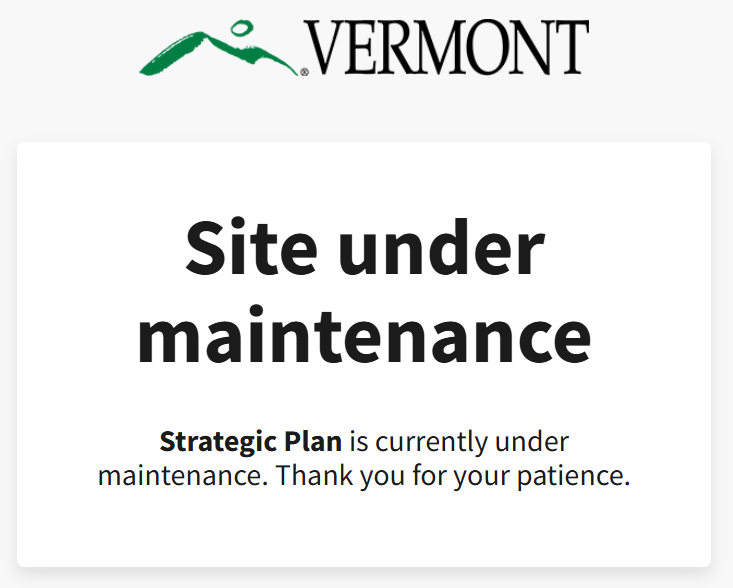
The State Strategic Plan covered the years 2018 through 2023. It expired on June 30, 2023, and it was never renewed.8 The Vermont that was promised to grow “measurably more affordable each year” has instead grown less affordable, year after year, and Governor Scott stopped keeping score.
He did not follow the plan with a new strategic plan. Instead, he replaced it with a set of slogans. The administration’s priorities are now described in three words — “Workers, Kids and Communities” — and three mandates: grow the economy, make Vermont more affordable, protect the most vulnerable.9 There are no targets. There are no dates. There is no way to keep score, which may be the point. The score has never gone as he promised. The man who in 2016 said Vermont, under his watch, would stop losing six workers a day no longer reports the number at all.
The State’s website tells visitors that “a regularly updated strategic plan guides this work.”10 But if you click on the link for this updated plan, you get a page that says, “Strategic plan is currently under maintenance. Thank you for your patience.” There has not been a new plan at least since 2023.
Each essay in this series will take up one promise from Scott’s 2016 Blueprint, state it in Scott’s own words, and set it beside what Vermonters actually got — using his administration’s own data and reputable Vermont reporting.
This series is not about Phil Scott’s character or motives. It’s about results.
If you have felt, these last few years, that you are working harder just to stay in place, you are not imagining it, and you are not alone. Phil Scott gave us the yardstick for assessing his stewardship. In the essays that follow, we are simply going to use that measuring rod.
We will begin where Vermonters feel it first: the cost of their schools, and the property tax bill that arrives every summer.
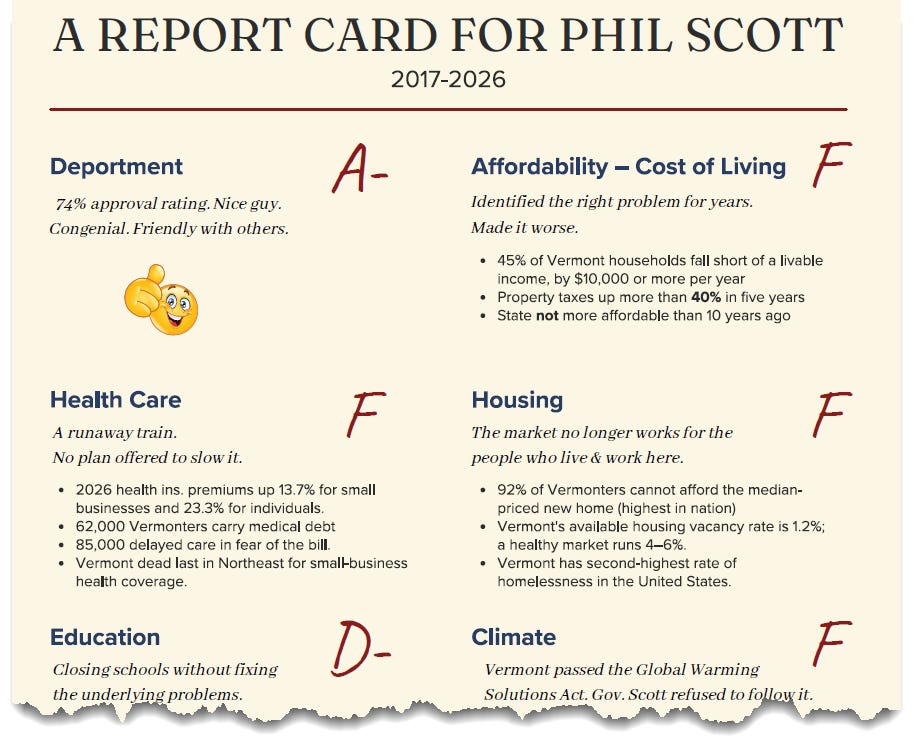
Click on this link to learn about and get involved with the Amanda Janoo Campaign.
Phil Scott: Vermont’s No Plan Man, June 7, 2026
Where the successor plan should be, there is now a page that reads: “Under Maintenance. Strategic Plan is currently under maintenance. Thank you for your patience.”
Comments
Nothing yet. Say the first thing.
Sign in to join the conversation.