
The job of a state governor has three parts:
First, develop a vision for what the state could and should be.
Second, create a strategy for achieving that vision.
Third, inspire legislators, administrators, NGO’s, and citizens to get the job done.

You cannot achieve what you do not first conceive. Thinking — proactive, disciplined thinking — is the first job of the governor. Other people help with the thinking, of course. But the buck stops with the governor. Making the final judgment on any policy or program is the governor's responsibility. So is setting up the processes that produce the thinking in the first place.
For eight years, Governor Scott has named three priorities:
Grow the economy,
make Vermont more affordable, and
protect the most vulnerable.
These are his priorities, by his own statement, in every State of the State and every budget address. They are good priorities. The intentions are admirable. The question this essay asks is not whether Phil Scott wants the right things for Vermont. The question is whether, in eight years of holding the office that has the power to deliver those things, he has done the work the office requires.
We must ask, therefore, how has he done? We owe it to the people whose lives these intentions were to have made better to ask: Has he succeeded in growing the economy, making Vermont more affordable, and protecting the most vulnerable?
Sadly, we must conclude that by each of these measures, Governor Scott has failed, abysmally so.
The economy. Wages have not kept pace with the rest of the country.1 “Over the past two decades, real wages for the lowest earners in Vermont grew more slowly than in any other New England state or in the U.S. as a whole.”2
Affordability? In a February 2026 interview with the Boston Globe, Governor Scott admitted, “the affordability crisis that some of us have been talking about for decades is real.” Scott has heard friends and family members say, “I just can’t afford it anymore. I just can’t stay here anymore, because I’ve talked to my cousin in Tennessee or Florida, and things aren’t as bad there as they are here.” “And Scott himself readily concedes the picture has not improved during his time in office. ‘When I talk with Vermonters today, they certainly don’t think Vermont is more affordable than it was 10 years ago,’ he said. ‘Nor do they think it was affordable then.’”3 Vermont has the most unaffordable housing in the United States.4
The most vulnerable. Vermont has the second highest homeless rate in the country.5 Over 45% of 2-adult households with no children do not have livable incomes. That is, they have to cut corners and go without some basic necessities. Over 187,000 underinsured Vermonters can’t afford to see a primary care provider to address early-stage illnesses or preventable diseases like hypertension and diabetes because their deductibles are $4,000 or more. They are more, not less, vulnerable.6
For all Governor Scott’s congeniality, he has failed where it matters in the daily lives of Vermonters.
To quote the cliché: Are you better off now than you were eight years ago? By Scott’s own admission, most Vermonters would say NO.
The work of state agencies cannot be coordinated without a strategic plan. A good plan sets short-, medium-, and long-term goals that agencies can use to direct their work. It identifies necessary resources and how to get them. It develops legislation to support the work. It determines who will do the work. It sets a timeline for achieving them. And it sets measurable, time-bound goals against which everyone involved can be held accountable.
Without a strategic plan, agencies make it up as they go along. Voters cannot hold a governor accountable for missing goals he never set. Journalists cannot ask agency heads about progress against benchmarks that do not exist. Legislators cannot draft bills to advance an agenda that has never been articulated. Everything stays at the level of amorphous generalities like “growing the economy.”7
Strategic planning has been the consensus best practice in American public administration for nearly a century. John Bryson’s standard reference, Strategic Planning for Public and Nonprofit Organizations (6th edition), defines it as the disciplined work of producing the fundamental decisions that shape what an organization does and why it does it. Scott has not produced a strategic plan since 2017.
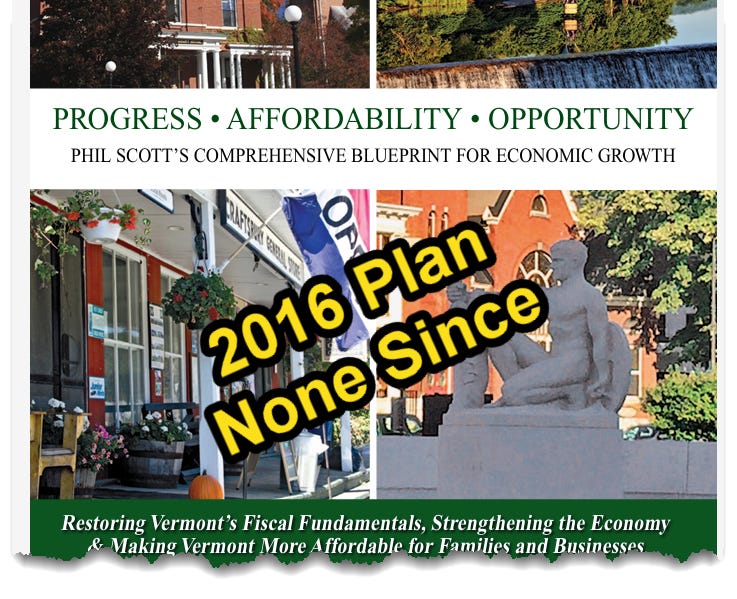
In 2016, candidate Phil Scott handed Vermont voters a forty-page comprehensive blueprint for economic growth. It contained more than fifty specific proposals across twelve subject areas — a Government Modernization plan, a Truth in Budgeting plan, a Transportation Priorities plan, an Opiate Action plan, and an Economic Growth plan with a dozen parts of its own.
In 2017, Governor Scott followed it with a State Strategic Plan covering 2018 through 2023. That was the first, last, and only such strategic plan. If you go on the website where the latest plan should be, you will find a picture stating “Site under maintenance. Strategic Plan is currently under maintenance. Thank you for your patience.”
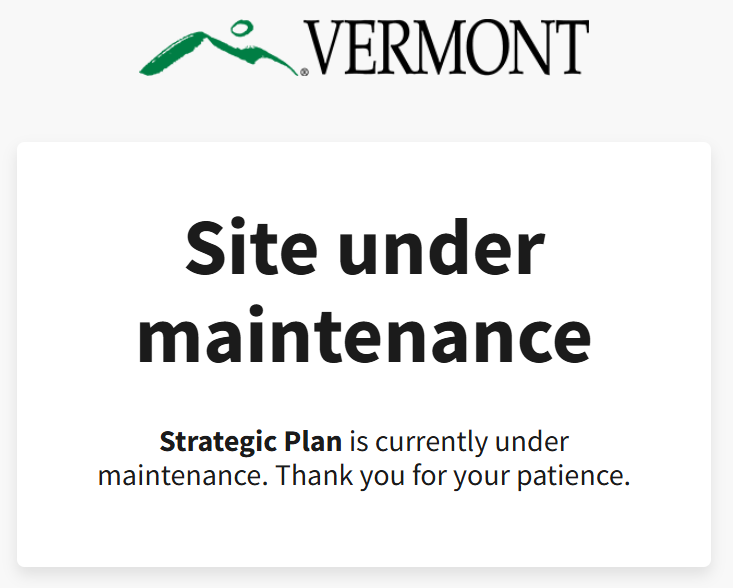
For at least the past 3 years, there has been no plan. Phil Scott is the No Plan Man.
Much of Vermont’s decline over the past nine years could have been avoided if competent professionals had been appointed to lead agencies guided by a well-written plan. You can see the cost in hospitals struggling to survive, in property taxes rising at double-digit rates, in greenhouse-gas-reduction goals quietly missed, in young Vermonters leaving and too few moving in to replace them, in schools underperforming, and in the second-highest homelessness rate in the union.
This bleak scorecard is the result of failed leadership at the most basic level.
Vermonters have been patient long enough. They deserve a governor who has a vision for the state, a strategy for achieving it, and the discipline to do the hard thinking the office requires.
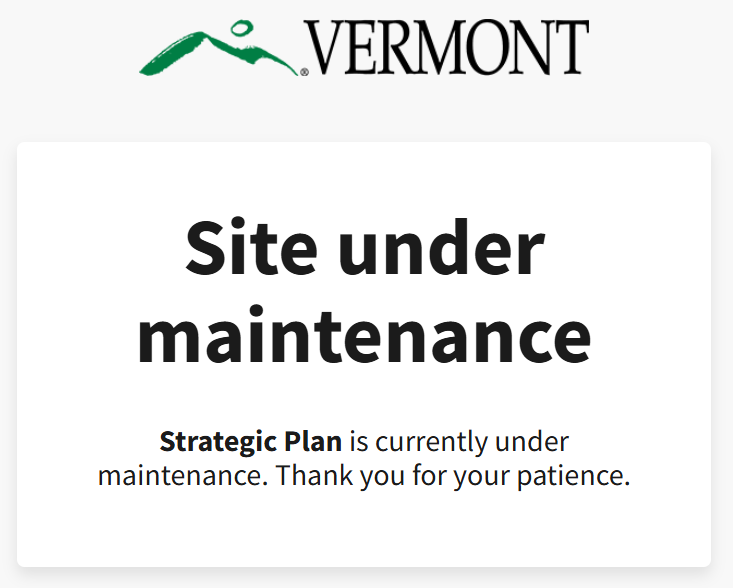
You can help change the course of Vermont history by sharing just one fact from this essay with friends and neighbors. For example, “Did you know that Governor Scott has not put a strategic plan in place for over 3 years and that the site where it would normally be says it’s ‘under maintenance.’?” Start a conversation. Share this essay. Download, print, and share the Report Card below.
We are the ones we’ve been waiting for.
If you want to get help elect Amanda Janoo, click on the picture below, then download and print the page. Cut it into four squares and hand them out to friends and neighbors.

Editor’s Note: This is the first in a series of essays on the Governor Vermont needs to meet its current challenges. Subscribe to get every essay and leave a comment to join the conversation.
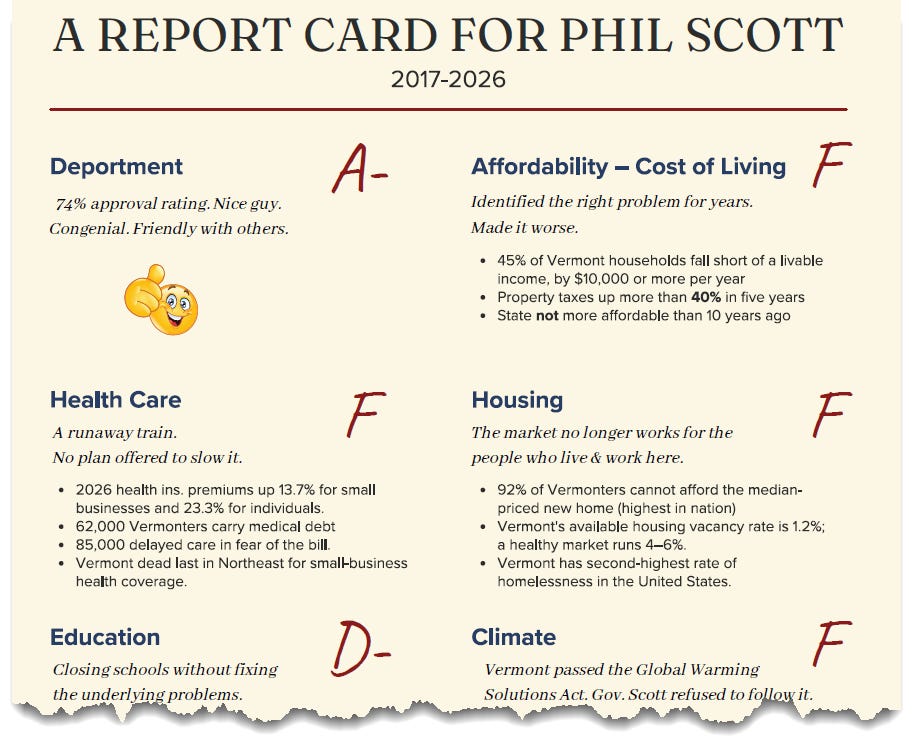
Get your own copy of A Report Card for Phil Scott and share with friends and neighbors.
See “As wages grow across America, one state is left behind,” The Economist (Jan. 30, 2020). Peter Hirschfield of Vermont Public reported in January 2025 that experts told the General Assembly that “Vermont’s Economy is going strong, experts tell officials,” Vermont Public (Jan. 22, 2025). That conclusion is belied by the report the experts submitted, which states: “Vermont’s total relative nonfarm payroll job count total continued last month to be in a comparatively unfavorable position relative to the U.S. average as a whole and in comparison, to the New England average through October, despite that amount of job availability. “Consensus Revenue Forecast Update for the General Fund, Transportation Fund, and Education Fund [Partial]” prepared by Economic and Policy Resources (Jan. 22, 2025) (emphasis added). Moreover, the EPR report focused mostly on projected state revenues, not on the vitality of the economy for working Vermonters.
Governor Scott appears to have been aware of this in 2017, when he signed Executive Order 01-17, Governor’s Strategic Goals, directing all state agency secretaries and department commissioners to use their powers, duties, and programs to establish those three priorities as the cornerstones of their strategic and operational goals. See Executive Order 01-17, “Governor’s Strategic Goals,” January 5, 2017. See EO 03-17, “Government Modernization and Efficiency Team,” and EO 04-17, “Program to Improve Vermont Outcomes Together,” signed during Scott’s first weeks in office. Those appear to have been the last such Executive Orders.
Comments
Nothing yet. Say the first thing.
Sign in to join the conversation.