
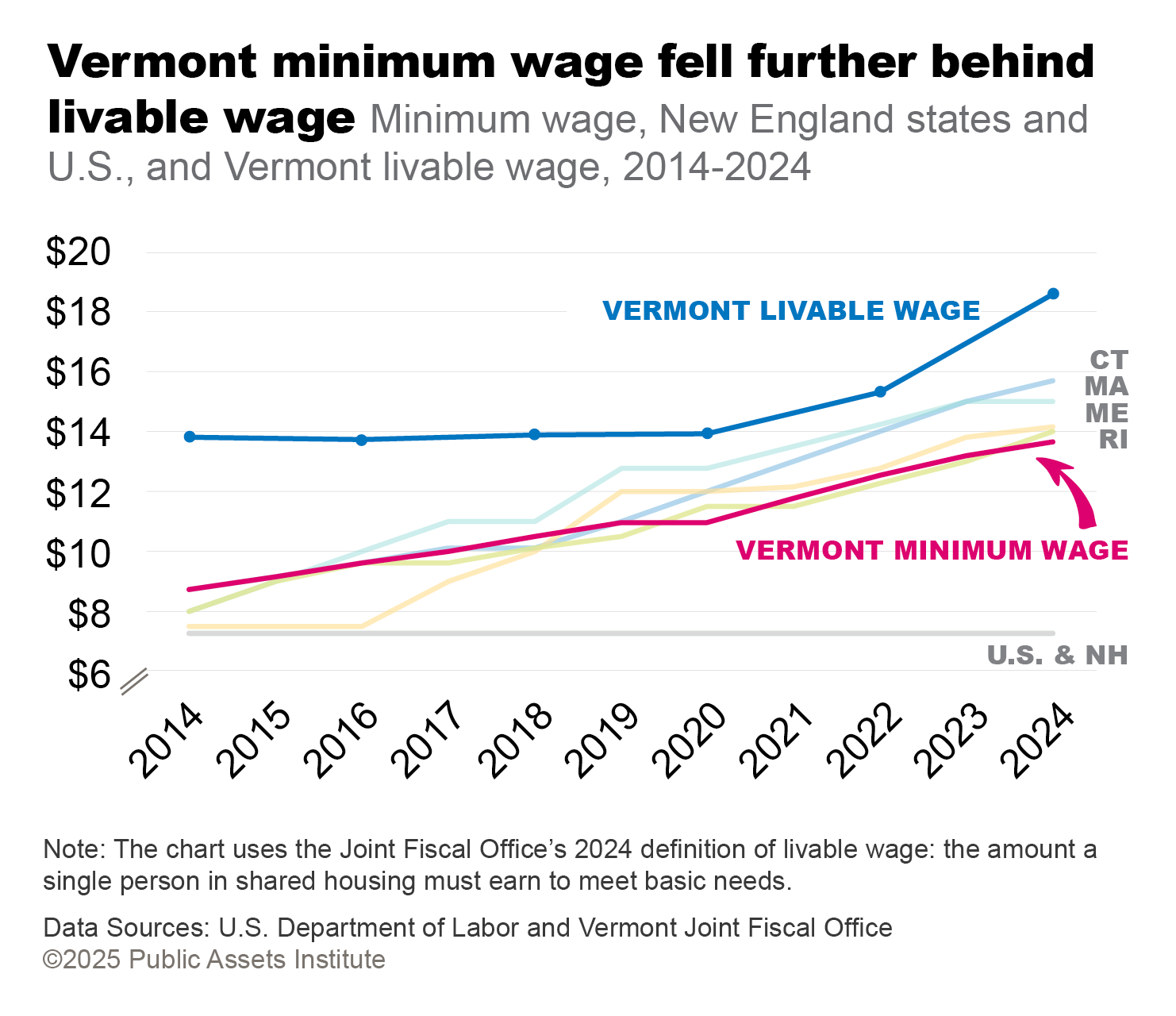
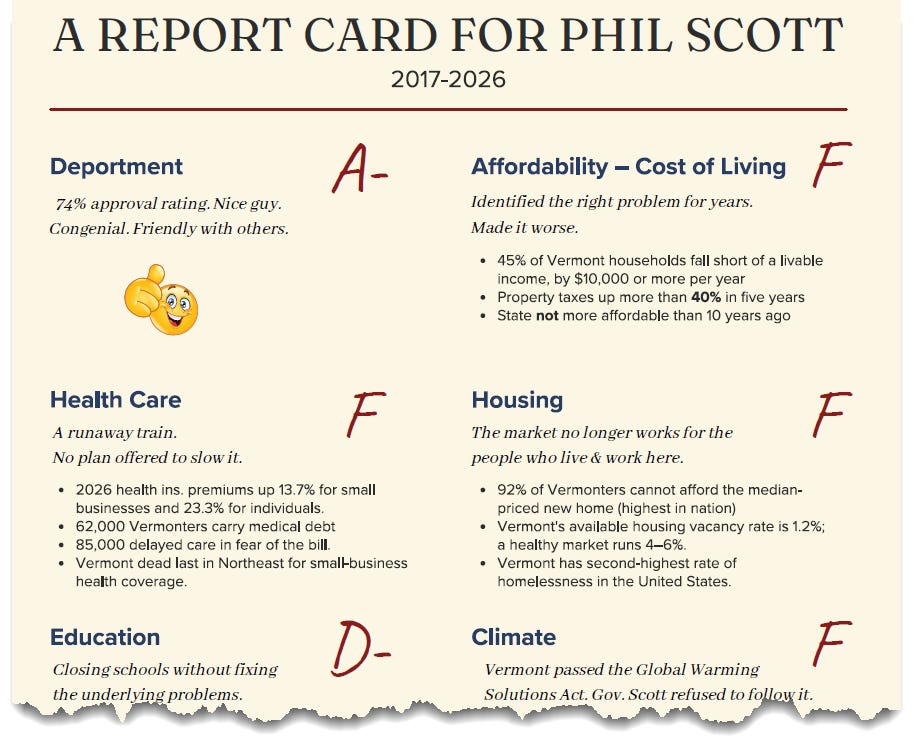
Over the past 9 years, Governor Scott has failed abysmally to achieve even the three objectives he repeatedly mentions when giving a major address or budget speech:
Grow the economy
Make Vermont more affordable
Protect the most vulnerable
While most Vermonters would agree that Governor Scott means well, the data show that he has not gotten the job done. His good intentions have not translated into more affordability or a better life for the most vulnerable. Working Vermonters are worse off than they were in 2017 when he took office.1

To solve a water damage problem, it’s necessary to find out how the water is getting into the house. If you just patch the damaged ceiling, the next big rain will cause the same damage again.
To solve a leadership problem, either the leader changes or you change the leader.
At the core of most leadership problems is either the failure to think or improper thinking.
With Governor Scott, it is possible that we have both. That is, he is not doing the thinking the job requires. And the mindset with which he approaches his work is fundamentally flawed.
In Vermont’s No Plan Man, I explained that Governor Scott has not put forth a strategic plan for Vermont in at least three years. That’s a failure to think.
Neither he nor his Administration has articulated a vision for Vermont with a plan for how to achieve it, including milestones and other benchmarks by which voters can hold him accountable. That’s basic nonfeasance, a fancy word for not doing the job. It’s like you hired an architect to design an office building but never saw any drawings. All you got were generalities about how nice the building would look.
The Scott Administration has no senior economic-policy strategist or growth architect at its center. It has no standing council of economic advisers and no office of strategic planning. The Administration does not produce or maintain a current statewide plan with measurable targets. There is no institutional home for the root-cause analysis that Vermont’s problems demand.
On its webpage, the Agency of Commerce and Community Development advertises a “2020 Comprehensive Economic Development Strategy” (CEDS). That document is a federally-supported plan produced regionally by the Regional Development Corporations and Regional Planning Commissions. It is not a comprehensive strategy developed by the Administration.
More important, the CEDS was last updated in February 2016, that is, under the Shumlin Administration. The Scott Administration has not updated the Comprehensive Economic Development Strategy in the 9 years that Governor Scott has been in office.
The federal government created the Council of Economic Advisers in 1946 on a simple premise: a modern executive cannot govern an economy without professional economic counsel positioned to advise on direction, not just to keep the books. Given Vermont’s specific problems—a shrinking working-age population, the nation's highest health-insurance premiums, a severe housing shortage, and taxes rising faster than incomes — we need a chief economist with a small analytics team, a strategic plan that sets and tracks measurable goals, and the practice of commissioning rigorous diagnoses before committing to remedies. We have none of that.
It’s almost as if Governor Scott had hung a sign on the door: “Gone Fishing.”
When a CEO fails to do the job, most boards don’t agonize over why. The just replace the CEO with someone they believe can get it done. This happens routinely in the corporate and nonprofit worlds. And CEO’s understand: Either they deliver the goods or they must leave.
But that’s short-sighted thinking. How do you know what to look for in the replacement if you don’t understand why the first person failed. You could be putting someone in the job who just repeats the same mistakes. So, let’s take a moment to examine what might have led Governor Scott to completely neglect his planning responsibilities as Governor.
Based on Governor Scott’s own speeches and pronouncements, it appears that he is trapped in a “magic of the marketplace” mindset.
In his FY2027 budget address, Governor Scott explained that every proposed initiative is run past three questions — does it grow the economy, make Vermont more affordable, protect the most vulnerable — and if it doesn't satisfy at least one of these three, it doesn't move forward. He first set these as an executive order on his opening day in 2017. The structure is the argument. Economic growth and affordability are the gatekeepers, and the safety net enters as a residual ("the most vulnerable"), not as a general purpose of government.
Governor Scott is using a market-first priority as an operating rule. It’s a belief system that was expressed most strongly by Milton Friedman and other economists at the University of Chicago.
A companion piece of this thinking is the notion that the economy will grow and everyone will be better off if we lower taxes and curtail regulation. In this view, lower taxes will lead to investment and stimulate growth.2 Free, unregulated markets—driven by self-interest and voluntary exchange—spontaneously organize the efforts of millions of people to produce goods efficiently.3
The following joke sums up the Chicago School ideology:
How many Chicago School economists does it take to change a lightbulb?
None. If the lightbulb needed changing, the market would have already done it.
A crude way of putting this is, “Let the rich get insanely rich and everyone else will be OK.” It’s the “rising-tide-lifts-all-boats” meme from the 60’s turned into government policy.4

But as the wealthy have increased their wealth in complete disregard for everyone else, the boats of the poor and middle class have not risen. They’ve been swamped.
By implementing magical market thinking in Vermont, Governor Scott has opened the door to the destruction of Vermont’s housing market by private equity firms, the explosion of health care costs, and the second-highest rate of homelessness in the nation. He has failed to implement the Global Warming Solutions Act to mitigate Climate Change. In short,
IT’S NOT WORKING.
After 9 years of Scott’s Governorship, Vermont ranks 51st in the nation—51st!—on economic momentum.5 Vermont is dead last in property tax burden. Vermont’s average wage in 2025 was $67,164, well below the U.S. average of $78,722.6 Not even Chittenden County gets up to the national average.
Governor Scott says his approach to governing is pragmatic. But it has nothing to do with the pragmatism developed by C.S. Peirce, William James, and John Dewey at Harvard and Columbia at the beginning of the 20th Century. Rather, it is the dregs of a gouge-the-poor selfishness dressed up in a supposedly respectable but defunct economic theory.7
“Practical men who believe themselves to be quite exempt from any intellectual influence, are usually the slaves of some defunct economist.”
John Maynard Keynes
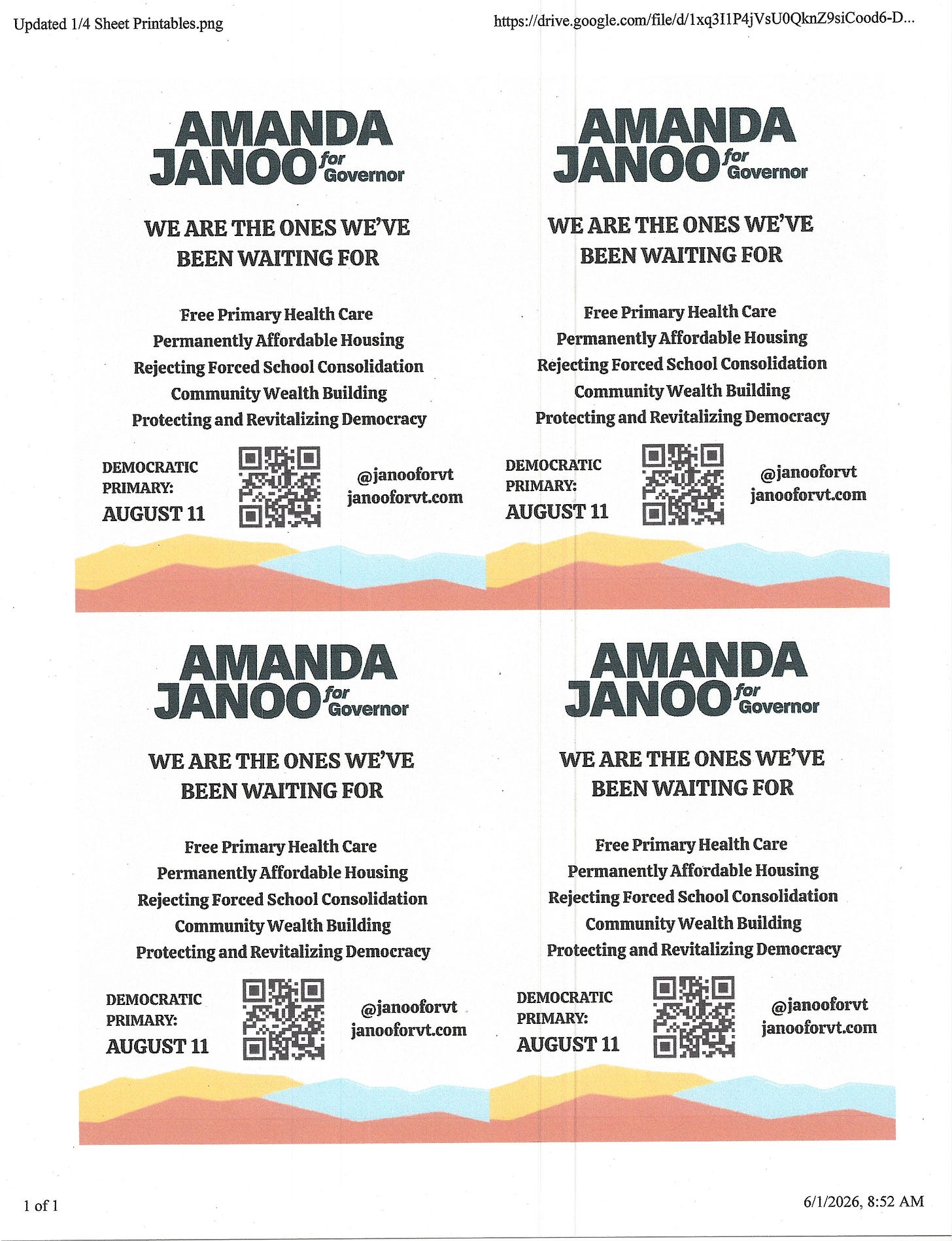
It’s time for thinking that actually works. Amanda Janoo has helped Pamona, California, Toronto, Porirua New Zealand, and Perth Scotland put well-being economies in place.8 She can do the same for Vermont.
If you want a better life in and for Vermont, sign up at Janooforvt.com to help get her elected. You can make a gift, canvas, put up a lawn sign, and do your own bit in other ways.
Editor’s Note: This is the third in a series of essays on the Governor Vermont needs to meet its current challenges. Subscribe to get every essay and leave a comment to join the conversation.
Phil Scott: Vermont’s No Plan Man, June 7, 2026
The Plan Phil Scott Once Had, June 15, 2026
If you want to get help elect Amanda Janoo, click on the picture below, then download and print the page. Cut it into four squares and hand them out to friends and neighbors.
Even though Vermont’s economy has experienced modest growth in inflation-adjusted dollars over the last nine years (see, e.g., “Vermont Real GDP,” Y-Charts), by Governor Scott’s own admission Vermont is less, not more affordable and the most vulnerable are worse off as well. (See “Phil Scott: Vermont’s No Plan Man,” Together for Good, June 7, 2006.)
This is the essence of the Laffer Curve, which George H.W. Bush called “voodoo economics” and President Reagan made the centerpiece of his economic policy in the 80’s.
Early on, Governor Scott urged Vermont to “grow the economy to support jobs and organic growth, expand our tax base” and so ease the burden on taxpayers. Office of the Governor, “Second Inaugural Address,” January 10, 2019. In his FY2027 address, he described the aim as bringing in revenue organically rather than asking more of taxpayers.
“Choosing Progress: A Unified Path Toward Affordability and Economic Resilience,” Vermont Chamber of Commerce (December 12, 2025). States at the bottom of the list “struggle with population loss, limited economic diversification, and slow job growth.” Last year, the Vermont Chamber led the creation of a Vermont Economic Action Plan. “Vermont’s affordability crisis and stagnant population growth have strained public services, increased housing costs, and limited economic opportunities. Without strategic action, these challenges will continue to erode the state’s economic vitality. The Economic Action Plan offers a bold alternative—a future of affordability, sustainability, and shared prosperity.” Id.
See John Maynard Keynes, The General Theory of Employment, Interest and Money 383 (MacMillan & Co., Ltd., 1936). The full context of this quotation reads: “The ideas of economists and political philosophers, both when they are right and when they are wrong, are more powerful than is commonly understood. Indeed the world is ruled by little else. Practical men, who believe themselves to be quite exempt from any intellectual influence, are usually the slaves of some defunct economist. Madmen in authority, who hear voices in the air, are distilling their frenzy from some academic scribbler of a few years back. I am sure that the power of vested interests is vastly exaggerated compared with the gradual encroachment of ideas.”
Comments
Nothing yet. Say the first thing.
Sign in to join the conversation.