

Slava Ukraini! In early 2022 I began a Telegram channel aggregating news from a number of sources daily on the war in Ukraine. In June 2023 I began providing a daily draft for the Ukraine War Brief Podcast collecting news from over 70 sources daily, which formed the basis of the script. While the Podcast no longer exists I have continued to make this Brief available for my subscribers here on Substack and anyone who wishes to keep up with the news from the war.
If you find the Brief informative I would appreciate it if you shared it with others.
For: Aug 13, 2026
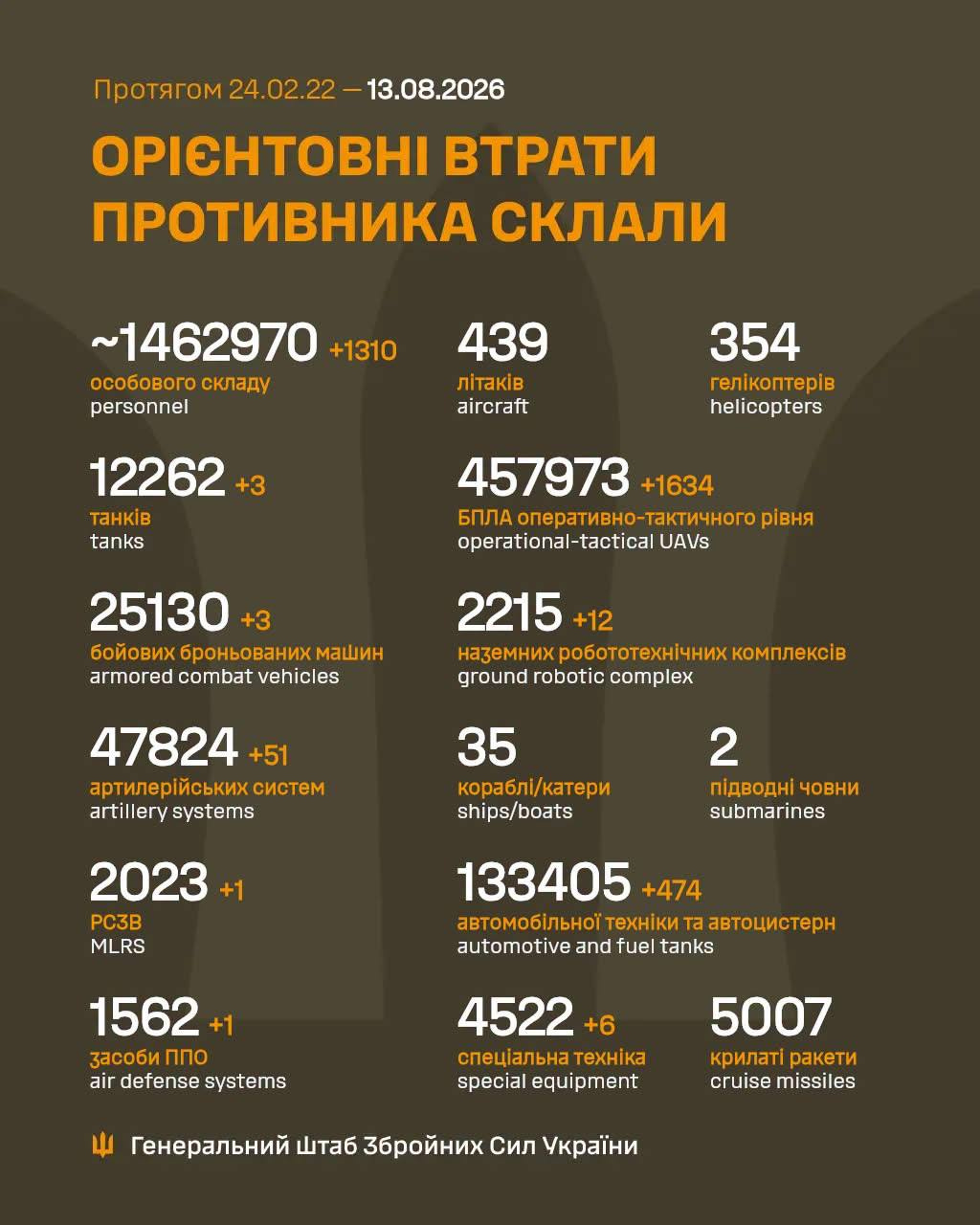
The General Staff of the Armed Forces of Ukraine in its Operational Information update at 08:00 on Aug 13 stated that day 1632 of the full-scale invasion of the Russian Federation against Ukraine had begun.
Ukrainian defenders continue to actively conduct the systematic destruction of the enemy and offer effective resistance in all areas of the front, causing them significant losses in personnel, equipment and technology. The AFU are exhausting the enemy along the entire front line and disrupting their plans to advance deeper into the territory of Ukraine.
Over the past 24 hours, 204 combat engagements took place.
During the past day, aviation, missile troops and artillery of the Defense Forces of Ukraine affected eight areas of concentration of enemy manpower, three artillery systems and an ammunition warehouse.
Over the past 24 hours, the enemy carried out 78 air strikes, used 10,066 attack drones and carried out approximately 3,090 attacks on populated areas and the positions of Ukrainian forces.
Air Force Daily Report
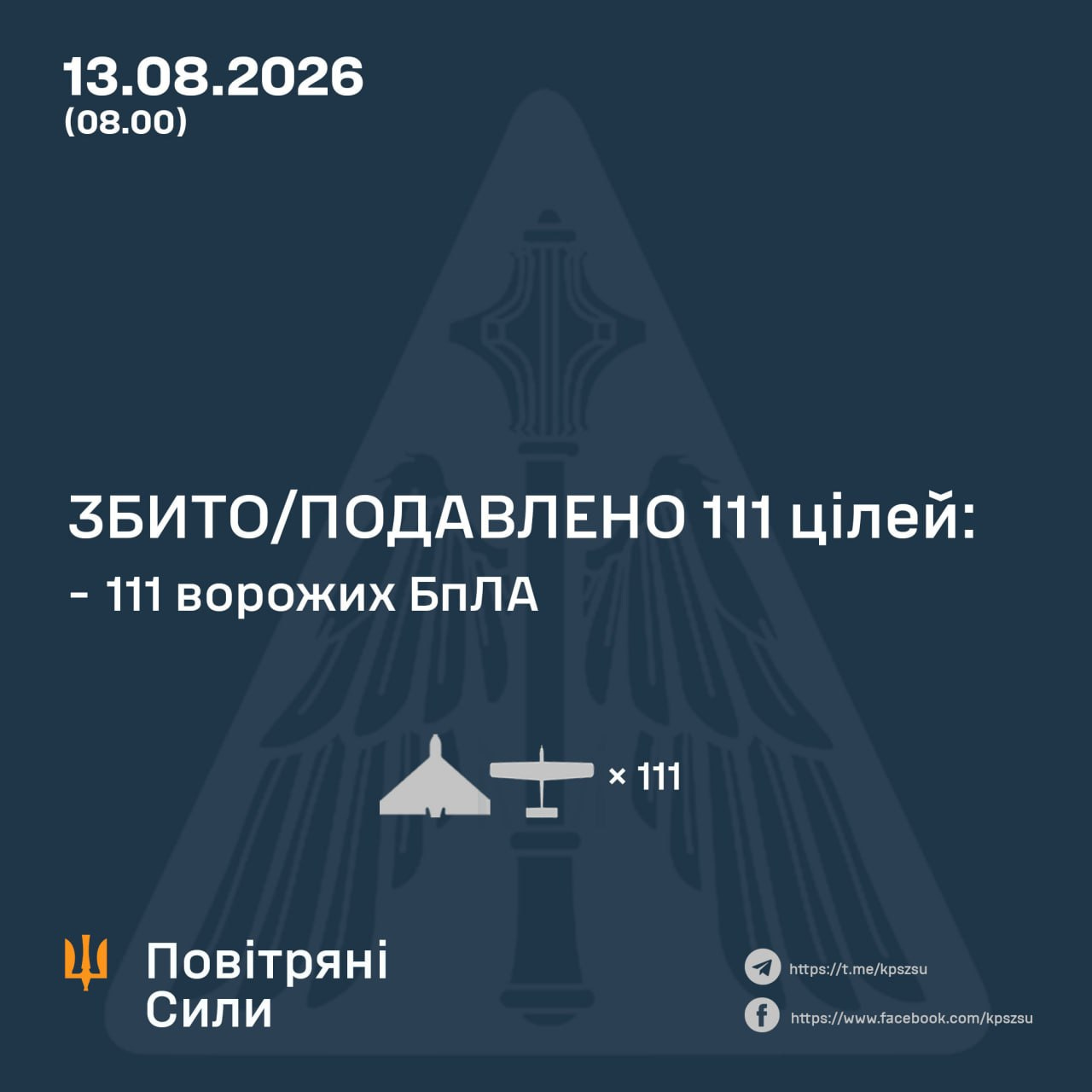
111 ENEMY TARGETS SHOT DOWN/SUPPRESSED
➖➖➖➖➖➖➖➖➖
During the night of Aug 13 (from 18:00 on Aug 12), the enemy attacked with 133 attack drones of the Shahed type (including jet-powered ones), “Geran” drones, and imitation drones of the “Parody” type, launched from the directions of: Kursk, Orel, Millerovo, Primorsko-Akhtarsk - Russia, temporarily occupied territory of Donetsk, and Gardiivske - temporarily occupied territory of Crimea.
The air attack was repelled by aviation, anti-aircraft missile forces, electronic warfare units, and unmanned systems, as well as mobile fire groups of the Ukrainian Defense Forces.
According to preliminary data, as of 08:00, the air defense forces shot down/neutralized 111 enemy drones of the Shahed, Geran, and other types in the north, south, and east of the country.
Hits by enemy air attack assets were recorded at 15 locations, and debris from downed drones fell at 16 locations.
This section of the Brief is compiled from information taken from the Institute for the Study of War (ISW), a US based think tank, in their daily Russian Offensive Campaign Assessment.
Velykyi Burluk Sector: Russian forces recently conducted an infiltration mission in the Velykyi Burluk direction.
Geolocated footage published on Aug 11 shows Ukrainian forces striking a Russian servicemember east of Chorne (northeast of Velykyi Burluk) after what ISW assesses was a Russian infiltration mission.
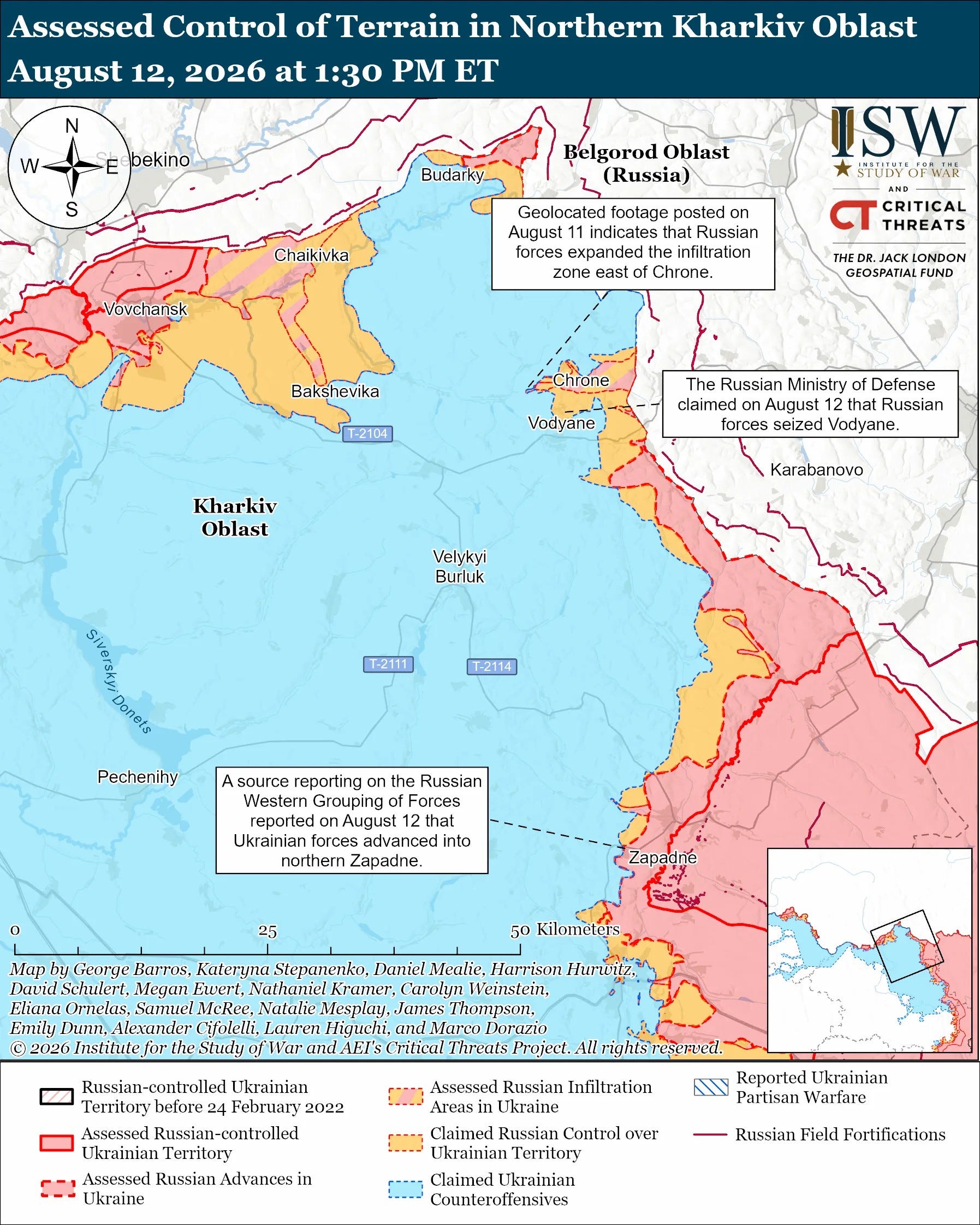
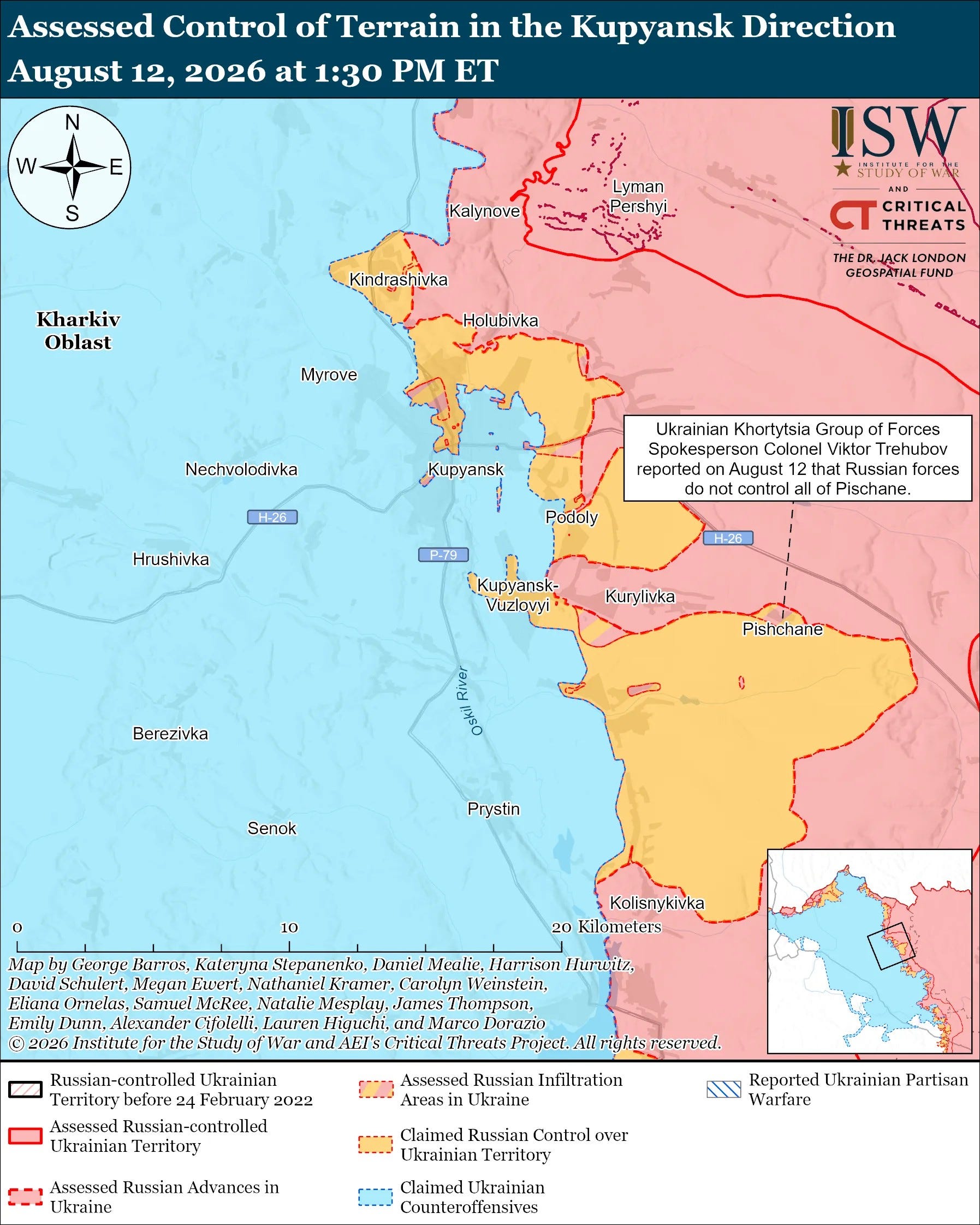
Kupyansk Sector: Ukrainian forces recently advanced in the Kupyansk direction as Russian forces continue infiltration missions in the area.
A source reporting on the Russian Western Grouping of Forces acknowledged on August 12 that Ukrainian forces advanced into northern Zapadne (north of Kupyansk).
Geolocated footage published on August 10 shows Ukrainian forces striking a Russian position in northwestern Kupyansk after what ISW assesses was a Russian infiltration mission.
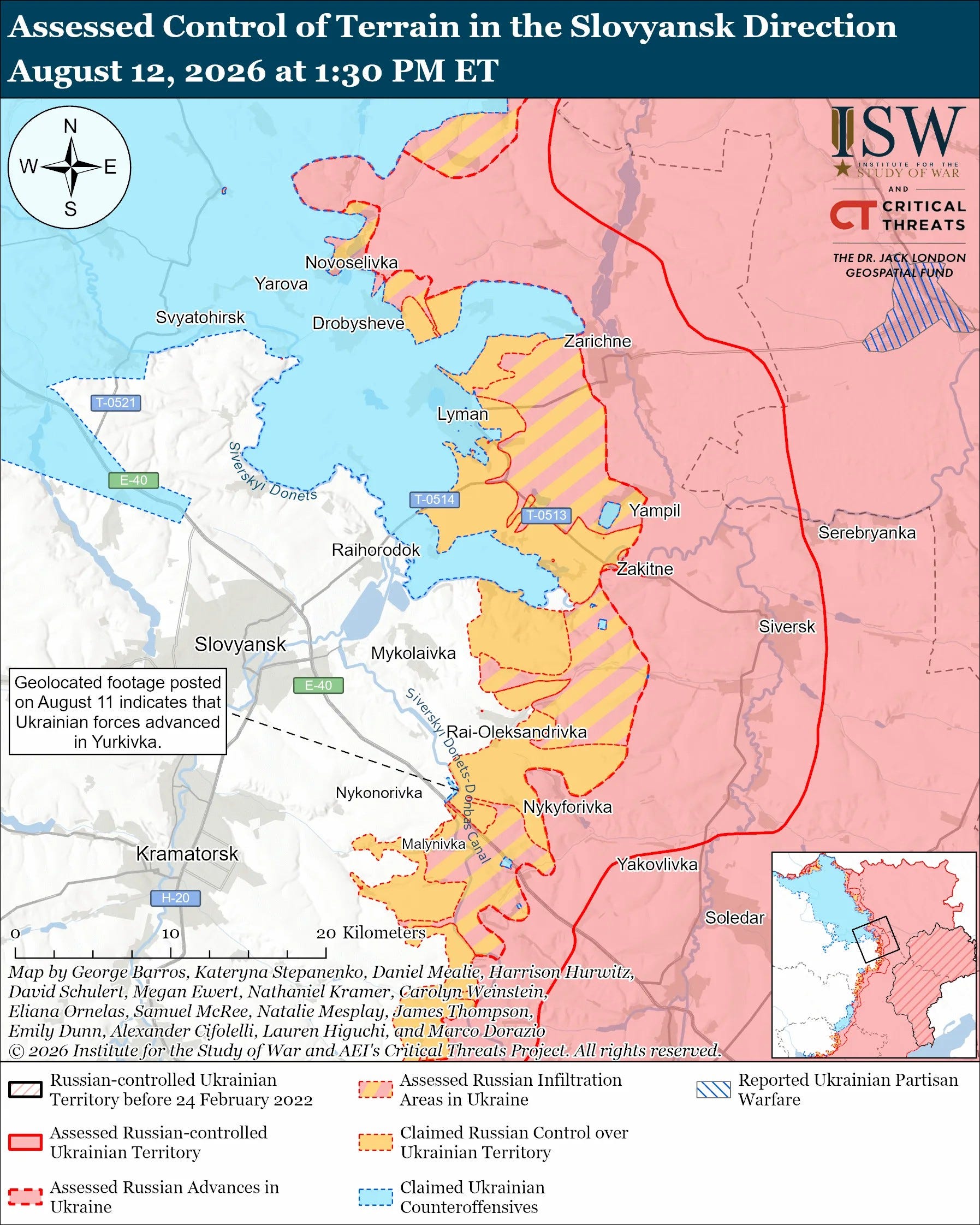
Slovyansk - Lyman Sector: Ukrainian forces recently advanced or maintained positions in the Slovyansk direction.
Geolocated footage published on Aug 11 shows Russian forces striking Ukrainian positions in Yurkivka (southeast of Slovyansk) — an area in which Russian sources previously claimed Russian forces maintained positions.
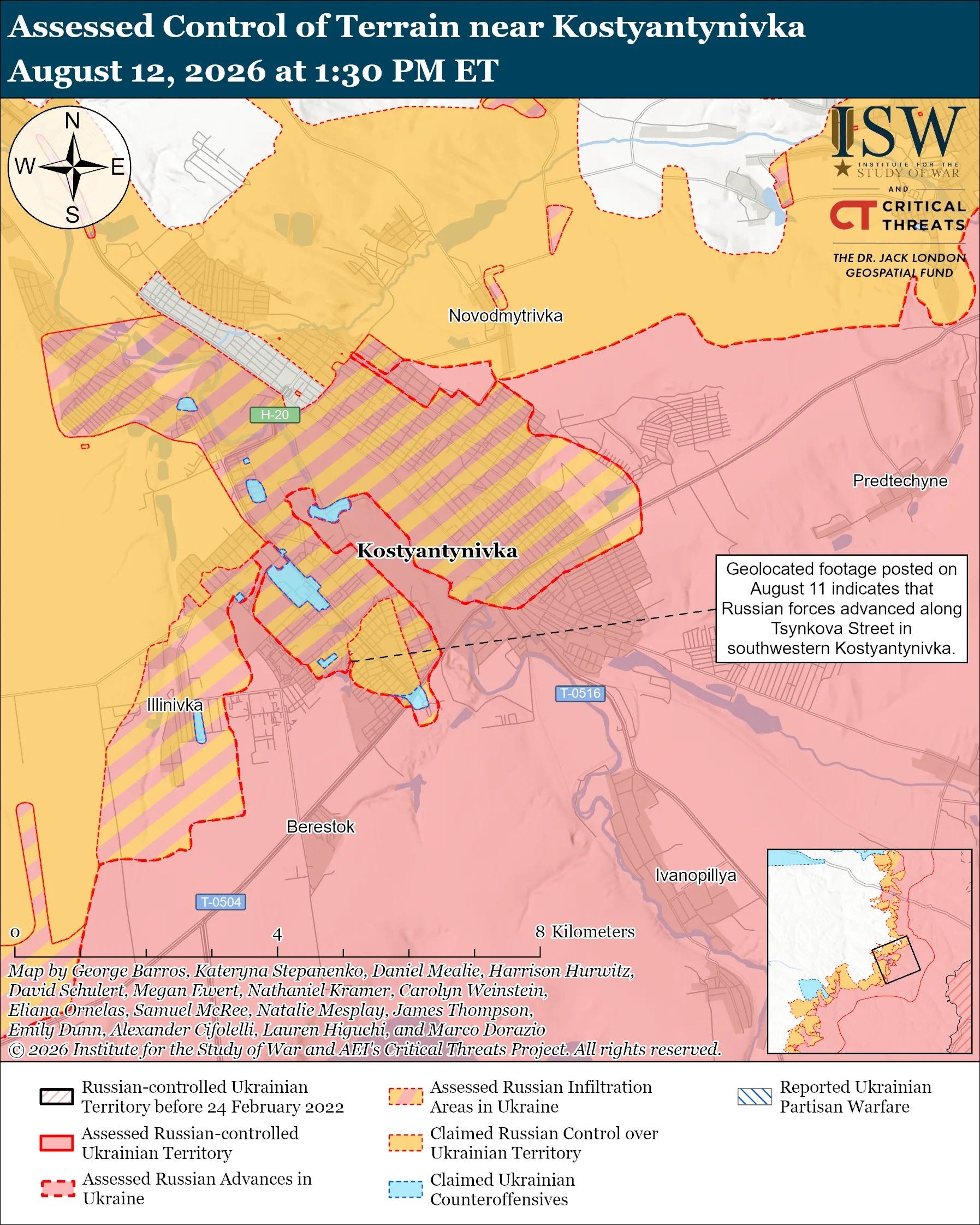
Kostyantynivka Sector: Russian forces recently advanced in the Kostyantynivka-Druzhkivka tactical area.
Geolocated footage published on Aug 11 shows a Russian servicemember in civilian clothing (an act of perfidy and a war crime under the Geneva Convention) attempting to throw an anti-tank mine into a Ukrainian-occupied building in western Kostyantynivka, indicating that Russian forces recently advanced in the area.
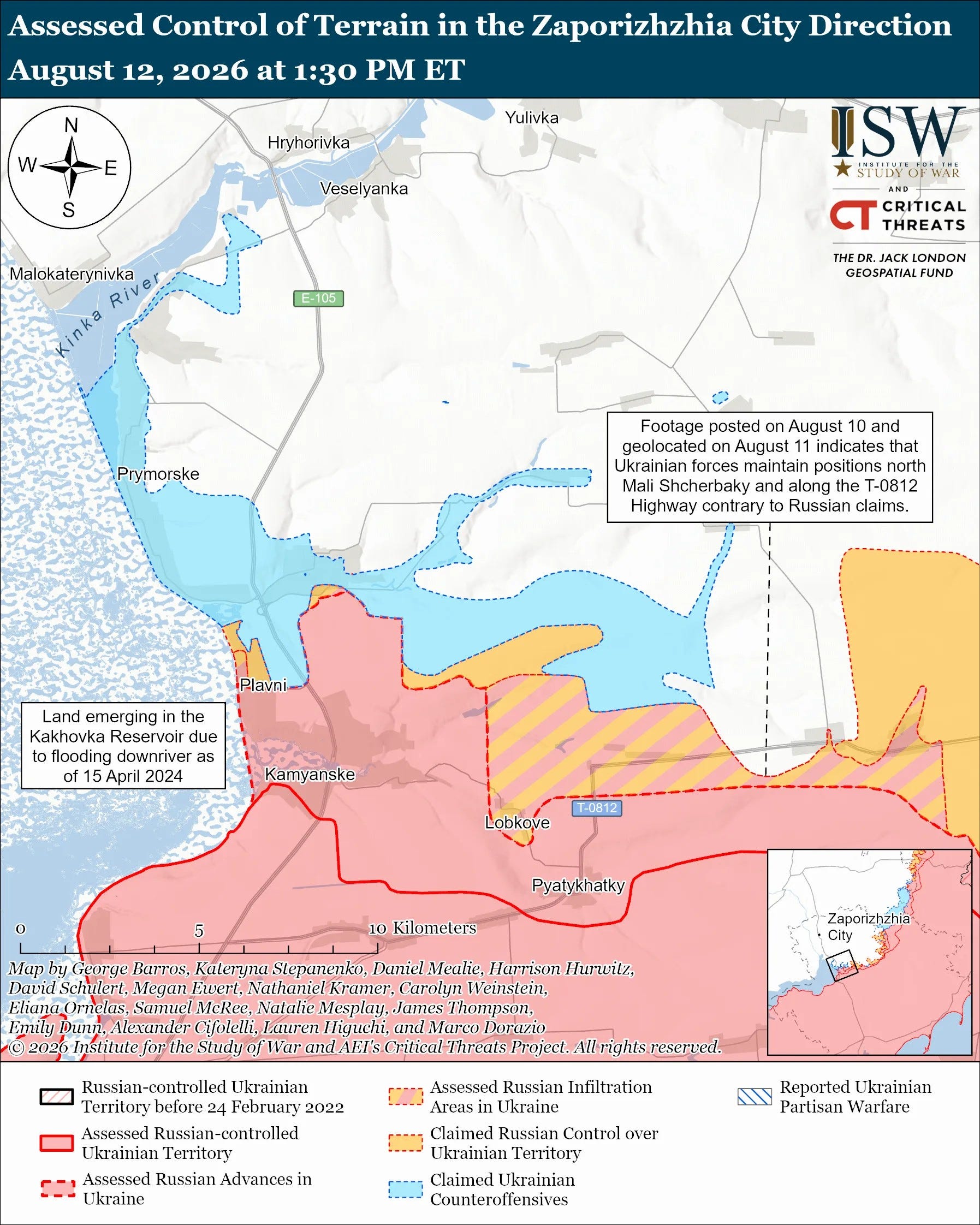
Western Zaporizhia Sector: Ukrainian forces recently advanced or maintained positions in western Zaporizhia Oblast.
Geolocated footage published on Aug 10 shows Russian forces striking Ukrainian positions between Mali Shcherbaky and Stepove (both west of Orikhiv) — an area in which Russian sources previously claimed Russian forces maintained positions.
On the night of August 11-12, the Ukrainian Defense Forces launched the most massive combined strike using missiles, long-range strike UAVs as well as USVs on Novorossiysk. Of particular note is that, among other means, Neptune anti-ship missiles and Palyanytsya jet drones were used, Defense Express reports.
The main blow fell on the military base, which became the last refuge of the Russian Black Sea Fleet, which had previously been forced to flee from the temporarily occupied Crimea due to targeted strikes of Ukraine’s Forces.
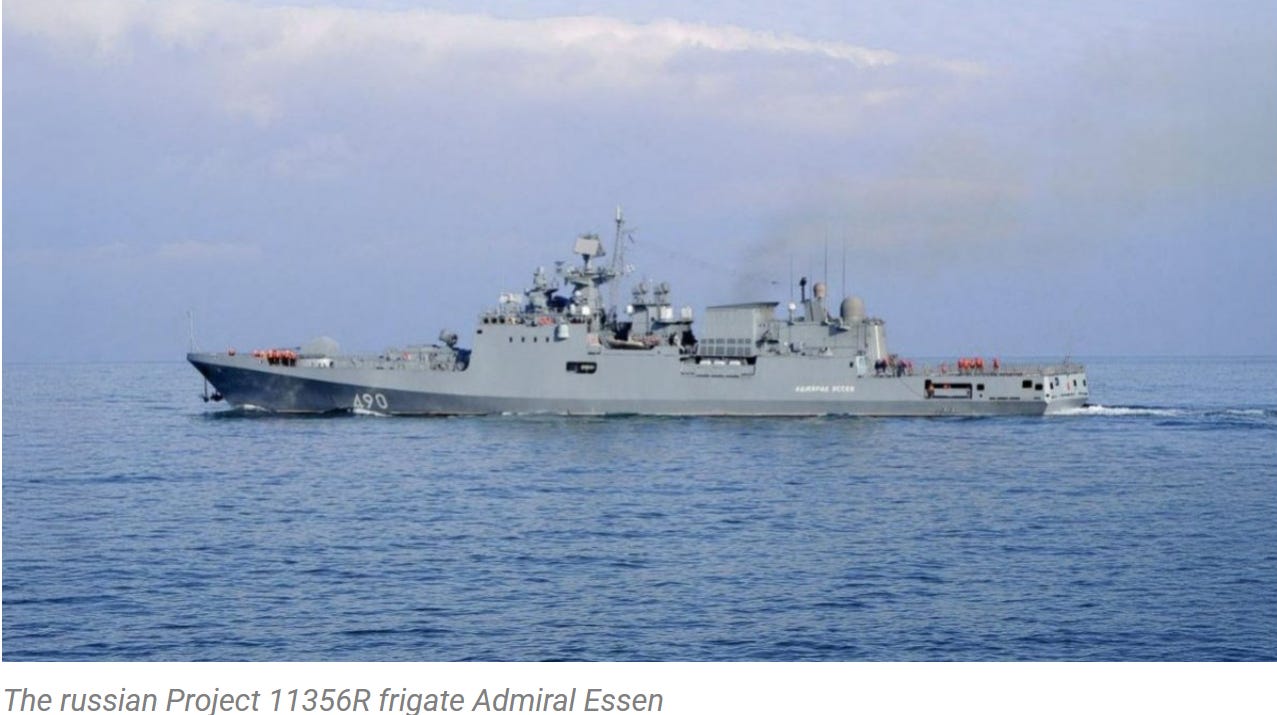
The General Staff of the Armed Forces of Ukraine previously announced the successful targeting of two Russian frigates of project 11356: namely Admiral Makarov and Admiral Essen, Buyan-M2 small missile ship of project 21631 and Vasil Bykov patrol ship of project 22160.
OSINT analysts of “KyberBoroshno” OSINT community also analyzed satellite images in detail. They recorded the successful strike of two frigates of project 11356R – Admiral Makarov frigate and Admiral Essen frigate in the area of the launchers of 3M14 Kalibr cruise missiles. In addition, Admiral Makarov frigate was also damaged in the area of the aft superstructure, where radar stations and antennas are located.
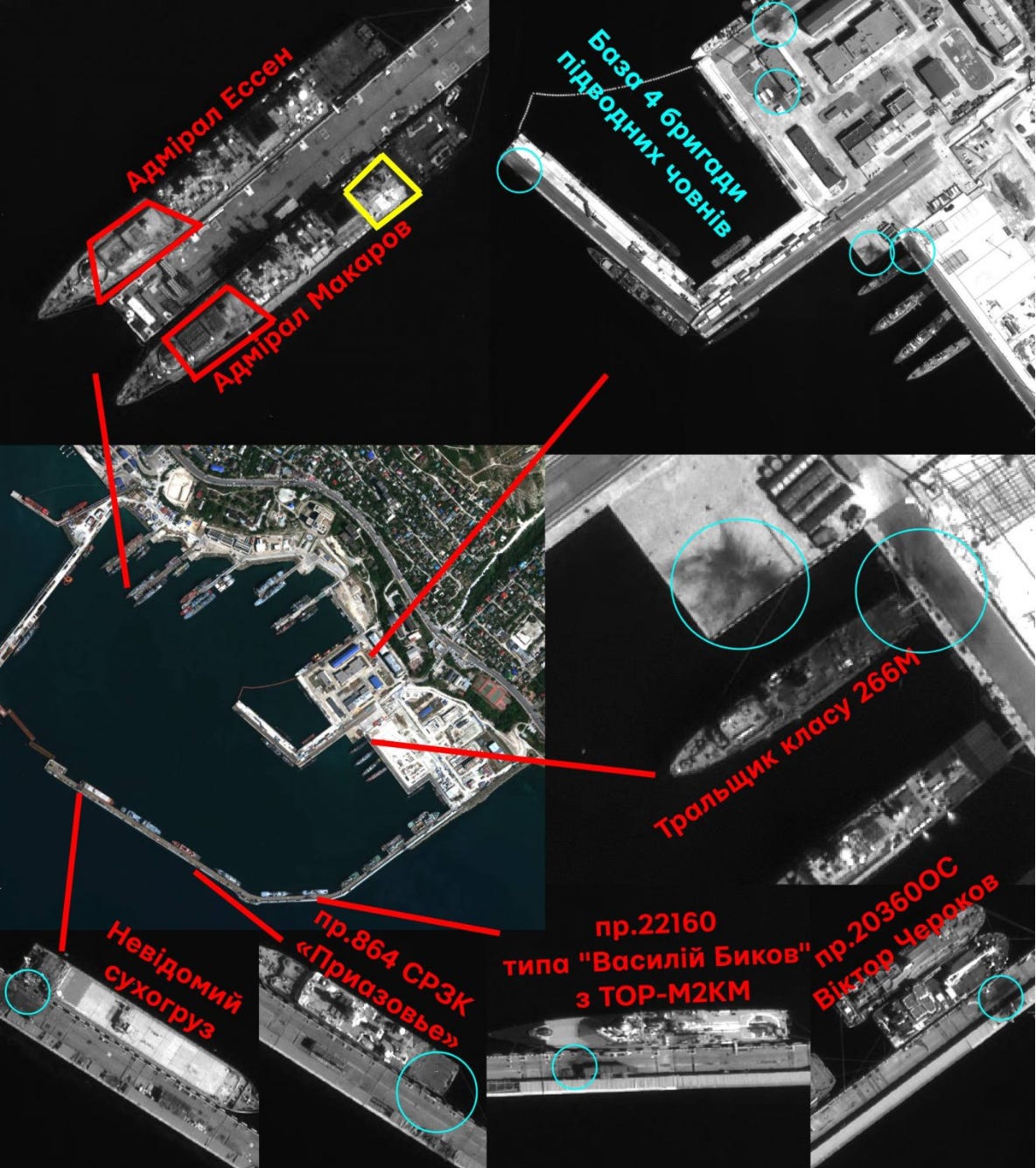
We add that if these damage hit the launchers and antennas hard enough, then we can quite talk about the incapacitation of two Kalibr cruise missile carriers at once with a total salvo of 16 missiles (8 per ship). As a result, both frigates will have to undergo long-term expensive repairs.
Satellite images also indicate that a minesweeper of Project 266M, Viktor Cherokov research vessel of Project 20360 OS, a patrol ship of Project 22160, the Priazovye reconnaissance ship of Project 864, as well as an unidentified dry cargo ship were hit in the port of Novorossiysk.
In addition, the infrastructure of the military port was hit, as well as infrastructure on the territory of the 4th submarine brigade, where two Varshavyanka-class submarines of Project 636.3 were located at the time of the hit.
In addition, the grain terminal of PJSC “Novorossiysk Bread Products Plant” was hit in Novorossiysk itself, which provides about 12% of all Russian grain exports, which according to available information has stopped working. In total, there are 2 more large grain terminals in Novorossiysk - Novorossiysk Grain Terminal (NZT) and KSK.
The first provides another 12% of all grain exports to the Russian Federation, and the second provides 14%. That is, about 40% of all Russian grain exports pass through these three terminals alone. However, according to satellite images? These two terminals were not damaged.
In addition to the grain terminals, the Sheskharis oil terminal was also hit in Novorossiysk. In particular, the first berth, which accepts large Aframax and Suezmax tankers, which can usually take on board 800 thousand and 1 million barrels of oil, respectively, was hit. Also, it seems that an Aframax tanker was hit while loading.
But that’s not all. The Security Service of Ukraine announced that during this attack, they struck a 30N6E radar station of the S-300 SAM system as well as a mobile fire group on the pier at the port was hit too.
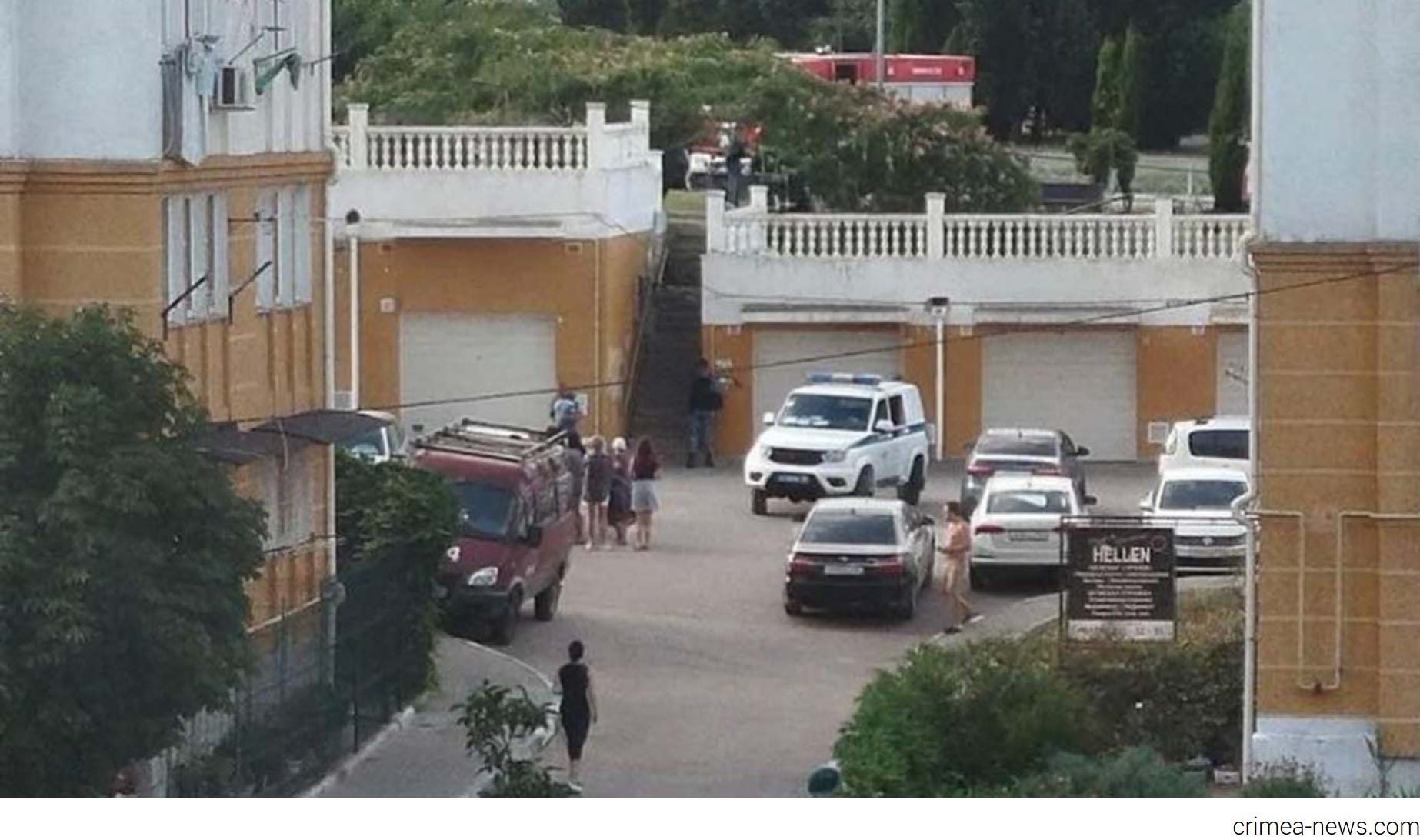
A senior Russian military officer was killed in a targeted bombing in annexed Crimea, the Moscow Times reports citing Kremlin-installed officials and the Federal Security Service (FSB).
The explosion occurred around 10 a.m. local time on a street in western Sevastopol, the home port of Russia’s Black Sea Fleet, according to the news outlet Ostorozhno Novosti.
Citing the FSB, the outlet reported that an explosive device was placed in a trash can and detonated when the officer walked by.
The FSB confirmed the death of a Russian Defense Ministry serviceman but did not disclose his identity, according to state news agencies.
The security agency announced the arrest of a 32-year-old Russian woman who they said was acting on the instructions of Ukrainian special services.
“Investigators established that she acted on instructions from Ukrainian special services and showed no remorse,” said Mikhail Razvozhayev, the Kremlin-installed governor of Sevastopol.
Unverified reporting by Ostorozhno Novosti claimed to identify her as Margarita Reutt, who lives in the southern Russian resort city of Sochi, volunteered to clean up oil from beaches in nearby Anapa and ran her own business.
The outlet previously reported that a court in August 2025 fined Reutt for “discrediting” the Russian military over public remarks on board a train in response to news of a Ukrainian drone strike.
Telegram channels with links to Russia’s security services claimed to identify the victim as Captain First Rank Robert Shageyev, who previously commanded the Ukrainian Navy’s only submarine before defecting to Russia during the 2014 annexation of Crimea. Shageyev reportedly served as deputy commander of a Russian Black Sea Fleet submarine brigade.
The Moscow Times was unable to independently verify the details of those reports.
Razvozhayev said earlier that five people were killed overnight during an operation to dispose of an explosive device.
Russian attacks killed at least eight people and injured 50 others across Ukraine over the past day, the Kyiv Independent reported citing local authorities on Aug 13.
In Odesa Oblast, a Russian jet-powered attack drone hit a passenger train, killing the driver and his assistant, Ukrainian Railways CEO Oleksandr Pertsovskyi said in a post on Facebook.
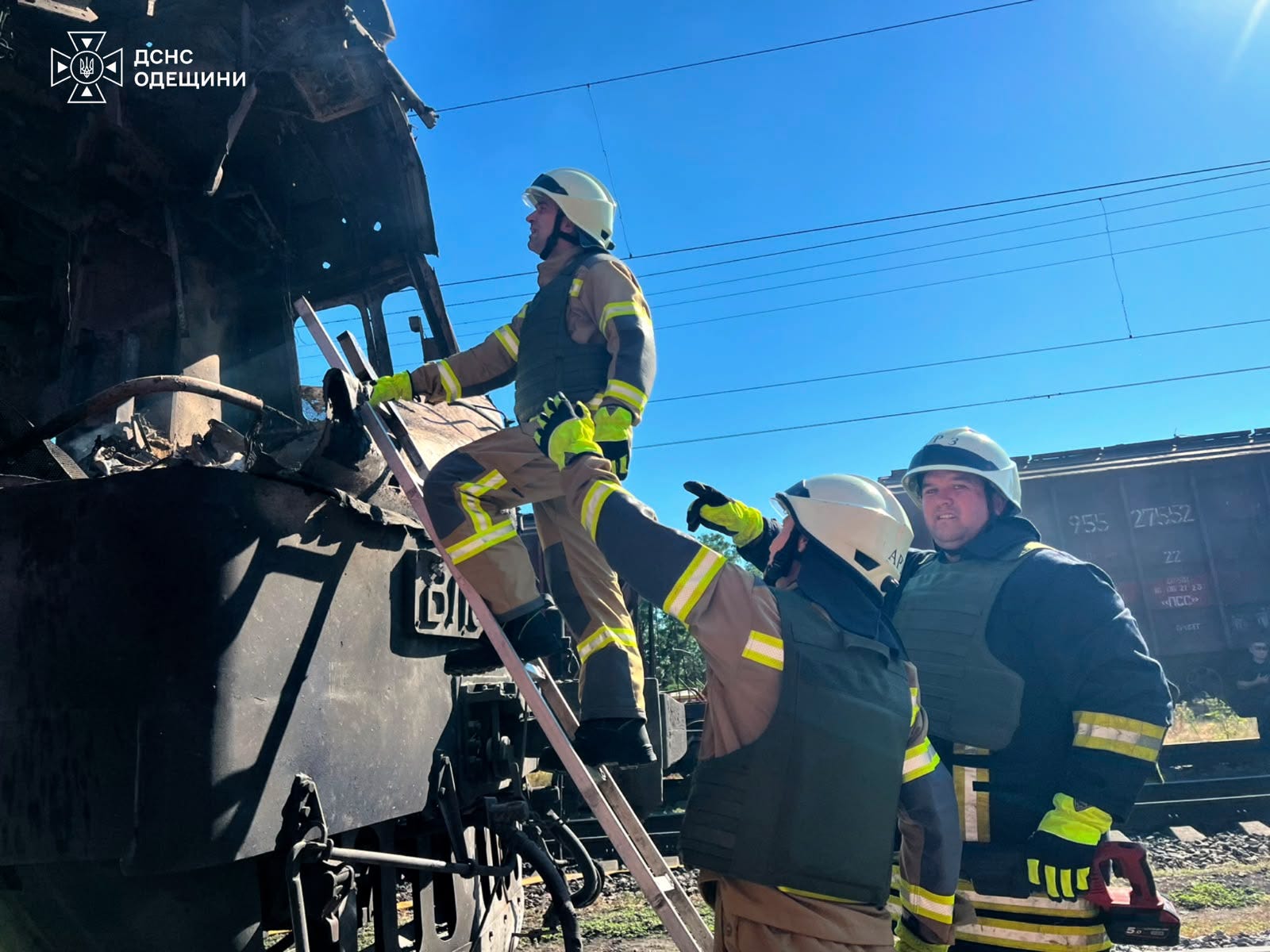
Pertsovsky said the train was entering a station so passengers could be evacuated after a drone threat was detected.
“The locomotive crew did not have enough time to completely stop and evacuate themselves,” he said, adding none of the passengers were injured.
Odesa Oblast authorities had not released a full daily report of casualties at the time of publication.
In Kherson Oblast, Russian forces targeted 28 settlements, including the regional center of Kherson, killing three people and injuring 19 others over the past day, the local military administration said.
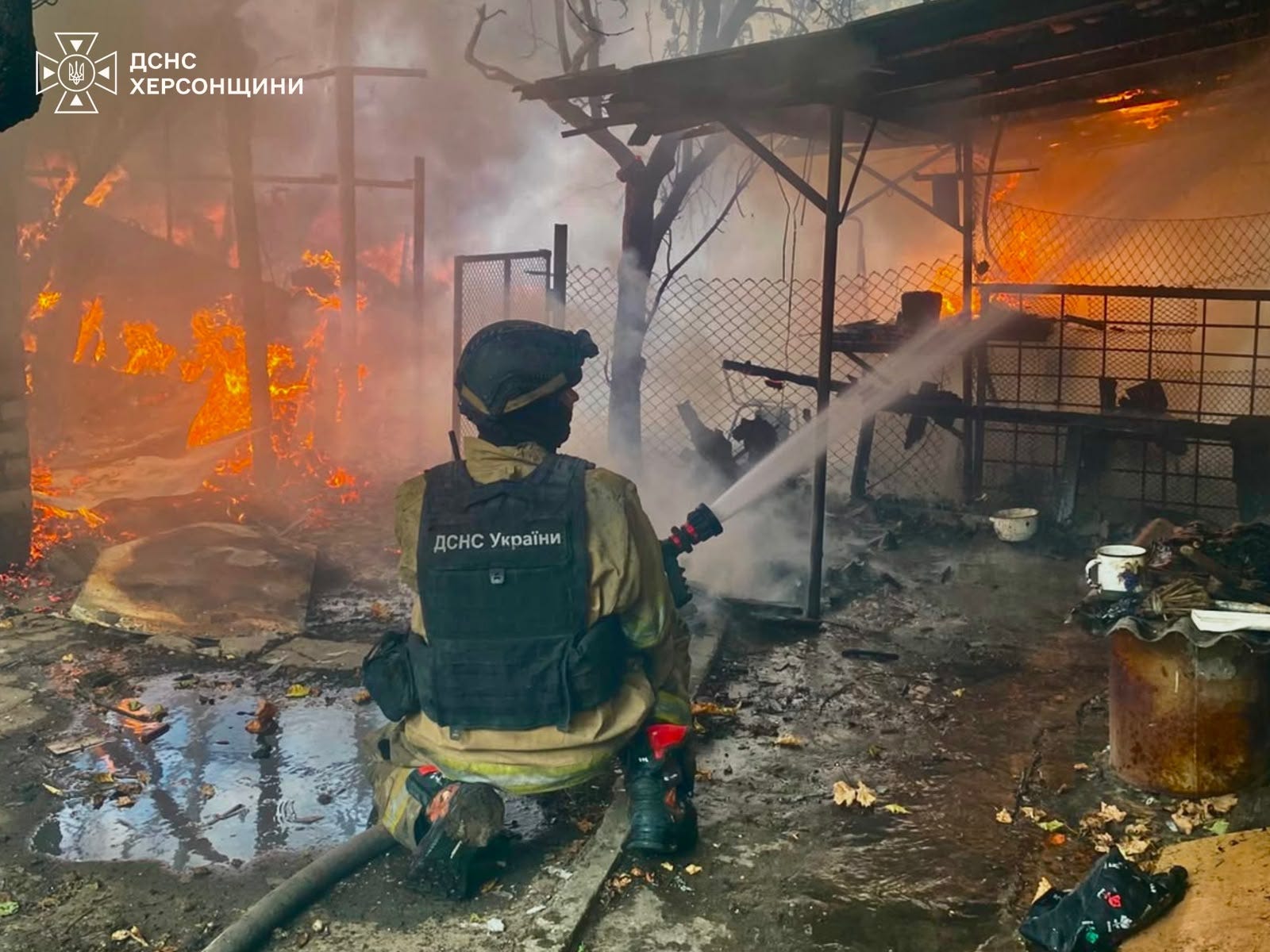
In Sumy Oblast, Russian attacks injured seven people, according to the local military administration.
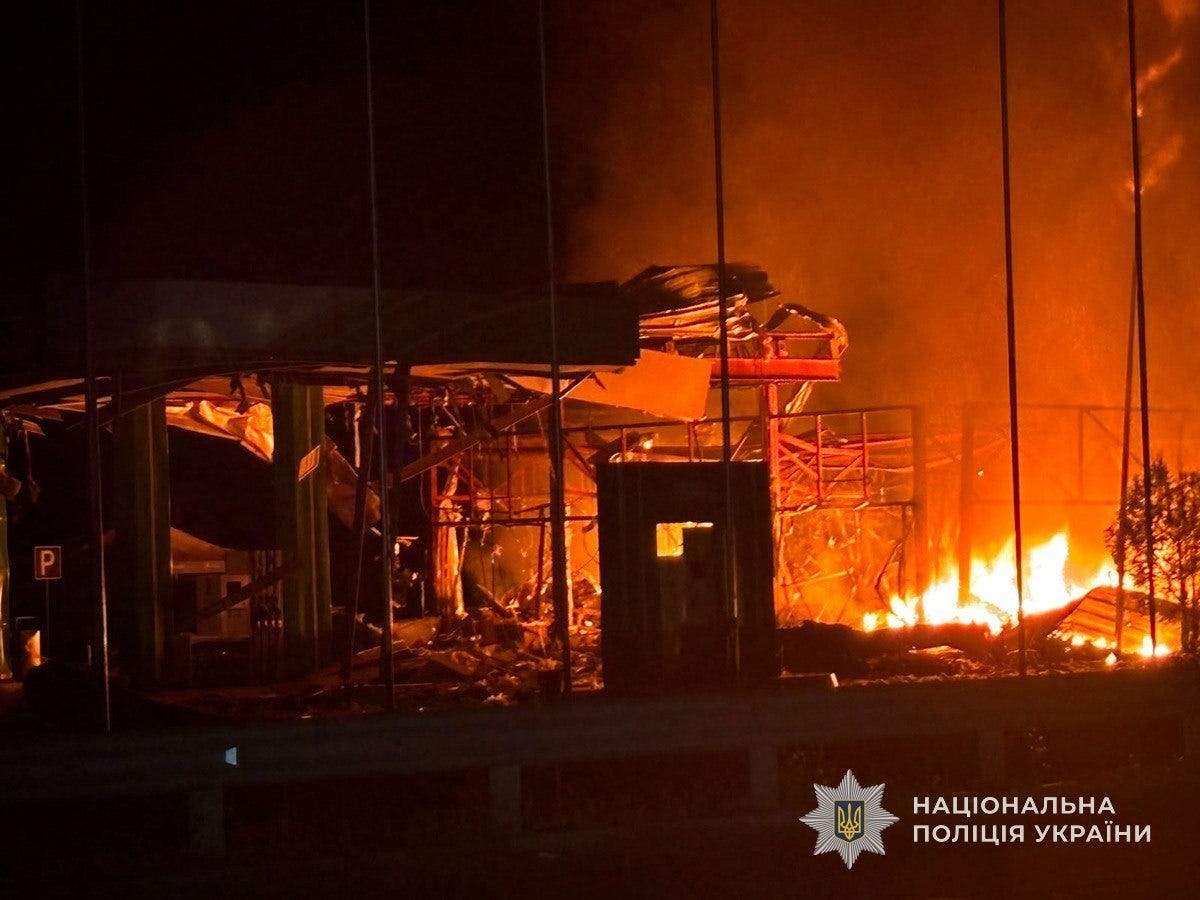
In Donetsk Oblast, Russian forces killed two people and injured six others across the eastern region, Governor Vadym Filashkin said.
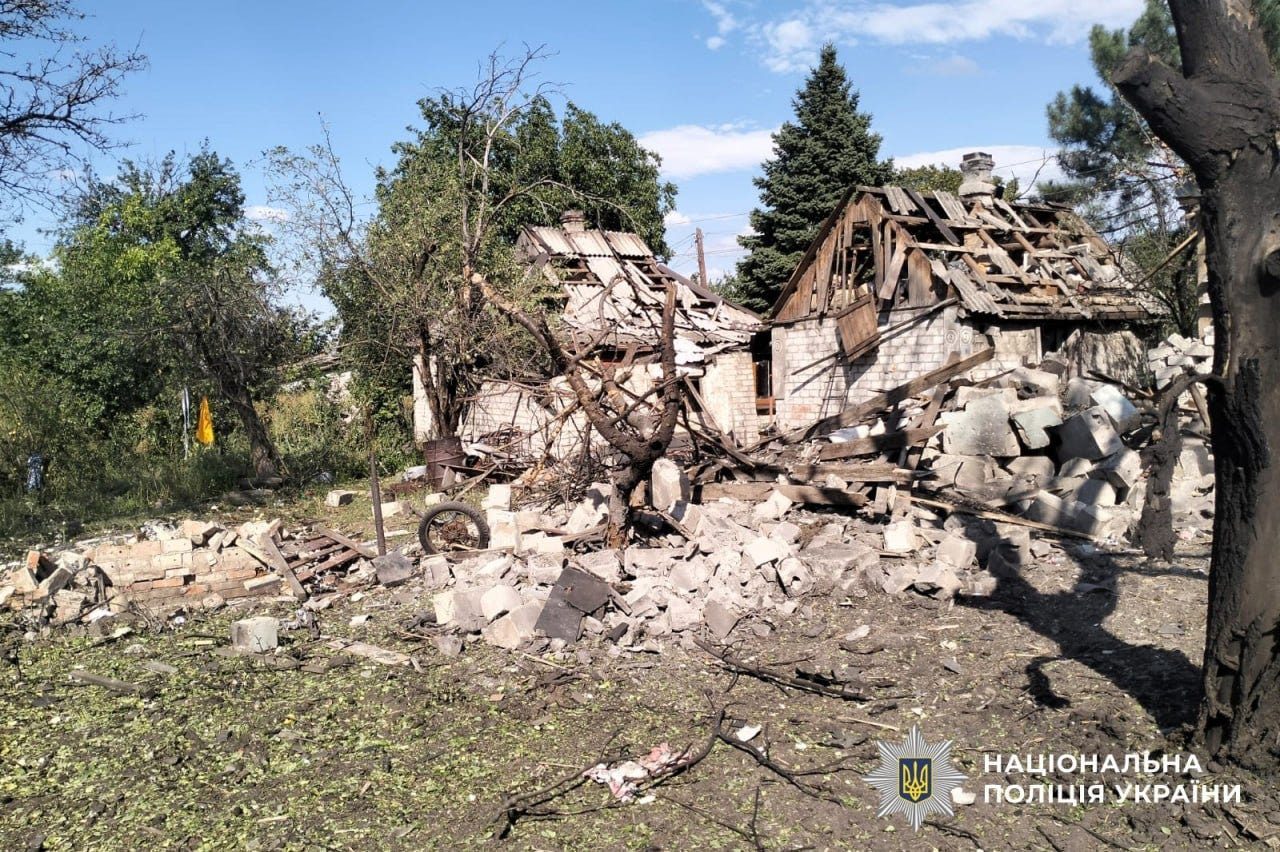
In southeastern Zaporizhzhia Oblast, Russian attacks killed one person and injured four others over the past day, according to local authorities.
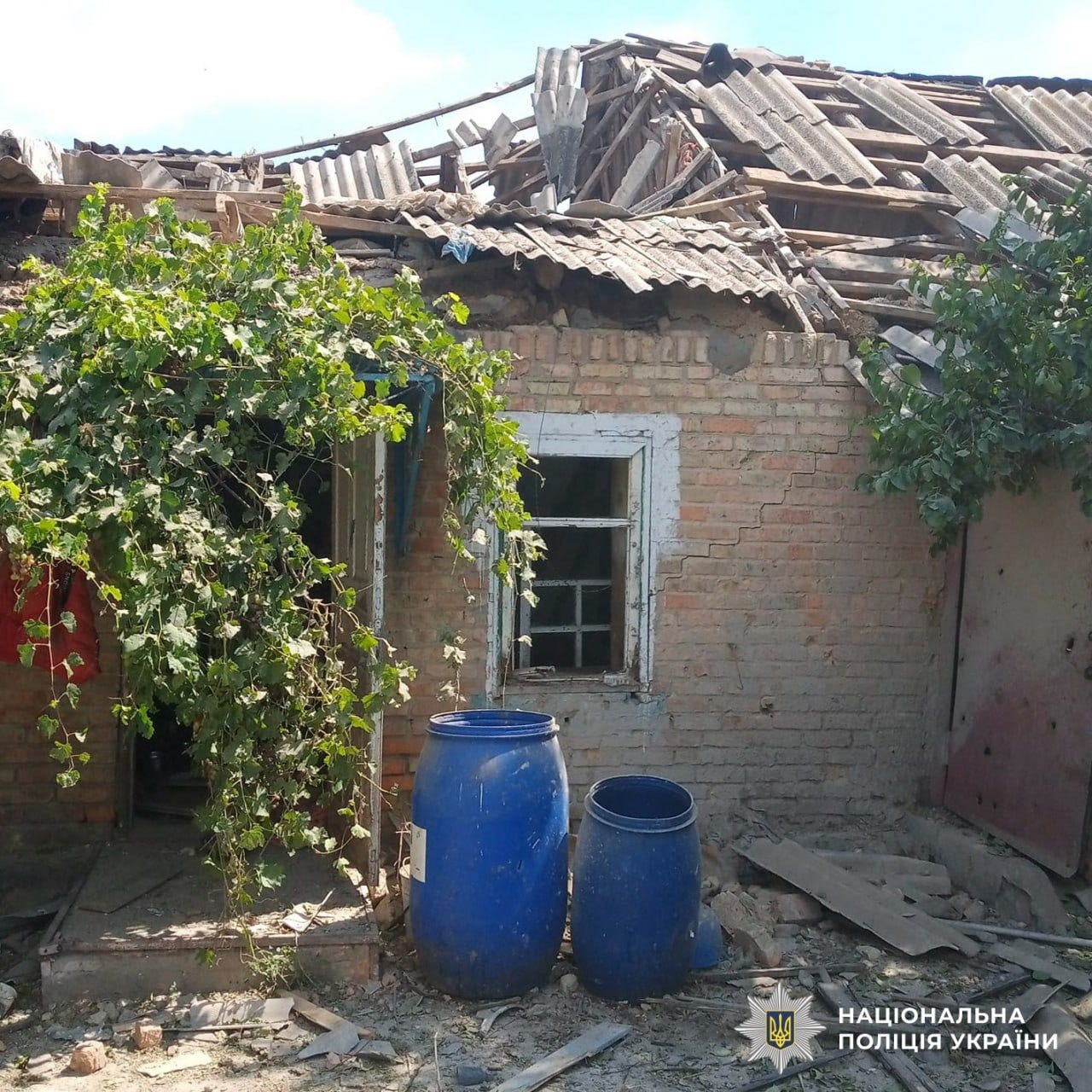
In northeastern Kharkiv Oblast, eight people were injured in Russian attacks, including a 15-year-old boy, Governor Oleh Syniehubov said.
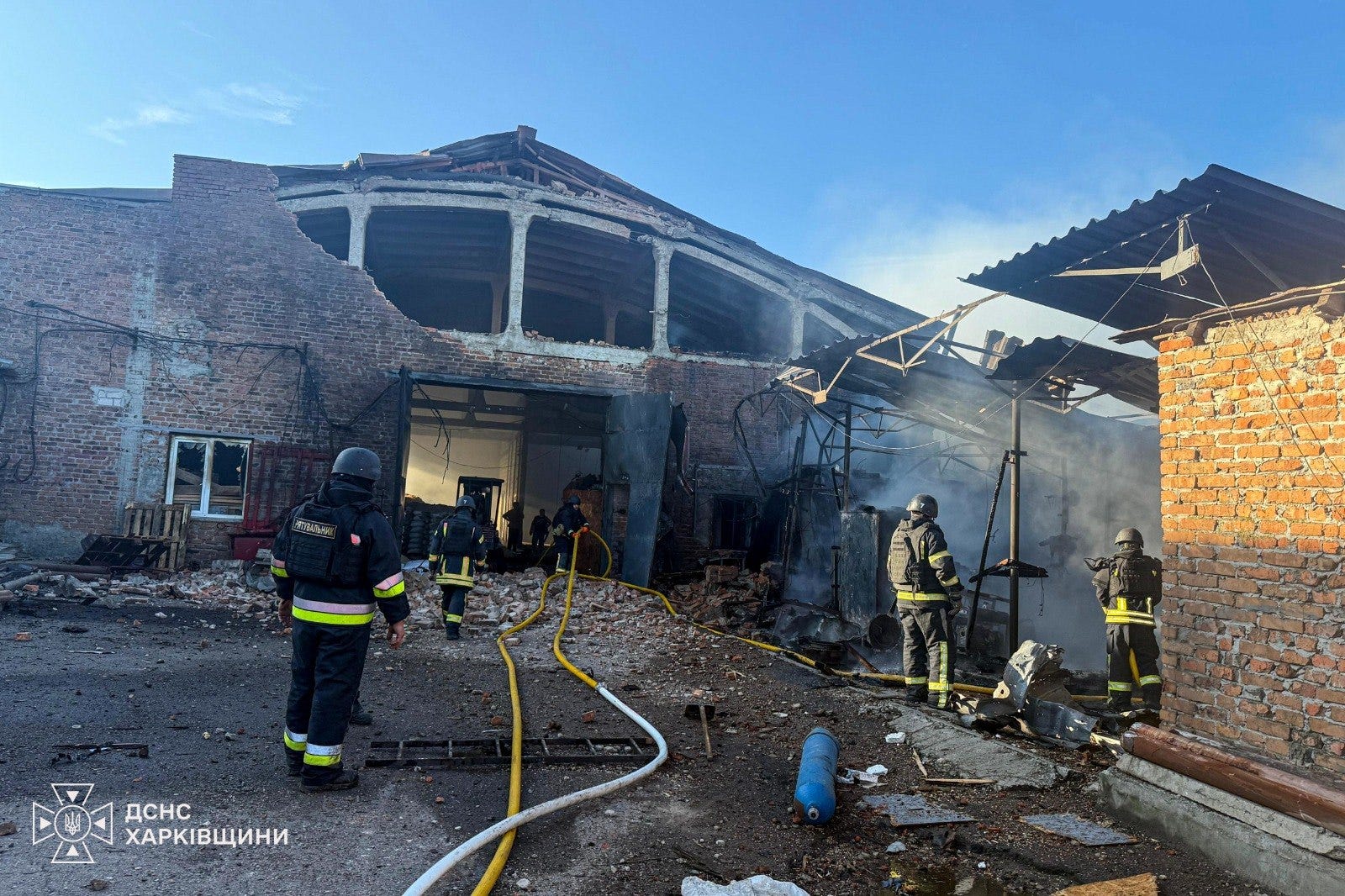
In northern Chernihiv Oblast, a 10-year-old girl was injured in Russian drone attacks over the past day, Governor Viacheslav Chaus said.
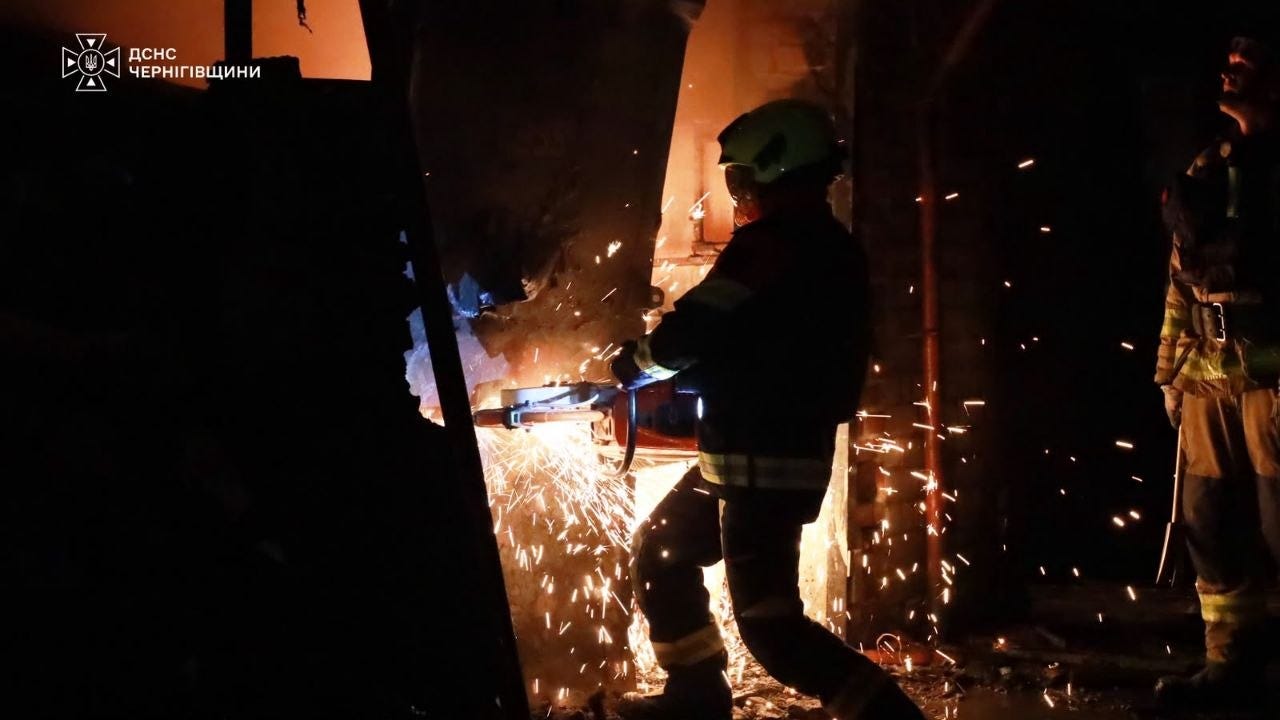
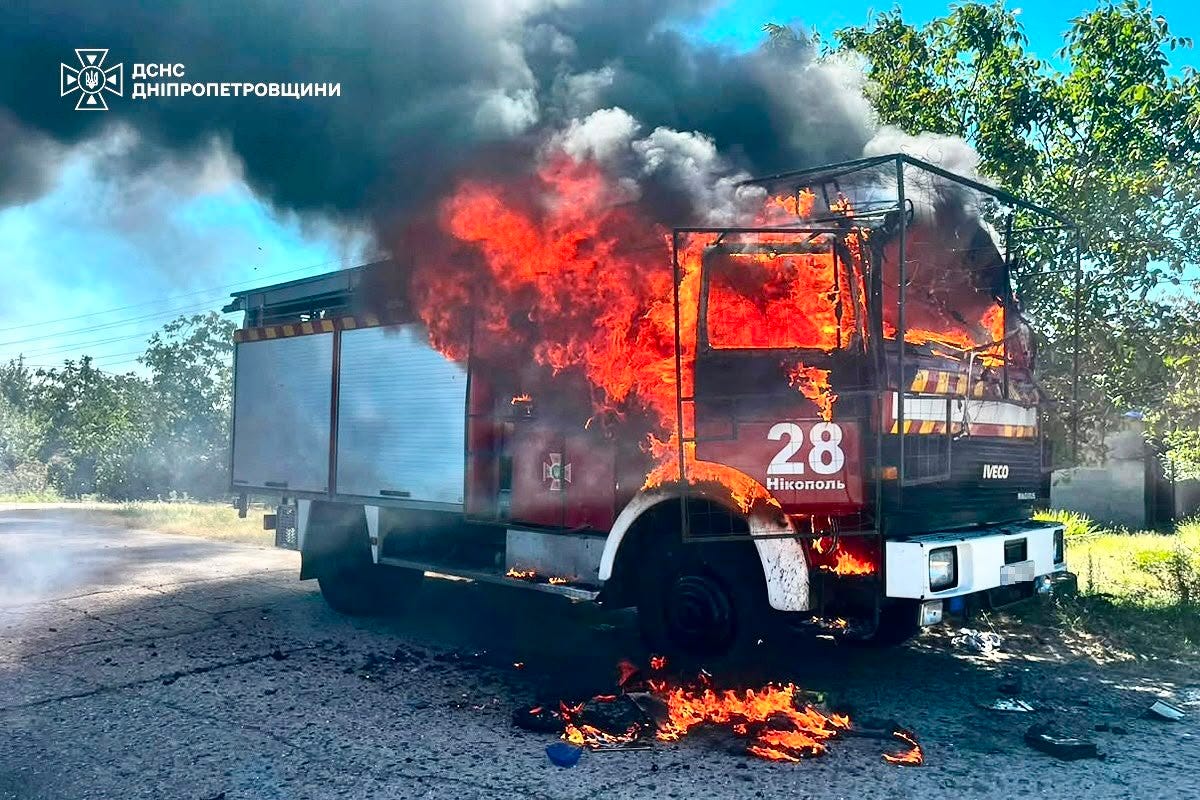
In Dnipropetrovsk Oblast, five people were injured in more than 10 drone and artillery attacks, Governor Oleksandr Hanzha said.
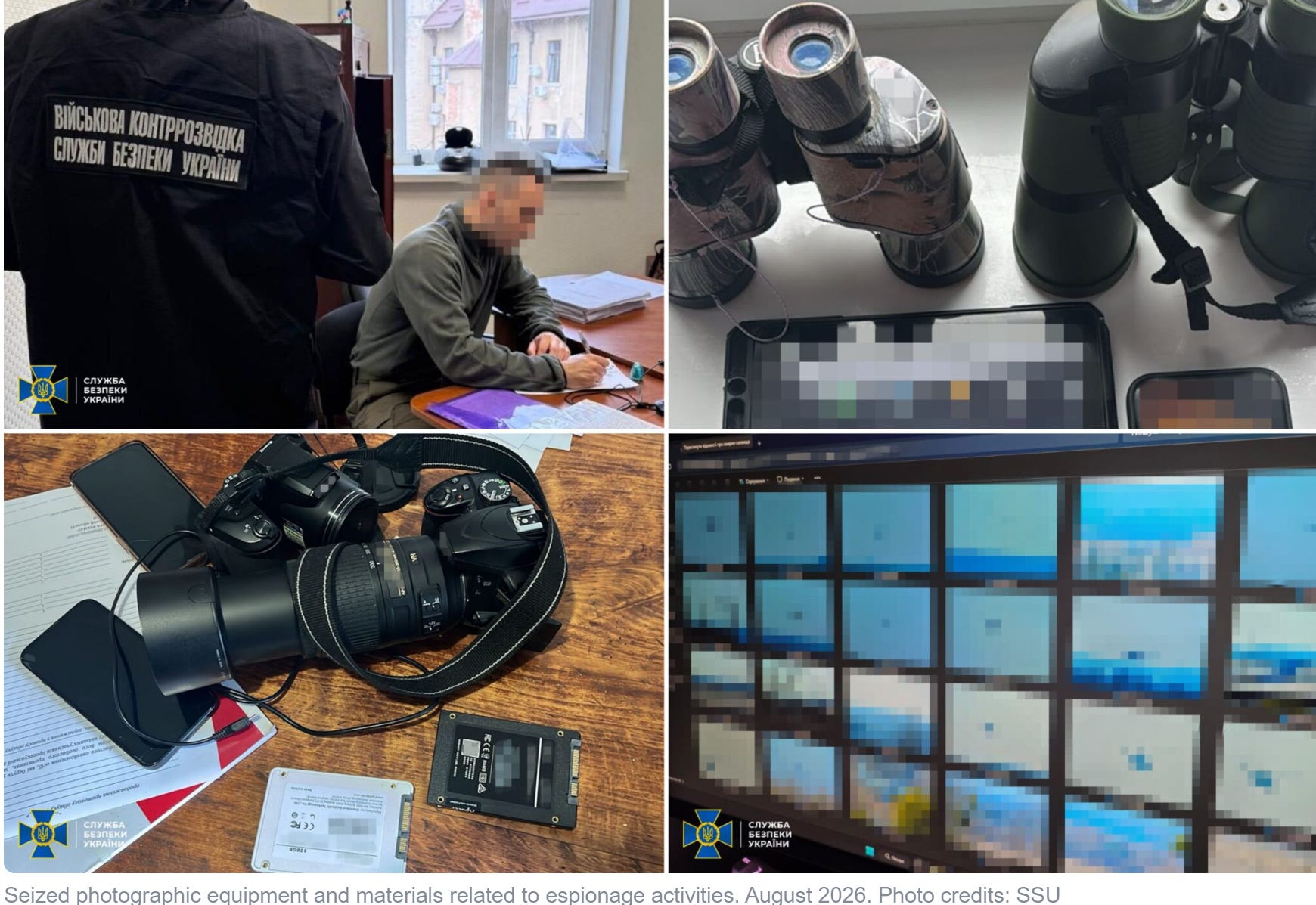
The SSU’s military counterintelligence unit exposed a Russian military intelligence network that was gathering data on aviation infrastructure and F-16 and Mirage 2000 fighter jets Militarnyi reports citing a release on the website of the Security Service of Ukraine.
The network consisted of 14 individuals from various regions of Ukraine. Initially, Russian intelligence recruited a resident of Lviv who administered a Telegram channel about aviation and posted photographs of Ukrainian combat aircraft in pro-Kremlin chat rooms.
To carry out the missions, he enlisted 13 of his subscribers who had high-quality photography equipment and lived near the Defense Forces’ aviation infrastructure.
They photographed Ukrainian airfields, military aircraft, their crews, and technical personnel, and also recorded takeoff and landing times.
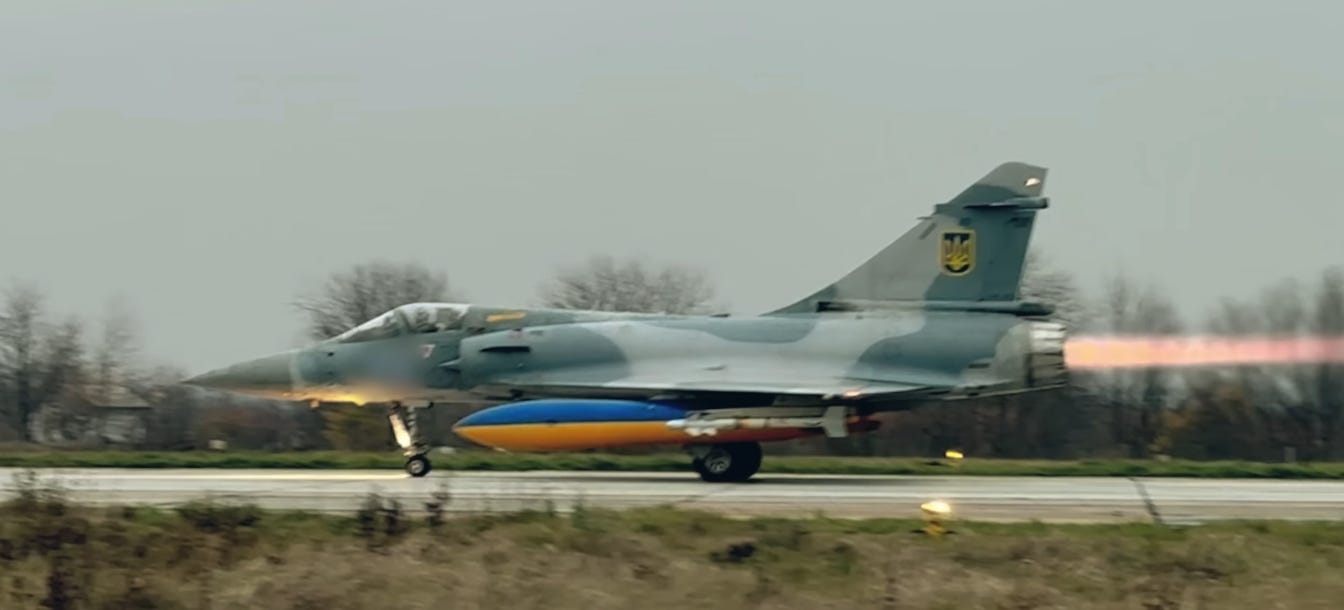
To do this, they used professional cameras, hiding in abandoned buildings or in open areas near air bases.
The photographic materials were stored in an online repository, access to which was provided by a resident of Lviv. From there, he forwarded them to his handler in Russia, whose identity the SSU has already established.
In addition, the agent ‘leaked’ flight schedules for combat helicopters to the Russians. This information was provided to him by a commander of a Ukrainian Armed Forces aviation squadron, who acted on his own initiative.
During searches of the suspects’ premises, authorities seized smartphones and digital photography equipment containing evidence of activities on behalf of the enemy, as well as photographs of Defense Forces aviation facilities.
The SSU also blocked four Telegram channels and 10 thematic groups where photographs and other data about the Ukrainian Armed Forces’ aviation units were being disseminated.
Currently, the detained agent, his accomplice, and a military servicemember have been notified that they are suspected of committing crimes against the foundations of national security.
In late July, the SSU reported the detention of FSB agents who attempted to eliminate several dozen Ukrainian servicemembers by organizing a ‘charity’ party for them.
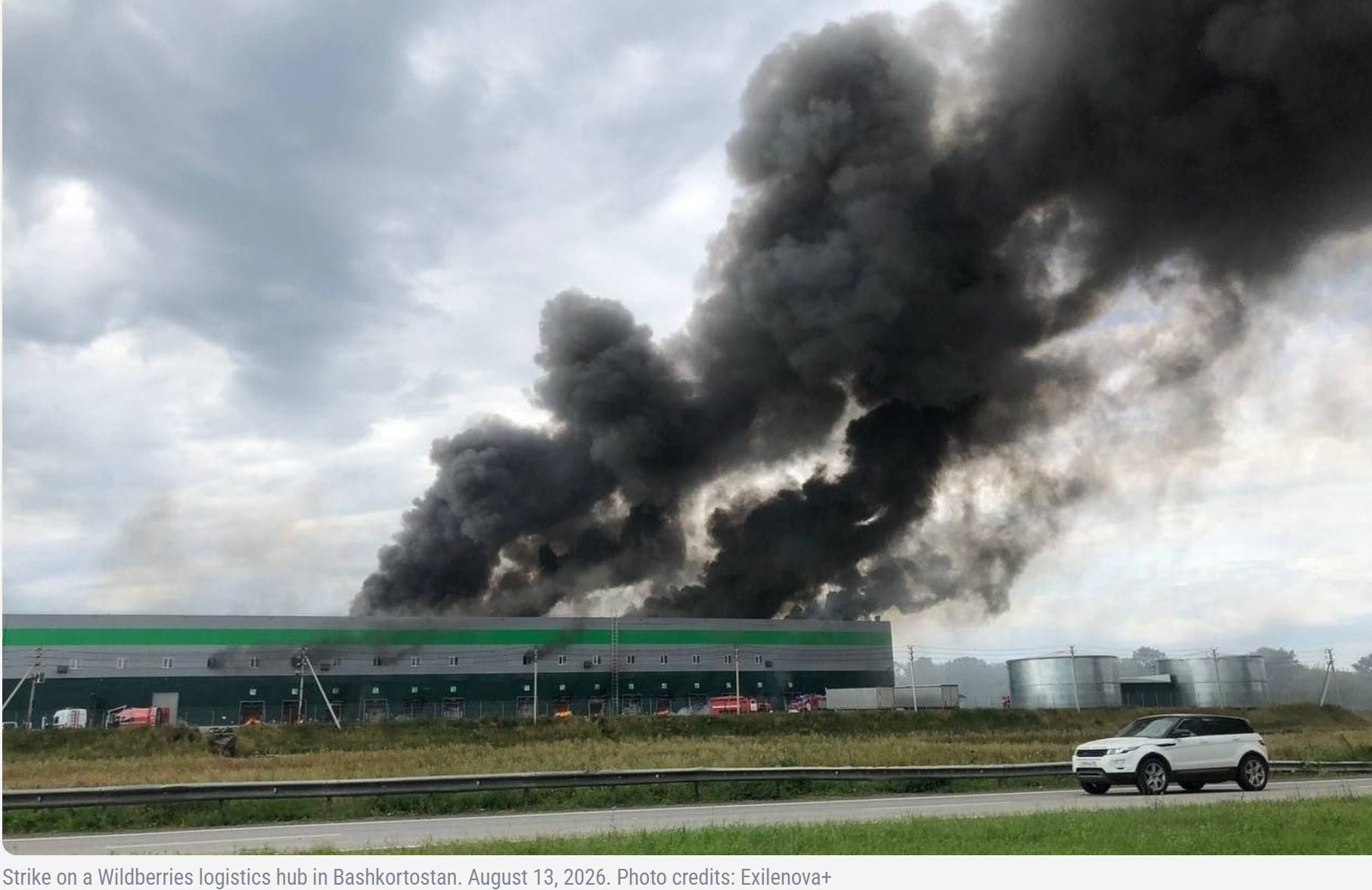
On the morning of August 13, the Ukrainian Defense Forces launched a drone strike on a Russian e-commerce platform Wildberries logistics hub in Bashkortostan Militarnyi reported on Aug 13.
Following the strike, a fire broke out at the site. Footage of the incident was published by monitoring outlets, including Exilenova+.
Militarnyi’s OSINT analysis confirmed the strike on the company’s logistics facility located within the Center for Agrotechnologies agropark in the Chishminsky district of the region.
Wildberries later confirmed the attack on a logistics hub in Bashkortostan.
“An airstrike in Bashkortostan caused a fire in an industrial zone where one of the company’s facilities is located. Fire crews are on the scene…,” the press service stated.
Construction of the logistics center attacked today began in 2024. The facility has a total area of about 186,800 square meters and is divided into two buildings measuring 123,300 and 63,500 square meters, respectively.
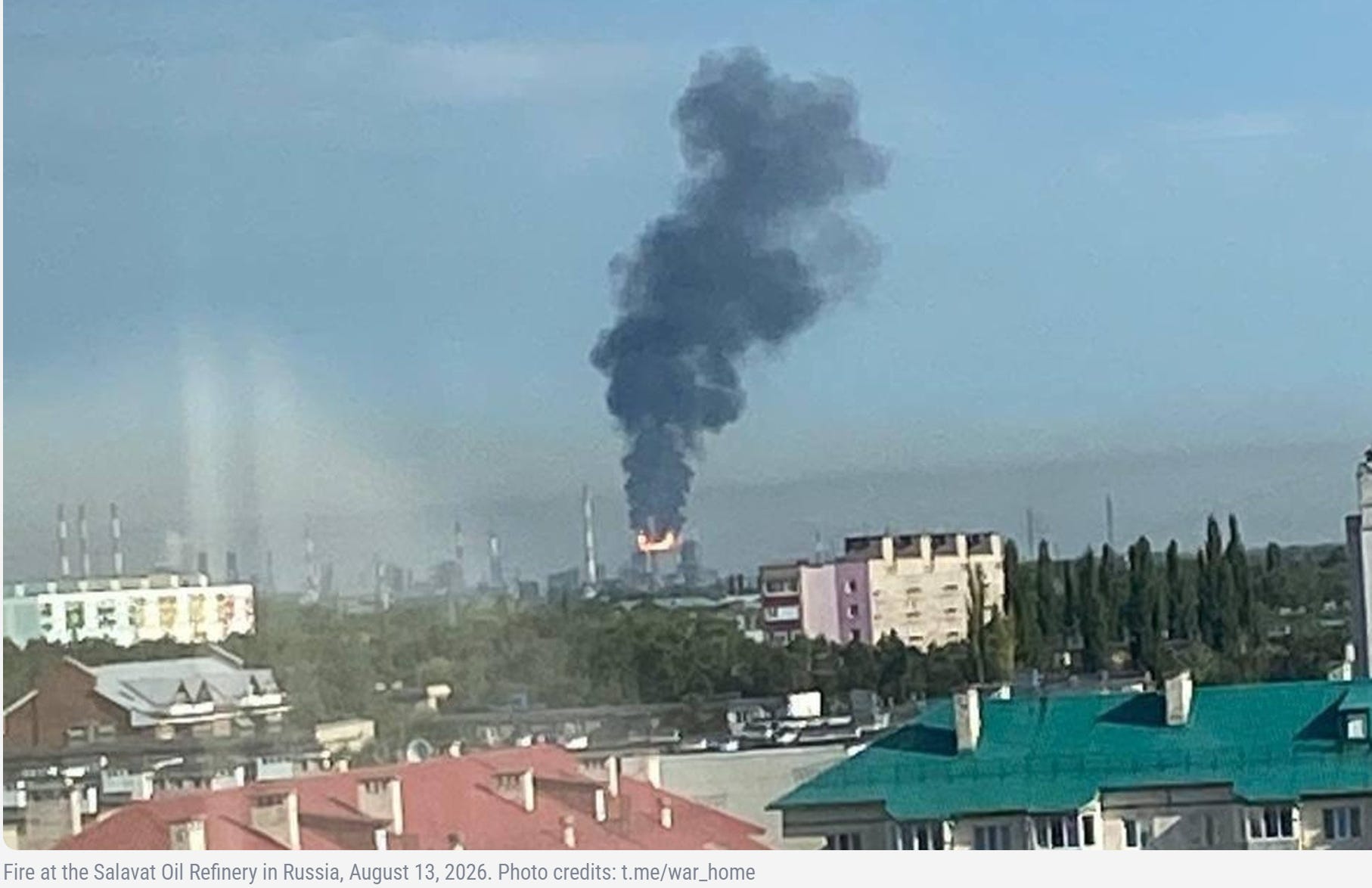
On the same morning Ukrainian UAVs struck the Salavat Oil Refinery in Bashkortostan, Russia.
A fire has broken out on the enterprises’ premises. Footage from the site was posted by news outlets, including Exilenova+.
Militarnyi’s OSINT analysis confirmed that the Gazprom Neftekhim Salavat facility, located 1,400 kilometers from the Ukrainian border, had been hit.
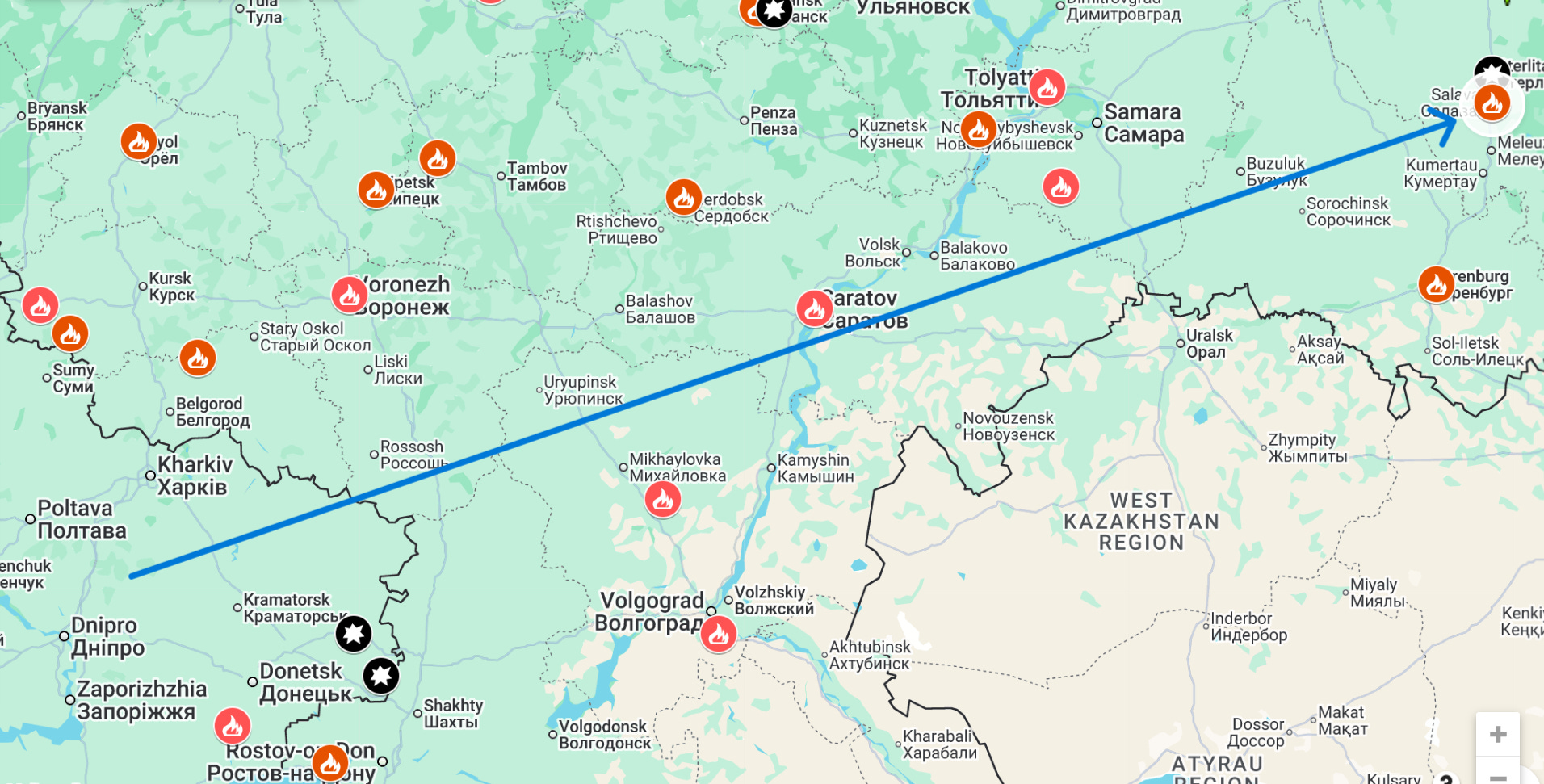
A drone alert was announced in Bashkortostan prior to the strike. Footage from the scene shows that the Ukrainian Defense Forces used Liutyi drones for the strike.
Later, the region’s governor, Radiy Khabirov, confirmed the UAV attack and stated that ‘debris’ from one of them had fallen in the Salavat industrial zone, causing a fire.
Gazprom Neftekhim Salavat is one of Russia’s largest oil refining and petrochemical production complexes.
The refinery specializes in the production of gasoline, diesel fuel, jet fuel, bitumen, lubricants, polyethylene, ammonia, methanol, and other petrochemical products.
The enterprises’ design capacity is 10 million tons per year, and its actual processing volume for 2022 was 6.8 million tons. The company’s structure includes an oil refinery, a gas chemical plant, and the Monomer factory.
Two senior Democratic U.S. senators on Wednesday pressed Trump administration officials on why they have paused imposing fresh sanctions on companies, banks and other entities that help Russia evade existing restrictions over its invasion of Ukraine, even though peace talks have not proved fruitful, Reuters reports.
Senators Elizabeth Warren, the top Democrat on the Senate Banking Committee, and Christopher Coons wrote the letter to Secretary of State Marco Rubio and Treasury Secretary Scott Bessent. The senators say the administration has paused regular, targeted counter-evasion sanctions on Russia for 17 months.
The U.S. last imposed major sanctions on Russia in October 2025, when the Treasury targeted oil companies Rosneft and Lukoil. The senators believe those sanctions were a one-off and that Russia easily evades them.
Contacted for comment by Reuters, a Treasury Department spokesperson pointed to the sanctions on Russian oil companies and said the Trump administration will continue to act in the interest of U.S. national security and a peaceful resolution to the war in Ukraine. A State Department spokesperson said the department does not preview potential sanctions actions.
The senators’ letter cites Bessent telling Congress in February that the administration wanted to “see where the peace talks go” before resuming some counter-evasion sanctions even as the administration imposed sanctions on Iran and Cuba during talks with those countries.
The letter also cites Rubio saying in May that peace talks between Russia and Ukraine were not fruitful and there were no such talks occurring at the time.
The letter says there were 111 sets of sanctions on Russia following the February 2022 invasion until January 2025, the month President Donald Trump took office for a second time.
Senators ask the officials to respond by August 28 to this question: “If the administration paused regular Russia sanctions because of peace talks, and those talks stalled months ago, why hasn’t the Administration resumed routine and frequent U.S. sanctions to rebuild leverage for a just peace in Ukraine?”
Senate passed new sanctions legislation on Russia this month, but its future is uncertain as Democrats and some Republicans are concerned it could allow Trump new powers to impose tariffs on goods from U.S. allies including Japan and some countries in Europe.

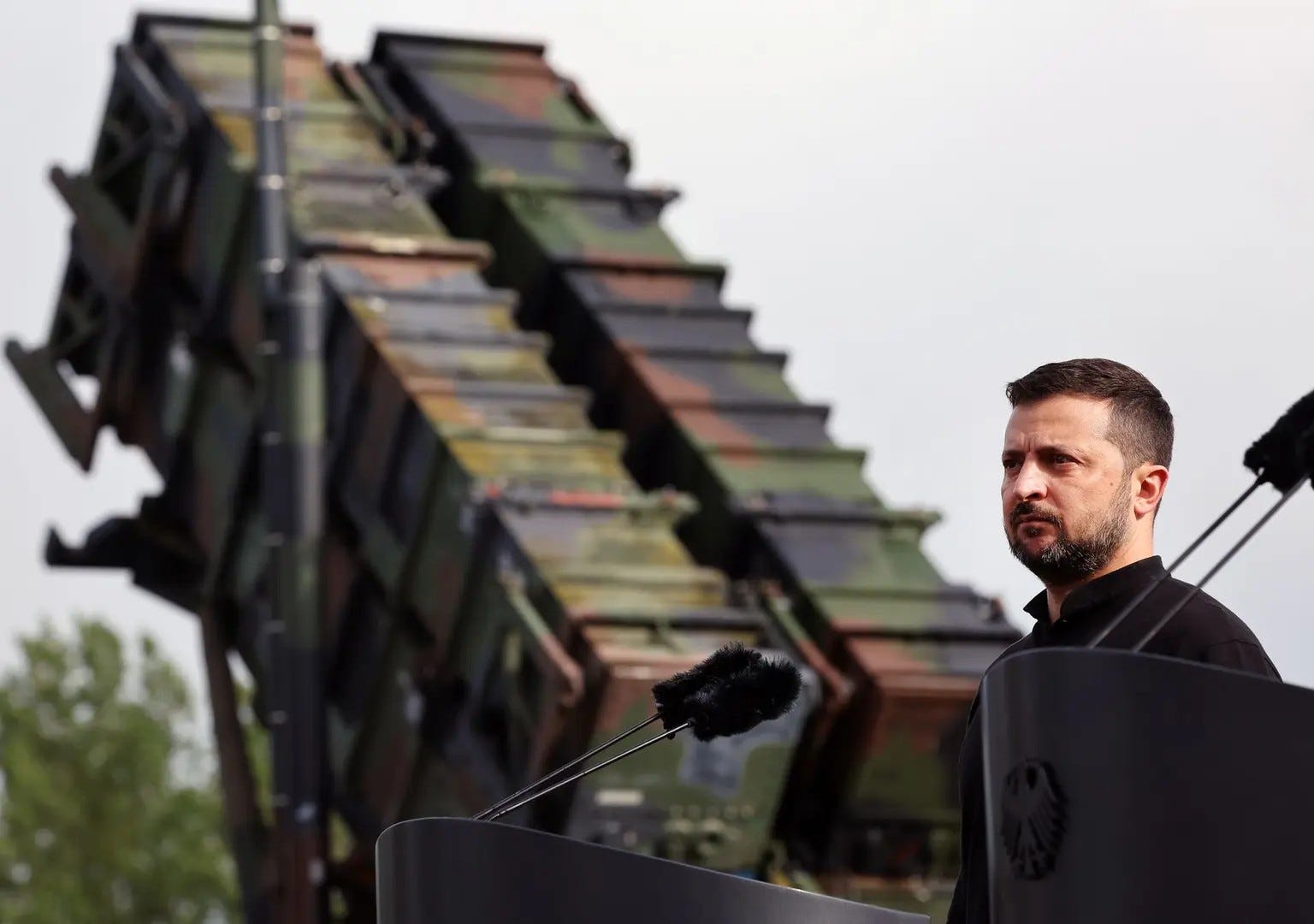
President Volodymyr Zelenskyy claimed on Aug. 12 that Ukraine could destroy all Russian ballistic missiles if the United States were to sell Kyiv 10% of its Patriot interceptor missile stockpile.
“This year I’m asking American partners to sell me 5% of missiles, what they have in their stocks,” said Zelenskyy in an interview with CNN. “If they sell us 5% we will go through the winter and save people’s lives. If they can sell us 10%, we will destroy all the Russians’ ballistic missiles,” the president added.
The appeal for more interceptor missiles from Zelenskyy comes amid a severe shortage of air defense supplies for Ukraine. In July, Ukraine intercepted only 29 of the 195 ballistic missiles Russia launched at the country, making it the deadliest month for civilians since the full-scale invasion began in 2022, according to the UN.
“I have 1%,” said Zelenskyy, referring to current Ukrainian acquisition of U.S. interceptor missiles.
Ukraine has asked the White House to increase the sales of air defense missiles as Russian strikes pummel civilian and energy infrastructure, leading to confrontation, walk-backs, and pleading with the Trump administration.
The U.S. itself has a reported shortage of missiles as the Iran war has depleted stockpiles. U.S. President Donald Trump said on Aug. 6 that the United States “needs missiles too.”
While Kyiv has been working to cut a deal with Washington allowing for the co-production of Patriot interceptor missiles, U.S. Ambassador to NATO Matthew Whitaker said that would be unlikely to come to fruition before the winter.
At the same time, Russian ballistic missiles stockpiles remain high, Zelenskyy said.
“Russia has two times more ballistic missiles per month than they had before,” Zelenskyy said, referring to Russian missile supplies in 2025.
Ukrainian intelligence reports claim that Russia’s monthly production of key missiles is running 10–20% above target, while the output of some models is even higher.
Given the challenges of obtaining more missiles, Ukraine is currently working to produce its own ballistic and anti-ballistic missile system, with the weapons set to be combat-ready as soon as this fall.
Speaking with CNN, Zelenskyy opened up about his daily deal-making negotiations with allies to secure more missiles. “With everybody, I try to exchange something (for) missiles,” said Zelenskyy.
Two Belarusian cousins were convicted on Aug. 12 by a Vienna court for supplying manufacturing equipment to Russia’s weapons industry in violation of EU sanctions.
The duo were convicted for using an Austria-based business and a network of shell companies to transport metalworking machines and tools into Belarus through third countries, including Turkey, Kyrgyzstan, South Korea, and Poland.
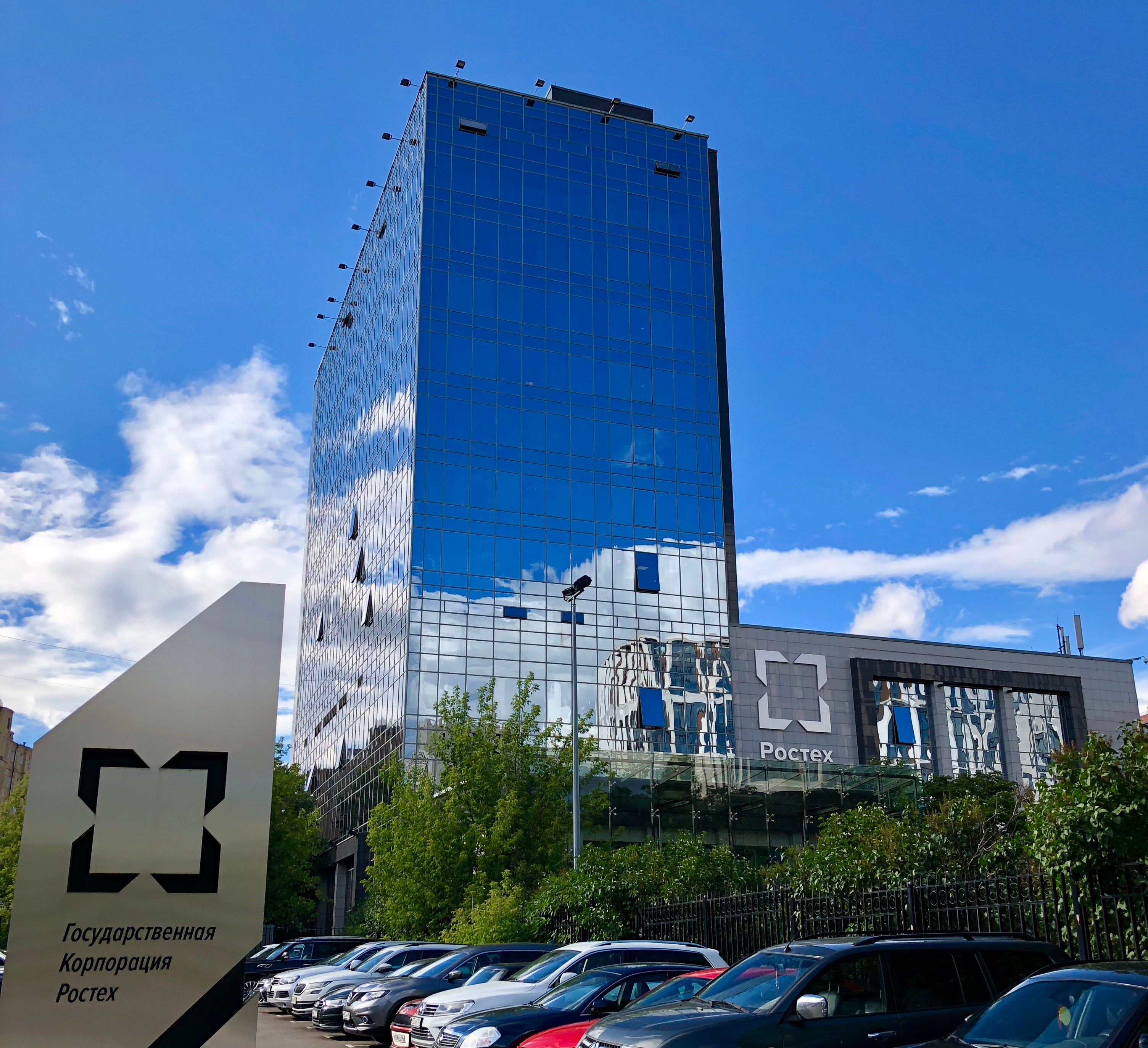
The smuggled equipment was used to manufacture engines for missiles and fighter jets, the Austrian government said. The smuggled equipment was destined for companies affiliated with the Russian state-owned conglomerate Rostec, according to Austria’s Interior Ministry.
Rostec is subject to international sanctions and accounts for half of Russia’s military production, the company claims.
Some of the weapons systems Rostec is behind include the Pantsir air defense system, the Kh-101 cruise missile, and the Iskander ballistic missile used in recurring fatal strikes against Ukrainian civilians.
The pair plead guilty in front of the Vienna Regional Court.
“This case demonstrates the lengths to which international networks go to circumvent existing sanctions,” said Austria’s intelligence service Director Sylvia Mayer in a press release.
The main defendant, a 28-year-old man and mechanical engineering student from Minsk whose name was not disclosed, was the director of the Vienna-based firm at the center of the investigation. The man was arrested in Austria on May 13, and property worth 140,000 euros (approximately $161,000) was seized by Austrian authorities.
The man alleges that his father and uncle orchestrated the scheme, which operated since 2022, and both worked for an unspecified Russian company, according to Reuters. The other defendant, the man’s cousin, was a 24-year old woman who served as an accountant for the business.
The man was sentenced by the Austrian court to serve 21-month in prison, of which 19 months were suspended. He was released, having already served the remainder of his sentence in pretrial detention. The woman was given a 15-month suspended sentence. Both declined to appeal the ruling.
In May, Austria expelled 3 Russian embassy staff members over suspected signals espionage.
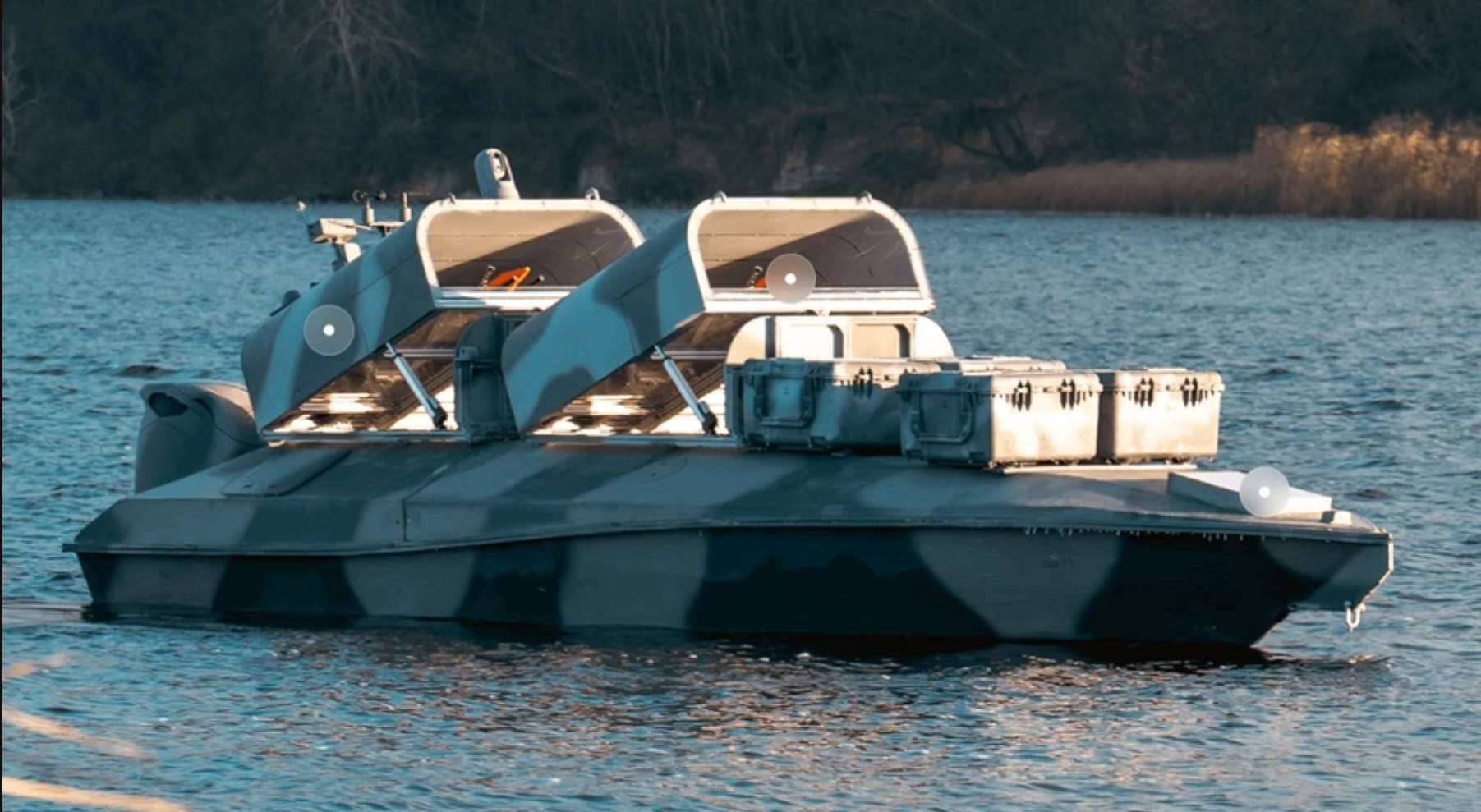
Ukrainian companies MAC HUB and Sky Defenders have signed a memorandum of cooperation, which provides for the integration of Sky Defenders drones into the Katran family of maritime drones. MAC HUB told “Defense” about this, Mezha Defense reports.
The company plans to integrate Sky Defenders UAVs into Katran maritime drones in the near future. However, the company has not yet specified which drone models will be used.
Sky Defenders specializes in the development of combat unmanned systems. MAC HUB told that the company has created three models of UAVs for offensive and defensive missions, which have been used in combat conditions for almost two years. Sky Defenders also has active contracts with the Ministry of Defense of Ukraine.
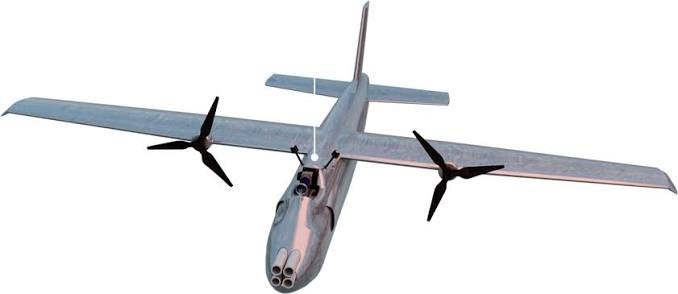
Among the company’s developments is the Zigzag-S medium-range aircraft-type tactical strike UAV.
The Zigzag-S is catapulted and intended for single combat use. Its claimed range is over 150 km, speed is up to 250 km/h, and warhead weight is from 3 to 5 kg.
In addition, Sky Defenders, together with LAB254, is working on integrating a machine learning module for predicting target trajectory and the AI-autolock automatic target acquisition function into its drones.
MAC HUB noted that they are developing their own solutions for use on land, in the air, and on water, but believe that development in a closed system has limitations. Therefore, the company cooperates with Ukrainian and foreign partners.
According to MAC HUB, specialists with combat experience are involved in working on the company’s projects. MAC HUB projects are supervised by a special agent with the call sign “Devyatyi”, commander of the Black Sea Legion naval unit of the Military Directorate of the Ministry of Defense of Ukraine, on the part of the end users - the Ukrainian military.
“We already have clear goals, now we will reach the enemy at a distance of two thousand kilometers. The plans include strikes on the coastal guard, the destruction of Russian radar systems, their air defense systems, command personnel, and critical infrastructure,” said “Devyatyi.”
He added that this generally refers to enemy targets located near water. The companies plan to announce other details of the cooperation between MAC HUB and Sky Defenders later.
The Katran family of naval drones has a claimed range of over 1,500 km. Depending on the configuration, they can be equipped with MAC Thunder FPV strike drones, MAC Dead Fly FPV drones and interceptors.
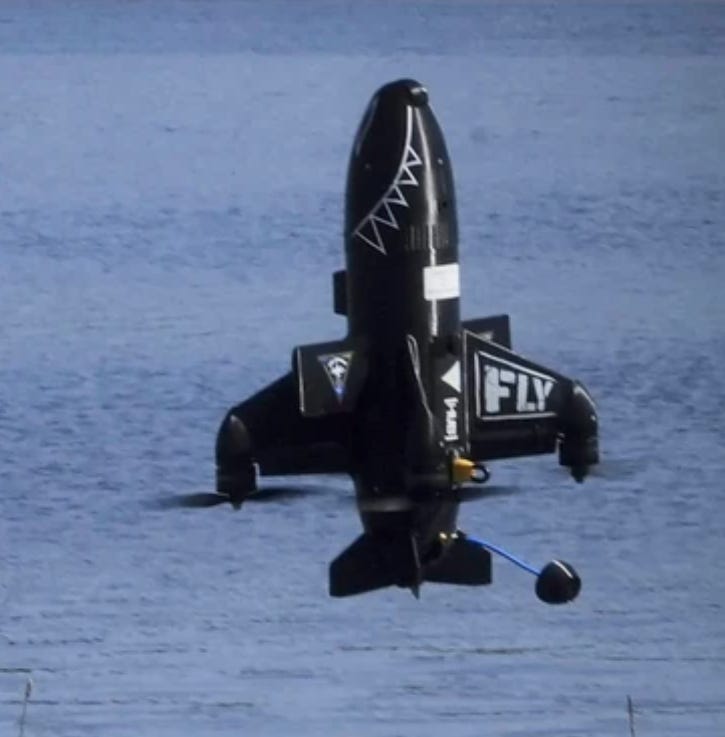
The Katran X3 strike version can carry a 300 kg warhead. Other claimed capabilities of the family include a single control center, an artificial intelligence system, a 360° all-round camera, and an acoustic air target detection system.
Earlier, the Katran X1.2 naval drone with 27 MAC Dead Fly interceptor drones was demonstrated during tests on the Dnipro. It was noted that the “Black Sea Legion” had previously officially confirmed attacks on Russian oil and gas platforms in the Black Sea, and the Katran X1.2 was already used during operations last fall.
That’s it for today’s Brief folks if you would like to keep up with events in Ukraine daily please consider subscribing, it’s free!
Comments
Nothing yet. Say the first thing.
Sign in to join the conversation.