
It’s not like they’ve been subtle about it. But you’re forgiven if you missed the signs.
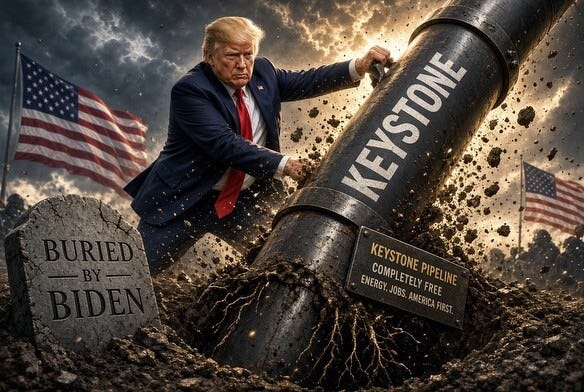
Tuesday’s late-night posts from Donald Trump announced a three-day hold on new tariffs and referred to the “great Keystone XL Pipeline, long ago killed by Sleepy Joe Biden,” being “awoken from the grave!”
This sure sounded like a plot twist. But with the benefit of hindsight, it’s only the latest step in a long and highly public attempt by Carney government officials to expand elements of Canada-US trade, even as they seek new markets and new partnerships elsewhere.
The apparent goal is to turn “either/or” into “both/and”: to treat the maintenance of the North American market and the search for new markets abroad as complementary, not antagonistic.
Inevitably this summer a lot of Canadians’ attention has been on the trade talks in Washington. But much of the action has been elsewhere, and it started earlier.
In March, Tim Hodgson, Carney’s energy minister, went to the giant CERAWeek energy conference in Houston, TX. He met with Trump’s energy secretary, Chris Wright, and interior secretary Doug Burgum. (Burgum’s undergraduate studies were at North Dakota State University, where the legal drinking age was 21. Hodgson’s, a few years later, were at the University of Manitoba, three hours north, where the legal drinking age was 18. The two bonded over Burgum’s memories of cross-border beer runs.) The Reuters headline out of Hodgson’s March trip was pretty clear: “Canada discusses Keystone XL revival with Trump administration officials.”
Like all references to “Keystone” in this story, this one was close enough. The reference is actually to a new project by Calgary’s South Bow, which spun off the oil pipeline parts of TC Energy’s business five weeks before Trump was re-elected in 2024, and Bridger Pipeline of Casper, Wyoming. The project, promoted entirely by private companies, would ship half a million barrels of oil per day from near Hardisty, AB to Montana and on to Wyoming and Oklahoma.
Oil industry watchers view the project — dubbed Prairie Connector on the Canadian side, Bridger Expansion in the US — as one of several that are cheaper and likelier outlets for Canadian oil than Carney and Smith’s most prominent pet project, the West Coast pipeline that so far has no private proponent. But practical doesn’t mean negligible: by itself Prairie Connector/ Bridger Expansion would increase total Canadian oil exports to the US by 12%.
On the Canadian side the project would actually use pipe laid by Keystone for the XL project before Joe Biden cancelled the project in 2021. Awoken from the grave, if you will.
Trump signed the authorization order for US construction at the end of April. Danielle Smith was thrilled.
Hodgson’s language at the Houston meeting was striking. As is so often the case, short quotes don’t really convey the tone. In an interview there with Politico’s Debra Kahn, Hodgson said:
“The U.S. wants to achieve energy dominance. We support you in that view.
“Today, the U.S. produces 12 to 13 million barrels per day, the largest producer of oil in the world. You consume 20. Like, be clear: You produce 12 to 13, you consume 20. Sixty-three per cent of that difference comes from Canada.
“We want to help you achieve energy dominance. We have some of the largest reserves in the world that we can help you achieve that energy dominance. The U.S. today exports 20 BCF [billion cubic feet] of gas to the world. One of the reasons you can do that is you import 8 billion cubic feet a day from Canada. We have the ability to dramatically increase that. As you look at the AI race that we’re in — and let’s just put some some numbers on this. The U.S. did an incredible job last year. It added 50 gigawatts of new capacity. Okay, China added 450. 50 versus 450.
“We will win this race. We will only win it with natural gas, and if you look at large parts of the country in the United States, you get your gas from Canada. If you look at the Pacific Northwest, 90% of the gas that that fuels the Pacific comes from Canada. If you look at the Midwest around Chicago, 40% of the gas comes from Canada. If you look at Northern California, 40 plus percent of the gas comes from Canada. We have the ability to send more. That helps you with your energy dominance. That helps you win the race for AI dominance. We’re good with that.”
That’s four references to Canada helping the US achieve energy dominance in two minutes.
Under further questioning, Hodgson explicitly tied the Bridger Expansion to the renewal of CUSMA. “we believe the logical thing to do is have Fortress North America,” he said. (In trade circles, the distinction between “Fortress America” and “Fortress North America” is eternally significant.) “We started this journey back in 1960s with the Auto Pact. Where we are today is with the USMCA. … We believe that if we continue to have free trade, that benefits both of us.”
Sometimes a good interviewer simply helps a subject repeat himself. Kahn asked: What did Hodgson talk to Burgum and Wright about? “We were talking about how we could help the United States achieve energy dominance.” Great, thanks for clearing that up.
By selling more energy? “Whether it’s oil, whether it’s natural gas, whether it’s uranium — you’ve got a huge nuclear build going on, a zero-carbon solution. You need uranium to do that. Canada is the biggest supplier of really the highest-quality uranium in the world. Whether it’s affordability — you get 70% of your potash from Canada. It fertilizes every farm across the country. When you look at defense, the biggest critical mineral, the biggest supply issue is aluminum. We have the aluminum. We can send you the aluminum. We have the gallium. We have the germanium. We have the scandium. We want to be good partners.”
The discourse around the Canada-US relationship under Trump and Carney has become so encrusted with panicky cliché — peddled by both the Liberals’ detractors and their most cartoonish cheerleaders — that it’s hard to concentrate on what’s actually going on. Where are Carney’s elbows? At what precise angle? Is he making concessions? Has he signed a deal? Is Team Canada holding steady? Who’s a traitor? IS THE SIGN IN THE WINDOW?
A day after Carney’s Davos speech, when the global progressive left was still trying to peel itself off the ceiling, I wrote: “There will still be days when Carney’s awfully accommodating toward Trump.” Easiest prediction ever. But those accommodating days still come as surprises.
In May Carney addressed the Global Progress Action Summit in Toronto, addressing opposition politicians from several Western countries, a crowd so full of ambitious outsiders (Hi, Pete Buttigieg!) I made worried noises in my post about the event.
Carney opened with hilariously off-the-rack Great Leap Forward rhetoric: “Our response, at this time, must be to resist any temptation to preserve or restore elements of the past. We prefer to build anew.” But then, having zigged Davos-wards, he energetically zagged:
Canada, “like Mexico, remain[s] open to deeper integration, including options for fortress North America in selected sectors,” Carney said. “And to be clear, those offers are on the table. But if that route is not ultimately possible, we will invest heavily in new markets and products.”
These remarks came 12 days after Trump signed the Bridger Expansion authorization. Talking in the same speech about resisting “any temptation to preserve or restore elements of the past” and about pushing new oil through abandoned Keystone XL pipeline capacity is a stretch that probably qualifies as too cute by half. But again, now that the significance of the Bridger Expansion is clear, the thread of intent becomes easier to spot.
Seventeen days after that Toronto speech, Carney was at the Economic Club of New York with an even more striking turn of phrase. “Canada Strong will help make America Great Again,” he said. Everyone noticed that. Here’s what he said next: “The examples are legion where we should work together and compete with the world together. To those ends, we have made specific, practical proposals to the U.S. Administration.” Now we’re learning what some of those proposals were.
In Washington last week, Janice Charette, Carney’s lead negotiator on the Canada-US talks, was reported to have warned that Trump’s threatened new tariffs would constitute a “cliff” that would end trade negotiations between the two countries. One conceivable answer to that bad-cop routine would be “So what?” This answer has already occurred, many times, to Trump. Getting Americans to view Canada as a source for anything useful can be a struggle. Charette in Washington, Hodgson in Houston and Carney in St. John’s start to look like elements of the same pitch: Canada matters in the world and it will matter more. It can matter to the United States or to other countries. Surely it will do both, but the proportions of that mix should interest a US administration that believes itself to be pragmatic.
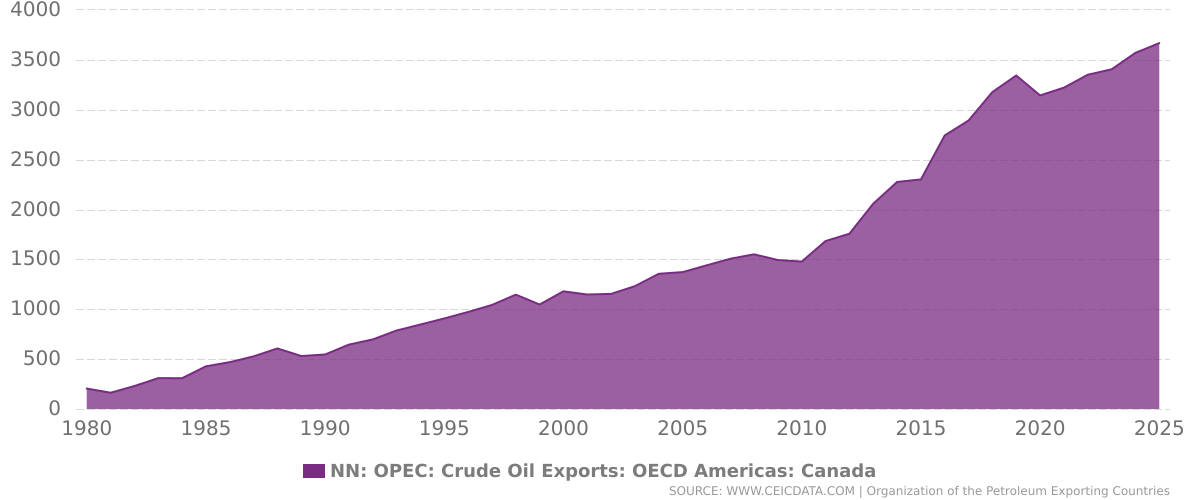
A word on continuity. In Canada over many years, we have debated the meaning of Canadian oil endlessly and then sold it, mostly to the Americans, in almost constantly increasing amounts. Under Mulroney, Chrétien, Harper and Trudeau, the dollar value of Canadian oil exports, overwhelmingly to the US, increased in almost every year:
In 2001 I watched the Chrétien government, which had only ever dealt with President Bill Clinton, get acquainted with the very different new administration of George W. Bush. I wrote a cover story about that effort for Saturday Night magazine, which appeared three months before 9/11 changed everything. What the Chrétien crew had noticed was that Dick Cheney had clout in that administration; that the conclusion of his post-inauguration energy task force was “Make more energy;” and that Canada could help. The fanciful cover illustration for my Chrétien-Bush story depicted Chrétien as a gas-station attendant filling the tank of Bush’s car. “Anything else, Mr. Bush?” Chrétien says cheerfully. I don’t recall where Chrétien’s elbows were in the illustration.
No posts
Comments
Nothing yet. Say the first thing.
Sign in to join the conversation.