
It’s been a week of waiting, but it began with Prime Minister Mark Carney, Quebec premier Christine Fréchette, and Newfoundland and Labrador premier Tony Wakeham at Pier 17 in St. John’s, announcing that the precarious Quebec-Newfoundland agreement on new Churchill Falls development had ballooned into an immense tripartite plan for power and infrastructure development across the region over the next 50 years. Carney said that whatever came out of Washington, the Churchill Falls deal was bigger news. The plan is so big it’ll surely morph a thousand times, but in the first days it drew rave reviews from observers ranging from a National Post columnist to a climate NGO.
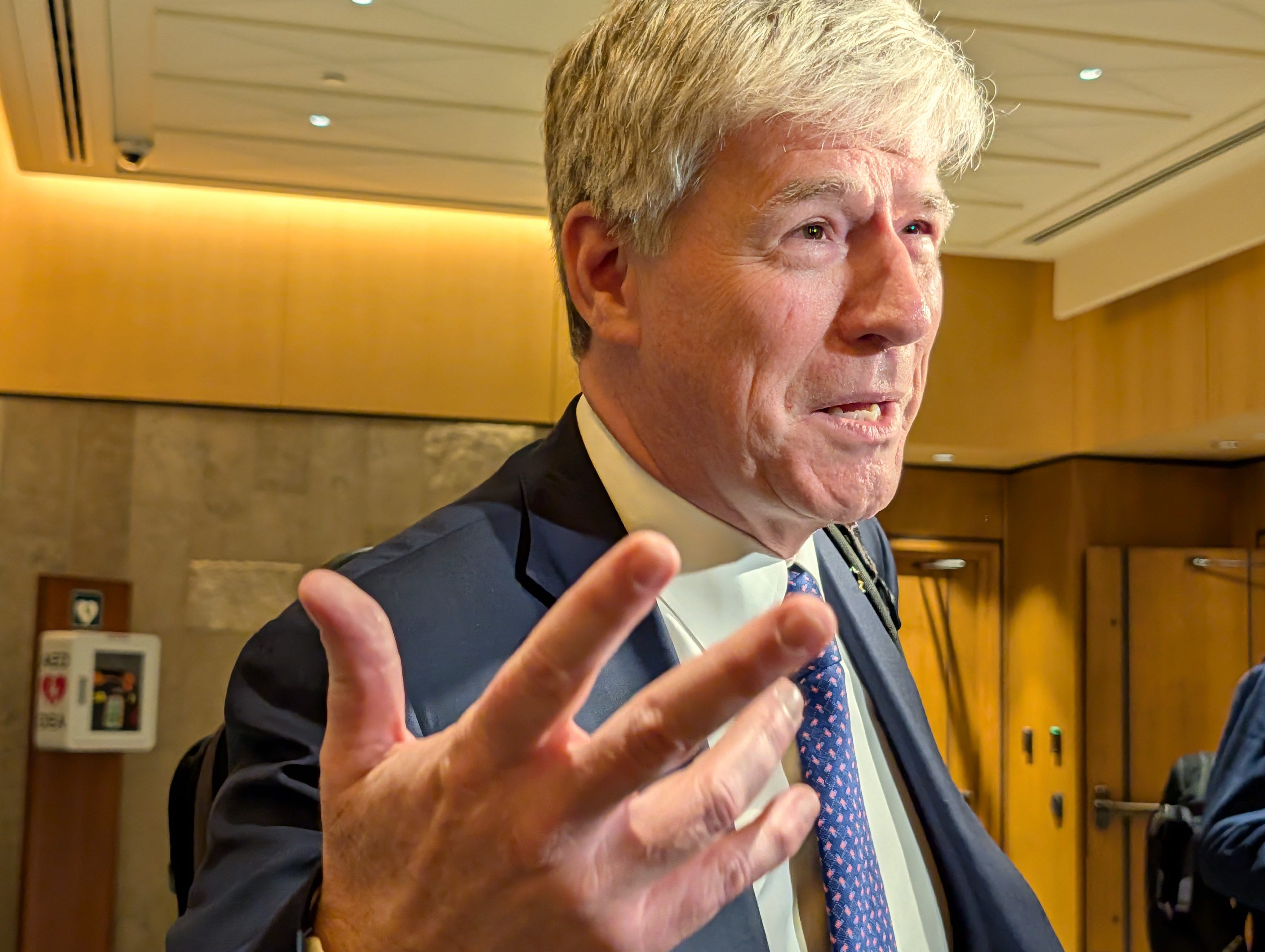
Tim Hodgson, Carney’s minister of energy and natural resources, was at St. John’s too. This interview constitutes our first long conversation, but if I were running a five-reporter Ottawa bureau I’d have one of those reporters following Hodgson full-time. As I mentioned the last time I wrote about him, the Winnipeg-born army brat and reserve officer — Manitoba, UWO, PwC, Goldman, Bank of Canada, Hydro One — is central to Carney’s biggest plans. With the Washington trade talks still up in air, I asked Hodgson to talk about all this other stuff. The transcript of our interview has been edited for length and clarity.
Paul Wells: The Prime Minister said the biggest news this week is the Churchill Falls announcement. But meanwhile, there’s this avalanche of other news out of Washington. Why on earth would Churchill Falls be a bigger deal than the suspense over tariffs this week?
Tim Hodgson: You know, the Prime Minister has a number of things that he says that people think are throwaways, but they’re not throwaways. They’re actually deeply important thoughts. He has said over and over again, “We can give ourselves more than any other country can take away from us.” “We can be masters of our own house.” He said it in both French and English. He talked about how we can make the weather. The world is, as he says over and over, a more volatile and dangerous place.
In his speech in Davos, he talked about the two hegemons battling it out, but it’s not the U.S. against us. It’s the U.S. trying to deal with the Thucydidean Trap. They are a dominant superpower dealing with a rising superpower. And they are choosing to reorient how they show up in the world. We cannot control that, but we can control what we do. And what [Prime Minister Carney] announced this week is the biggest single investment in Canadian history. He announced the biggest single clean energy project in the history of North America. Those two things will stand the test of time. Those two things are fundamental to how we show up in the world.
I’ll be a little bit careful with what I say. Pronouncements about trade deals with the United States tend to evolve every 24 hours, every Twitter cycle. And so, I think what the Prime Minister is saying is, Hey, that was today’s announcement coming from the White House. It was a little bit premature, we haven’t actually inked a deal yet. We’re still working on it. But what we did in St. John’s is show Canadians and show the world we can be masters of our own house.
PW: How did it get so big? I’m old enough to remember the 2024 Memorandum of Understanding, which was a bilateral agreement between the governments of Quebec and Newfoundland and Labrador. I went back and checked, and there was no provision for substantial federal involvement in that. Obviously, the new premier, Wakeham, was not satisfied with that. Why — and also, concretely, how — did it become a trilateral agreement with a larger geographic theater of operations, a larger array of policy areas, and a much larger federal involvement?
Hodgson: If you think back to late winter, early spring, we were working hard on our electricity Green Paper around our vision for doubling the grid. Dealing with the world as it is, not as we wish it to be, electricity demand was going to double. We needed to think about how we were going to respond to that reality.
We were developing our Climate Competitiveness Strategy, about how we build our way to net zero, not prohibit our way to net zero. And while we were working on our plan, the single biggest clean energy project in North American history is sitting there dormant. How do we feel about that? And we said, that’s not the right place for that to be.
We reached out to the two parties, and said, “You two want to try and get something done but there seems to be a disagreement over how you split the pie. Instead of arguing about how you split the pie, you thought about how you could grow the pie so there was more to share, each of you could be winners.” Canada could be a winner, too, because we’re creating $70 billion of capital investment, 23,000 new jobs, a source of clean energy at a time where we need that, at a point in time where we want to demonstrate to Canadians that we will be both a clean and conventional energy superpower.
What we said is, “Why don’t you guys go think about how you grow the pie? And if you can get to a deal, let us know, and we’ll tell you how we’ll support you.” That’s what they did. They went away and thought about how to get more out of Churchill Falls, and how to get more out of Gull Island. What if we added one of the largest wind projects in North American history so that we could turn those hydroelectric dams into monstrous batteries with wind? What if we use this new electricity and put a new power line into Western Labrador so we could unlock four of the best iron ore mines in the world? The highest purity iron ore, which helps produce green steel. And what if we got those mines going, and we had to expand the ports, and expand the railways? Think about the positive impact on GDP.
We also said, if we find new power, that’s an opportunity to share more with First Nations. That’s an opportunity to create more own-source revenue for First Nations, so they are more excited about this project. We improve the lives of Indigenous Canadians.
There were so many positive things.
PW: Some people we’re worrying this week that all it’s going to take now is a dispute between two provincial premiers — Wab Kinew mad at Scott Moe, or something — and Carney and Hodgson are going to show up and turn on the money hose to try and put out that brush fire.
Hodgson: There’s nothing in this deal that we wouldn’t do for others. We have said in our electricity strategy that we are going to support interprovincial transmission and intra-provincial transmission. We actually announced in our electricity strategy, five priority interconnects. There weren’t any between Newfoundland and Quebec at the time, because they didn’t want to build them, but if the provinces want to build, we’d be supportive of them. This is us doing what makes sense. We would do this if this project were anywhere in Canada.
PW: To some extent, that’s the concern that I’m conveying. It seems these days that a lot of things make enough sense to be worth $10 billion of federal money — which in the end is taxpayers’ money.
Hodgson: If you put $10 billion towards unlocking $60 billion of private capital, which will unlock tens of billions of mining dollars, which — I think that the numbers that I saw, the revenues from those mines would generate over $200 billion over the life of those mines. They would generate $500 million $1 billion a year to the two governments in royalties and income taxes. Well, guess what? That’s money that we don’t have to provide. You can give somebody a fish, or you can teach them how to fish. I think that’s the old saying. If the $10 billion taught people how to be really good fishermen—or fisher-people—that’s a good thing.
PW: On the CBC the other day, you said that you’re just getting started. Is Churchill Falls the largest energy project that you’re envisioning? Or is there something else coming down the pike?
Hodgson: I usually respond to that by saying I don’t get in front of my boss. But I would say we are looking at several other things that could be of this scale or larger.
PW: Where?
Hodgson: I’m not going to get ahead of my boss.
PW: Is this Churchill Falls project all-or-nothing? I mean, there are so many components to it that surely something’s got to come up bust. If the iron mines in the Labrador Trough don’t pan out, does everything start to fall apart?
Hodgson: The Prime Minister said this, and I’ve said this: “Energy security is economic security is national security.” When we generate this electricity—and it’s very cost-effective electricity, I don’t know if you saw the Quebec deck, where they show this deal at 6 cents a kilowatt, which is less than half the next closest alternative.
I think we’re betting that if that electricity doesn’t get used to power mines, it’ll get used to power other industrial opportunities, or ways to help Canada be competitive in the world. Power at that price is an incredible resource, and I’m sure Canadians can figure out how to use it.
PW: When the President wrote on Truth Social about bringing Keystone back from the dead, I redid my homework on the evolution of that file—South Bow and Bridger— and that led me to your trip to Houston in the spring in which you were adamant that your goal is to help the Americans achieve energy dominance.
As a political matter—and I’m conscious of asking a rookie politician about his experience of politics—but is it hard to juggle a more intense bilateral relationship with the Americans while you’re seeking to diversify Canada’s energy exports to third parties?
Hodgson: I actually think it’s really simple. I’m new to this, but one of the things that I kept thinking about is how do I explain what’s happening to my constituents in Markham- Thornhill. How do I explain it to the average Canadian.
Almost every business in Markham-Thornhill is a small or medium-sized enterprise. And the analogy that I hit upon is this: You make widgets. You manufacture widgets, and you start selling your widgets into the marketplace, and you’re doing pretty well. You decide to open a factory to make more widgets. Actually, you used to maybe buy them from someone, so now you’re making your own widgets and you’re selling them.
And you get a phone call one day from Walmart. They say: “Do you know that you sell 85-90% of every widget you make to us? Congratulations! For the privilege of selling to Walmart, we have this thing called the Walmart Supplier Fee that you get to pay us for the privilege of selling 80-90% of your products to us.”
What do you do when you’re a small businessperson, and you’ve just leveraged your house and everything you own to build a factory, and you’ve got 500 workers there? You can’t say to Walmart, “Screw you. I’m not going to pay.” Because they say, “Well, we’ll cut off the order. Good luck paying your mortgage. And how about those workers that aren’t going to have a job anymore?”
What you do as a small business is you say: “I’m not sure I agree with that fee, but let’s keep talking about it.” Then you call Canadian Tire, and you say: “Hey, I’ve got some widgets to sell you. Would you like to buy some?”
And then you call Rona, and you say, “I’ve got some widgets to sell you.” And then you call Costco.
You keep doing it and you get to a place where when Walmart calls you back and says, “Actually, I’ve decided that the Walmart Supplier Fee isn’t 10% of what you sell me anymore, it’s 20%,” you say, “That’s okay, because I can’t sell you as much anymore. I’ve got all these new customers.”
And then Walmart says, “Actually, I need a little bit more.” And you say, “I’m sorry, I can’t, as long as you’re charging me that fee. I’ve got other people who I could sell to.”
That’s exactly what we’re doing. I’m happy to sell more to Walmart but it’s going to be on terms that work for me. And if I can find someone who doesn’t want to charge me the Walmart Supplier Fee, guess what? That’s good for me, and that’s good for Canada.
The 22 deals that the Prime Minister has inked, the reason he’s going around the world, the reason we’re focused on getting Germans to buy LNG, the reason the Indians want to come and buy LPG, the reason we’re getting people to buy our uranium, the reason we’re getting people to buy our potash, is that we don’t want to be in that position that I just described to you.
PW: Another concern that I sometimes hear around Ottawa is that it’s getting to the point where it’s actually easier to get the government’s attention if you are Hydro-Quebec, or NL Hydro, than if you are a small company that’s trying to make its way in distributive energy, solar panels on the roofs of individual houses, and so on. That it’s getting easier for big players — that have an attentive ear in your office and a pipeline to the Major Projects Office — but not particularly easy for individual entrepreneurs and small businesses. That it’s still bureaucracy and delay and timidity, instead of the magic carpet that some of the big companies are getting.
Hodgson: Well, I would disagree with that. When you look at the initiative that Minister MacKinnon and Minister LeBlanc were leading over the summer, it takes down approvals from five years plus, under the previous government. We brought it down to two years with the Build Canada Act. The new legislation would bring it down to one year. That’s for every project in Canada. The “one project, one review” initiative that we’ve developed where we have now signed those agreements with almost every province where we’ve said the federal government will step out of the way if there’s a provincial regulatory counterpart which is working.
That works for everyone. The initiative we used around taking down interprovincial trade barriers, where we’ve taken down every single federal trade barrier, and we’re in the process of redoubling the effort around provinces taking down barriers. That applies to everybody.
Maybe I could throw it back and say, the media is good at reporting on big, glossy projects but they’re not actually good at reporting on all the hard work down in the trenches that is being done to remove bureaucracy for everyone.
No posts
Comments
Nothing yet. Say the first thing.
Sign in to join the conversation.