
This question lies at the heart of one of the most important debates in modern cancer biology. It is no longer simply an academic discussion—it fundamentally influences how we think about cancer prevention and treatment.
For much of the past half-century, cancer has been viewed primarily as a genetic disease driven by the accumulation of mutations. More recently, however, increasing attention has focused on the possibility that metabolic dysfunction may precede and even promote many of these genetic alterations. Rather than being mutually exclusive, these two models are increasingly viewed as complementary components of a much larger biological process.
The Somatic Mutation Theory (SMT) has dominated cancer biology since the 1970s. According to this model, cancer begins when a normal cell acquires one or more “driver mutations” that confer a growth advantage.
The sequence is generally described as:
Driver mutation → Oncogenic signaling → Metabolic reprogramming → Tumor growth
Examples include:
KRAS mutations increase glucose uptake and stimulate glycolysis.
MYC induces GLUT1, hexokinase II, LDH-A, glutaminase, and ribosome biogenesis.
PI3K/AKT/mTOR stimulates glucose transport, protein synthesis, and cell growth.
EGFR activation enhances glycolysis through PI3K and MAPK signaling.
Wnt/β-catenin directly activates MYC transcription.
HIF-1α induces dozens of glycolytic enzymes under hypoxic conditions.
Within this framework, the Warburg effect is viewed as a downstream consequence of oncogenic mutations. In other words, mutations create the metabolic phenotype characteristic of cancer.
This model has undoubtedly been successful. It has led to targeted therapies against EGFR, BRAF, ALK, HER2, and numerous other oncogenic drivers. However, several observations have suggested that this explanation may be incomplete.
Nearly a century before oncogenes were discovered, Otto Warburg observed that cancer cells preferentially convert glucose to lactate even when oxygen is abundant—a phenomenon now known as aerobic glycolysis or the Warburg effect.
Warburg proposed that mitochondrial dysfunction was the initiating event in cancer, forcing cells to rely increasingly on glycolysis for energy production.
The proposed sequence becomes:
Mitochondrial dysfunction → Warburg effect → Genomic instability → Driver mutations → Cancer progression
Potential causes of early mitochondrial injury include:
chronic inflammation
oxidative stress
environmental toxins
smoking
radiation
chronic infections
obesity
insulin resistance
aging
hypoxia
alterations of the microbiome
Mitochondria are not simply the cell’s “power plants.” They regulate apoptosis, reactive oxygen species (ROS), calcium signaling, intermediary metabolism, and many aspects of innate immunity. Even modest impairment of mitochondrial function can therefore have profound biological consequences.
As oxidative phosphorylation becomes less efficient, cells compensate by increasing glucose uptake and glycolysis. Initially, this adaptation may be protective. Over time, however, it creates a metabolically abnormal state that favors malignant transformation.
One criticism of the metabolic theory has been the question: How does altered metabolism produce genetic mutations?
Several mechanisms are now well recognized.
Mitochondrial dysfunction increases production of reactive oxygen species (ROS). Excess ROS damages:
DNA
mitochondrial DNA
proteins
membrane lipids
DNA repair systems become overwhelmed, leading to:
point mutations
chromosomal instability
copy-number alterations
aneuploidy
telomere dysfunction
At the same time, chronic inflammation activates cytokines such as IL-6 and TNF-α, which further increase oxidative stress and stimulate proliferative pathways including NF-κB and STAT3.
Thus, genomic instability can arise as a consequence of chronic metabolic stress, rather than solely from random mutational events.
Several classic experiments have challenged the notion that nuclear mutations alone determine malignant behavior.
One line of evidence comes from cytoplasmic transfer experiments, in which nuclei from cancer cells were introduced into cells containing healthy mitochondria. In some experimental systems, malignant characteristics were substantially reduced despite the persistence of cancer-associated mutations.
Conversely, introducing damaged mitochondria or metabolically abnormal cytoplasm into otherwise normal cells has been shown to alter cellular behavior and promote features associated with transformation.
Although these experiments are technically challenging and not uniform across all models, they suggest that mitochondrial function exerts a powerful influence on whether a cell expresses a malignant phenotype.
Importantly, the relationship is not one-directional.
Once driver mutations appear, they further reinforce the metabolic phenotype.
For example:
MYC dramatically increases glycolysis and glutamine metabolism.
KRAS enhances glucose uptake, nucleotide synthesis, and lipid biosynthesis.
PI3K/AKT/mTOR stimulates anabolic metabolism.
HIF-1α activates virtually every major glycolytic enzyme.
Loss of p53 reduces oxidative phosphorylation while favoring glycolysis.
These mutations amplify the Warburg effect, increasing nutrient uptake and biosynthesis while promoting rapid cell proliferation.
Cancer is unlikely to arise through a single universal mechanism.
Hereditary cancers
Inherited syndromes demonstrate that mutations can come first.
Examples include:
APC (familial adenomatous polyposis)
BRCA1 and BRCA2
Lynch syndrome
TP53 (Li-Fraumeni syndrome)
RB1 (retinoblastoma)
Individuals carrying these mutations are born with a greatly increased lifetime risk of cancer. Nevertheless, most hereditary cancers still require years or decades to develop, implying that additional metabolic, inflammatory, immune, and environmental influences are necessary for tumor progression.
Sporadic cancers
The majority of human cancers are sporadic.
These tumors often arise in tissues exposed to decades of:
obesity
hyperinsulinemia
chronic inflammation
tobacco
alcohol
environmental toxins
aging
microbiome alterations
In these settings, mitochondrial dysfunction and metabolic reprogramming may emerge long before numerous driver mutations accumulate.
The distinction is more than theoretical.
If cancer is viewed solely as a genetic disease, therapy naturally focuses on blocking mutated signaling pathways. This strategy has produced remarkable successes in selected cancers but is often limited by the emergence of drug resistance as tumors activate alternative pathways or acquire new mutations.
If metabolism plays a central role, additional therapeutic opportunities become available. Interventions that reduce glucose availability, improve mitochondrial function, lower insulin signaling, modulate inflammation, and alter the tumor microenvironment may complement mutation-directed therapies by reducing the evolutionary pressures that drive resistance.
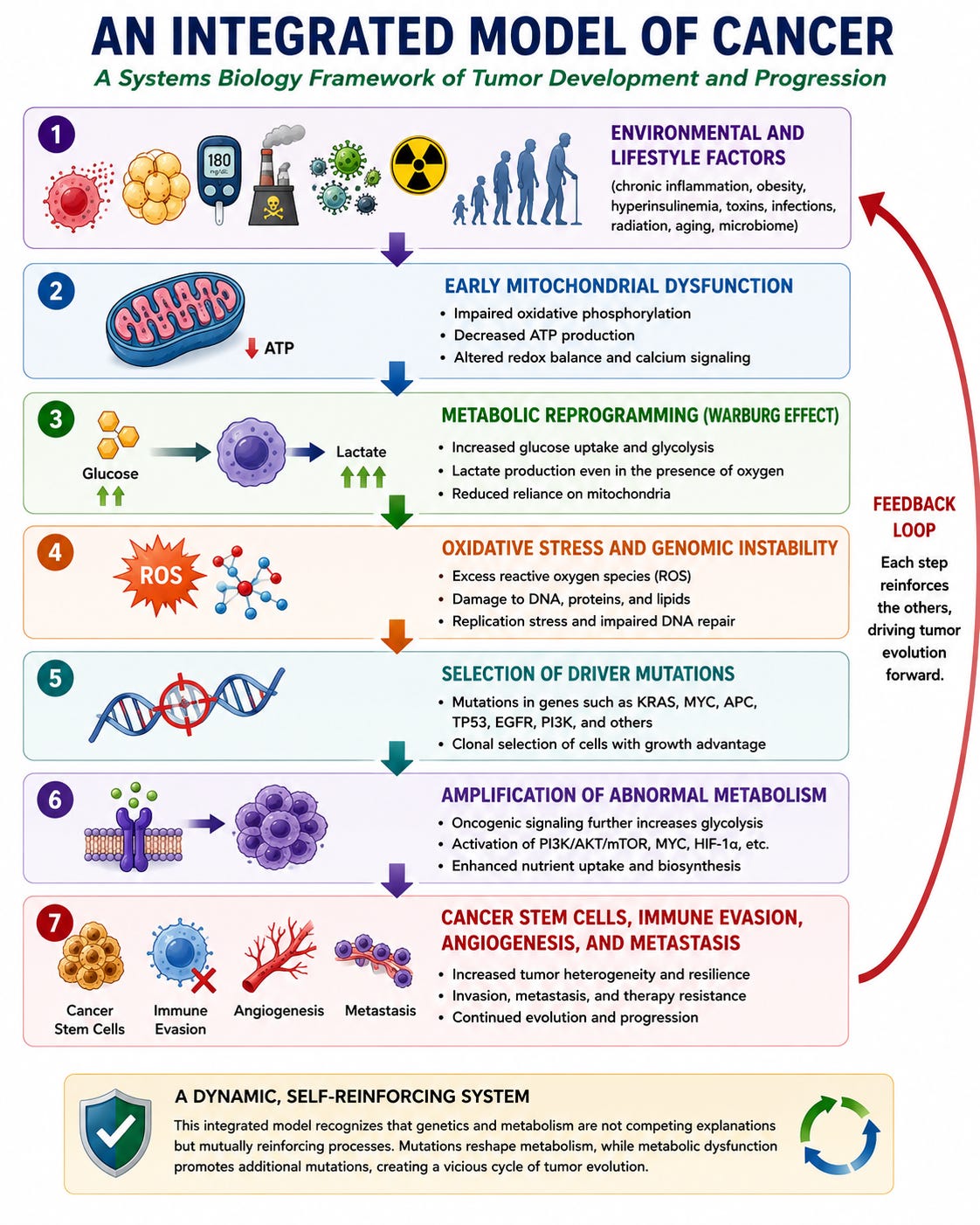
Rather than asking whether cancer is genetic or metabolic, the emerging evidence suggests that it is both. Genetic mutations, metabolic dysfunction, immune dysregulation, chronic inflammation, and alterations in the tumor microenvironment form an interconnected network that evolves over time.
The distinction between hereditary cancer syndromes, which traditionally support the Somatic Mutation Theory (SMT), and the metabolic theory of cancer becomes less clear when viewed through the work of Seyfried and colleagues.(1) They argue that impaired oxidative phosphorylation (OxPhos) is a common feature of most hereditary cancer syndromes (HCS), suggesting that mitochondrial dysfunction may be the fundamental abnormality underlying these disorders rather than the inherited mutation itself.
In this model, inherited cancer-associated mutations are viewed as predisposing factors rather than sufficient causes of cancer. Indeed, no known hereditary cancer gene demonstrates 100% penetrance—many individuals carrying pathogenic variants in genes such as BRCA1, BRCA2, APC, or TP53 never develop cancer. Seyfried therefore proposes that chronic OxPhos insufficiency is the primary driver of malignant transformation, while inherited mutations increase susceptibility by lowering the threshold for metabolic failure.
This hypothesis is further supported by the observation that virtually all major cancers produce elevated concentrations of lactate and succinate, the end products of glucose-driven glycolysis and glutamine-driven glutaminolysis, respectively. (2) Accumulation of succinate stabilizes hypoxia-inducible factor-1α (HIF-1α), promoting a persistent metabolic state that favors oxygen-independent glucose and glutamine fermentation even in the presence of adequate oxygen.
Within this framework, the classic Warburg effect—increased cytosolic substrate-level phosphorylation through glycolysis—occurs alongside the Q-effect, in which glutamine supports mitochondrial substrate-level phosphorylation. Seyfried argues that both metabolic adaptations arise as compensatory responses to impaired oxidative phosphorylation rather than as primary consequences of oncogenic mutations.(1)
Beyond altering cellular metabolism, OxPhos insufficiency has widespread downstream effects. Mitochondrial dysfunction disrupts calcium signaling, impairing regulation of the cell cycle, mitotic fidelity, DNA repair, and cell-cell communication. At the same time, dysfunctional mitochondria generate excessive reactive oxygen species (ROS), which can damage nuclear and mitochondrial DNA, contributing to the somatic mutation burden observed in many cancers.
Taken together, these observations support the hypothesis that chronic mitochondrial dysfunction and OxPhos insufficiency can account for many of the hallmark features of cancer, including metabolic reprogramming, genomic instability, uncontrolled proliferation, and tumor progression. From this perspective, the diverse genetic alterations observed across cancers may represent downstream manifestations of a common underlying disorder of mitochondrial function rather than the primary initiating event.
Important note: This interpretation reflects the metabolic theory of cancer as proposed by Seyfried and colleagues. It remains an area of active scientific debate and is not the current consensus view, which generally considers genetic and metabolic abnormalities to interact during cancer development rather than attributing all cancers primarily to mitochondrial dysfunction.
The question of whether driver mutations or metabolic reprogramming comes first does not have a single answer that applies to every cancer. In hereditary cancers, driver mutations often precede metabolic changes. In many sporadic cancers, however, chronic metabolic stress and mitochondrial dysfunction may develop first, fostering genomic instability and the later emergence of driver mutations.
A growing body of evidence therefore supports an integrated model in which metabolism and genetics continuously interact throughout tumor evolution. This perspective helps explain why targeting a single mutation often produces only temporary responses, whereas future cancer therapies may be most effective when they combine genomic targeting, metabolic intervention, immune modulation, microenvironment reprogramming, and cancer stem-cell suppression into a coordinated, multi-target strategy.
References:
1. Kaplan B, Duraj T, Lee DC, Seyfried TN. Hereditary cancer syndromes linked to oxidative phosphorylation insufficiency. Oncologie. 2025.
2. Lee DC, Duraj T, Chinopoulos C, Seyfried TN. Succinate and lactate produced as conserved biomarkers through chronic and transient substrate-level phosphorylation: from microorganisms to cancer. J Bioenerg Biomembr. 2026;58(1).

Comments
Nothing yet. Say the first thing.
Sign in to join the conversation.