
The remarkable advances in molecular oncology have transformed the treatment of several cancers. The discovery of driver mutations such as BCR-ABL, EGFR, ALK, HER2, BRAF, and BRCA-associated DNA repair defects led to the development of highly effective targeted therapies that have improved survival for many patients. In some diseases, such as chronic myeloid leukemia, targeted therapy has been truly transformative. However, despite these successes, most solid tumors eventually progress. Initial responses are frequently followed by acquired resistance, relapse, and metastatic spread. These observations suggest that, while driver mutations are important, they represent only one component of a far more complex biological system.
Cancer is fundamentally a dynamic, adaptive ecosystem rather than a disease driven by a single genetic abnormality. The dominant characteristic of malignant cells is not simply uncontrolled proliferation, but their extraordinary ability to adapt to changing environmental conditions. This adaptability, often referred to as metabolic flexibility, enables tumors to survive virtually any selective pressure imposed by therapy. Consequently, blocking a single signaling pathway rarely produces durable control because cancer rapidly activates alternative pathways that restore growth and survival.
Although different cancers harbor different driver mutations, many converge on a relatively small number of intracellular signaling networks. Mutations involving KRAS, EGFR, BRAF, MYC, PI3K/AKT/mTOR, and numerous other oncogenic pathways ultimately stimulate similar downstream processes:
Increased glucose uptake
Activation of glycolysis (Warburg effect)
Enhanced glutamine metabolism
Increased lipid synthesis
Increased nucleotide synthesis
Activation of HIF-1α and MYC transcriptional programs
Suppression of apoptosis
Promotion of angiogenesis
Immune evasion
These mutations therefore do not function independently. Instead, they act as different entry points into a common metabolic network that supports malignant growth.
This convergence explains why tumors with completely different genetic mutations often display remarkably similar metabolic phenotypes.
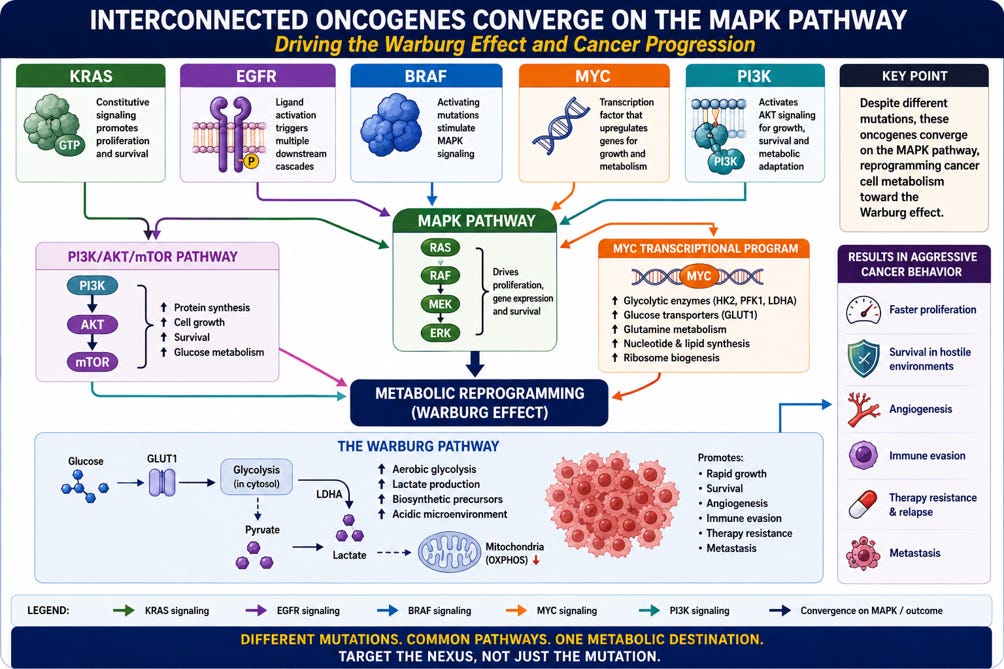
Nearly every major cancer demonstrates increased aerobic glycolysis, commonly known as the Warburg effect. However, glycolysis represents only one arm of a highly interconnected metabolic network.
Cancer cells can generate ATP and biosynthetic intermediates through numerous alternative fuels, including:
Glucose
Glutamine
Lactate
Fatty acids
Ketone bodies
Alanine
Branched-chain amino acids
Serine and glycine metabolism
If glucose metabolism becomes restricted, tumors frequently increase glutaminolysis. If glutamine becomes limiting, fatty acid oxidation or scavenging pathways may increase. Likewise, inhibition of oxidative phosphorylation can be partially compensated by increased substrate-level phosphorylation within glycolysis and glutamine metabolism.
Cancer therefore behaves much like a city with numerous interconnected highways. Closing one road simply diverts traffic onto alternative routes.
Targeted therapies provide numerous examples of this principle.
Patients with EGFR-mutant lung cancer often experience dramatic initial responses to osimertinib. Yet most tumors eventually acquire resistance through secondary EGFR mutations, MET amplification, HER2 activation, KRAS activation, small-cell transformation, or activation of alternative receptor tyrosine kinases.
Similarly:
BRAF inhibition activates EGFR signaling in colorectal cancer.
KRAS-mutant tumors activate PI3K signaling when MAPK is inhibited.
PI3K inhibition frequently results in compensatory activation of MAPK.
MYC can reprogram metabolism to maintain glycolysis despite inhibition of upstream pathways.
Thus, resistance is not merely genetic evolution; it is frequently metabolic adaptation.
Cancer cells do not exist in isolation. They interact continuously with stromal fibroblasts, endothelial cells, immune cells, adipocytes, and the extracellular matrix.
These surrounding cells provide:
Lactate
Alanine
Fatty acids
Growth factors
Cytokines
Immunosuppressive signals
Cancer-associated fibroblasts may even undergo aerobic glycolysis themselves, exporting lactate that neighboring cancer cells oxidize through intact mitochondria—a phenomenon termed the reverse Warburg effect.
Consequently, even complete inhibition of an intracellular signaling pathway may fail if the surrounding microenvironment continues supplying nutrients and survival signals.
A further challenge is the presence of cancer stem cells (CSCs). These cells often differ metabolically from the bulk tumor population.
Whereas proliferating tumor cells frequently rely on glycolysis, CSCs may preferentially utilize:
Oxidative phosphorylation
Fatty acid oxidation
Autophagy
Ketone metabolism
Eliminating glycolytic tumor cells while leaving metabolically distinct stem cells intact allows tumor regrowth once therapy is discontinued.
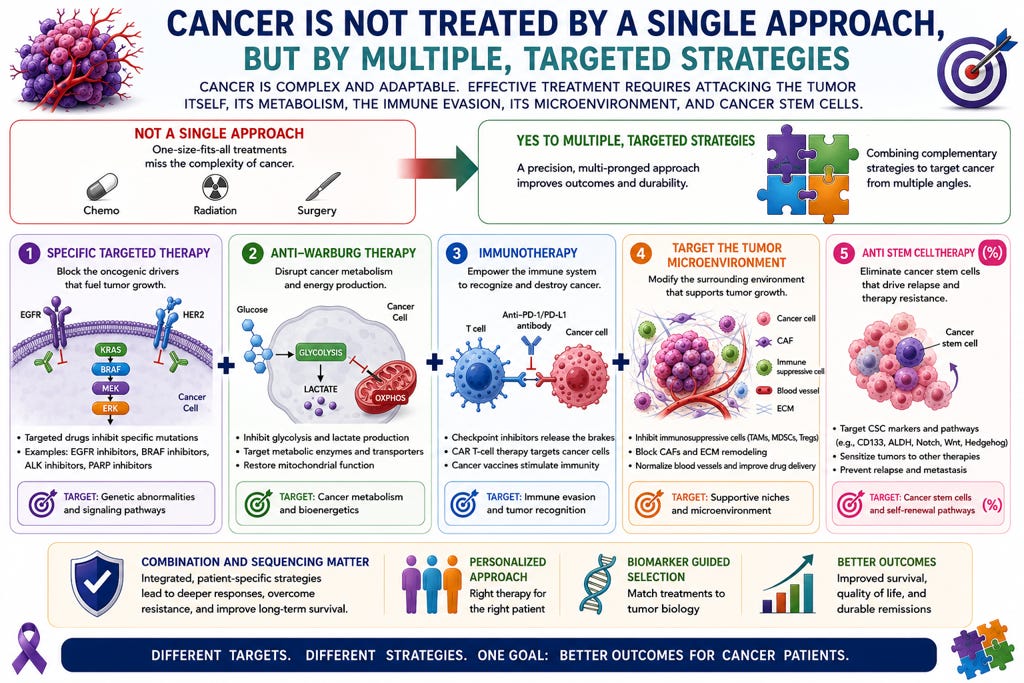
These observations suggest that successful therapy must attack cancer simultaneously at several vulnerable points.
An integrated strategy may include:
1. Targeted therapy
Inhibit the dominant driver mutation (EGFR, ALK, BRAF, HER2, PARP, etc.).
2. Anti-Warburg therapy
Reduce glycolysis.
Lower insulin signaling.
Target lactate production and glucose transport.
3. Mitochondrial and metabolic therapies
Disrupt mitochondrial function.
Target glutamine metabolism.
Reduce metabolic flexibility.
4. Immunotherapy
Reverse immune suppression.
Restore T-cell function.
Improve immune recognition.
5. Tumor microenvironment targeting
Normalize vasculature.
Reduce stromal support.
Inhibit inflammatory signaling.
6. Cancer stem cell targeting
Eliminate the reservoir responsible for relapse.
Reduce tumor heterogeneity.
Prevent metastatic recurrence.
Each intervention alone produces partial metabolic stress. Together, they may overwhelm the tumor’s ability to adapt.
Modern oncology has largely focused on identifying the “right mutation” for the “right drug.” This approach has yielded important advances, but it risks oversimplifying a disease that behaves as a complex adaptive system.
A tumor harboring an EGFR mutation remains dependent on glucose metabolism, glutamine metabolism, angiogenesis, immune suppression, stromal interactions, and cancer stem cells. Likewise, KRAS-, BRAF-, and PI3K-driven cancers all rely on overlapping metabolic networks despite different initiating mutations.
Consequently, precision medicine should move beyond precision genomics toward precision systems biology, integrating genomic information with metabolic phenotype, immune contexture, and tumor microenvironment.
The major lesson emerging from contemporary cancer biology is that cancer is metabolically flexible. Driver mutations initiate malignant transformation, but long-term tumor survival depends on the ability to continually reroute metabolism, activate compensatory signaling pathways, exploit the tumor microenvironment, and maintain cancer stem cell populations.
This explains why therapies directed against a single pathway—even highly effective targeted agents—often produce only temporary benefit. Blocking one escape route simply encourages the tumor to exploit another.
The future of oncology is therefore unlikely to be defined by a single “magic bullet.” Rather, durable cancer control will probably require coordinated, multi-target treatment strategies that simultaneously inhibit oncogenic signaling, disrupt metabolic adaptation, restore immune surveillance, remodel the tumor microenvironment, and eliminate cancer stem cells. Such an approach acknowledges cancer not as a static genetic disease, but as a resilient adaptive system whose greatest strength is its metabolic flexibility—and whose greatest vulnerability may lie in attacking multiple interconnected pathways at the same time.

Comments
Nothing yet. Say the first thing.
Sign in to join the conversation.