
You’ve probably heard of Puerh, you might have heard of Liubao, you’ve possibly heard of Anhua Heicha, but chances are you’ve probably not heard of Sichuan heicha. Most Sichuanese Heicha in the modern day tends to fall into the category of “Kang Zhuan” (康砖, ‘Tibet brick’), large tea bricks intended for export to Tibet. These bricks tend to use very coarse, low grade material - mostly stems and yellow leaves, with almost no buds.
The standard manner of brewing Kangzhuan is to boil it, with a great deal of tea and over many hours. The resulting liquid is used to make Butter Tea. However, most of us do not have time to boil tea for hours on end, or would really rather prefer not to. As of such, the standard brewing approach for most tea enthusiasts tends to be something that resembles Gong Fu cha, with short steeps and high ratios. The tea used tends to be quite extractive, either with high bud content or processed in a manner that enables it to release flavour easily. Given that Kangzhuan is mostly thick, coarse material, it is very much unsuited for Gong Fu cha, which is probably why it has never reached any level of prominence within the West.
However, Kangzhuan is not the only Sichuanese Heicha.
Within the Yunnan, Sichuan, and Guangxi provinces, compressing tea into bowl shapes known as “tuocha” is and was a relatively common practice. Xiaguan is famous for them, and they used be regarded as higher quality than the tea cakes that are popular today: “Bowl-shaped Tuocha is known to be of the highest quality. […] Tea cakes, also called round tea (yuancha), are a by-product made from the scraps left over from high-end square tea or tuocha”1.
The material for Chongqing Tuocha is processed in a relatively standard “raw” manner, akin to puerh - withering, rolling, fixation and then drying. At one point, the legal definition for puerh was not based on origin in Yunnan, but rather how the tea was produced, allegedly leading to some examples of these tuos being puerh, but I have not found any examples of that.
The grade of material that composes most Tuocha is much higher (hence ‘Te Ji’ 特级 and ‘Jia Ji’ 甲级) than Kang Zhuan, with more buds and smaller leaves, creating a more potent tea. The leaves also tended to be chopped up a decent bit more, creating a tea that extracts more easily, leading to something quite suitable for Gong Fu cha, in theory.
In practice?
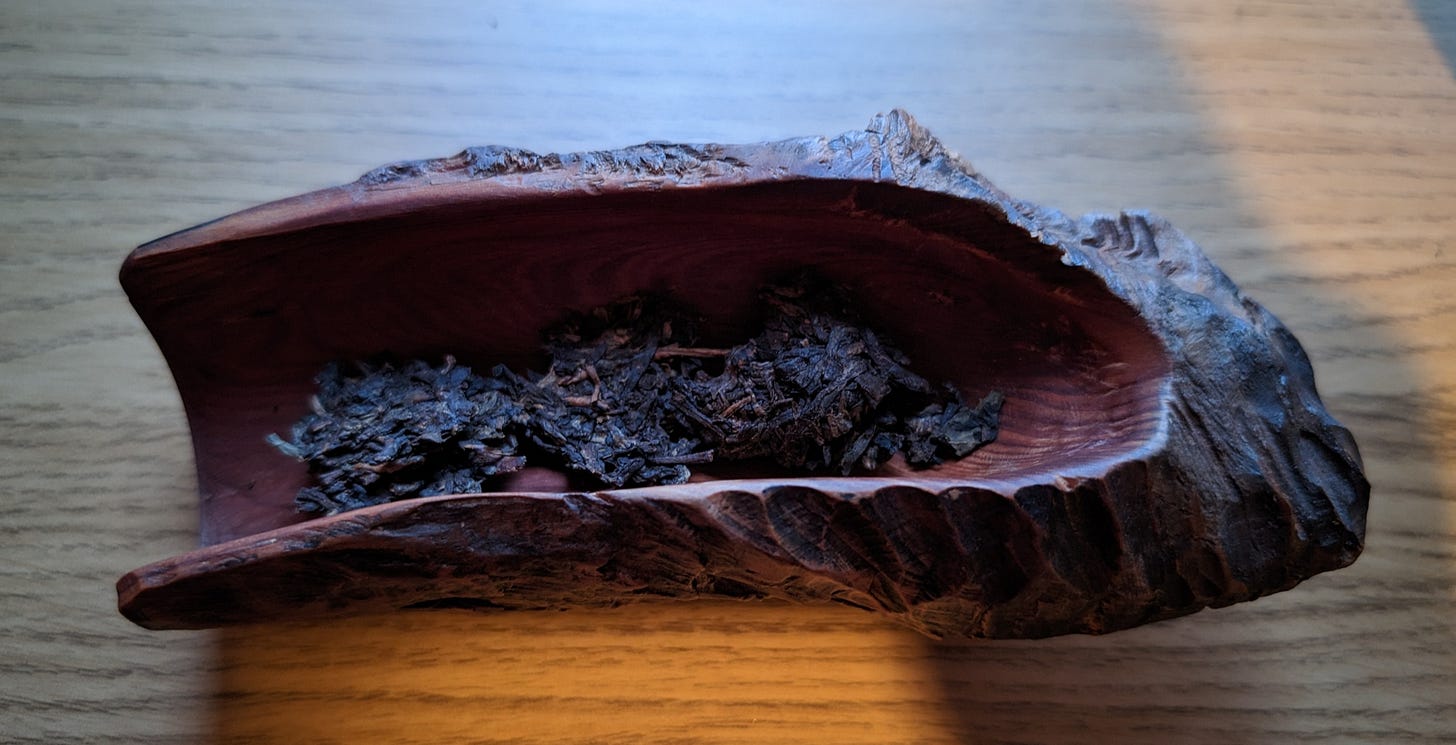
Yunnan Sourcing is the only vendor I’ve found that currently (as of December 2025) stocks a Sichuan tuocha23. Chawangshop stocked a Yibin tuocha, but it appears to be permanently out of stock. Yunnan Sourcing is based in Kunming, meaning their storage is “dry”. This tends to make for teas that are quite burly, even with considerable age, so I ensured that I ate a quite heavy meal before starting with this tea.
In the early steeps of my first session with the tea, it was quite light, both in terms of body and profile. It still felt somewhat green, with some red berry notes and a hint of black pepper. It had a nice coating texture, and a slight sweetness. Once the tea had had a few steeps, however, it very suddenly transitioned to a more powerful, poorly integrated bitterness. This bitterness was accompanied by a slight hoppy aftertaste that quickly dissipated. After the bitterness subsides, which happens rather quickly, there is nothing. It steeps out quickly - I only got around 4 steeps with decent character, with the rest being too thin.
In my subsequent session, I took more care to carefully dismantle the tea, getting my desired quantity (5g) in a single chunk, rather than multiple as with the previous (pictured). This allowed me to preserve the leaves in a more whole manner. This lead to a somewhat more interesting session. The taste was grain-like and lightly fragrant, the tea warming in the shoulders, and later, where the bitterness appeared in the last session, astringency appeared. The sensation remaining after the astringency feels very much like a young sheng puerh. The texture in the early steeps was creamy, in a similar manner to a high mountain oolong, but without the corresponding bright and fresh character. I cannot imagine the tea’s overall character is that different to how it was when it was younger, other than having lost some harshness and freshness.
When I received this tea, it was packaged in plastic film, and a desiccant was included. I suspect this desiccant has drained a significant amount of humidity and life out of the tea, and I’ll need to store it more aggressively to recover it.
It will be a long time before I reach for this one again.
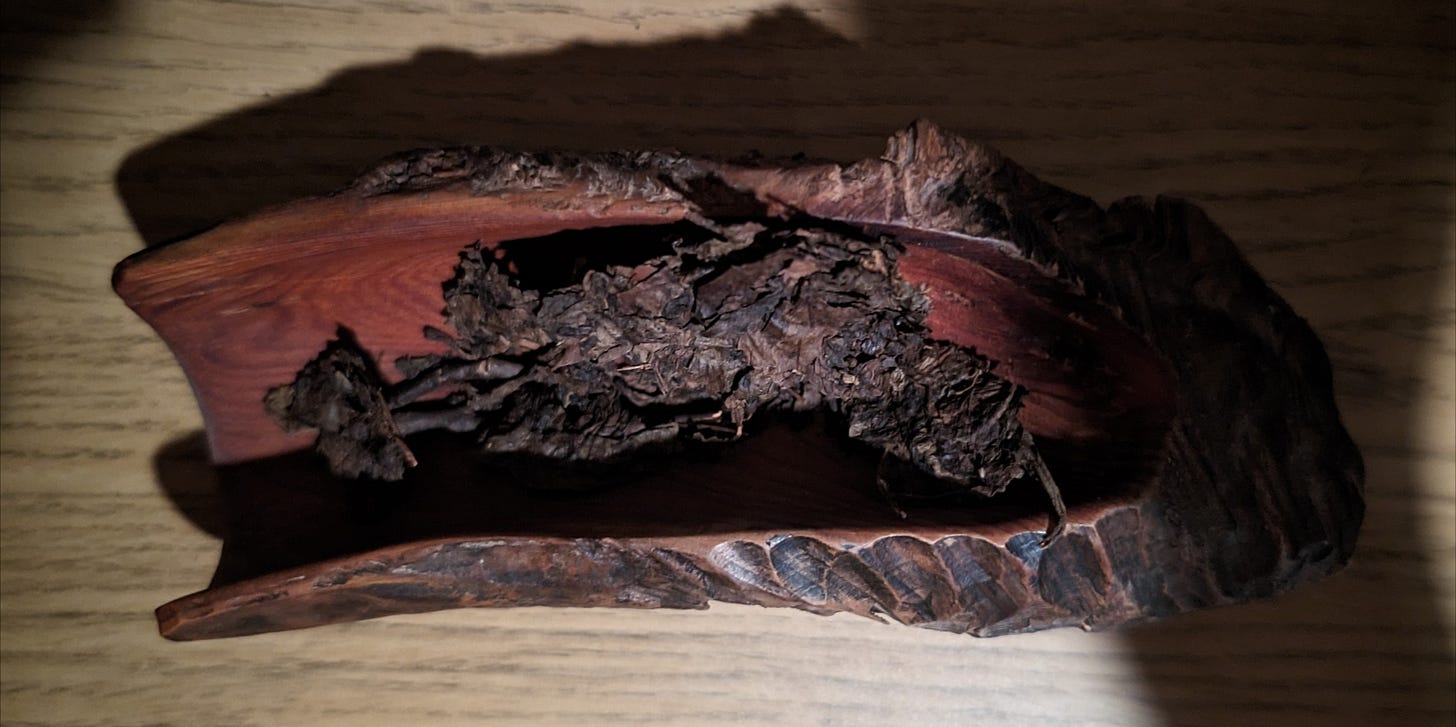
This tea was my first introduction to Sichuan heicha, and it intrigued me enough that I’ve been seeking it out since. The tea itself is very low grade, with incredibly fibrous, large leaves. As a result, I find it to be pretty emblematic of a particular character I tend to find in old, large leaf teas. This ‘old yellow leaf’ experience is somewhat woody, relatively sweet, and can be quite pungent. It resembles wet firewood, an old table, or, rarely, barrel aged spirits.
I’ve observed this note in many different teas, manifesting differently. Some of the teas I’ve found it in include the 70s Puer that Wistaria offers, TWL’s 80s Ripe Liubao, various Heizhuans, and, of course, Kangzhuans.
Due to the low longevity and extractiveness of the teas that have this character, it’s taken quite a bit of effort to find a brewing method that gives me satisfying results relatively consistently. Many people advocate brewing in a thermos or boiling in a pot. However, I tend to get poor results, with the teas ending up somewhat discordant. When using high capacity vessels, the character is coherent, but understandably thin. It would work well as an accompaniment to food, but rarely satisfies. Standard gongfucha lacks heat and time, with short steeps not allowing the tea to infuse sufficiently. Some people choose to compensate for this by using very high ratios, but this tends to highlight flaws in the teas for me.
As of such, my methodology for such teas has settled on a more standard gongfu ratio (for me, roughly 5g/100ml), and immediately starting with extended steeps after a rinse, until the pot is no longer too hot to touch. This has produced enjoyable brews for me, with plenty of body and complexity.
When applying this methodology to the KTM Kang Zhuan, the tea was exhausted in 3 steeps. It was incredibly thick in the mouth, but was not coating. Pungent wood up front, with a nutty undertone. On the second and third steeps, the pungency receded, getting somewhat nuttier and woodier. At the back of the mouth, there was a rough drying sensation. This, much like every other aspect of the tea, was incredibly brief. No lingering, no aftertaste.
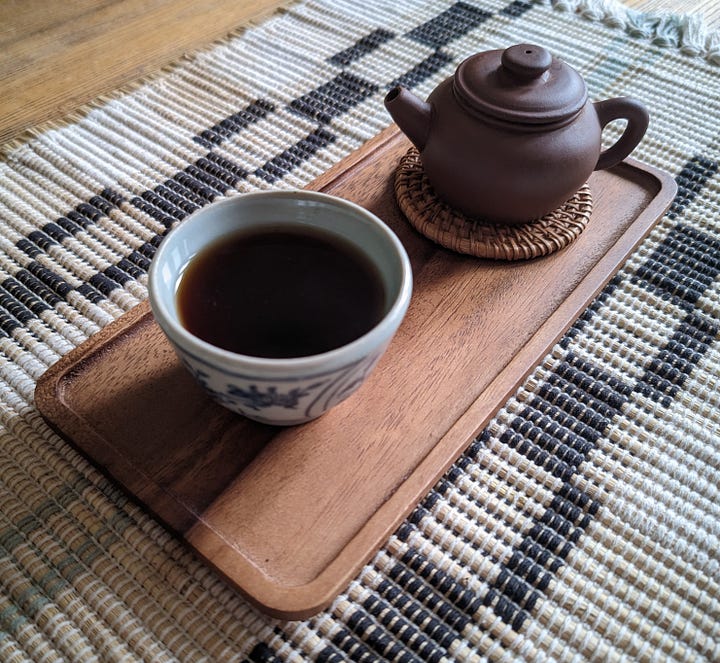
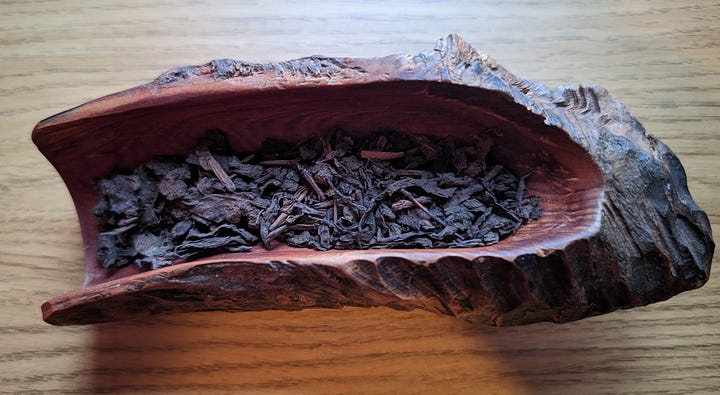
I’ve saved the best tea for last. Despite the fact that this tea originated as a Kangzhuan, the material is a lot higher grade than the KTM tea, with the leaves not being particularly fibrous. This tea is actually quite pleasant to drink. It’s noticeably sweet, in a darker manner as in unrefined sugar. It has a pleasant slight bitterness, reminiscent of wood smoke without actually being smokey. In the early steeps, the old yellow leaf character is minimal. In the later steeps, the tea becomes cleaner, woodier, and sweeter. It took about 5 steeps to completely exhaust the tea, and it never felt discordant or harsh. Overall, very enjoyable.
Sichuanese Heicha is not particularly well represented in the West. This is both because it is hard to find, and because the examples one can find are rather poor. Most Kangzhuan is closer to the KingTeaMall’s than it is to thetea.pl’s. This creates a negative reinforcement cycle, and prevents demand for Sichuan heicha, which prevents good examples from making their way to inventories, because there’s no reason to seek them out.
It does not help that the conditions in which the tea was grown are poor — fluorosis is common in Tibet, owing to their consumption of high stem brick teas, such as Heizhuans, Fuzhuans, and, of course, Ya’an Kangzhuans. The problem is sufficiently widespread that it has been given a name — “brick tea fluorosis”4. Many teas can attribute their popularity to health claims, with ripe teas and Fuzhuan gaining quite a market owing to weight loss connections. Sichuan heicha instead is at the root of a health crisis.
Even within Sichuan, Kangzhuan is looked down upon. When Rivers and Lakes Tea visited Sichuan, they had the following to say: “we could not find anyone in the area outside of the [Ya’an Tea Factory Company] that claimed to enjoy this kind of tea when asked — with many getting quite the chuckle from this inquiry.”5
It is not a surprise to me that this is the case, but I wish it was not. Sichuan is quite a good terroir for tea, and these examples are quite promising. Despite the fact that the Yunnan Sourcing tuocha was not great, it was certainly far from bad. The flaws feel fixable, and the reviews of the listing reflect that fact. There exist reviews out there of other tuos that I have been unable to get my hands on, and they have been quite favourable6.
There is unrealised potential.
Famous Teas of China by Zhuang Wanfang, 1979, translated by One River Tea: https://onerivertea.com/blogs/one-river-tea/puer-tea-introduction-1979-zhuang-wanfang-selection
According to YS, this isn’t a Chongqing tuocha, but instead a Yunnan tuocha: “An unusual tea in terms of it’s origins. Yunnan-grown pu-erh was pressed in Yunnan and then packaged and sold under the “Chongqing Tuo” Brand (a sub-brand of the CNNP Chongqing Branch).”
However, the tea does not have “Puer” written on it. Chongqing factory produces Chongqing tuocha from Chongqing material. Pressing Yunnan material in Yunnan is not particularly unusual. There was, however, a practice of pressing non-Yunnan material in Yunnan, for a brief period of time. I suspect that this is probably not Yunnan material, given that it makes very little sense for it to be. Occam’s Razor.
Yes, Chongqing isn’t part of Sichuan in the modern day. However, this division occurred in 1997, and Chongqing tuocha production predates that.
https://pmc.ncbi.nlm.nih.gov/articles/PMC9792988/
https://riversandlakestea.net/sichuan-ii-cang-cha-and-bad-bad-tea/
https://my.teadb.org/teas/heicha/yibin-tea-factory/sichuan-yibin-tuo
No posts
Comments
Nothing yet. Say the first thing.
Sign in to join the conversation.