
I drink Liubao almost every day. This is not an act of self-flagellation as plenty might assume, but a result of a deep appreciation for the genre and what it has to offer. These are reviews of the best Liubaos I’ve had thus far.
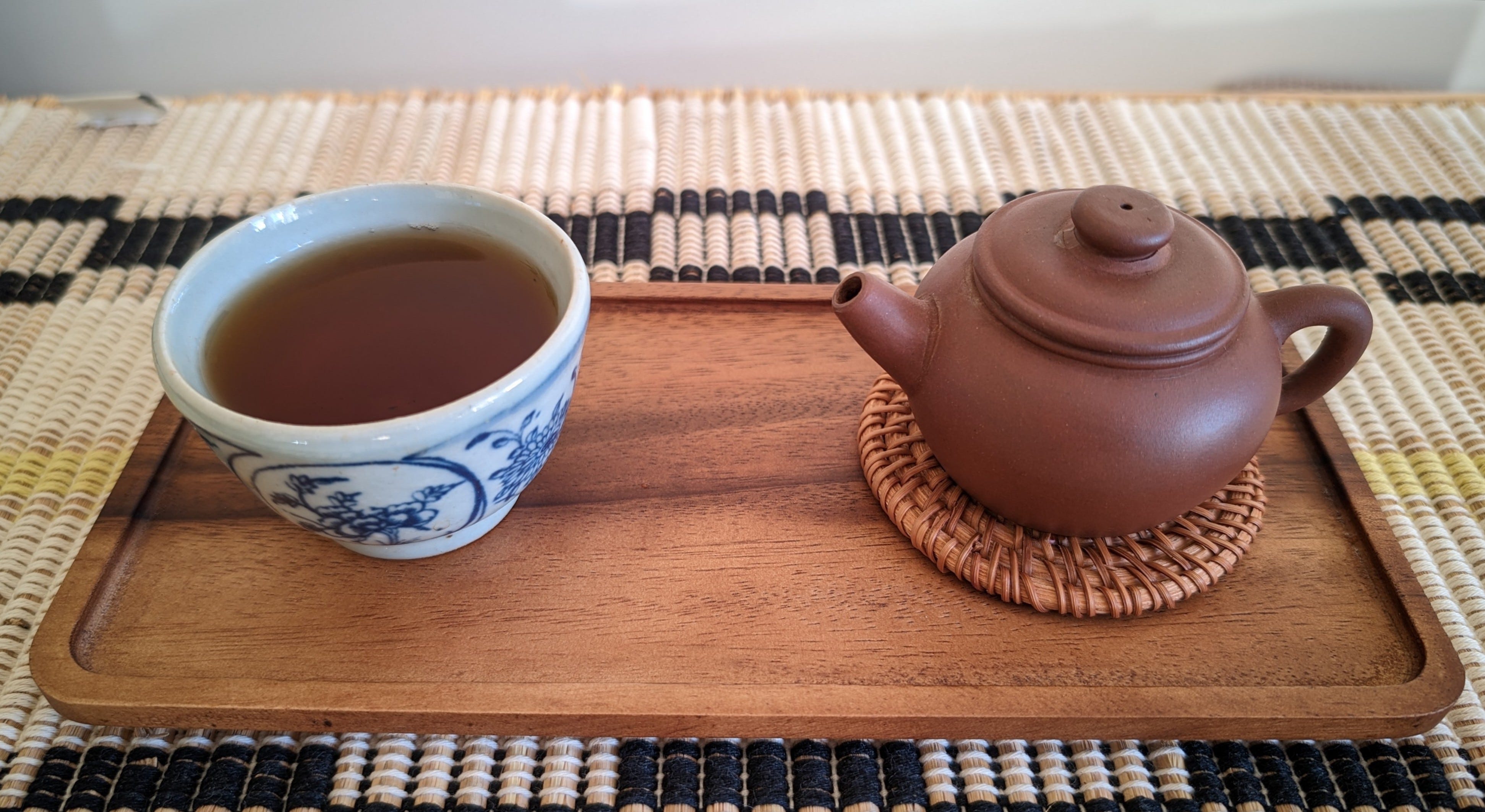
Sometimes, Liubao is labelled for its aroma. This one has been named Mù xiāng (木香), “Wood Aroma”. The tea itself, however, is a Liubao produced via single steaming, with many buds.
Owing to the high “grade” of the tea, it is really quite potent. The texture is like a thick broth, lingering in and coating your mouth. The tea opens with a powerful note found in many bud-heavy Liubao, alongside an interesting herbal funk similar to mint, or gin. As the tea progresses, the funk fades, giving way to the aroma of “a forest walk in autumn” - petrichor and fallen leaves, particularly in the aftertaste. It is not, however, “basement”-y or wet, nor is it “dirty” or “muddy”.
I described this tea as a “yardstick”. I feel like it is the best example of a bud-heavy (would this be ‘first grade’ or ‘special grade’ nowadays?) Liubao I’ve had, fulfilling my expectations of what a Liubao ought to be, and exceeding them in many regards, such as the potency and longevity. It took up to the 6th steep for me to stop steeping it briefly, and it kept going for far longer than that.
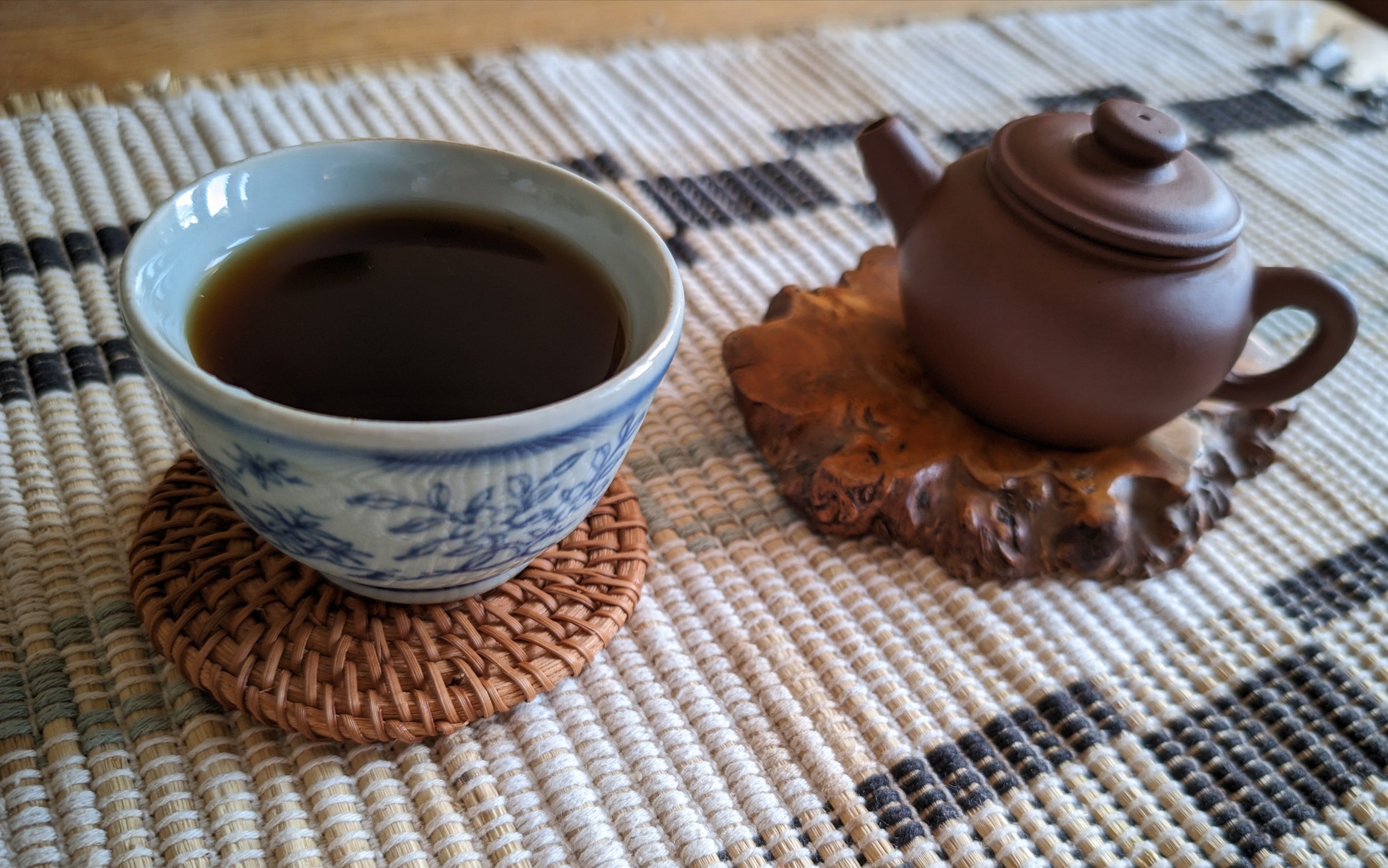
Wild Liubao is also known as “Yesheng” Liubao, a term sufficiently diluted that it is hard to derive any workable meaning from it. I dislike claims of “wild grown” and “old tree”, which is why I tend to omit them from any descriptions of teas, and their titles. Here, my hand is forced. I’ve found that Liubao labelled “Yesheng” tends to have a more rustic, rawer, processing with a coarse sorting — larger leaves and stems are present, but the blend is not dominated by them or yellow leaves.
This tea represents a very good example of the genre. It goes without saying that this tea has an overall ‘dark’ profile. It is quite thick, slightly woody, and starts with a touch of lingering bitterness. Despite not being a “ripe” tea (it did not undergo wet piling), the bitterness in the material feels reminiscent to that you can find in some shou puer. It is quite warming, starting in the head, and is relaxing. It had more longevity than other examples of Yesheng Liubao I’ve had, but is more gentle, and far more complex.

Laochapo is a style of tea that uses the old, coarse yellow leaves of Liubao. I might hesitate to label it a Liubao directly, because the method that is used to produce Laochapo is no longer used to produce any other Liubao. Being a very old tea, and one that uses the largest, least extractive leaves, it is usually recommended that this tea is brewed either by boiling it, or in a thermos, as is common with other similar teas. I do not enjoy the profile of either boiled or thermos-ed tea, and this tea was not an exception to that, so I will not comment on the results of my thermos brewing of the tea.
Instead, I will comment on the fact that despite the fact that gong-fu style is a poor fit, it performs remarkably well. It has a rich texture, some sweetness, and lacks the pungency that I usually find in yellow-leaf teas. Early steeps have a slightly woody character, and leave an aftertaste of tobacco. Later steeps become cleaner and lighter, but also woodier. At one point, I got a hint of marshmallow.
This tea is not particularly potent, and does not have much longevity. I steeped it 5 times, each one drawn out. It is not fair to knock it for these characteristics, because it does not need to be. It is a yellow-leaf tea, a Laochapo, and the best I have had so far.

Baolan (寶蘭) is a well established brand of Liubao. This particular example has plenty of buds, but also a few more mature leaves mixed in, and was stored in Malaysia.
The tea opens with strong, dark herbals. Black pepper, the greenness within brown sugar and molasses, vegetal. It is slightly bitter at the start in a similar manner to the Daxue Jiadao Muxiang, likely owing to the high grade. It has a very full body and texture, being incredibly thick. The aftertaste in the early steeps is somewhat herbal, and lingers and lingers and lingers, throughout the entire tea. I hesitantly identified “camphor” in the aftertaste, but I am unsure on how to identify said note at present.
For the other teas, they have had a noticeable effect on my body, generally in the form of either being warming or relaxing. This tea is sufficiently relaxing that I have to call it sedating — I had to lie down after three steeps. It was never harsh, however. I would recommend listening to music with this tea. The longevity of the tea was also excellent. A truly unique Liubao, unlike any I’ve had.

Unlike the other teas in this selection, the Yeeon Original Liubao was stored in Hong Kong. Yeeon describes the tea as having “grade 7” leaves and it does have some noticeably more mature leaves, but it is certainly not an incredibly coarse picking. I also believe it is “single steam”, in a similar manner to the Daxue Jiadao Muxiang.
There is a slight geosmin (beetroot, petrichor) note in the first infusions. It is not as prominent as Yeeon’s other teas, and is cleaner. The first infusions are rich, comfortable and sweet. Later steeps begin to have a cooling effect, with a hint of a minty herbal taste and woody, foresty notes. When inhaling after the middle steeps, it felt like breathing in cold November air. I accidentally let a later steep cool down, and it tasted like the smell of a swimming pool. This was not unpleasant, but certainly odd. Most of the sweetness of the tea gathers in the back of the throat, particularly in the final steeps. I did not observe any sesame, which Yeeon notes.
The longevity of this tea is reasonable, but somewhat impacted by the lower grade. That lower grade fills out the body, thickness and sweetness considerably, so I think this is an acceptable trade. If brewed at a lower ratio (3g/90ml) with extended steeps, it becomes really rather thick, slightly mineral, and very quaffable. It does lose a significant amount of complexity as a result, so I do not think that this is an acceptable tradeoff, considering the price of the tea.
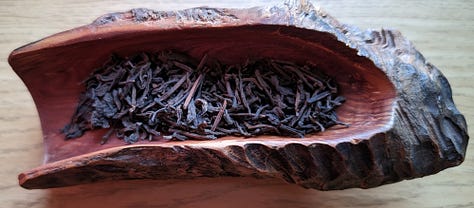
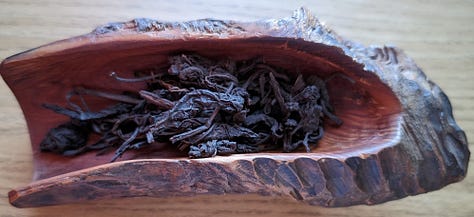

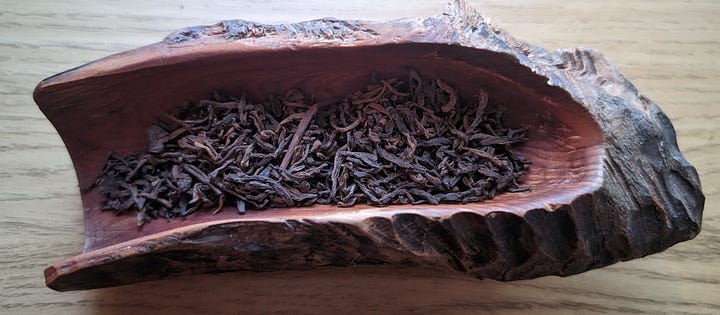

One of the big challenges for me as a tea drinker has been description. Being able to understand what I am tasting, and then being able to convey that accurately to others are monumental hurdles. These hurdles are made taller in the West by the fact that tea and most understanding and evaluation of it rely on a cultural context that I am not party to. For instance, “betel nut aroma” is a common label for Liu Bao, and is considered one of the most desirable traits for an aged Liubao to develop. However, I have not seen a betel nut in person, let alone tasted or smelled one. When something is said to have a “wood” aroma, the wood that comes to mind tends to be either oak, pine, or cedar, none of which I can say I have tasted or smelled in any tea. This, I feel, is where Daxue Jiadao’s Liubaos have been most helpful for me.
If I had to describe each of Daxue Jiadao’s Liubaos with a single word, it would be the same for all three: “exemplar”. I have had many Liubaos across many categories before, and have developed my own observations and expectations of them as a result. Each of them acted in line with my observations, and fulfilled my expectations, and then went beyond. I might even dare to describe them as approaching the platonic ideal, were I an adherent to the theory of forms. So, while I may not agree that the Muxiang has a “wood aroma” (it is the only Liubao of the set where my raw notes do not contain the word “wood” even once), it is useful to know that if a tea shares a trait with this one, it might in fact be “wood aroma”.
The last two teas, however, stand in stark contrast to the Daxue Jiadao Liubaos. They were both recognisably Liubao, but they were entirely dissimilar to any others I’d had — I only have my own experience to understand them, beyond token words like “rich”, “smooth”, “mature”, and “aged”. I did not expect to taste the things I did, nor did I make any particular effort to look for “taste notes”. It is here that I lament the fall of platforms like Steepster. I cannot find a single review of Teaswelike’s Baolan Liubao via search engines, and Teas We Like’s own description, while true, is certainly minimal. As of such, some of my notes are likely entirely subjective to myself, nowhere to be found even if searched for.
It is for this reason that I tend to place emphasis on my tasting notes being unimportant when discussing tea elsewhere — have you ever observed “nigorizake” as a note in a Liubao? For these teas, the most important aspect I’ve found in all of them has been what I might call “fullness”. Throughout the entire session with each tea, they were deep, complex, and interesting, with many things to be found at each layer. This shows up in the plentiful and varied notes, but also in the longevity, with each tea having something to observe and ponder far later than most other teas. It of course shows up in the pronounced effect on the body, the strength and power of taste, and so on. There is no single thing I can point to as the “fullness” of these teas, which is what I am pointing to.
None of these teas left me wanting.
No posts
Comments
Nothing yet. Say the first thing.
Sign in to join the conversation.