
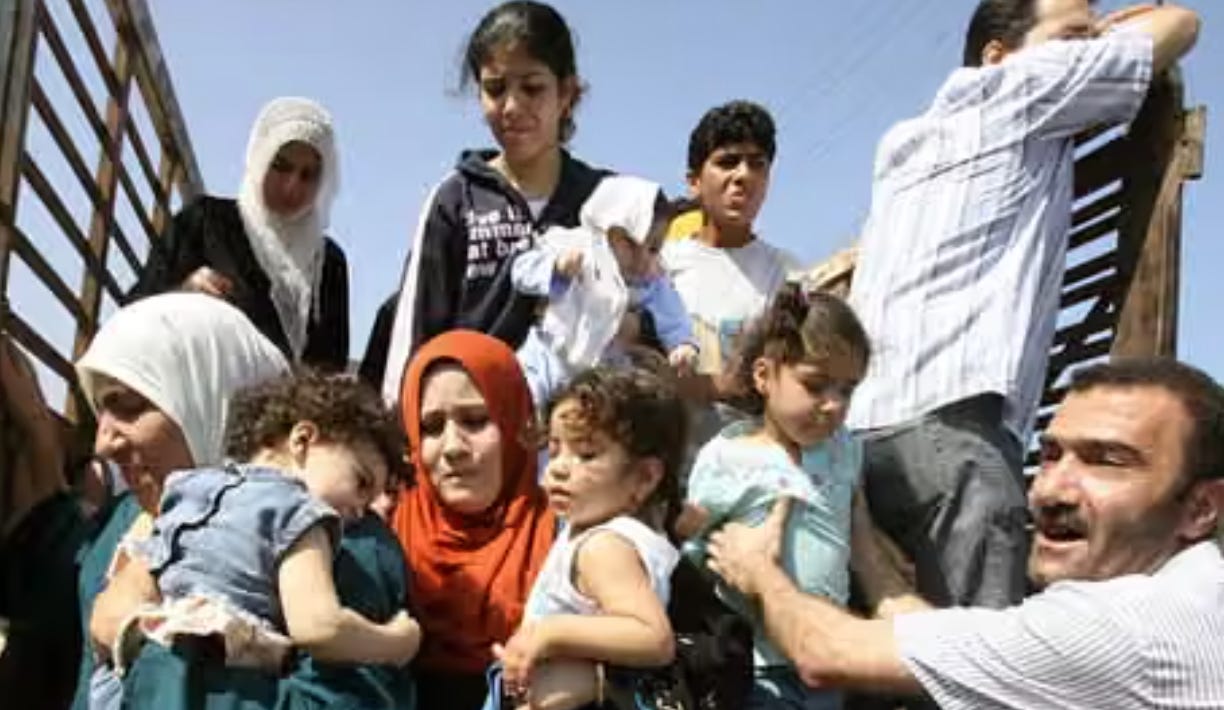
Almost everyone knows about the Palestinian refugees. Their statelessness is a central sticking point in the 80-year conflict.
About 750,000 Palestinians became refugees during the 1948 Arab-Israeli war, and hundreds of thousands more were displaced during the 1967 war. (Some were forced out. Others were encouraged by their own leadership to leave, promised they could return to the spoils of the routed Jews after the war.)
Today, the UN agency that serves as a quasi-government in Palestine, UNRWA, counts about 5.9 million Palestinian refugees.
How did a few hundred thousand become almost 6 million?
Because, unlike any other refugees in the world, Palestinian “refugees” include the descendants of those displaced — the only inheritable refugee status in the world. UNRWA, of course, is an organization that exists to perpetuate Palestinian statelessness, not to resolve it, which puts a bit of a crimp in the numbers. But anyways.
Ask the average person — including the “experts” who have made Palestinian refugees their favorite hobby — about Jewish refugees from the same era and you are likely to get a blank stare.
During roughly the same period, about 850,000 Jews fled or were expelled from Arab and Muslim-majority countries, especially after 1948 and 1967; most were resettled in Israel or elsewhere and were therefore not maintained as a multigenerational refugee population.
These stories are not identical, but they are comparable in one important respect. Both involved the uprooting of communities. In the case of the Jewish refugees, almost every one of them could trace their roots back many generations in Algeria or Yemen or, in the case of Iraq, almost three millennia. A large proportion of the Palestinian refugees had arrived in Palestine only a generation or two earlier, drawn by the economic boom created by — wait for it — the Zionists! But anyways.
Both produced refugee populations numbering in the hundreds of thousands. Yet one refugee story became central to international consciousness. The other was, for all practical purposes, forgotten.
Why?
The overwhelming majority of Jewish refugees rebuilt their lives. About two in three of the refugees settled in Israel. Others dispersed across Europe, North America, and elsewhere. They were absorbed — sometimes reluctantly, sometimes imperfectly, at enormous economic and social cost.
The experience was hardly idyllic. Israel was a desperately poor new state struggling to house wave after wave of immigrants while fighting for its survival.
Jews arriving from Iraq, Yemen, Morocco, Egypt, Libya, and elsewhere often encountered prejudice from the predominantly European Jewish establishment. They lived in transit camps. Many endured years of poverty. Integration was difficult.
But the refugees ceased being refugees.
By contrast, much of the Palestinian refugee population remained refugees — not simply because history took an unfortunate course, but because governments and the United Nations made deliberate political choices.
Rather than permanently integrating Palestinians into the societies in which they found themselves, most Arab states refused to grant citizenship or civic inclusion. They penned them up in one of the world’s biggesgt moral atrocities. The refugee issue was preserved as an open political wound, intended to reinforce claims connected to the conflict with Israel.
PLEASE … if you support my work, the most important thing you can do is share it. Share it on Facebook, Insta, X, Bluesky, wherever. Email it to your long-suffering family. Print it out and mail it to your uncle. Just SHARE IT.
UNRWA has institutionalized refugee status across generations instead of encouraging permanent resettlement and integration.
An additional hypocritical, irrational aspect of this whole debacle is the lunacy of the refugee label.
Consider the Hadid family. Baba Mohamad, an American property developer, and supermodel daughters Bella and Gigi, are arguably among the United States’ vaunted 1%ers.
They are also Palestinian “refugees,” eligible for all the undeniable rights, bonuses, perks, and victimology brownie points that come with that inheritable birthright.
However ludicrous this situation, more than 75 years after 1948, the Palestinian refugee issue remains one of the defining features of the conflict.
The Jewish refugee issue, by contrast, has entirely vanished from public consciousness.
In practical terms, that is understandable. Humanitarian attention naturally gravitates toward people who continue to suffer. Jewish refugees found homes. They built businesses and raised families. They helped build one country and enriched many others.
They are no longer a humanitarian emergency.
But practical explanations are not moral explanations.
The disappearance of Jewish refugees from our collective memory has had consequences. It has encouraged the misleading impression that only one side experienced mass displacement. It has obscured the fact that the Arab-Israeli conflict produced two refugee populations.
And it has diminished an entire chapter of Jewish history because its victims were, in the end, resilient enough to recover.
There is another irony here.
The success of Jewish refugees has become the reason their story is forgotten.
The continuing tragedy of Palestinian refugees’ failure and enforced poverty (despite receiving more humanitarian aid per capita than any other group on the planet!) has become the reason their story dominates.
Yet we seldom ask why those trajectories diverged.
One refugee population was, however imperfectly, integrated into new societies. The other was, in many places, deliberately kept separate from them. Stories like the Hadids notwithstanding.
That difference did not happen by accident. It happened because political leaders made political choices. Arab and Muslim elites — who coopted UN bodies—perpetuated and exploited Palestinian “refugees” as pawns in one of the grisliest political chess games in human history.
If we genuinely care about justice, we should remember both refugee stories, because Jewish refugees represent an undeniable, crucial chapter in the history of this conflict, the region, and the world. Their story is a narrative of mass injustice that the world has chosen to forget.
But the world remembers (and perpetuates) the Palestinian refugees for all the wrong reasons.
The moral of the Palestinian refugee narrative is Zionist venality: Generations of innocent people held in generations-long statelessness.
But that moral is exactly wrong. Precisely backward.
The Palestinian refugee problem is evidence of a mercenary, corrupt, degenerate conspiracy by Arab and Muslim elites, in cahoots with a subjugated and coopted United Nations, to prolong the Palestinian refugee problem so these human beings can be used a bludgeons in an abominable global PR war against Israel.
The world has spent generations obsessing over Palestinian refugees — without asking why they remain refugees generations later.
It has spent remarkably little time remembering the Jewish refugees from the same era or exploring why and how they are no longer refugees. The world has certainly not learned from the Jewish experience as a model for how a displaced, uprooted, impoverished people can become a forward-looking, successful, constructive nation.
No, “denormalization” has been the watchword for Palestinian relations with Israel — the very country and people whose experiences Palestinians should be emulating in order to stop condemning yet more generations to hopelessness and statelessness instead of building a positive future.
This lack of knowledge — and stubborn absence of curiosity — tells us a great deal about the world’s very distinctive approaches to Palestinians and Jews. And, as usual, the world’s approach to the conflict hurts Palestinians at least as much as it hurts Israelis.
Share Pat’s BEATEN WITH A SHTICK Substack
Follow me on Facebook: https://www.facebook.com/profile.php?id=61588402258315
Follow me on Insta: https://www.instagram.com/patsshtick/
Follow me on X: https://x.com/PatsShtick
*
Some people have generously asked me to make it possible to make one-time contributions to support my work. I have now set up a PayPal link for donations. If you like snappy smackdowns of antisemitism and anti-Zionism and want me to keep it up, any support is deeply appreciated. Click here.
Comments
Nothing yet. Say the first thing.
Sign in to join the conversation.