
In Soul on Ice, Eldridge Cleaver, a leader of the Black Panther movement, made one of the most horrifying admissions in modern political literature.
Cleaver wrote that he had sexually assaulted Black women as preparation before targeting white women. He described his crimes against white women as politically motivated — an “insurrectionary act,” committed not merely against individual human beings but against the racial order he believed they represented.
It was an unimaginably monstrous idea: violent rape recast as romantic revolution.
Cleaver eventually repudiated this reasoning (well … he repudiated it from prison while serving a term for assault with intent to murder). But the reasoning itself deserves attention because it exposes one of political extremism’s most dangerous operations. First, assign an individual to a collectively guilty class. Then strip that individual of innocence. Finally, recast violence against the person as violence against the system.
Sound familiar?
Yep. It sounds a lot like the global justification for October 7, which included mass rape of men and women, living and dead.
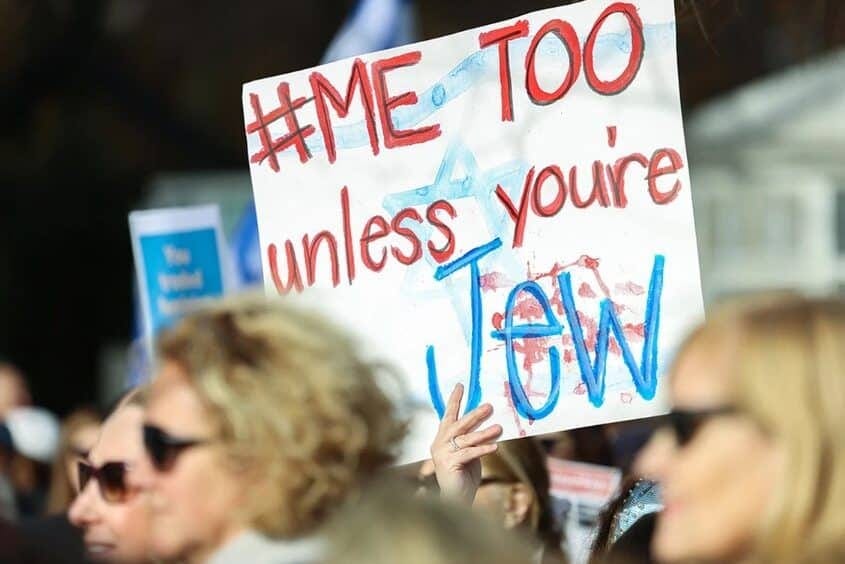
Israeli women were assaulted during the Hamas-led attacks and after hostages were taken into Gaza. Yet almost immediately, people and organizations that had spent years telling us to believe women, centre victims, and understand sexual violence as an instrument of domination suddenly discovered an apparently limitless appetite for disbelief, rationalization, and deflection.
Where other alleged victims might have been offered solidarity, Israeli women were subjected to ideological cross-examination. Were there witnesses? Was there video? Were the bodies examined correctly? Was every reported case independently verified? Could the evidence have been fabricated? Were the allegations merely Israeli propaganda?
October 7 exposed something rotten in a strain of contemporary activism that owes much to the earlier, worst versions of political extremism.
Cleaver was not a direct colleague of Malcolm X and the Nation of Islam, but their brands of extremism have both infused the “pro-Palestinian” movement. Malcolm X touted his ends “by any means necessary,” which is a familiar slogan at anti-Israel hate rallies worldwide today.
Cleaver’s concept of rape as a political tool is asserted, if not outright celebrated, by people who claim to be humanitarian rights activists seeking a better world by “freeing” Palestine.
For years, feminist and progressive movements developed a vocabulary intended to correct the reflexive dismissal of sexual-violence victims. We were told to listen to women. We were taught that trauma can affect memory and testimony. We were warned that the absence of a perfect forensic record does not prove that an assault did not occur.
When the victims were Israelis, suddenly activists who once treated doubt as an instrument of patriarchal oppression became amateur defence attorneys for Hamas. People who had insisted that survivors should not be retraumatized by impossible demands for proof required Israeli women to provide a kind of evidence rarely available after a surprise massacre, the destruction of crime scenes, and the mass murder of victims and potential witnesses.
Even the dead were presumed to be lying.
Or, more accurately, the Jewish institutions speaking for them were presumed to be lying.
A Palestinian allegation is understood through structures of power, trauma, and historical context. An Israeli allegation is treated as a military information operation until proven otherwise — and often after it has been proven otherwise.
Cleaver transformed the woman he attacked from an individual into a representation of whiteness. Once she became the embodiment of the oppressor, he could tell himself that an act of personal brutality was an act of political rebellion.
Again: Sound familiar?
An Israeli woman is no longer simply a woman. She becomes a settler. A colonizer. A Zionist. A soldier, whether she served in the military or not. A beneficiary of “apartheid.” A representative of a supposedly genocidal state.
Once the political labels have accumulated, her terror can be contextualized. Her rape can be denied (by people who want to maintain some semblance of political credibility) or celebrated (by people who revel in being the most transgressive activist on the block).
This is how an individual human being vanishes inside a theory. It may be the ultimate endpoint of the dehumanizing collectivism of the current race theory, which sees people not as individuals but primarily, or exclusively, as members of a group.
And when the individual vanishes, almost anything can be justified.
Today, activists have signed on to Palestinian resistance “by any means necessary.”
But what does “any means” actually mean? People often repeat the words while declining to examine them. They enjoy the theatrical militancy without accepting responsibility for its content.
Does “any means” include murdering children? Does it include taking civilians hostage? Does it include attacking elderly people? Does it include sexual violence?
If not, then the means are not unlimited, and the slogan is false.
If so, then its advocates should stop hiding behind euphemism and acknowledge the barbarism they have endorsed.
Many of us have already condemned ostensibly legitimate figures — politicians, union leaders, writers, activists — who march alongside people calling for intifada, which is a clarion call for mass murder of Jews.
We need to call out anyone who doesn’t call out the bloodcurdling slogan “By any means necessary.”
For all the good it will do.
Thanks for reading Pat’s BEATEN WITH A SHTICK Substack! This post is public so feel free to share it.
Political violence always arrives with a vocabulary designed to make the intolerable sound necessary. This linguistic laundering rarely presents itself to its supporters as atrocity. It presents itself as justice unconstrained by bourgeois morality, colonial law, or the supposed namby-pamby civility of people unwilling to do what liberation requires.
“By any means necessary” is attractive precisely because it abolishes the need to make moral distinctions.
Two things are going on. Denial that rape happened, on the one hand, and, on the other, open acceptance that it happened and either justification or celebration of that fact.
Frankly, I simply don’t believe anyone doesn’t believe the rapes happened. These are more of the mind games that are the backbone of the Palestinian narrative. It’s all a lark to them. Cat-and-mouse antics that take the most serious crimes, like rape — and like genocide — and toy with them just to get the Jews’ goat.
But rape denial protects the narrative of absolute Palestinian innocence and absolute Israeli guilt. Acknowledging atrocities against Israelis would require moral complexity. It would mean recognizing that people identified as oppressed can commit evil and people identified as privileged can become victims.
For an ideology built on rigid categories of oppressor and oppressed, this is intolerable.
Also, sexual violence individualizes suffering. It brings grand political abstractions down to the vulnerability of one human body. The ideological project therefore requires the person to be absorbed back into the collective: Israeli, Zionist, settler, colonizer.
Once that happens, sympathy can be withdrawn without the activist having to think of herself as cruel.
She is not disbelieving a woman, she tells herself.
She is resisting propaganda.
There is, obviously, inevitably, a specifically antisemitic dimension.
Throughout history, violence against Jews has repeatedly been justified by first constructing the Jew as collectively guilty: guilty of deicide, ritual murder, financial conspiracy, revolutionary subversion, capitalist exploitation, or racial contamination.
Violence then becomes not aggression but defense.
The modern category “Zionist” can perform the same function when used not to describe a political belief but to erase individual Jewish humanity.
One need not say “Jews deserve this.”
One need only say that Zionists are colonizers, that colonizers are not civilians, and that resistance is justified by any means necessary.
The conclusion is left for the mob to draw.
October 7 demonstrated how rapidly supposedly universal principles can collapse when the victims are Jews and the accused are members of a movement romanticized as resistance.
Eldridge Cleaver — and now “pro-Palestinians” — showed how ideology can convert a woman into a symbol, a crime into an insurrection, and a perpetrator of the most intimate crime into a revolutionary.
We should have learned from his moral catastrophe.
Instead, after October 7, too many people reproduced its logic: deny the crime, diminish the victim, or explain that the victim represented an enemy so monstrous that ordinary morality no longer applies.
That is where “by any means necessary” ultimately leads.
The answer must be unequivocal.
Rape is not resistance.
Disbelief is not solidarity.
And no political cause — however righteous and romantic it imagines itself to be — has the power to turn an atrocity into an act of liberation.
But the overseas Palestinian movement has tried to do so. And it doesn’t matter that — maybe, possibly — not every person who calls themselves “pro-Palestinian” does not buy into this pro-rape narrative.
They are marching with those who do. Almost unanimously, as far as I can tell, they are refraining from criticizing or condemning the pro-rapists. They are certainly not excommunicating these monsters from their ranks.
So it becomes a matter of not a few rotten apples. It is a movement that has accepted rape as legitimate “resistance.” And that colors every activist who calls themself “defines,” every congressman and member of parliament, every union leader and feminist thinker, every academic and social media hack who define themself as “antizionist.”
That’s where we are now. This is the movement that Israelis — and Jews — are up against.
Isn’t it romantic?
Share Pat’s BEATEN WITH A SHTICK Substack
Follow me on Facebook: https://www.facebook.com/profile.php?id=61588402258315
Follow me on Insta: https://www.instagram.com/patsshtick/
Follow me on X: https://x.com/PatsShtick
*
Some people have generously asked me to make it possible to make one-time contributions to support my work. I have now set up a PayPal link for donations. If you like snappy smackdowns of antisemitism and anti-Zionism and want me to keep it up, any support is deeply appreciated. Click here.
Comments
Nothing yet. Say the first thing.
Sign in to join the conversation.