
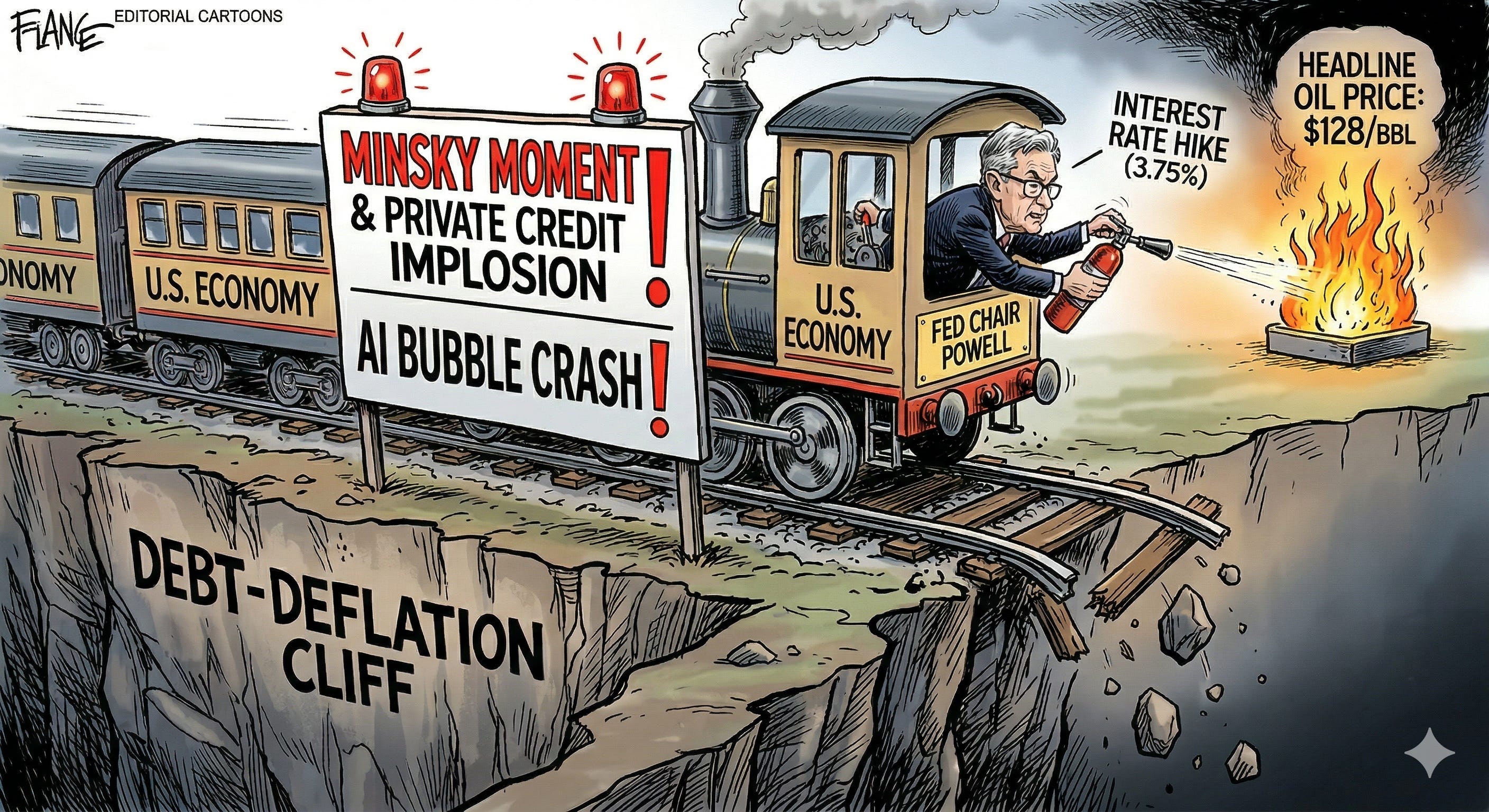
The Federal Reserve is currently fighting an “inflation” that is actually a supply-side tax, and in doing so, they are driving the U.S. economy toward a structural cliff. While headline numbers are propped up by $120+ Brent crude and a naval blockade in the Strait of Hormuz, the organic economy is already deflating.
The MV=PY Reality: With the money supply (M) stagnant and velocity (V) collapsing as households hoard cash amid price uncertainty, total spending is shrinking. The Fed’s refusal to cut rates is starving an already seizing engine.
The “Thin Air” Fallacy: Expectations of inflation cannot create money. Without credit expansion, high gas and electric prices (driven by the AI power drain) act as a massive drain on liquidity, not a catalyst for a wage-price spiral.
Hidden Underemployment: The 4.3% unemployment rate is a mirage. The shift toward gig work (the “Underemployment Trap”) masks a deep recession in discretionary purchasing power.
The Minsky Moment: We are reaching the breaking point for $39 trillion in public debt and record margin leverage. As the AI capex bubble bursts and private credit freezes, the “Volcker Mistake” of staying tight risks a self-reinforcing Fisherian debt-deflation spiral.
Bottom Line: The Fed is applying a 1970s demand-side remedy to a 2026 supply-side catastrophe. If they don’t pivot now, the “Grave Error” will become the Great Collapse.
The Federal Reserve under Chair Jerome Powell is currently repeating one of the oldest and most dangerous mistakes in central banking. They are fighting the wrong kind of price pressure with the wrong tool at the wrong time.
The United States finds itself in a precarious position. We are engaged in conflict in Iran, the Strait of Hormuz is effectively disrupted, and Brent crude spot prices are climbing toward $128 per barrel. Headline inflation measures are rising, driven entirely by the energy sector. In response, the Fed has held the Federal Funds Rate in the restrictive 3.5 to 3.75 percent range, with markets now pricing in the possibility of zero rate cuts for the remainder of the year.
This stance is not prudence. It is a policy blunder that risks converting temporary cost increases and a massive redirection of capital into a self-reinforcing deflationary spiral.
To understand the error, we must first define the enemy. Higher oil prices should not be labeled “inflation” in the classical sense. True inflation is a sustained decline in the purchasing power of money, typically driven by excessive growth in the money supply relative to real output. What we are experiencing today is a relative price change: a classic negative supply shock.
The Fed’s current obsession with “inflation expectations” suffers from what we might call the Thin Air Problem. There is a persistent belief among central bankers that if people expect inflation, they will magically create it through their behavior. But expectations cannot create money out of thin air any more than the expectation of rain can cause a storm. For expectations to translate into a “wage-price spiral,” there must be an expansion of credit to fund those higher wages and prices.
In an environment where the money supply is fixed and credit is tightening, expectations of higher prices do not lead to a spiral. They lead to a collapse in demand. As consumers are forced to redirect every spare dollar toward the gas pump and the electric bill, discretionary spending is vanishing. In the organic economy, prices for clothing, electronics, and services are already deflating because the liquidity has been sucked out of the room by the energy tax.
The most critical framework for understanding this crisis is the Quantity Theory of Money, expressed by the formula:
$$MV = PY$$
In this equation, $M$ is the money supply, $V$ is the velocity of money (the rate at which a single dollar circulates through the economy), $P$ is the price level, and $Y$ is the real economic output. This is not just a formula; it is a fundamental law of financial physics.
Currently, the Fed is keeping $M$ (money supply) relatively restrictive. At the same time, we are seeing a catastrophic collapse in $V$ (velocity). Velocity is a psychological variable. In times of uncertainty and spiking energy costs, households and firms do not spend; they hoard cash. When money stops moving, the total volume of nominal spending in the economy ($MV$) shrinks.
On the other side of the equation, $Y$ (real output) is being hammered by resource redirection. If $MV$ is shrinking faster than $Y$ is falling, then $P$ (the general price level) must fall. By keeping interest rates high, the Fed is incentivizing even more hoarding, further slowing the velocity of money and ensuring that the price collapse is violent rather than gradual.
Compounding the collapse of velocity is a massive redirection of real-world resources toward non-consumer ends. For one thing, the FY2027 budget request for $1.5 trillion for the Department of War represents a sizeable shift in capital allocation. This is joined by the AI Malinvestment Cycle. As reported by critics, the AI “capex bubble” has reached a breaking point. Trillions of dollars have been poured into data centers to power AI and blockchain. While this has consumed a massive share of the nation’s electricity and pushed residential utility bills to record highs, it has yet to yield a proportional surge in actual productivity.
This is the Broken Window Fallacy on a global scale. There is a persistent myth, often pushed by those who benefit from military contracts and bubble spending, that it is stimulative because it creates jobs. But as the 19th-century economist Frédéric Bastiat famously argued, this ignores “the unseen.” Every dollar spent on a missile that will be expended in a conflict or a server rack which anticipates future rather than present demand is a dollar taken away from currently productive private-sector investments. The “seen” is the worker in the munitions factory or data center; the “unseen” is the restaurant, the bridge, or the startup that was never funded because the capital was diverted.
We are essentially burning our economic furniture to keep the lights on in data centers that produce unprofitable chat bots rather than real-world utility. This is a massive drain on the $Y$ (output) in our equation, creating a “hollow” economy where costs rise due to scarcity while the base of wealth actually shrinks.
We are now approaching a Minsky Moment. Named after economist Hyman Minsky, this describes the point in a debt cycle where the cash flow from assets is no longer enough to service the debt taken out to buy them. Minsky identified three stages of debt: Hedge (you can pay principal and interest), Speculative (you can only pay interest), and Ponzi (you have to sell assets or borrow more just to pay interest).
The signs of a move into the “Ponzi” stage are everywhere. As market observers have noted, the private credit markets — the “shadow” banking sector that grew to fill the void left by traditional banks — are starting to implode. These markets are opaque and highly leveraged. Middle-market companies that relied on these loans are finding that they can no longer afford high interest rates on top of record energy costs.
When the cash flow stops, the selling starts. This is the “forced liquidation” phase of a Minsky Moment. If the Fed continues to hold rates high, they are effectively ensuring that this liquidation is not an orderly exit, but a fire sale.
This instability is magnified by record levels of leverage. According to data from the New York Fed, U.S. household debt has reached a breaking point. Consumers are highly leveraged, often using credit cards to bridge the gap between stagnant wages and $120 oil. At the same time, margin debt — money borrowed by investors to buy stocks — has reached record highs.
This creates a terrifying feedback loop. Because people are forced to seek returns in risky markets to outpace the energy tax, they have borrowed more than ever to play the stock market. When the AI capex bubble bursts or the private credit markets freeze, it triggers margin calls. Investors are forced to sell their holdings to pay back their brokers, which drives prices lower, triggering more margin calls. This is the “cliff” that the Fed is driving us toward.
The Fed remains haunted by the ghost of Paul Volcker. They want to be the heroes who broke the back of inflation in the 1970s. But they are making the Volcker Mistake: applying a demand-side sledgehammer to a supply-side catastrophe.
In the 1970s, the U.S. had low debt and high productivity. Today, we have $39 trillion in public debt, even more in private debt, and a labor market that is far more fragile than the headline numbers suggest. Powell is watching for the official unemployment rate to rise as a signal to cut. But he is ignoring the Underemployment Trap.
In 2026, workers do not simply move from full-time factory work to the unemployment line; they move into the gig economy. They drive for Uber or perform freelance tasks just to stay ahead of their debt. These people are technically “employed,” but their discretionary purchasing power is gone. The labor market is not “tight” in a healthy way; it is “tight” in a desperate way. By waiting for a spike in official jobless claims, the Fed is ignoring the millions of Americans who are already living through a private recession and largely have been since COVID. The so-called vibecession never ended.
This dynamic echoes Irving Fisher’s debt-deflation mechanism. In a debt-deflationary spiral, the general price level falls, but the nominal value of debt remains the same. As non-energy prices continue to fall, the real burden of our $39 trillion public debt and record private debt actually rises.
Debtors are forced to cut spending even further to service their obligations, which causes prices to fall further, which makes the debt even heavier. This is a self-reinforcing downward spiral that the Fed will find nearly impossible to reverse once it gains momentum.
The Fed’s current policy is based on a fundamental misreading of history. They see war and high oil and they think “1970s Inflation.” But they are ignoring the fact that the Fed is not printing money to accommodate the shock, velocity is collapsing, and the private credit market is in a state of seizure. By treating this as a demand problem, they are compounding the contractionary forces already at work.
The appropriate response is to ease policy clearly and decisively. Rate cuts would stabilize the velocity of money, reduce the real burden of debt, and cushion the erosion of real incomes. The window to avoid a self-reinforcing debt-deflationary spiral is closing. It is time to cut before the Grave Error becomes the Great Collapse.
Unfortunately, the Fed is always looking in the rearview mirror and always acts too late. They are still fighting the last war. Thus the crash is all but inevitable and then they will panic along with everyone else.
Comments
Nothing yet. Say the first thing.
Sign in to join the conversation.