
The AI trade is over. NVDA touched $5 trillion market cap and dumped. CSCO double-topped after 25 years. Nobody trusts the games the AI companies are playing with circular investments and undervaluing technical debt. The Magnificent 7 are leading a massive crash that should take years to play out. Growth investing is dead for the foreseeable future. How can you preserve and grow your wealth in this environment and maintain reasonable returns?
There are methods available today to generate income on a brokerage account which don’t include HODLing high risk tech and crypto stocks whose bubble is now collapsing. In fact, very high returns can be had for very little risk. I’m talking better than 50% per year.
In the 1970s, Harry Browne (Fail-Safe Investing, How You Can Profit From The Coming Devaluation) designed a set-and-forget allocation to survive any macroeconomic environment. It looked like this:
25% Stocks - prosperity, growth
25% Long-term Treasuries - deflation, falling rates
25% Gold - inflation, currency devaluation, crisis
25% Cash / T-Bills - recessions, liquidity, rebalancing ammo
This “Permanent Portfolio” assumes four macro “seasons” drive asset behavior:
Prosperity → stocks win
Inflation → gold wins
Deflation → long bonds win
Recession/stagnation → cash preserves value
One of these regimes is always occurring, so the portfolio is designed to avoid major drawdowns at the cost of capped upside.
In the 1990s, Ray Dalio (Bridgewater Associates) developed a similar risk-parity portfolio designed to survive all economic environments by balancing exposure to different drivers of return, weighted not by dollars but by risk. Bridgewater’s “Holy Grail” of investing involves combining “15 good uncorrelated return streams, risk-balanced”. The popular, simplified version of his All Weather Portfolio for retail investors has a specific, risk-balanced allocation:
40% Long-Term U.S. Treasuries
30% U.S. Stocks
15% Intermediate-Term U.S. Treasuries
7.5% Gold
7.5% Commodities
This investment strategy is structured to be indifferent to shifts in discounted economic conditions. By balancing assets based on these structural characteristics, the impact of economic surprises can be minimized. Market participants might be surprised by inflation shifts or a growth bust, but All Weather would chug along, providing attractive, relatively stable returns. The strategy is passive; in other words, it’s the best portfolio Ray and his close associates could build without any requirement to predict future conditions.
In the 2020s, Chris Cole (Artemis Capital) popularized a long-volatility, antifragile strategy for tail risks and regime change. This is a direct answer to the failure of traditional 60/40 portfolios in stagflationary or volatility-clustered regimes. He thought that a portfolio should not merely hedge inflation/deflation cycles, but also:
Volatility clusters
Currency collapse / debt cycle resets
Equity market failure
Long-run structural regime shifts
The “Dragon Portfolio” suggested weights include:
20% Stocks
20% Bonds
20% Commodities & Trend-Following
20% Long Volatility / Tail Risk
20% Hard Assets (gold, commodity producers, real assets)
In short, the Dragon Portfolio is the “next-level” evolution of the Permanent Portfolio and All Weather Portfolio for a world of currency debasement, near-zero rates, and nonlinear market structures. Once again, this portfolio hedges risks at the cost of capping upside. Also the long vol component makes it less set-and-forget than the previous strategies because being long vol is a very costly trade under most circumstances. It has to be put on when things are getting toppy (VIX convexity).
So how do you get good returns if you cap the upside? That’s what I set out to solve with my portfolio. And the answer is with high-yielding sectors and options strategies. Over the past few years, ETFs have launched which engage in covered calls, futures, warrants, and synthetic long/short strategies. This enables us to construct a risk-averse, balanced portfolio which adheres to the concepts of Harry Browne, Ray Dalio, and Chris Cole while also achieving high yields.
The first principle to incorporate is asset diversity. We want stocks, bonds, precious metals, T-bills, commodities, real assets, etc. Things which tend to perform in non-correlated cycles. I’m going further than the Permanent Portfolio, All Weather Portfolio, and Dragon Portfolio in terms of seeking diversity. I’m looking at real estate, midstream energy companies, utilities, gold & silver mining, polymetal mining, consumer staples, small-cap companies, tech companies, natural resources, oil and integrated energy, etc.
Not only that, but as a corollary to this first principle, I want to be both long and SHORT. Certain bubble companies and sectors should be bet against with an income-producing options strategy to balance out any longs that are taken.
The next principle is issuer diversity. Since we’re employing ETFs, and the managers of said ETFs may have biases, we want to ensure that a lot of different managers and cultures are included. So for example, we don’t want to just invest in all of the State Street SPDRs or BlackRock iShares funds.
The third principle is location diversity. A U.S.-only portfolio has too much political, monetary, and financial system risk. We should include lots of global and foreign assets across many sectors.
The fourth principle is diversity of income-producing strategies. Some are riskier than others. We want a core of dividends because they are the safest. Then we want to add traditional covered calls against owned assets. Then we can start adding futures, warrants, total return swaps, synthetic covered calls, synthetic covered puts, 0DTE calls, etc. These income strategy risks (together with sector, concentration, location, and other risks) are incorporated into a safety score for each position.
The next, and perhaps most important principle is to prefer the highest yields possible. This is how to generate large returns. We’re choosing instruments that pay above-average yields to exceptional yields while keeping a diversity of safety scores. We don’t want only very risky, super-high yield funds, but there should be some.
Finally, the combination of yield, expense ratio, and safety score are used to calculate an overall score for each position. The higher the score, the greater the weight in the portfolio. The score is theoretically 0-100, although the portfolio ends up with more constrained scores due to screening.
This is not a set-and-forget portfolio. The short components only work when the targeted companies/sectors are bubblicious, as they are today. Once the P/E ratios come down to reality, these positions need to be tapered off. Otherwise, the distributions will come from return-of-capital (ROC) and the NAV will decline substantially.
A long vol ETF such as UVXY or TAIL could be added during extremely low vol periods (market tops), but that’s not included in the portfolio because it’s not income producing and decays quickly. It could be a further hedge though during those time, generating capital for portfolio balancing.
Also, I wouldn’t automatically fully fund all of the long stock positions in a bubble market that’s topping, but could be dollar-cost-averaged into as valuations get more reasonable. That said, the portfolio is already short-biased and precious metal-biased, so it wouldn’t be terrible to hedge with the long stock positions right off the bat.
Additionally, safety scores can change over time based on market conditions. E.g. after the Russell 2000 crashes to historic low P/E ratios, the safety score on RDTE may increase since the probability to the upside is so much higher. Rebalancing can come from the short stock positions, short duration bonds, long bonds, gold mining, etc., which should also see safety scores change inversely. It would make sense to rebalance whenever any sector sees some major change in valuation.
So without further ado, here’s the model portfolio with weighted allocations assuming a $100,000 total value (click to open fully). There are a total of 41 positions ranked from highest to lowest overall score. Assuming positions are weighted by the score, then the annual yield on $100k is better than $56k, or 56%. Much of it is paid on a weekly basis.
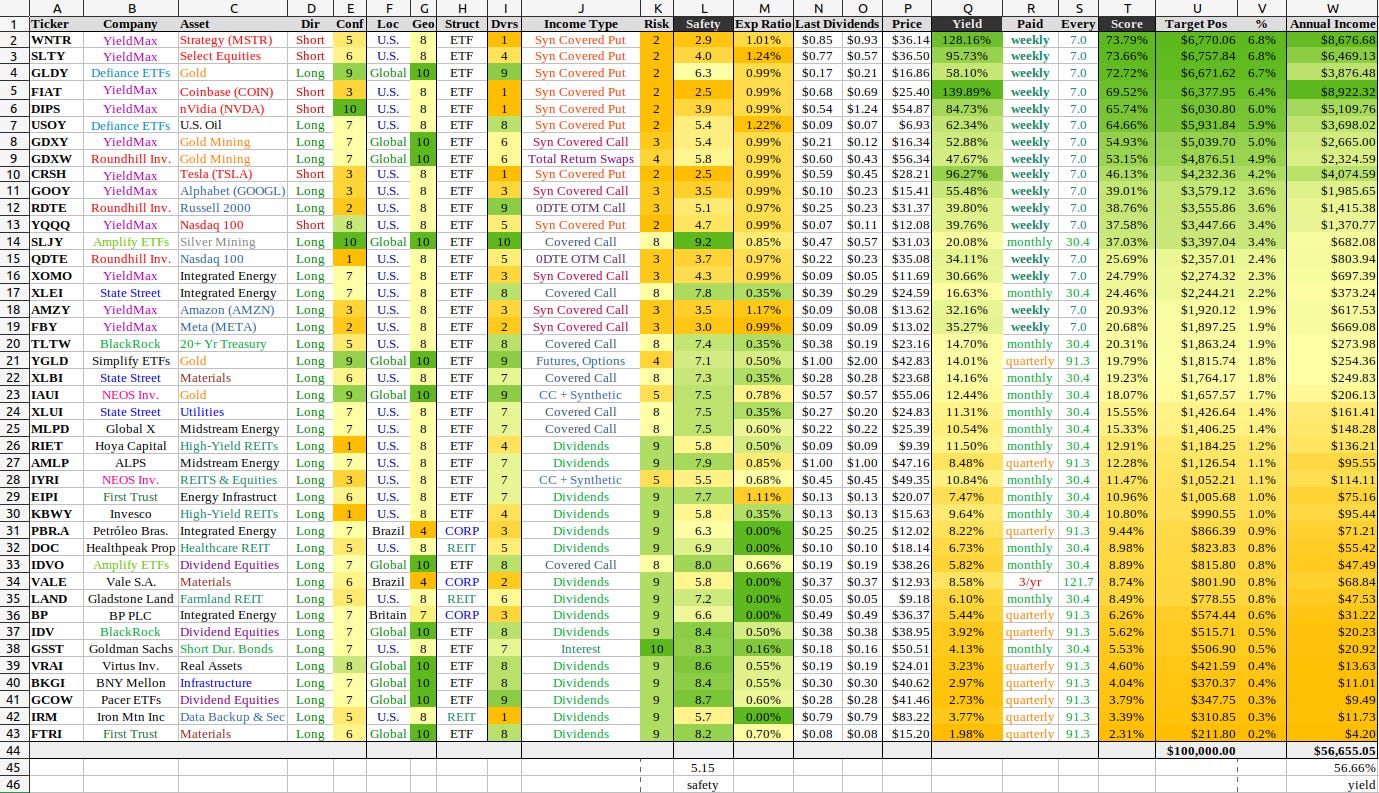
Column E represents your own personal confidence in this particular instrument and is the only really subjective aspect. You should rank these according to how strongly you believe this asset will gain in value in the future. Column G is the geographical risk, with some subjectivity on the per-country score. Column I is the diversity of underlying income streams, which may be scored according to how many equities are in an ETF, how many properties or types are in a REIT, or how many independent lines of business are in a CORP. Column K is the risk of the specific method of generating income. And column L is the formulaic composition of these other confidence/risk scores. The final score (column T) combines this safety score, yield, expense ratio, frequency of distributions, and whether distributions are increasing or decreasing in value. The end result is a safety and yield weighted portfolio to maximize income while minimizing risk.
As balanced and risk averse as this portfolio is, there is still the brokerage risk as well. If you’re using, say, Merrill Lynch, and Merrill Lynch should have some issue which prevents you trading or even loses your assets, then it would be a good idea to have some assets also in perhaps Alpaca or E*trade or Robinhood (use http://PassantGardant.com/Robinhood for a free stock). Splitting a $100k portfolio into four $25k portfolios in different brokerages would mean keeping and trading 3/4ths of your positions in the event of a brokerage problem (as may happen during extreme market conditions), even if only temporarily.
There’s also the issue of using digital securities at all. At least some of your assets, perhaps as much as 30-40% should be in physical precious metals. Some of these may be in your own possession in a home bolt-down safe (don’t use bank safe deposit boxes, as those can be frozen and confiscated). You can also use highly secure non-bank precious metal vaulting companies. I recommend the following two mostly highly:
BullionVault (http://PassantGardant.com/BullionVault)
Either of these companies will be able to store your wealth in gold, silver, or platinum in any number of fully insured vaults around the world. BullionVault has vaults in New York, London, Toronto, Zurich, and Singapore. OwnX has vaults in Delaware and Texas. Both will allow you to transfer money to and from any bank account and trade metals online. Not only will keeping your wealth in allocated precious metals protect against bank runs and money market runs, but it’ll also protect you against inflation and hyperinflation.
Unlike with banks and money market funds, allocated precious metals repositories like BullionVault and OwnX cannot suffer runs because customer assets are segregated and allocated to them specifically. There’s no loss of value or first mover advantage to redeeming your assets. They’ll still be there no matter how many other customers want to take delivery.
Having a mix of precious metals at home, allocated precious metal storage, and the Max Income Portfolio should preserve and grow your wealth in all possible economic scenarios.
I’m not your financial advisor and this is not individual financial advice. You make your own decisions and are responsible for them. This article is for information purposes only.
Comments
Nothing yet. Say the first thing.
Sign in to join the conversation.