
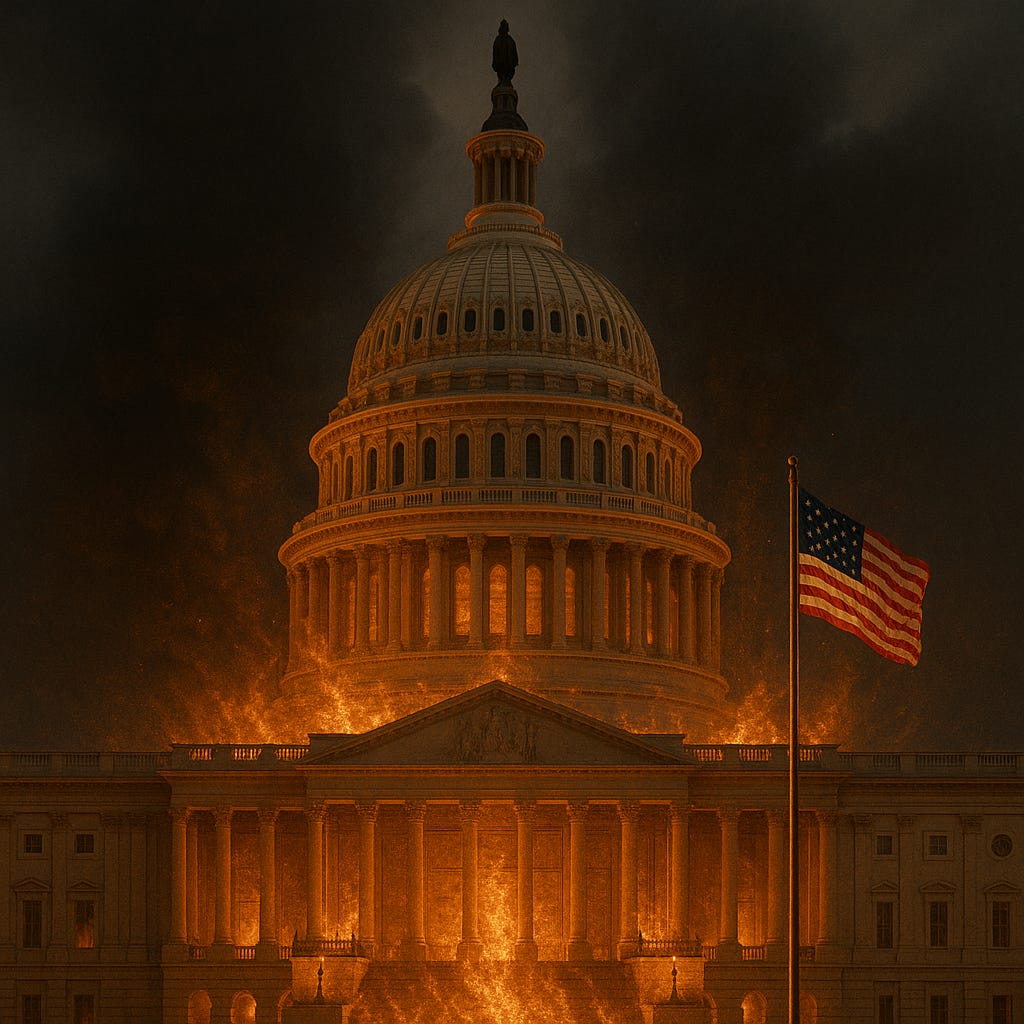
Historical precedents illustrate how political crises have been utilized to undermine opponents and centralize authority. The Reichstag Fire of 1933 served as a pretext for the Nazi regime to suspend civil liberties and dismantle the Communist Party, facilitating the establishment of authoritarian rule. Similarly, the events of January 6, 2021, at the U.S. Capitol have been interpreted as a manufactured incident that enabled Democratic leaders and associated institutions to pursue extensive prosecutions and heightened security measures against former President Trump and his supporters. This pattern aligns with documented CIA strategies for regime change in foreign nations, such as Iran in 1953, Guatemala in 1954, and Chile in 1973, which appear to have been adapted for domestic application. Additional historical analyses reveal that crises like these often involve disputed origins, rapid governmental responses, and long-term consolidation of power, as seen in the Reichstag Fire's role in enabling the Nazi dictatorship. The exploitation of such events can lead to the erosion of democratic institutions, with intelligence agencies playing a pivotal role in shaping outcomes. In the case of January 6th, intelligence failures and anomalies in security protocols have raised questions about orchestration, mirroring tactics refined abroad. This analysis examines the Reichstag Fire in greater detail, declassified CIA methodologies with expanded examples, and parallels in the response to January 6th, incorporating recent revelations and scholarly insights to underscore the consistency of crisis exploitation strategies.
On February 27, 1933, the Reichstag building in Berlin was set ablaze, an event that remains shrouded in controversy regarding its true perpetrators. The Nazi leadership, under Adolf Hitler and Hermann Göring, attributed the incident to the German Communist Party (KPD), despite contested evidence regarding their involvement and suggestions that the fire may have been orchestrated or at least opportunistically exploited by the Nazis themselves. Marinus van der Lubbe, a Dutch communist, was arrested at the scene and later executed, but historians have debated whether he acted alone or if Nazi agents facilitated the arson to create a pretext for repression. President Paul von Hindenburg, at Hitler's direction, issued the Reichstag Fire Decree, which suspended rights to free speech, press, assembly, and privacy of communications, while permitting indefinite detention without trial. Thousands of Communists were subsequently arrested, their leadership imprisoned, and their parliamentary representation obstructed. This facilitated the passage of the Enabling Act in March 1933, conferring dictatorial powers on Hitler's cabinet. Historical accounts establish that the Nazis leveraged the fire to neutralize opposition and justify the erosion of democratic norms under the guise of national security. Further examinations highlight how the Nazis propagated a narrative of communist terrorism through controlled media and public broadcasts, amplifying fear to consolidate support. The Brown Book, published by exiled communists, mixed factual reports of Nazi brutality with allegations of a Nazi conspiracy, underscoring the disputed nature of the event. This exploitation not only eliminated key rivals but also set a precedent for using "attacks on the nation" to dismantle democratic safeguards, a tactic echoed in later authoritarian regimes.
Declassified records outline recurring tactics in CIA-supported operations overseas, providing a blueprint for destabilization that emphasizes covert manipulation. In Iran during 1953, Operation Ajax employed propaganda, orchestrated demonstrations, and agent provocateurs to generate instability prior to the removal of Prime Minister Mossadegh, with the CIA explicitly acknowledging its role in declassified documents. The operation involved bribing journalists, staging riots, and disseminating false narratives to portray Mossadegh as a communist threat, ensuring plausible deniability for U.S. involvement. In Guatemala in 1954, Operation PBSUCCESS incorporated psychological operations, targeted disruptions, and controlled narratives to depose President Árbenz, including the creation of a "Study of Assassination" guide found in declassified training files. This coup featured radio broadcasts spreading disinformation about impending massacres and economic sabotage to erode public support. In Chile in 1973, U.S. covert activities exacerbated economic unrest and disseminated propaganda against President Allende, culminating in the Pinochet coup through amplified strikes and media campaigns. These interventions followed a consistent framework: (a) incitement through embedded agents; (b) framing narratives to discredit targets; (c) differential treatment in prosecutions; and (d) media-based psychological campaigns. Such approaches were engineered for destabilization while preserving deniability, and evidence suggests their transposition to domestic contexts. Additional declassified materials reveal motivations tied to economic interests, such as protecting corporate assets in Iran and Guatemala, and Cold War fears of Soviet influence. Scholarly analyses emphasize how these operations created chaos to justify intervention, a pattern that extends to other cases like the Congo in 1960, where similar tactics were used to remove Patrice Lumumba. The repeatability of this playbook underscores its adaptability, potentially informing responses to internal political challenges.
A key component of CIA destabilization efforts involves the deployment of provocateurs to initiate and direct unrest, often creating the appearance of organic chaos. In Iran, operatives compensated crowds to engage in riots against governmental symbols; in Chile, demonstrations were channeled toward strategic sites. Comparable elements emerged on January 6th, where individuals such as Ray Epps were recorded encouraging entry into the Capitol on January 5th and 6th, yet faced delayed and limited charges, fueling suspicions of protected status. Epps, a former Marine, became a focal point of conspiracy theories alleging he was a government agent, theories amplified by right-wing media but dismissed in court as baseless. Security barriers were relocated in certain instances, and defenses appeared insufficient, contributing to the event's intensification, as detailed in Senate reports highlighting intelligence and operational failures. These observations align with patterns of managed provocation observed in historical CIA operations. Further investigations reveal a "string of failures" across agencies, including poor planning and underestimation of threats despite online chatter warning of violence. The U.S. Capitol Police leadership's inability to communicate effectively during the breach exacerbated the escalation, with some officers reportedly standing aside as crowds advanced. Such anomalies parallel the Reichstag Fire, where access to the building raised questions about internal facilitation. Critics argue these lapses suggest engineered elements, consistent with foreign coup tactics where provocateurs are shielded to direct blame elsewhere.
Claims from Capitol Police officers further support the notion of intentional orchestration, suggesting that security was deliberately compromised to allow the event to unfold and generate a predetermined narrative. Former U.S. Capitol Police Lieutenant Tarik Johnson, who served for 22 years and was involved in evacuating lawmakers on January 6, has stated that he believes the events were a "set-up" and that a subsequent "enormous size cover-up ensued after to hide the facts." Johnson initially viewed the day as an insurrection based on media reports but revised his assessment as additional facts emerged, concluding it was planned behind the scenes by figures like former Assistant Chief Yogananda Pittman to advance personal ambitions, such as gaining favor with congressional leaders and securing promotion to chief. He recounted leadership failures, including unanswered radio calls for guidance during the breach, leaving officers without direction and fearing for their lives, which he interpreted as abandonment. Johnson was not called to testify before the January 6 Committee despite his direct involvement, and he has highlighted Pittman's role in intelligence mishandling as central to the chaos. A separate Capitol Police whistleblower, in a letter to congressional leaders, accused Pittman and acting chief of uniformed operations Sean Gallagher of deliberately opting not to assist officers under attack, instead watching footage "mostly with their hands in their laps" while doing little to intervene. The whistleblower alleged this was intentional and malicious, aimed at personal promotion, and that Pittman lied to Congress about sharing critical intelligence, including a report on threats from online forums. These accounts indicate premeditated lapses that allowed officers to be overrun and injured, fostering a narrative of unchecked insurrection to justify subsequent political actions.
Documented footage and claims from actor and filmmaker Nick Searcy, who was present at the Capitol on January 6, reinforce indications of orchestrated escalation. In his 2021 documentary "Capitol Punishment," Searcy presents never-before-seen footage from the rally, depicting a massive, largely peaceful gathering that he describes as resembling a "tailgate party" rather than a violent uprising. The film includes interviews with participants, law enforcement, and officials, asserting that the mainstream media misrepresented the events as a "planned and well-equipped insurrection," contrary to the footage showing limited violence amid a crowd of tens of thousands. Searcy highlights video of the shooting of Ashli Babbitt by a Capitol Police officer, cleared as self-defense, and interviews with her husband, emphasizing the event's tragic but isolated nature. These elements suggest a deliberate allowance of chaos to frame the broader assembly as threatening, aligning with CIA-style crowd management tactics.
CIA regime-change efforts routinely prioritize immediate narrative dominance to shape public perception and justify actions. In Guatemala, fabricated broadcasts via the "Voice of Liberation" accused Árbenz of impending atrocities to legitimize intervention. Following January 6th, the incident was promptly characterized as an "insurrection" and "coup attempt" by Democratic figures and media entities. President-elect Biden described it as "one of the darkest days in American history," while Speaker Pelosi referred to Trump as a "domestic enemy" in documented footage. The January 6th Committee has been critiqued as a partisan mechanism that reinforced this framing, as noted in subsequent Republican investigations. This expedited and uniform messaging reflects techniques employed in foreign destabilization campaigns. Media outlets replayed selective footage to emphasize violence, echoing Nazi propaganda post-Reichstag Fire that broadcast colored reports to incite anti-communist sentiment. Comparisons to the Reichstag event have been drawn by commentators, noting how both incidents were used to label opponents as existential threats. Political figures, including GOP nominees, have invoked these parallels to argue against perceived overreach in prosecutions. The speed of narrative consolidation, combined with suppression of alternative views, mirrors psy-op strategies designed to fix blame and mobilize support.
In CIA-backed coups, instigators often receive protection while broader opposition faces severe repercussions, creating intimidation and discrediting leaders. In Iran and Guatemala, key operatives evaded accountability amid widespread arrests of adversaries. The Department of Justice's response to January 6th constitutes its most extensive investigation, resulting in charges against over 1,500 individuals, many for nonviolent actions. However, Ray Epps, prominently involved in calls to enter the Capitol, was prosecuted only after significant delay and with lesser offenses, receiving a year of probation despite conspiracy allegations. This differential treatment, alongside pursuits against Trump, corresponds to the selective enforcement model documented in international operations. Epps' case led to a dismissed defamation lawsuit against media outlets that amplified theories of his government ties. Broader reports indicate equipment and training failures contributed to uneven responses, with some participants facing harsh sentences while others, potentially pivotal, escaped scrutiny. This echoes the Reichstag trial, where van der Lubbe was scapegoated amid a show trial that acquitted Nazi-accused figures but suppressed opposition. The pattern suggests a strategy to target rank-and-file while protecting instigators, fostering division and deterring dissent.
Filmed case studies in Nick Searcy's 2024 documentary "The War on Truth" illustrate these disparities through video evidence and interviews. For instance, former Tennessee Deputy Sheriff Ronald Colton McAbee is shown in footage assisting law enforcement and attempting to save Rosanne Boyland, who died during the events, yet he was convicted and sentenced to 70 months in prison. Dr. Simone Gold and John Strand, who entered the Capitol nonviolently, received 60 days and 32 months respectively, with Strand's harsher sentence attributed to rejecting a plea deal. Journalist Jesus "J.D." Rivera was sentenced to eight months, including two in solitary confinement, for following the story inside without violence. Victoria White's footage depicts her attempting to prevent violence before being beaten and sprayed by police in a crowd surge, leading to a 10-day sentence after a guilty plea. These examples, supported by expert testimony from FBI whistleblowers Kyle Seraphin and Steve Friend, as well as journalists like Julie Kelly, highlight a two-tiered system where prosecutions exaggerate culpability to silence dissent, mirroring selective tactics in foreign coups.
Psychological warfare forms a cornerstone of CIA strategies, involving the exaggeration of events via controlled outlets to generate fear and compliance. In Guatemala, staged incidents were magnified through radio; in Chile, disruptions were attributed to Allende. Coverage of January 6th emphasized violent footage repeatedly, despite the largely nonviolent nature of the gathering. Platforms, influenced by governmental directives, suppressed alternative accounts regarding potential instigators or security lapses, as evidenced in legal proceedings. This approach facilitated the adoption of enhanced surveillance measures, paralleling fear-inducing tactics used abroad. Nazi media saturation post-Reichstag amplified anti-communist hysteria, justifying the decree's suspensions. In modern parallels, social media censorship of January 6th theories mirrors historical propaganda controls, with accusations of "information warfare" to enforce a dominant frame. Broader analyses note how such operations erode trust, as seen in comparisons to 1930s Germany where media was co-opted to support authoritarian shifts.
"The War on Truth" further documents this through claims that federal actions constitute a deliberate campaign to distort reality and intimidate witnesses, with Searcy narrating how the government has twisted accusations against nonviolent participants to perpetuate the insurrection narrative. The film includes footage and interviews asserting that the events were exaggerated to label tens of thousands as "domestic terrorists" based on the actions of fewer than 300, creating a chilling effect on free speech akin to CIA psy-ops abroad.
The January 6th events occurred against the backdrop of the Russiagate inquiry, which recent declassifications portray as a politicized effort to undermine Trump. In July 2025, the Office of the Director of National Intelligence issued PR-18-25, asserting that President Obama directed the formulation of a biased 2017 Intelligence Community Assessment to challenge Trump's legitimacy, characterizing it as a prolonged effort to subvert his administration. Declassified correspondence from DNI James Clapper included the statement, "That’s OUR story," indicating narrative manufacturing. These disclosures, including a House report on the "manufactured Russia hoax," reveal suppression of doubts and publication of implausible reports claiming Russian preferences for Trump. A newly declassified appendix to the Durham Report exposes Clinton campaign plans to falsely tie Trump to Russia, with FBI failures to investigate. Media coverage has been criticized for burying these revelations after hyping the initial hoax. Political reactions include calls for indictments and grand jury probes into the conspiracy. These indicate that intelligence practices, traditionally applied overseas, were employed domestically, providing context for the handling of January 6th and suggesting a continuum of institutional bias.
Further declassifications implicate the CIA directly in signing off on fraudulent Russiagate intelligence reports, marking a clear instance of the agency's involvement in domestic political intervention. Under Director John Brennan, the CIA led the creation of the January 2017 Intelligence Community Assessment (ICA), which falsely asserted with high confidence that Russian President Vladimir Putin sought to aid Trump's election by discrediting Hillary Clinton, despite internal objections from veteran CIA analysts who noted the lack of direct evidence and reliance on substandard, unverifiable reporting. Brennan overruled these concerns, insisting on including dubious sources such as the Steele Dossier—known to be flawed and politically motivated—in the ICA's main text and annex, responding to challenges with remarks like, “Yes, but doesn’t it ring true?” The ICA, drafted by a small team of just five analysts under unusual political directives from Obama and senior appointees, mischaracterized intelligence, cherry-picked unrelated reports, and excluded contradictory evidence, such as Russian officials preparing for a Clinton victory and declining to release damaging information on her. DNI Tulsi Gabbard, upon releasing the declassified House Permanent Select Committee on Intelligence (HPSCI) report from September 2020, described it as exposing a "treasonous conspiracy" orchestrated by Obama and his officials to promote this false narrative, with the CIA failing to adhere to analytic standards and manufacturing evidence to legitimize the hoax. Transmitted declassified Durham documents, coordinated between the DOJ and CIA, further confirm this coordinated effort to propagate the Trump-Russia collusion falsehood, undermining Trump's presidency from its inception. This CIA endorsement of politicized intelligence not only eroded public trust but also exemplified the migration of foreign regime-change tactics—such as narrative framing and disinformation—into U.S. domestic politics, setting a precedent for subsequent events like January 6th.
In "The War on Truth," FBI whistleblowers like Kyle Seraphin and Steve Friend provide filmed testimony alleging agency involvement in inflating threats and suppressing exculpatory evidence, further linking intelligence operations to the January 6 narrative. Intelligence expert J. Michael Waller and journalists such as Tayler Hansen contribute claims that the events involved orchestrated elements, including potential FBI sources inciting violence, consistent with patterns in Russiagate.
This pattern of intelligence agency intervention extended to the suppression of the Hunter Biden laptop story just before the 2020 election, where the FBI engaged in "prebunking" efforts to discredit the revelations as foreign disinformation. Despite authenticating the laptop's contents by November 2019—which included evidence of Biden family influence peddling—the FBI's Foreign Influence Task Force (FITF) held over 30 meetings with social media companies in 2020, warning of an impending Russian "hack-and-leak" operation involving Hunter Biden and Burisma, described as an "October surprise" with "real or manufactured evidence." These briefings, involving officials like Assistant Special Agent in Charge Elvis Chan and the FITF's Russia Unit Chief, primed platforms like Facebook, Twitter, and Google to censor such content, leading to policy changes that restricted hacked materials. On October 14, 2020, when the New York Post published the story, platforms immediately suppressed it—Twitter blocked URLs, and Facebook demoted visibility by 50% for seven days—citing the FBI's warnings, as evidenced in internal messages like "FBI tipped us all off last week that this Burisma story was likely to emerge." Additionally, 51 former intelligence officials, coordinated by then-Biden campaign senior advisor (now Secretary of State) Antony Blinken with CIA awareness, issued a public letter on October 19, 2020, falsely claiming the story had "all the classic earmarks of a Russian information operation." A House Judiciary Committee report details how this prebunking, part of broader post-2016 efforts including surveillance abuses against Trump's campaign, potentially influenced the election outcome, with polls indicating that awareness of the scandal could have swayed 9.4% of Biden voters. These actions further evidence a coordinated intelligence effort to undermine Trump by protecting his opponent through narrative control and censorship, mirroring foreign regime-change tactics.
The Reichstag Fire exemplified the use of a crisis to suppress dissent and consolidate power, with disputed origins and rapid repression setting the stage for dictatorship. CIA methodologies refined this approach through provocation, narrative control, selective prosecutions, and psychological operations, as evidenced in declassified accounts of multiple coups. The response to January 6th exhibits these elements: involvement of apparent provocateurs, facilitated escalations, swift narrative imposition, uneven legal pursuits, and media intensification. Corroborated by the 2025 ODNI revelations concerning prior intelligence activities, these parallels suggest the adaptation of foreign intervention tactics to the U.S. political landscape. Broader historical comparisons, including to 1930s Germany, highlight risks to democracy when crises are exploited. Further examination is warranted to assess the implications for democratic institutions, ensuring safeguards against such strategies in the future.
Evans, Richard. The Coming of the Third Reich. Penguin, 2003. https://www.penguinrandomhouse.com/books/292754/the-coming-of-the-third-reich-by-richard-j-evans/
Gasiorowski, Mark. “The 1953 Coup d’État in Iran.” International Journal of Middle East Studies, 19:3 (1987). https://www.jstor.org/stable/pdf/163655.pdf
Kinzer, Stephen. All the Shah’s Men: An American Coup and the Roots of Middle East Terror. Wiley, 2003. https://leftychan.net/edu/src/1619919756920.pdf
Cullather, Nick. Secret History: The CIA’s Classified Account of Its Operations in Guatemala, 1952-1954. Stanford University Press, 1999. https://web.colby.edu/intothearchive/files/2018/01/Cullather.pdf
Kornbluh, Peter. The Pinochet File: A Declassified Dossier on Atrocity and Accountability. The New Press, 2003. https://archive.org/details/pinochetfiledecl0000korn_k4a5
Department of Justice. “Capitol Breach Cases,” 2023 update. https://www.justice.gov/archives/opa/pr/proud-boys-leader-sentenced-22-years-prison-seditious-conspiracy-and-other-charges-related
CBS News. “Nancy Pelosi footage on Jan. 6 aftermath,” Aug. 28, 2024. https://www.cbsnews.com/news/nancy-pelosi-jan-6-aftermath-footage-donald-trump/
CNN. “House GOP launches new January 6 probe,” July 25, 2025. https://www.cnn.com/2025/07/25/politics/house-gop-january-6-investigation
ODNI. Press Release PR-18-25, July 23, 2025. https://www.dni.gov/index.php/newsroom/press-releases/press-releases-2025/4090-pr-18-25
Missouri v. Biden, No. 3:22-cv-01213 (5th Cir. 2023). https://ago.mo.gov/wp-content/uploads/missouri-v-biden-ruling.pdf
New York Times. Article on Ray Epps, July 2022. https://www.nytimes.com/2022/07/13/us/politics/jan-6-conspiracy-theory-ray-epps.html
NPR. Coverage, January 7, 2021. https://www.npr.org/programs/morning-edition/2021/01/07/954308591/morning-edition-for-january-7-2021
Washington Post. Coverage, January 7, 2021. https://www.washingtonpost.com/sitemap/2021/1/7/
CBS. Report on Ray Epps charges, September 2023. https://www.cbsnews.com/news/ray-epps-jan-6-protester-charged-over-capitol-riot/
Politico. "Capitol Police whistleblower delivers scathing rebuke to 2 of its senior leaders on Jan. 6," October 8, 2021. https://www.politico.com/news/2021/10/08/capitol-police-whistleblower-rebuke-jan-6-515696
Newsweek. "Ex-Capitol Police Officer Reveals How He Decided Jan. 6 Was a 'Set-Up'," December 5, 2023. https://www.newsweek.com/capitol-police-officer-jan6-set-cover-riot-1849342
Newsweek. "Ex-Capitol Police Officer Has New Theory About People Behind Jan. 6 'Set-Up'," December 6, 2023. https://www.newsweek.com/ex-capitol-police-officer-has-new-theory-about-people-behind-jan-6-set-1850036
NPR. "Former Capitol Police officer on Jan. 6 says leadership ignored him," January 20, 2023. https://www.npr.org/2023/01/20/1150316026/jan-6-attack-tarik-johonson-former-police
Office of the Director of National Intelligence. "New Evidence Uncovers Obama-Directed Creation of False Intelligence Report," July 23, 2025. https://www.dni.gov/index.php/newsroom/press-releases/press-releases-2025/4090-pr-18-25
Department of Justice. "Department of Justice, CIA Transmit Declassified Durham Documents to Senator Chuck Grassley," July 31, 2025. https://www.justice.gov/opa/pr/department-justice-cia-transmit-declassified-durham-documents-senator-chuck-grassley
House Permanent Select Committee on Intelligence. "Crawford on the Release of the HPSCI Majority Staff Report," July 23, 2025. https://intelligence.house.gov/news/documentsingle.aspx?DocumentID=2576
BBC News. "Gabbard says declassified report 'exposes' Obama administration," July 23, 2025. https://www.bbc.com/news/articles/cx2l01ek0y7o
IMDb. "Capitol Punishment," 2021. https://www.imdb.com/title/tt16252560/
The War on Truth Movie. "BlazeMedia: Nick Searcy's and Chris Burgard's new January 6 documentary exposes ‘the war on truth’," June 3, 2024. https://thewarontruthmovie.com/blazemedia-nick-searcys-and-chris-burgards-new-january-6-documentary-exposes-the-war-on-truth/
House Committee on the Judiciary. "The FBI's Role in the Suppression of the Hunter Biden Laptop Story and Election Interference," October 30, 2024. https://judiciary.house.gov/sites/evo-subsites/republicans-judiciary.house.gov/files/evo-media-document/FBI-Election-Interference-Report-FINAL--10-30-24-.pdf
Comments
Nothing yet. Say the first thing.
Sign in to join the conversation.