
This week I dropped my four full episodes of The French Culture Podcast to players including Apple, Spotify and RSS: something that felt momentous after almost a year of feverish work on this project.
If you didn’t get or read last week’s issue, I shared Episode 2, on the life and legacy of the painter Henri Matisse, as an exclusive for Substack subscribers. You can catch up here:
This week, we begin our two-part look at Edith Piaf, the chanteuse and performer who in many respects has come to practically embody “Frenchness” (whatever that means) for generations of fans, especially outside the US.
More than a mere diva, Edith Piaf was something of a force of nature. She had an uncanny ability to reach a wide public with her soaring, guttural voice, but also with her odd physical presence.
She captivated audiences around the world with her repertoire of French working-class dance hall hits, love songs and portraits of marginalized women, from prostitutes to penniless, unmarried mademoiselles embarking on ill-fated affairs with military men.

In making this episode, one of the biggest challenges was sifting through seemingly endless myths about Piaf— ones Edith was a master at spinning and perpetuating herself, in many cases— to try to arrive at something like a realistic, factual and balanced (but hopefully still compelling ) portrait of a complex and brilliant woman.
In this first of two episodes on Piaf, we’ll address some of the holes at the heart of the Piaf myth, including her image as a tragic figure. In reality, she was a survivor and a master of reinvention. She was an acerbic wit with mad street smarts, an eternal vagabond with an instinct for survival and a conjoined, paradoxical instinct for self-destruction.
One thing you also won’t get from my discussion on Piaf this season is a laundry list of her lovers and romantic interests, which is how biographers have too often framed her life, even in relation to her music and the way it evolved over time. Instead, I’ll try to offer some context and background for the working-class musical and social traditions that helped to make Piaf who she was. I also want to highlight how she managed to bring this distinctive Parisian working class vernacular and culture to a global audience through her chansons réalistes— or ‘realistic songs’’.
In these two episodes you’ll also learn about some of her most important artistic collaborations, which led her to not only co-write some of her most memorable songs, but also to star in noteworthy plays and films, form lasting friendships with great composers, poets and performers, and mentor many young musicians over the years.
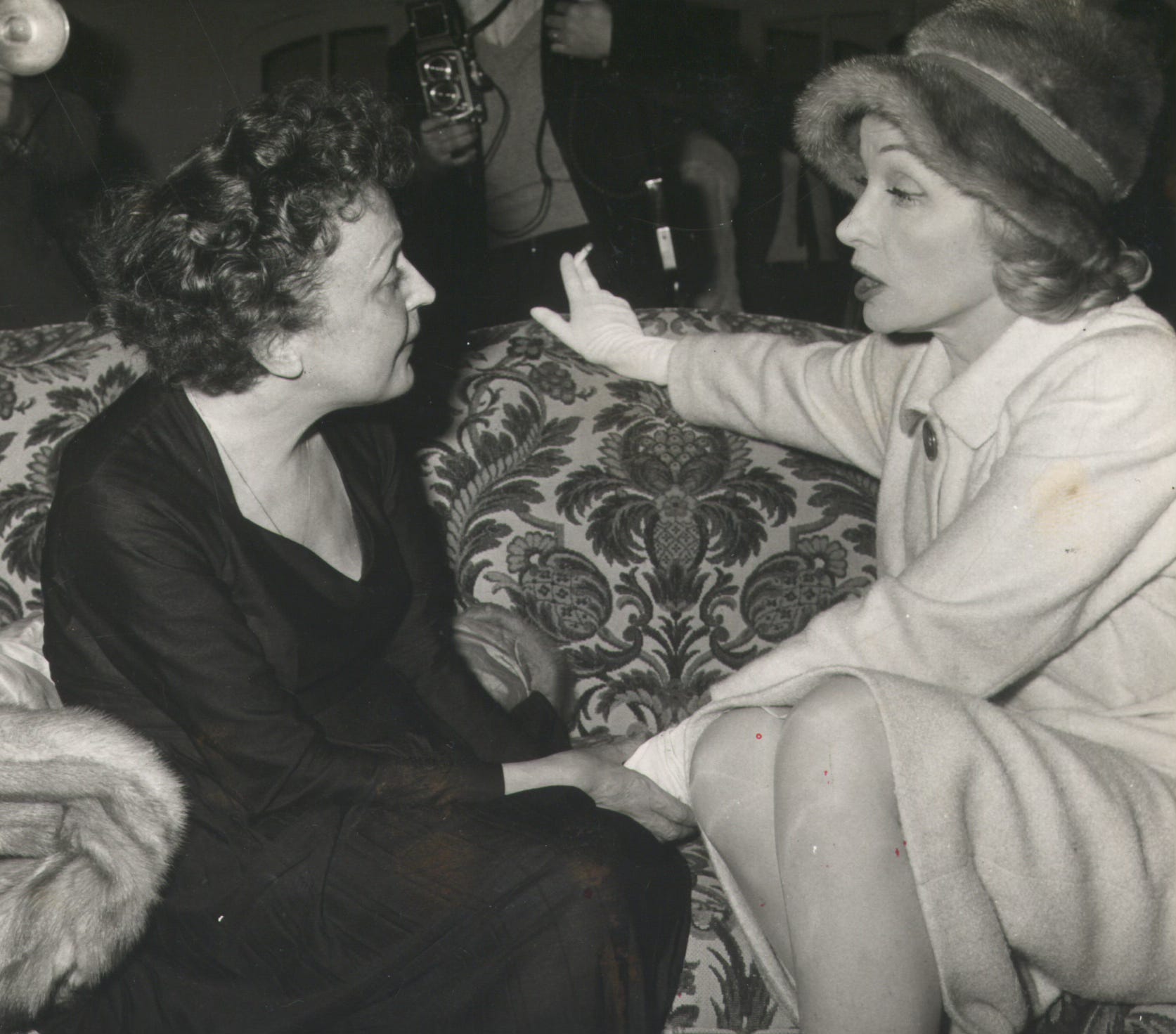
I also had fun learning and writing about her friendships with people like Marlene Dietrich, who she met while touring in New York in the 1950s. Rumors have occasionally swirled that Edith and Marlene, both Europeans finding their way in New York during crucial periods in their respective careers, had some sort of romantic affair— but I found very little evidence for this. It’s more likely, as I discuss in the episode, that theirs was a platonic but passionate friendship.
Finally, in this episode you’ll learn how Piaf’s early career was greatly boosted by her friendship with a nightclub owner named Louis Leplée, who (according to the mythology) plucked her off a street while she was busking, chastized her that singing in the streets would ruin her voice, and offered her a gig at his club, Le Gerny’s. Performing there would help transform her from a shabby, hard-knock street performer called “La Môme Piaf” into an ingenue of la chanson réaliste (realistic songs).
When Leplée was suddenly murdered in his apartment, Edith was questioned by the police. She was also interviewed– some would say harassed- by local tabloids like the longstanding Parisian rag Voici.
This was despite the fact that Edith had a verifiable alibi and had been let go.
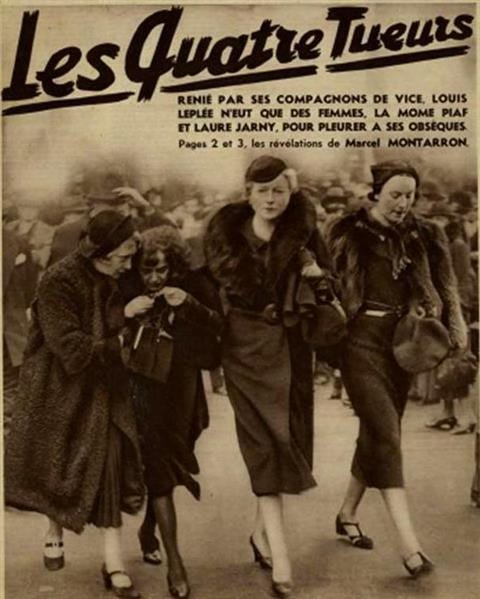
In the wake of Leplée’s murder, a headline in “Detective” magazine read “Les Quatre Tueurs”, or the “The Four Killers” and misleadingly showed a photo of Piaf and three other female mourners at Leplee’s funeral. Piaf, second from left, is hunched and appears to be crying.
As I detail in the podcast, being so close to the scandal may have been an essential ingredient in her rise to fame: this was a period when the public was hungry for titillation and scandal, and there was something riveting about a chanteuse whose associations with the seedy Pigalle world of pimps, prostitution and poverty (excuse the alliterative excess) made her seem an exciting antidote to the gentility of bourgeois Parisian life.
And while Piaf would soon shed her associations with the working-class districts of Belleville and Pigalle where she had spent her early life, living most of her adult years in the tonier districts of Western Paris, her continued dedication to telling working-class stories through her music was in part responsible for her widespread appeal. And her general rejection of adornment and glamour in favor of a simple, stripped-down persona (picture the tiny but powerful woman in a Balmain black dress and a cross necklace) was also part of her distinctive charisma.
In any case, I hope you enjoy this first episode in our two-part look at Piaf— and welcome your comments and feedback.
Within the next few months, I plan to release a bonus episode with some additional materials on Edith, and also go into some detail on my research process and subjective responses to Piaf’s work and biography.
If you’re not yet a paid subscriber, please do consider upgrading your subscription now. In addition to getting bonus episodes and early-release materials from the podcast, you’ll also have access to our full archive of Paris and France-related news stories, reviews, editorials, travel tips and in-depth itineraries— plus have the opportunity to schedule a personal consultation with me by email to help you plan your next trip!
Not only will it help support the development of the podcast, which, let’s face it, isn’t typically a lucrative endeavor at the outset— it’ll also allow me to keep writing and publishing deeply researched features on French and Parisian culture here at Substack.
Imagine this: for less than one expensive barista drink every month, you’ll be contributing to the creation of something made by a human, for humans— not for search algorithms or clickbait.
And if you love French culture— as I assume many or most of you do— this is one good way to help more people learn about and enjoy la culture française.
If you already have too many subscriptions, I get it. I probably do too. Why not consider giving whatever you can by buying us a coffee or tea at Ko-fi? No matter how small the amount, it will make a difference, helping to fund my work, as well as that of my producer and sound engineer. You can make a one-off donation, or offer a small monthly amount if you’d prefer to choose an amount different from the subscription options here at Substack.
Again, I can’t thank you enough for your vital support, whether it’s through a paid subscription or through telling a friend about the podcast or the newsletter.
Here are just a few places where you’ll find The French Culture Podcast, if you prefer to listen elsewhere:
I’d so appreciate it if you could take the time to add a rating (hopefully a good one!) on these platforms, as this will go a long way in helping me to build an audience beyond Substack.
We also have a YouTube channel, though as I mentioned in my last post, episodes there will feature only decorative stills or slideshows, rather than show me reading the episode or interviewing guests. Still, if YouTube is your preferred place to stream audio, you can find us there too!
This episode was conceived, written, narrated and edited by Courtney Traub. It was produced by Brendan Whalen, who contributed additional research and script editing. Additional audio editing and sound design was by Engin Hassan of Edit Fade Warp. Artwork for the Paris Unlocked Podcast was created by Mateeya.
If you liked this episode, please follow (and rate) The French Culture Podcast, then share it as widely as you can.
Translations of original French quotes in this episode are all by Courtney Traub. All images displayed in the show notes are out of copyright and in the public domain.
The problem of fair use and music clips: As I discuss in the episode, I was unable to secure the rights to Piaf’s music, in order to play short excerpts of the songs I reference in this episode. There is no “safe” amount of a piece of copyrighted music that one can play under fair use laws, so I preferred to be cautious in this regard and include none.
Spotify playlist: Please listen to the songs referred to in this episode by going to the Spotify playlist I’ve put together. It’s less ideal than playing clips from the songs in the episode, but it’s (at the least) a way to listen . If you can, I recommend keeping the playlist open as you listen to the episode, and pausing to play the song being referenced. Of course, please don’t attempt this while driving or operating machinery!
Intro and outro: Music by Trygve Larsen from Pixabay (“Erik Satie’s Gnossienne 1 – Classical Remix Piano and Sax”)
Music in order of use throughout episode:
Music by Mikado Koko from Pixabay (Cool Jazz Session 8″)
Music by u_bv0j8sxr2s from Pixabay (“Le Parrain de Minuit”)
Music by Jakob Welik from Pixabay (“Le Cœur de Paris”)
Music by Jean-Paul Verpeaux from Pixabay (“Bienvenue au Cirque”)
Music by Jakob Welik from Pixabay (“Etoiles de minuit”)
“Si tu n’étais pas là, performed by Fréhel. Sheet music published in 1935. Music composed by Gaston Claret, lyrics by Pierre Bayle. Originally published by “Editions Salabert”, Paris, 1935 (Wikimedia Commons (public domain)
Music by Saturn-3-Music from Pixabay (“Claire de Lune- Débussy)
Music by Jean-Paul Verpeaux from Pixabay (“Perdu dans Paris”)
Music by Jean-Paul Verpeaux from Pixabay (“Midnight in Paris”)
Music by VibeHorn from Pixabay (“French Paris Romantic Music”)
For this episode, we consulted a variety of print and online primary sources, including books, newspaper articles, blogs, documentaries, film clips and archival documents. They are presented in relative order of importance and/or order in which their information appears in the episode, rather than in alphabetical order. Sources are both in English and French; where available, I have also linked to the English-language version of the source.
Carolyn Burke, No Regrets: Edith Piaf. Bloomsbury, 2012.
David Loosely, Edith Piaf: A Cultural History. Liverpool University Press, 2015. Available online in open source: https://library.oapen.org/bitstream/handle/20.500.12657/26016/1004069.pdf
David Bret, Edith Piaf: Find Me a New Way to Die. Oberon Books, 2015.
Albert Bensoussan, Édith Piaf. Gallimard: 2013 (French-language paperback)
Robert Belleret, Piaf: Un Mythe Francais. Fayard, 2013.
David Conley McKinney, “The Influence of Parisian Popular Entertainment on the Piano Works of Erik Satue and Francis Poulenc”, The University of North Carolina at Greensboro, 1994 (unpublished PhD dissertation), https://libres.uncg.edu/ir/uncg/f/McKinney_uncg_9502709.pdf
“Sans Amour on n’est rien du tout”, (Documentary). Arte, 2003, directed by Marianne Lamour. Available on YouTube:
Maylis Besserie, “A la conquète de l’Amérique”, from the series “La Vie en Piaf”, Radio France, 25 July 2013, https://www.radiofrance.fr/franceculture/podcasts/la-vie-en-piaf/a-la-conquete-de-l-amerique-1947-1959-5579008
A.J. Liebling, “Edith Piaf’s Thousand (Delightful) Ways to Bum You Out”, The New Yorker, November 8, 1947, https://www.newyorker.com/magazine/2022/08/29/edith-piafs-thousand-delightful-ways-to-bum-you-out
Edith Piaf, Ma Vie, Union Générale d’Editions, 1964. Available at the Internet Archive: https://archive.org/details/mavie0000piaf/page/12/mode/2up
Cécile Hamsy, “Belleville Village”, France Culture (radio program), 27 September 2025, https://www.radiofrance.fr/franceculture/podcasts/les-nuits-de-france-culture/belleville-village-8393284
“Belleville au début du XXême siecle”, Paris ZigZag, no date, no author. https://www.pariszigzag.fr/insolite/histoire-insolite-paris/belleville-au-debut-du-xxe-siecle/
“Quelle est la tombe la plus visitée au Père-Lachaise?”, Perelachaise.com, no date, https://pere-lachaise.com/tombe-la-plus-visitee-au-pere-lachaise/
Demi Perera, “‘It’s an archive of Paris’: Why you should visit Père-Lachaise cemetery – with Edith Piaf among famous graves”, The Independent, 11 April 2025, https://www.independent.co.uk/travel/europe/france/paris/pere-lachaise-paris-cemetery-jim-morrison-edith-piaf-b2725908.html
Frantz Vaillant, “Piaf? Une Enfant-Dictateur”, TV5 Monde, 10 October 2013, https://information.tv5monde.com/international/piaf-une-enfant-dictateur-20140
Richard R. Lingeman, “Piaf. by Simone Berteaut”, The New York Times, 28 July 1972, https://www.nytimes.com/1972/07/28/archives/sad-songs-of-the-sparrow.html
Paul Morelle, “‘Piaf’”, par Simone Berteaut”’, Le Monde, 6 September 1969, https://www.lemonde.fr/archives/article/1969/09/06/piaf-par-simone-berteaut_2432170_1819218.html?search-type=classic&ise_click_rank=7
Susan Heller Anderson, “Piaf Remains a Mix of Myth and Reality”, The New York Times, 22 February 1981, https://www.nytimes.com/1981/02/22/arts/piaf-remains-a-mix-of-myth-and-reality.html
“Edith Piaf dans ‘La Garconne’ (1936)’’. Edith Piaf (YouTube channel), no date,
“Lundi 6 avril 1936: Louis Leplée assassiné”, Paris Visites, no date, http://paris.visites.jpkmm.free.fr/faits_divers/38_leplee.html
We’re just a few days shy of summer solstice, so I thought I’d take some time out from all things podcast to offer a few tips and suggestions, hopefully ensuring you don’t collapse into a trembling puddle from crowd stress and overheating.
Summer isn’t (in honesty) my favorite time of year in the capital, mainly because (as you might guess from above) I dislike crowds and strong heat— two things that are difficult to avoid these days. That said, the summer months can be very pleasant in Paris if you follow a few key tips:
Try to walk and take the bus. The metro (barring some of the newer lines, including line 1 and 14) is not air-conditioned. When heat waves strike, trying to get around the city while desperately trying not to get your head stuck under someone else’s sweaty armpit is guaranteed to cast a dystopian tone on your trip. I recommend trying to get around by foot and bus. Schedule walks in mornings and late afternoons/early evenings, when the sun is less punishing, and take the bus in between. See my guide to transport and accessibility for more on using Parisian buses.
Take advantage of open spaces, parks and free swimming holes. Thanks to efforts to “green” Paris over the past decade, there have never been so many verdant spaces to hang out and picnic in. Plan to spend some time in some of the city’s gorgeous parks and gardens, by the riversides, and in the Bois de Vincennes or Bois de Boulogne— massive woods that locals refer to as the city’s “lungs”.
Save money through free events and inexpensive summer festivals. June in particular is a wonderful time for stretched budgets. On June 21st, summer solstice, La Fête de la Musique sees hundreds of performers offer free concerts around the city. Nuit Blanche (White Night) is an all-night arts event that’s also free, and you can roam around the city taking in art installations, pop-ups, concerts, performances and free museum exhibits. This year, Nuit Blanche happens to falls this coming weekend (June 6th-7th); see more about the event here. There’s also pop-up pools, open-air cinema, jazz concerts for next to nothing— the list goes on. In short, you have no excuse to stay indoors all the time, nor to overspend if you don’t wish to. It’s expensive to get to Paris at this time of year, and lodging costs are also through the roof (more on that issue in another post)- but summer is probably one of the cheapest times for fun and merriment in the capital.
Get out of the city. It’s a well-known fact that urban areas are hotter and more stifling in the warmer months. Take a day trip to Monet’s gardens at Giverny, or to a nearby medieval village, or to Versailles or another 18th-century palace (though these can be hot inside; privilege a morning visit and spend the hotter hours roaming the lush gardens). See my suggestions for fantastic day trips from Paris here; most are accessible by train.
Full guide: Paris in the Summer
June 2026 in Paris: My Suggestions
Best Ice Cream & Gelato in Paris
How to Stage a Legit Parisian Picnic
Last but not least, I wanted to highlight a few inspiring, funny and well-written pieces I’ve been reading from around Substack this past month. I’m such a fan and admirer of the work of many of the hard-working writers I’m connected to here;. they’re one of the main reasons I remain at the network for now— despite my major misgivings about Substack and their refusal to take down newsletters written by Nazis.
I greatly enjoyed Emily Monaco’s post (and related podcast episode from “Fishwives of Paris”) exploring the “invention” of the restaurant in France. I learned a lot, including the fact that the “inn” or “tavern” may have preceded the formal gastronomic restaurant, but in a lot of ways its etiquette and format run totally counter to the modern restaurant.
As usual, Shelby Chambers of “Franchement” made me laugh aloud with her insightful and funny analysis of the French obsession with/aversion to air. She’s put to words something I’ve always found bizarre and annoying about French culture’s frequent embrace of claustrophobia and heat, but couldn’t quite articulate.
I’m always hungry for intel on where to find excellent set-menu lunches for prices that won’t make me want to cry, so Richard Nahem’s alluring review of Argile over at Eye Prefer Paris is one I’m bookmarking for later.
I always look forward to updates from the luminous and talented Jennifer Steil, and her recent post (at Liminal by Jennifer Steil) on why she “overshares” made me laugh, cry, and wonder why I myself am so averse to oversharing. Maybe it’s something about being a late-stage Gen X-er who lacks the millennial/GenZ impulse to disclose my whole life online, and clings to (pathetic illusions?) of privacy. Who knows. In any case, Steil made me wonder whether I’m missing out by being somewhat reticent to disclose the darker waters in my writing.
That’s (finally) a wrap for this week, les ami/es. Watch for a post next week, when we’ll continue our look at Piaf with a second episode.
Until then, enjoy the lengthening days,
Comments
Nothing yet. Say the first thing.
Sign in to join the conversation.