
You’ve waited for months as I’ve repeatedly teased The French Culture Podcast, a deeply researched project that has been immensely fun to work on— but that has also slowed down my posting here at Substack. I’ve appreciated your patience as I trudged up a steep learning curve, in pursuit of something that’s been both intellectually rewarding and (at times) exhausting.
I’m more than pleased to say that production for the first four hour-long episodes is winding down this week, and I’m set to formally launch the podcast in early June.
And since I appreciate your continued support and readership more than I can easily say, I thought it fitting to give you exclusive, early access to our first episode of Season 1, Great French Icons of the French Century: A look at the radically colorful world (and mind) of the painter Henri Matisse.
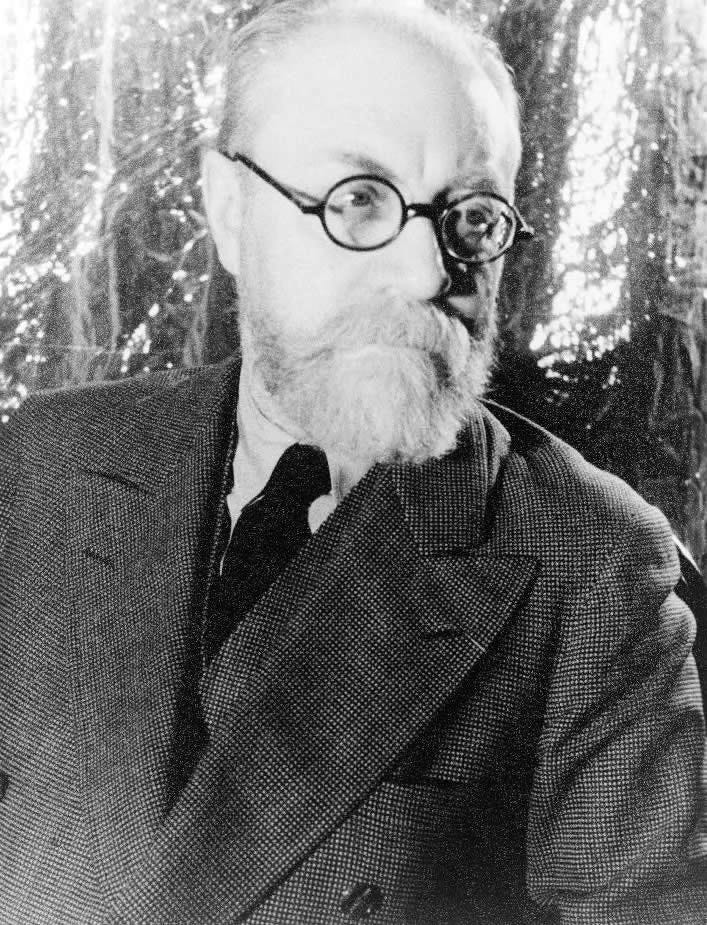
When I chose Matisse as the first of six French icons to portrait in our debut season— alongside Edith Piaf, Josephine Baker, Albert Camus, Serge Gainsbourg and Louise Bourgeois— it was mostly out of intense personal curiosity. I’ve always loved Matisse’s work, but in the casual, noncommital way most people do. I never really thought about the person behind the intensely sensual and colorful landscapes, which almost, as one critic puts it in the episode, seem to come at you with their vibrancy.
I also tended to think of his work as pleasantly decorative and harmonious, rather than as radical or provocative. Our contemporary eyes don’t tend to really see how radical Matisse’s work was.
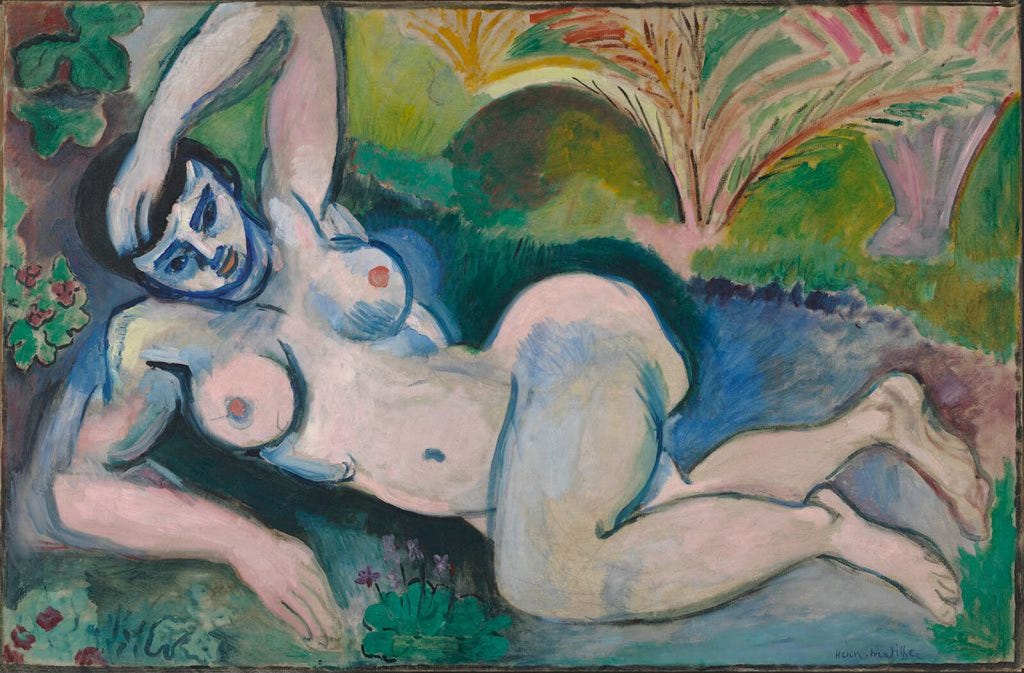
Yet many of his celebrated earlier paintings, from “Woman With a Hat”(1905) to “Blue Nude" (1907), were initially met with shock and even disgust. This didn’t make it into the podcast, but according to one source, in 1913 “Blue Nude” spurred such a furor among a group of art students who viewed the painting at a show in in Chicago that they staged a mock trial, sentencing Matisse to symbolic death. Elsewhere, the painting was also burned as an effigy.
And while Matisse is now firmly recognized as one of France’s greatest 20th-century artists, in his earlier years he was well-known but not respected by the art establishment. Far from being considered a national treasure in France, Matisse was often viewed both by earlier audiences and critics as either a trader in shock, or simply a laughing stock. His bizarrely bright colors, unrealistic compositions and focus on decoration for its own sake even offended the sensibilities of many Impressionist artists, not to mention the classical stalwarts.
And even in avant-garde circles, he too often felt like an outsider who couldn’t quite get on board with the groupthink. He wasn’t political enough; or he was too bourgeois, or he was too extreme in his use of color.
In making this podcast episode, my aim was to finally understand a bit about the man behind the work, and to hopefully give you an understanding of Matisse beyond the endless commercialism of decorative prints and mugs.
In the episode, I attempt to (briefly) answer some of the following questions: how did Matisse use the irritating grain of public outrage, and the inspiration of new places, to produce such original work? And how did he go from copying Dutch and European masters in a stuffy Parisian art academy to inventing radical new ways of “feeling through” color and form, as he so often put it?
Along the way, I also explore the artist’s personality quirks, including a lifelong battle with insomnia and health problems, and an affection for collecting pretty rugs, butterflies and live birds. Oh, and the young Matisse also had a weird habit of shooting passersby with petty pellets from his Parisian studio.
No artist gets to where they are without others— so in the episode we also take a look at Matisse’s relationships with his wife Amelie and his daughter Marguerite, with Gertrude Stein and her family, with Pablo Picasso, and other luminaries of his period.
I sincerely hope you enjoy this exclusive sneak peek at the podcast. I welcome any feedback, positive or negative, and would also love to hear from you about how you’d like to see the show evolve down the line: a season on French food history and myths? (In truth, it’s already halfway in the works). An interview-based season that profiles contemporary French creators, from chefs to fashion designers? I’m more than open to your ideas: they’d be super valuable to me. This season will be, in many ways, a sort of “first pancake”— so your input will go a long way in helping me to refine the concept, and make stuff that y’all really want to listen to.
This has sometimes been a lonely endeavor, but your continued support and readership have made it all worth it. And as always, my intention is for this deeply-researched work to reach as many people as possible, during a time when AI slop is taking over the web, and we (arguably) need a slower, closer approach to all things culture.
If you’re not yet a paid subscriber, please do consider upgrading your subscription now. Not only will it help support the development of the podcast, which, let’s face it, isn’t usually a lucrative endeavor at the outset— it will also allow me to keep offering in-depth travel tips and itineraries, TV and film reviews, interviews and all manner of other stuff on French/Parisian culture here at Substack.
After much thought, I’ve decided to offer “Donor” subscribers and “Star Supporters” perks including bonus episodes and early access to some content, alongside personalized travel advice from me by email, and a rich newsletter archive comprising hundreds of features. Just think: for less than one expensive barista drink every month, you’ll be contributing to the creation of something made by a human, for humans— not for search algorithms or clickbait.
And if you love French culture— as I assume many or most of you do— this is one good way to help more people learn about and enjoy la culture française.
If you already have too many subscriptions, I get it. I probably do too. Why not consider giving whatever you can by buying us a coffee or tea at Ko-fi? No matter how small the amount, it will make a difference, helping to fund my work, as well as that of my producer and sound engineer. You can make a one-off donation, or offer a small monthly amount if you’d prefer to choose an amount different from the subscription options here at Substack.
Again, I can’t thank you enough for your vital support. I (sincerely) couldn’t have made it this far with this project without your help.
I hope you'll follow and recommend the podcast, whether here or on one of your favorite platforms. Here are just a few where you’ll find The French Culture Podcast:
We also have a YouTube channel, though truth be told, I don’t think we’ll be doing much by the way of video features. Maybe a few decorative stills. I profoundly dislike being on camera, and I honestly don’t know why anyone would want to watch me blabber into the camera. I think it would take away from your ability to get lost in the French cultural moments and worlds I’m trying to bring you into in the show.
Still, if YouTube is your preferred place to stream audio, you can find us there too.
Stay tuned for more in June, when I’ll drop three more episodes here (always with extra content for Substack subscribers). I’ll also devote some (much-needed) attention to interesting things happening in Paris these days, offer some advice on summer travel in France amid a few stressful trends, and share some compelling stuff from around Substack.
In July, I may even attempt a book review. (Spoiler alert: it’s a book that traces the (mostly fictional) adventures of a certain 18th-century French woman who would turn waxworks into a public attraction). Stay tuned.
See you in June! In the meantime, restez au frais (stay cool in the shade).
This episode was conceived, written, narrated and edited by Courtney Traub, with additional audio editing by Engin Hassan of Edit Fade Warp. Brendan Whalen contributed additional research, script editing and voiceovers. If you liked this episode, please share it as widely as you can.
And as I mention at the beginning of the episode, you can also lend your precious support to both the French Culture Podcast and to our sister website and newsletter, Paris Unlocked, by buying us a coffee– or even better, becoming a “Donor Subscriber” on Substack. You’ll get unlimited access to a large archive of Paris and France-related news stories, reviews, audio stories, essays and travel tips, as well as personalized travel advice from me.
Translations of original French quotes in this episode are all by Courtney Traub. All images displayed in the show notes are out of copyright and in the public domain.
Intro and outro: Music by Trygve Larsen from Pixabay (”Erik Satie’s Gnossienne 1 – Classical Remix Piano and Sax”)
Music by Samuel F. Johanns from Pixabay (“Erik Satie, Gymnopédie No. 1” )
Music by Trygve Larsen from Pixabay (Songs From the 18th Century -Belle O Brien (1895)
Music by Victory Day from Pixabay (La Belle Dame Sans Merci/Violin Duet)
Sound Effect by freesound_community from Pixabay (marché
“Sardana” Kevin MacLeod (incompetech.com) Licensed under Creative Commons: By Attribution 4.0 License (http://creativecommons.org/licenses/by/4.0/)
Music by Trygve Larsen from Pixabay (Classical piano by Debussy: Suite Bergamasque 1905-Menuet
Visuals: Artwork for the Paris Unlocked Podcast was created by Mateeya.
For this episode, we consulted a variety of print and online primary sources, including books, podcasts, newspaper articles, blogs and unpublished archival documents. They are presented in relative order of importance and/or order in which their information appears in the episode, rather than in alphabetical order. Sources are both in English and French; where available, I have also linked to the English-language version of the source.
Hilary Spurling, Matisse: The Life. Penguin Books, 2009.
Pierre Courthilon. Chatting With Henri Matisse: The Lost 1941 Interview. Edited by Serge Guilbault. Getty Institute, 2013.
France Culture, “Matisse: Artiste demiurge” {podcast in French}. Episode 1, “Matisse et le bonheur de vivre”. Available at: https://www.radiofrance.fr/franceculture/podcasts/la-compagnie-des-oeuvres/matisse-et-le-bonheur-de-vivre-4829837
France Culture, “Matisse: Artiste demiurge” {podcast in French}. Episode 2: Matisse à l’oeuvre”. Available at: https://www.radiofrance.fr/franceculture/podcasts/la-compagnie-des-oeuvres/matisse-a-l-oeuvre-7767927
Modern Art Notes Podcast. “Matisse on Matisse” (interview with Serge Guilbault about the 1941 interview.) Available at: https://www.getty.edu/research/exhibitions_events/events/chatting_matisse.html
Encyclopedia Britannica. “Henri Matisse. French artist”. Available at: https://www.britannica.com/biography/Henri-Matisse.
Musée Matisse. “Henri Matisse and the Chapelle du Rosaire”. Available at: https://www.musee-matisse-nice.org/en/the-artist/matisse-and-the-rosary-chapel/
Patrick Amine. “Henri Matisse: Comme un Roman”. Exporevue, November 2020. Available at: https://www.exporevue.com/magazine/fr/index_matisse.html
Clara T. McChesn, “A Talk With Matisse, Leader of Post-Impressionists” The New York Times (archive), 9 March 1913. Available at: “https://www.nytimes.com/1913/03/09/archives/a-talk-with-matisse-leader-of-postimpressionists.html?searchResultPosition=67
Paul Cezanne.org. “Three Bathers”. Available at: https://www.paulcezanne.org/three-bathers.jsp.
Henrimatisse.org. “Paul Cezanne’s Impact on Henri Matisse”. Available at: “https://www.henrimatisse.org/matisse-and-cezanne.jsp.
Artchive. “Arcueil (1899) by Henri Matisse”. Available at: https://www.artchive.com/artwork/arcueil-henri-matisse-1899/.
Phillipe Dagen, “ Marguerite Matisse, a model daughter essential to her father”, Le Monde (English version), 8 April 2025. Available at: https://www.lemonde.fr/en/culture/article/2025/04/08/marguerite-matisse-a-model-daughter-essential-to-her-father_6739955_30.html.
Hilarie M. Sheets. “The Forgotten Dealer Who Discovered Matisse and Picasso”, The New York Times, 29 September 2024. Available at: https://www.nytimes.com/2024/09/29/arts/design/berthe-weill-dealer-paris-grey-art-museum.html.
Virginie Larouse, “La religion, l’idéologie, la science… : quand les maladies du « croire » mettent la démocratie en danger”. Le Monde, 11 June 2021. Available at: https://www.lemonde.fr/idees/article/2021/06/11/la-religion-l-ideologie-la-science-quand-les-maladies-du-croire-mettent-la-democratie-en-danger_6083701_3232.html.
Berthe Weill, “Pow! Right in the Eye! Thirty Years Behind the Scenes of Modern French Painting”. Edited by Lynn Gumpert. Translated by William Rodarmor. Abakanowicz Arts and Culture Collection.
The Museum of Modern Art. Press Release, November 14, 1963 (announcing the museum’s acquisition of “Dance” by Henri Matisse, from Nelson Rockefeller). Available at: https://www.moma.org/momaorg/shared/pdfs/docs/press_archives/3203/releases/MOMA_1963_0115_111.pdf
Christie’s, “André Derain (1880-1954)”, ‘Matisse et Terrus’. Available at: https://www.christies.com/en/lot/lot-6476170
Richard Cavendish, “The Fauves at the Salon d’Automne”. History Today, Volume 55, Issue 10, October 2005. Available at: https://www.historytoday.com/archive/fauves-salon-d%E2%80%99automne
The New York Times (archive). No byline given. “SALON GIVEN OVER TO FREAK PAINTINGS; Ridicule Aroused by Many of the Modern Works in the Fall Exhibition. IMPRESSIONISTS OUTDONE Galleries Dominated by Works of Matiese and Van Dongen and Their Followers”, 11 October 1908. Available at: https://www.nytimes.com/1908/10/11/archives/salon-given-over-to-freak-paintings-ridicule-aroused-by-many-of-the.html?searchResultPosition=62
Roberta Smith, “Matisse and Derain: The Audacious ‘Wild Beasts’ of Fauvism in a Radiant Show”. The New York Times, 9 November 2023. Available at: https://www.nytimes.com/2023/11/09/arts/design/matisse-derain-fauvism-metropolitan-museum.html
Montmartre Artists’ Studios. “The Bateau Lavoir Montmartre Where Picasso Was ‘Born’”. Available at: https://montmartrefootsteps.com/picasso-bateau-lavoir/
Janet Flanner, “King of the Wild Beasts- 1”. The New Yorker, 15 December 1951. Available at: https://www.newyorker.com/magazine/1951/12/22/henri-matisse-profile-king-of-the-wild-beasts-i
Beverley Whitney Kean, “All the empty palaces : the great merchant patrons of modern art in pre-Revolutionary Russia”. Internet Archive. Available at: https://archive.org/details/allemptypalacesg0000kean/
Stanley Steinberg, “Sarah Stein: The Woman Who Brought Matisse to San Francisco A Memoir: Learning about Art and the Art of Psychoanalysis”, American Imago, Vol. 68, No. 3 (Fall 2011), pp. 517-542. Available at: https://www.jstor.org/stable/26305237
Haber’s Art Reviews. “Gertrude and Leo Stein as Collectors”. Available at: https://www.haberarts.com/glmstein.htm
Annette Rosenshine, “”Life’s Not a Paragraph” (unpublished memoir, typescript carbon). Gift of Annette Rosenshine, 1968. Beinecke Rare Book and Manuscript Library, Yale Library Digital Collections. Available at: https://collections.library.yale.edu/catalog/17213027
Gertrude Stein, “The Autobiography of Alice B. Toklas”. Project Gutenberg Australia ( uploaded 2015). First published in 1933. Available at: https://gutenberg.net.au/ebooks06/0608711h.html
James R. Mellow, “The Stein Salon Was the First Museum of Modern Art”. The New York Times (archive), 1 December 1968. Available at: https://archive.nytimes.com/www.nytimes.com/books/98/05/03/specials/stein-salon.html?scp=71&sq=catholic%20museum&st=cse
Cath Pound, “The Shocking Memoir of the Lost Generation”, BBC Culture, 27 July 2021. Available at: https://archive.nytimes.com/www.nytimes.com/books/98/05/03/specials/stein-salon.html?scp=71&sq=catholic%20museum&st=cse
The Met. “The Steins Collect”: Matisse, Picasso & The Parisian Avant-Garde. (documentary, 2012). Available at:
Baldassari, Anne. Matisse Picasso. Tate Publishing, 2002.
Flam, Jack. Matisse and Picasso. The Story of Their Rivalry and Friendship. Basic Books, 2004.
Wizevich, Eli. “Meet Marguerite, Henri Matisse’s Eldest Daughter—and One of His Most Influential Models”. Smithsonian Mag, 2 June 2025. Available at: https://www.smithsonianmag.com/smart-news/meet-marguerite-henri-matisses-eldest-daughter-and-one-of-his-most-influential-models-180986684/
Monod-Fontaine, Isabelle. Marguerite Matisse: La jeune fille au ruban. (in French). Grasset, 2025.
Russell, John. Matisse: Father and Son. Harry N. Abrams, Inc, 1999.
Gorham, Christopher C. Matisse at War: Art and Resistance in Nazi Occupied France. Citadel Press, 2025.
Lifson, Edward. “A Wartime Matisse Full of Pain and Beauty”. Weekend Edition Sunday, NPR, 13 June 2010. Available at: https://www.npr.org/2010/06/13/127745865/a-wartime-matisse-full-of-pain-and-beauty
Comments
Nothing yet. Say the first thing.
Sign in to join the conversation.