
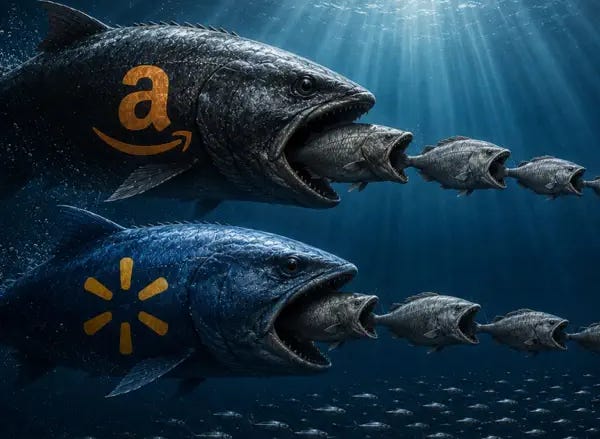
The majority of power being held by a minority is neither a new nor rare experience.
Income and wealth are increasingly concentrated. The top 10% of households hold some two-thirds of total household wealth. Equities are even more lopsided: the top 10% of Americans hold over 87% of corporate equities and mutual fund shares, and the top 1% owns nearly half the market outright.
Sticking with the stock market, the Mag 7 — Apple, Microsoft, Alphabet, Amazon, Nvidia, Meta, Tesla — make up about 34% of the S&P 500, up from 12.3% in 2015. The top 10 stocks overall went from 22% of the index in 2020 to just shy of 40% today. Over the past three years, the Mag 7 alone have driven between 42 and 62% of total equity market gains.
In many places it's the short head, rather than the long tail, where power lies. In two domains where I have some experience, about 1% of all podcasts command 99% of downloads, and in the book industry just 4% of books account for 60% of profits.
Closer to where I’m headed with this article, Moody’s pegs the top 10% of earners as driving nearly 50% of all consumer spending.
Way back in 2015 I coined the term “retail’s great bifurcation” in an article that updated my “death in the middle” blog post from a couple of years earlier. In it I pointed out that retail results were becoming increasingly and quite dramatically polarized.
Growth in revenues and store openings was strong at either end of the value spectrum. Price- and convenience-oriented players (Walmart, warehouse clubs, off-price retailers, and dollar stores) were gobbling up share. At the same time, above average growth was being realized among premium and luxury specialty retailers. The trouble was in what I later came to call “the unremarkable middle.”
My observations were rooted in data, but in 2018 a Deloitte study (which I contributed to) brought a lot more rigor to the table, reinforcing its findings with an analysis of how profound demographic shifts were fueling the phenomenon.
Even as the largely nonsensical “retail apocalypse” narrative took hold, it was obvious to anyone who cared to look that thousands of stores were opening on the part of retailers that were remarkably efficient, as well as those that delivered far more emotionally connecting experiences. Virtually all the store closings came from those that failed to pick a lane.

On an absolute basis US retail is quite concentrated. Since Amazon doesn’t report its Gross Merchandise Value figures, market shares are estimated by various sources. But it looks like the big three (Walmart, Amazon, and Costco) control just over 20% of total retail spend. The National Retail Federation estimates have the top ten retailers accounting for 35-40% of the market.
In e-commerce it’s even more extreme. Just Amazon and Walmart combined capture over 50% of the market. Add in the rest of the top ten and you are likely at over 60% concentration.
Yet it’s what’s going on at the margin that is both fascinating and frightening.
Credit to Jason “Retail Geek” Goldberg for shining a light on the powerful dynamic we see occurring with incremental spending behaviors.
I first noticed Jason’s analysis in early 2025 when he found that over 60% of all incremental spending was captured by just six retailers: Amazon, Walmart, Costco, Temu, Shein, and TikTok Shops. That meant that the minority share was left to be split among many thousands of retailers, big and small.
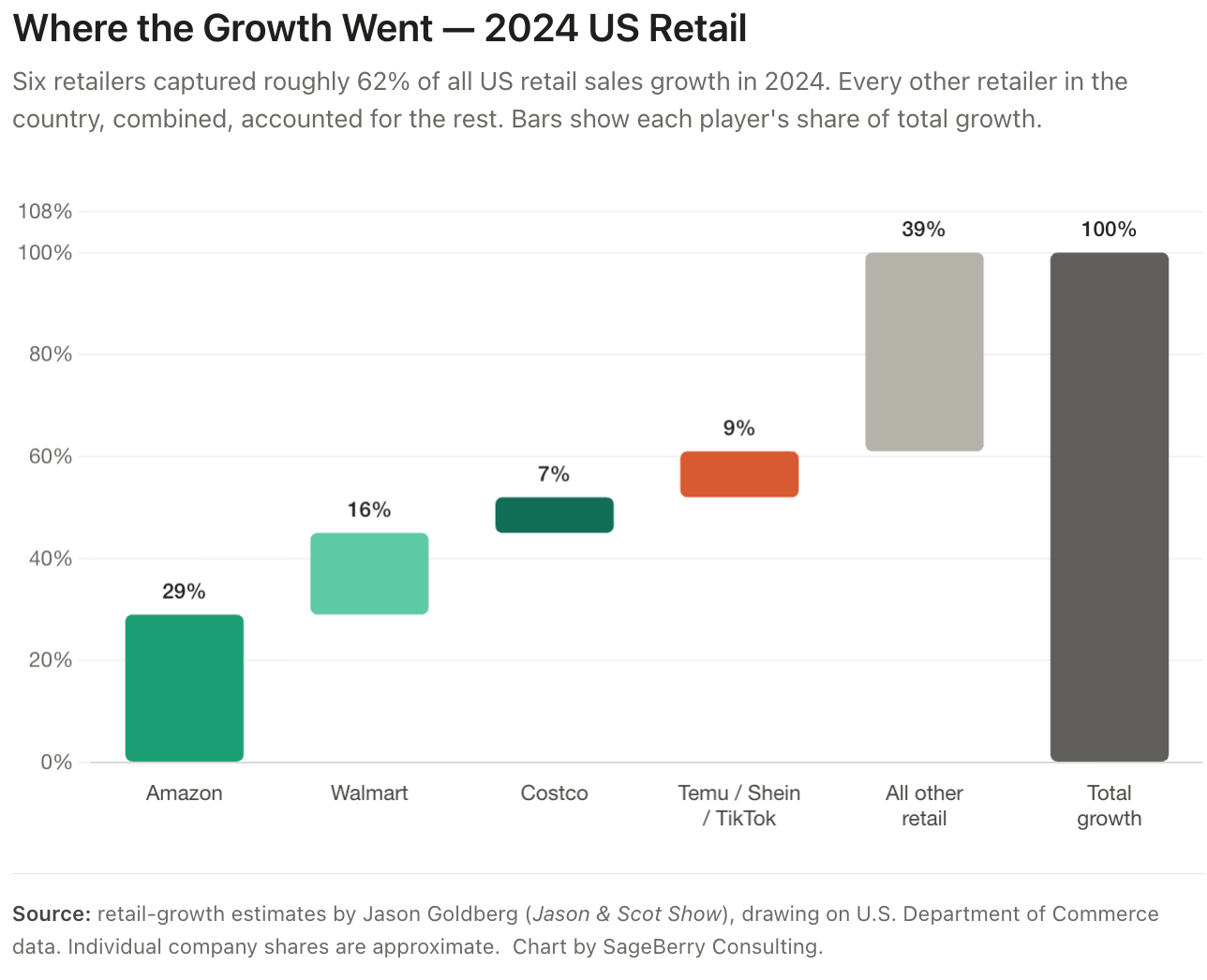
This concentration appears to have increased even more since. While figures for the three Chinese-originated platforms are harder to come by, we know that Amazon, Walmart, and Costco’s growth rates have easily exceeded the industry averages in 2025, as well as so far this year.
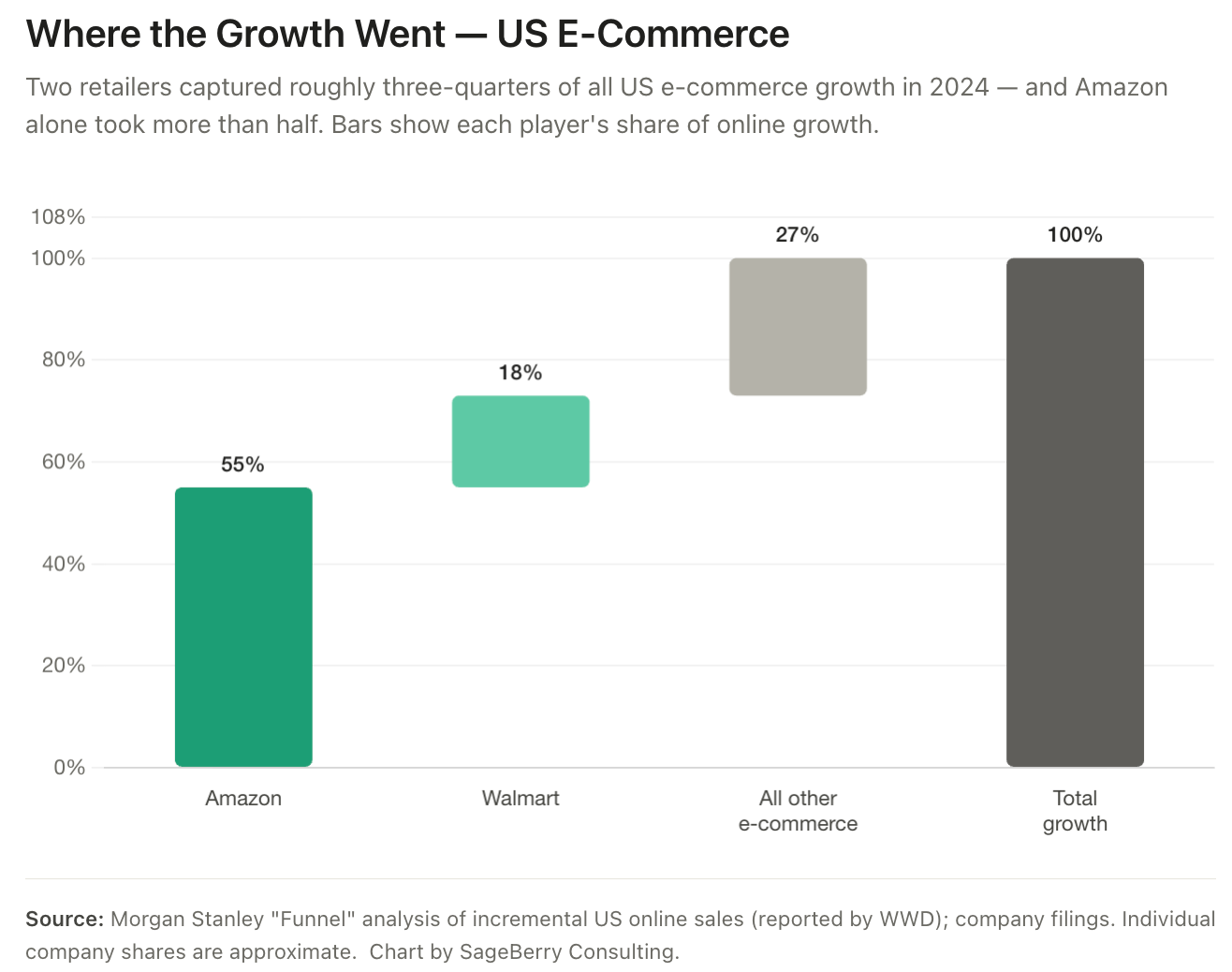
Again the picture is even more extreme in e-commerce. eMarketer estimates that Amazon and Walmart will account for 51% of all online shopping in the US this year. But here too the amount of incremental growth captured is the shocking story, as the super scaler from Seattle and the beast of Bentonville are capturing nearly 75% of every incremental dollar spent online.
Even crazier is that Amazon and Walmart are capturing nearly 90% of incremental—and incredibly profitable—retail media spend.
There’s a well-worn adage that the bigger you get, the harder it is to grow. The law of large numbers, people call it.
A $2 billion retailer can post well above average gains; a half-trillion-dollar one can’t, because the dollars needed to move the needle become harder to find. Growth drifts back toward the market’s pace. Gravity wins.
Apparently someone forgot to tell the giants.
Amazon’s North American retail grew around 9% last year, three times the broader industry’s rate, on a base north of half a trillion dollars. That single year added roughly $50 billion — an increment larger than the entire annual revenue of Macy’s, Nordstrom, or Best Buy.
Walmart, already the largest retailer on earth, grew fast enough to become the first traditional retailer worth a trillion dollars. Costco just keeps compounding. None of this is how a business behaves at the ceiling its size is supposed to impose.
The math wins eventually, as it always does, and at some point all three will start regressing toward the mean. The fashionable candidate for what finally provides a real headwind is agentic commerce. The theory is that once an AI agent shops the whole market on your behalf, assortment and discovery stop being moats, demand floats free of the platforms that hoarded it, and the field reopens.
Maybe.
But agents mostly optimize for price, speed, and convenience, precisely where Amazon and Walmart already win. What makes these companies formidable isn’t simply that they’re big. It’s that they are relentless optimizers operating at a scale no one else can approach.
Which is why their eventual deceleration won’t be the reprieve so many in the middle seem to be counting on. When the math finally bites, the share that comes loose won’t drift gently home. It likely flows to the next-best optimizer on the value side of the bifurcation. Almost no one else has anything sufficient to claw it back.
The giants slowing down was never a strategy you could wait out. The math may eventually turn against them, but right now this great concentration has a ton of momentum.
And if your goal was to out-Amazon Amazon or out-Walmart Walmart it’s never going to turn for you, least of all if your plan is merely delivering a slightly better version of mediocre.
Concentration stories tend to get filed under “interesting but inevitable.” Big gets bigger; it always has. Move on, nothing to see (or do) here.
Here’s what’s new. The giants are no longer just winning more than their share of the market. They’re winning nearly all of the growth, and growth is the only oxygen a retailer has. When retailers struggle to keep pace with inflation, that can foretell a profit squeeze, inevitably followed by rounds of cost-cutting and store closings. But eventually the core economics stop working completely.
Which takes retail’s great concentration back to the great bifurcation.
For a decade I’ve argued that the middle of retail — the merely adequate, the undifferentiated, the stuck-in-between — was being hollowed out. The concentration data is what that hollowing looks like once you put a number on it. The “retail apocalypse” was never an apocalypse; it was a culling of the retailers who ended up standing for nothing in particular once disruption took hold. And it’s far from over.
The uncomfortable truth is that there is no safe middle left to retreat to. You cannot out-scale Amazon and Walmart on price and convenience. That lane is taken, and it’s held by the two most operationally relentless companies in the history of commerce.
If you can’t be remarkably efficient and the middle is untenable, what’s left?
What’s left is to stop hoping to win a race to the bottom and instead race to the top.
The race to the top isn’t always about high price points and serving affluent customers.
It’s about delivering a remarkable experience, an assortment, or a point of view that an algorithm tuned for price and speed simply cannot replicate.
It’s something people will cross the street for, or drive many miles to enjoy — and afterward tell all their friends about, or amplify on social media.
It’s about more art than science.
Connection, not mass production.
Humanity, instead of indifferent efficiency.
Curation, craftsmanship, the merchant’s eye.
That is a narrow door. It is also the only one open for most of us.
Strong sales. Sour sentiment. Tough turnarounds. The numbers and the mood are barely on speaking terms.
"The Analysts are back." Sucharita Kodali, Simeon Siegel, and Neil Saunders join Michael LeBlanc and me to unpack an earnings season where the results were largely good and everyone felt largely terrible.
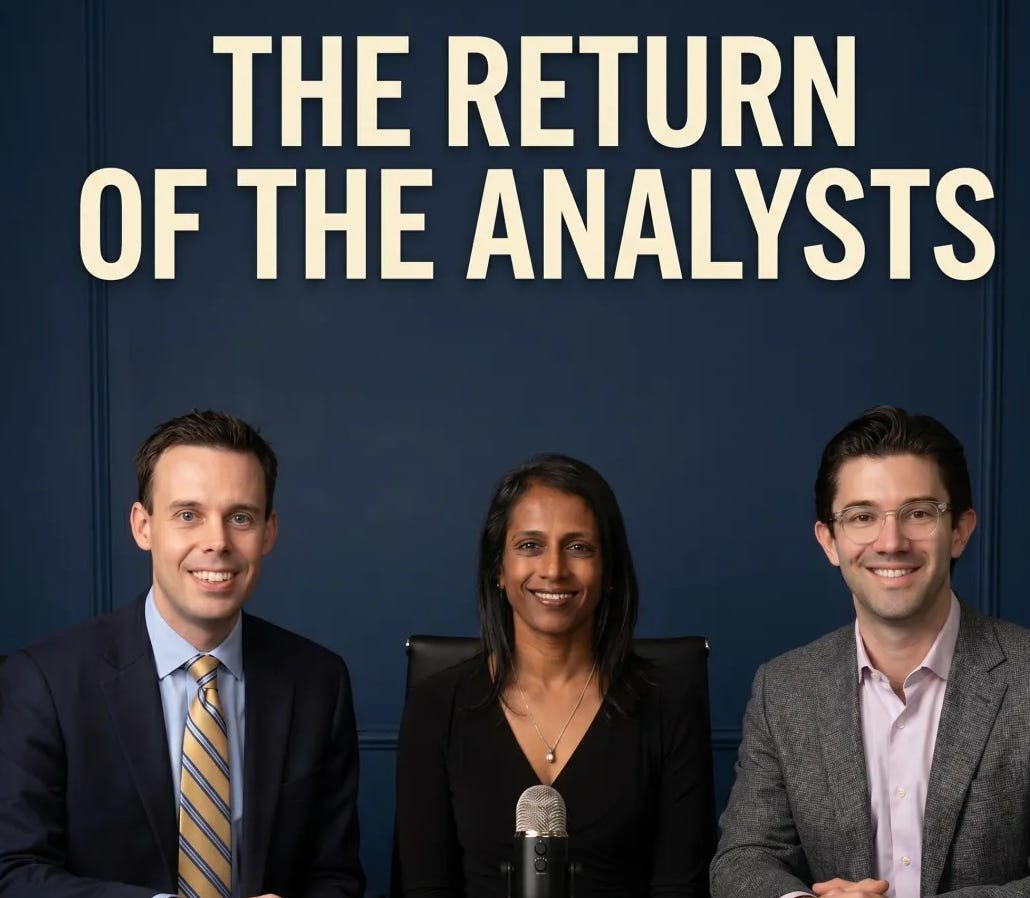
Listen here, watch here, or follow us wherever you enjoy your podcasts.
BUY A BOOK. Remarkable Retail is the best-selling, highest rated retail strategy book of the past decade. Leaders Leap is my latest and it lays out seven mind leap to help you navigate a volatile and uncertain future.
BRING ME TO YOUR NEXT EVENT TO SPEAK. I’ve delivered inspiring keynotes at major events on six continents, as well been a featured speaker at dozens of corporate events, customer dinners, and the like.
SHARE THIS NEWSLETTER with a friend or colleague.
Comments
Nothing yet. Say the first thing.
Sign in to join the conversation.