
VC secondaries or secondary operations refer to the buying and selling of pre-existing investor commitments in a VC fund or acquiring directly equity from existing shareholders. Unlike primary investments, where capital is provided directly to startups or funds in exchange for equity, secondary transactions involve the exchange of already issued equity or fund interests between investors.
Direct secondaries: An individual (founder, early hire, angel investor) or entity (VC fund, bank, PE firm) sells their participation in a company to a different entity
LP Secondaries: A limited partner (LP) agrees to sell their stake in an existing portfolio of companies managed by a venture fund.
GP Secondaries: A general partner (GP) from an existing fund transfers partially or totally their venture portfolio to a different fund and extends the possibility to their LPs to sell their participation or roll it to the new fund under a new set of rules.
Secondaries provide a wide set of advantages for early investors, employees and venture funds. Some of the most salient are:
VC Secondaries provide liquidity to early investors or employees, allowing them to cash out some (or all) of their shares before an IPO or acquisition.
Investments in VC through secondaries tend to be less risky than primary investments. This is mostly due to the selection of exclusively mature companies in later stages by VC secondaries funds. Those companies have already sorted out the most complex early-stage challenges (i.e. finding product-market fit, building the foundational team, defining the first processes and culture of the company, etc) and therefore enables LPs in those structures to become exposed to promising companies on a more advanced segment of the J-curve.
Founders and venture funds maneuvering in convulse markets may face difficulties to achieve exit events with valuations that reflect the actual potential of their companies. The VC secondaries asset class enables GPs to maintain top performers in their portfolio and compound carry gains by moving them to a new fund while at the same time providing liquidity to LPs that require it.
As mentioned by Industry Ventures -a top VC secondaries fund in the US-, while almost all venture rounds are announced in press releases by both the companies and the investors, practically none of the secondaries deals receive any coverage. This causes a scarcity of information regarding this niche asset class which makes notably difficult to estimate the true size of the VC secondaries market.
McKinsey -using Preqin data- estimated that the global secondaries fundraising reached 92B in 2023, while Lazard calculated an estimate of the global deal volume of $109B in the same year by surveying 80 of the most salient. Finally, Industry Ventures provides the highest estimate valuing the total market size in $138B.
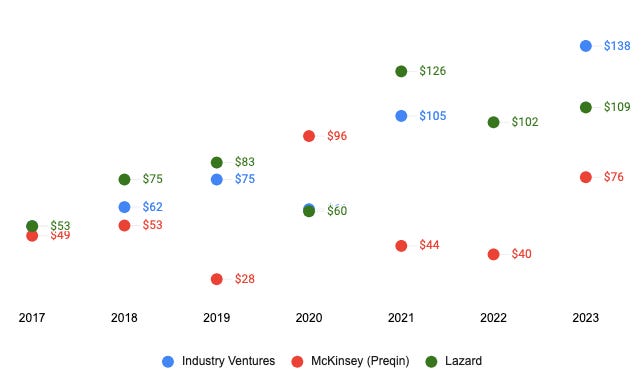
Source: Paramo Partners from IV, McKinsey and Lazard estimates
As mentioned by Industry Ventures and Pitchbook, a key feature of the 2023-24 venture market is an excess in demand for funds (companies and founders seeking resources) and a relative scarcity in supply. This will allow institutional investors to negotiate in the short term rounds with more down-to-earth valuations and preferential terms when compared with the bullish 2020-21 market.
Moreover, as McKinsey pointed out, as a consequence of this strained market and the IPO paralysis, GPs that increased their portfolio in the last 5 years are being pushed by their LPs to provide higher distributions and therefore are increasingly open to sell positions through direct secondaries or restructure their portfolios through GP led secondaries.
Mature companies from 2010-2016 vintages as relevant as Stripe, Figma or Databricks in the US; Klarna in Europe; Swiggy and Ola Electric in SEA; or Rappi in Latam are waiting for the market to finish its contractive cycle to carry out their IPOs or proceed with MA opportunities. With some of those liquidity events expected to begin as soon as late 2024, it is foreseeable to expect more available resources for secondaries investments.
https://www.forbes.com/advisor/investing/upcoming-ipos/
https://techcrunch.com/2024/06/11/startups-not-likely-to-ipo-2024/
No posts
Comments
Nothing yet. Say the first thing.
Sign in to join the conversation.